What Size Generator for a 3000 Sq Ft House? Tiers, Loads & Real Math
**Quick answer:** Most 3000 sq ft houses land on a 22–26 kW standby generator for whole-house coverage, or a 10,000–14,000W portable if you only need the essentials. A gas-heated home with one 4–5 ton AC sits comfortably at 22 kW, while two AC systems usually need 24–26 kW with soft starters and load shedding to survive simultaneous compressor starts. All-electric homes — heat pumps with auxiliary strips, electric water heating, electric range and dryer — are the exception: plan on 26–30 kW with aggressive load management, because the fuel split matters more than the square footage.
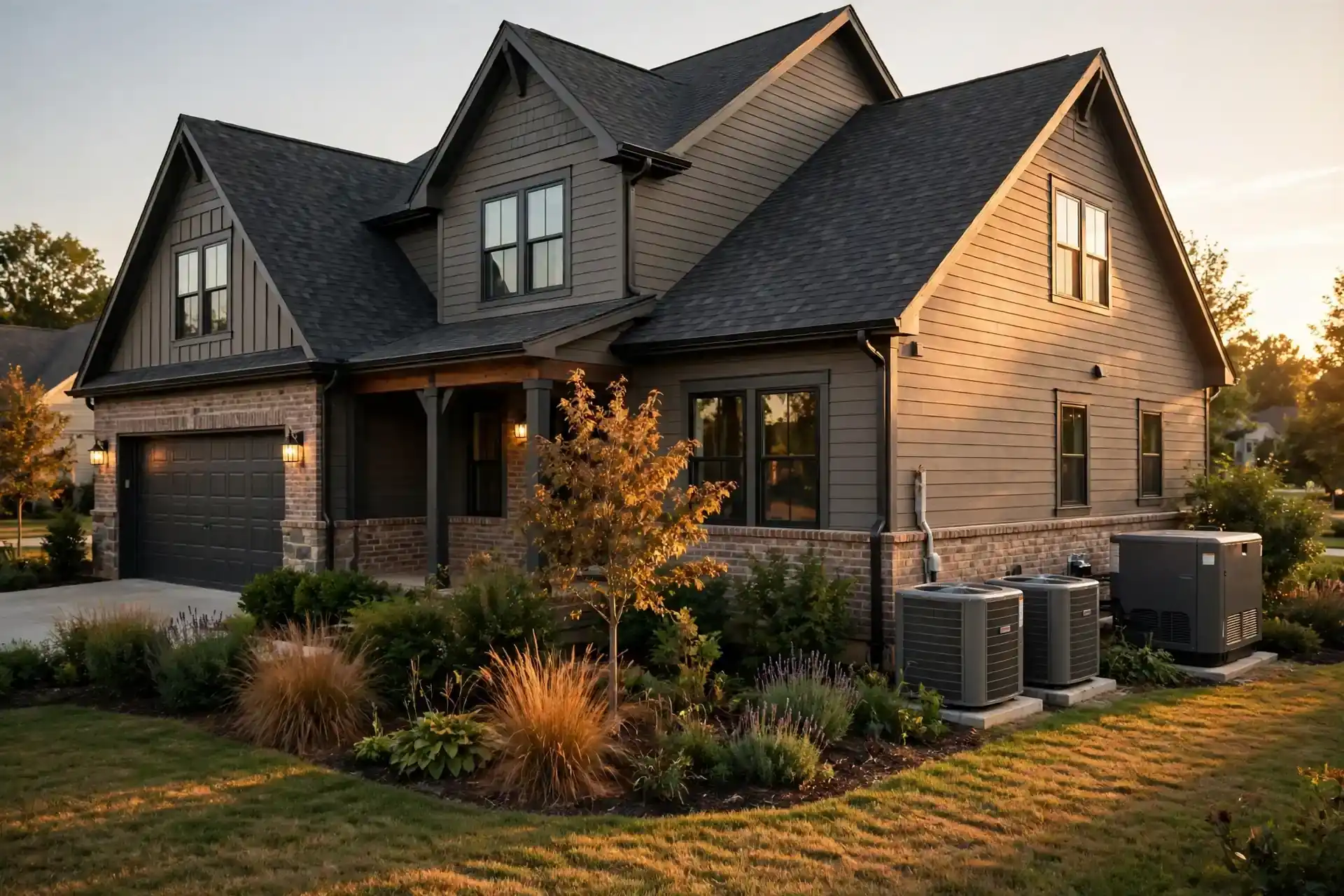
Quick answer: Most 3000 sq ft houses land on a 22–26 kW standby generator for whole-house coverage, or a 10,000–14,000W portable if you only need the essentials. A gas-heated home with one 4–5 ton AC sits comfortably at 22 kW, while two AC systems usually need 24–26 kW with soft starters and load shedding to survive simultaneous compressor starts. All-electric homes — heat pumps with auxiliary strips, electric water heating, electric range and dryer — are the exception: plan on 26–30 kW with aggressive load management, because the fuel split matters more than the square footage.
If you’re asking what size generator for a 3000 sq ft house, here’s the answer I give on service calls, before we’ve even looked at the panel: most of you end up at 22–26 kW in a standby, or 10,000–14,000 watts in a portable if you’re only covering essentials. But 3000 sq ft is exactly the size where the generic chart starts lying to people, because at this size houses stop being uniform. Two HVAC systems or one big one. A pool pump nobody remembers until it kicks on. A second water heater. The floor plan got bigger — what grew with it is what actually decides your generator size.
I’ve sized and installed standby units in 3000 sq ft homes for the better part of two decades. Two houses on the same street, same square footage, have walked away with a 14 kW and a 26 kW respectively, and both were sized correctly. This article shows you the math so you can see which house is yours.
Why does square footage tell you so little?
Honestly? Square footage is a proxy, and a lazy one. Your generator doesn’t care how big your rooms are. It cares about one thing: how many watts of electric load try to run at the same time.
Here’s the proof. Take two 3000 sq ft houses:
- House A (mostly gas): Gas furnace, gas tank water heater, gas stove and dryer, one 4-ton AC. Its biggest electric draws are the AC (about 4,200W running) and the furnace blower (800W). A bad-moment peak — AC running, fridge cycling, lights, TV, microwave — is around 13–15 kW.
- House B (all-electric): Two heat pumps with auxiliary heat strips, an electric water heater, electric range and dryer, and a pool. When it’s 25°F out and both heat pumps call for aux heat (10 kW of strips each is common), that house can demand 35 kW or more without anyone doing anything unusual.
Same square footage. One needs a generator less than half the size of the other. This is why I tell people to read my general method in What Size Generator Do I Need to Run My House? and then apply the 3000 sq ft specifics below — the fuel split between gas and electric is the single biggest variable in this entire calculation, bigger than the house itself.
Square footage does predict some things, though. A 3000 sq ft house almost always has a bigger AC load, more bathrooms, and more “house systems” than a 1500 sq ft house. Let’s inventory what that actually looks like.
What does a typical 3000 sq ft house actually run?
At 3000 sq ft, the usual profile looks like this:
- HVAC: Either one 4–5 ton system, or — very common in two-story homes — two systems: a 3–3.5 ton for the main floor and a 2–2.5 ton for upstairs. This is the fork in the road for generator sizing.
- Water heating: A 50–80 gallon tank, or two tanks in bigger layouts. Gas tank: nearly free electrically (a few watts for controls). Electric tank: 4,500W when an element fires.
- More bathrooms: Three or four means more hot water demand, but electrically that’s mostly the water heater again. Hair dryers are 1,500W each but brief.
- A pool, about half the time: A 1–1.5 HP pool pump is the forgotten load of this house size, and it gets its own section below.
- The normal stuff: Fridge, freezer, lighting, TVs, home office, garage door, washer — collectively smaller than people fear.
Here’s the load table I work from:
| Load | Running watts | Starting/surge watts |
|---|---|---|
| 5-ton central AC | 5,000–5,500 | 13,000–16,000 |
| 4-ton central AC | 4,000–4,500 | 11,000–14,000 |
| 2-ton second-zone AC | 2,200–2,800 | 7,000–9,000 |
| Furnace/air-handler blower (each) | 500–900 | 1,000–1,500 |
| Electric water heater (50 gal) | 4,500 | 4,500 (no surge) |
| Pool pump, 1.5 HP single-speed | 2,200–2,500 | 5,000–7,000 |
| Pool pump, variable-speed | 300–1,500 | minimal |
| Refrigerator | 150–250 | 800–1,200 |
| Electric range (one burner + oven element) | 2,000–3,500 | none |
| Electric dryer | 5,000–5,800 | 6,000 |
| Well pump, 1 HP (if applicable) | 1,400–2,000 | 3,000–4,000 |
Notice the pattern: two loads dominate everything — air conditioning and electric resistance heat/water heating. Get those two right and the rest is rounding.
Which tier fits your house? The three honest options
Tier 1: Essentials-plus portable — 10,000–14,000 watts
A big dual-fuel portable on a 50-amp inlet with an interlock kit will run a 3000 sq ft house selectively: fridge, lights, devices, gas furnace blower, one AC system if it has a soft starter (more on that below), and the pool pump — just not all at once, and not the upstairs AC at the same time as the downstairs one. You’re the load manager, walking to the panel and choosing.
This tier works because most outages are about comfort and food, not about living like the grid never failed. Installed cost with the inlet and interlock: roughly $1,500–3,000 all-in including the generator. For the full cost picture by approach, see Whole-House Generator Cost: Standby, Portable & Battery Compared.
Tier 2: Whole-house standby — 22–26 kW (the common install)
This is what most 3000 sq ft homes actually buy, and for good reason. A 22 kW covers the gas-heated single-AC house outright. A 24–26 kW covers dual AC with load management, an electric water heater, and the pool — shedding loads for the few seconds it matters instead of tripping. A 26 kW Generac or Kohler installed typically lands at $13,000–17,000 depending on gas line work and panel distance.
Tier 3: 30 kW and up — rarer than salesmen suggest
Thirty-plus kW is justified when the house is all-electric and large and the owner refuses any load management: dual heat pumps with aux strips, pool, hot tub, electric everything, EV charger in the mix. That’s a real house profile — I’ve seen them — but it’s maybe one in eight of the 3000 sq ft homes I quote. If a contractor quotes you 38 kW for a gas-heated home with one AC system, ask him to show you the load calculation. He won’t have one.
Why do two AC systems break the math?
A single AC is a surge problem. Two ACs are a coincidence problem.
Your 4-ton downstairs unit wants up to 14,000 surge watts for the second it starts. Your 2-ton upstairs unit wants 9,000. If both compressors happen to kick on in the same moment — and after power returns, they absolutely try to — that’s 23,000 watts of surge demand before a single light bulb. A 22 kW standby sags, faults on undervoltage, or drops the load. The homeowner concludes the generator is “too small.” It isn’t. It’s unprotected against a coincidence.
There are three fixes, in the order I recommend them:
- Soft starters on both units. A MicroAir EasyStart (about $300–400 installed per unit) cuts compressor inrush by 65–75%. Your 14,000W surge becomes roughly 4,500W. This one change does more for a dual-AC house than jumping a full generator size. I go deep on this in What Size Generator to Run a 5-Ton AC Unit — the tonnage math is the same logic, scaled.
- Load-shed modules. Standby load management modules (Generac’s are about $150–250 each) monitor generator load and temporarily drop an AC, the dryer, or the pool pump for the seconds a compressor is starting, then restore it. From inside the house, you notice nothing.
- A delay/stagger timer. The upstairs thermostat gets a 5-minute start delay after power transfer. Crude, cheap, effective.
With soft starters and load shedding, a 26 kW handles dual AC gracefully. Without them, you can buy a 30 kW and still watch it stumble if both units and the pool pump align on a hot restart.
A worked example: one real 3000 sq ft house
Let me run the numbers on a composite of a house I quote about twice a month — two-story, gas heat, two AC systems, electric water heater, pool:
Running loads on a summer evening: 4-ton AC (4,200W) + 2-ton AC (2,500W) + two blowers (1,600W) + water heater cycling (4,500W) + pool pump (2,400W) + fridge, lights, TV, office (1,200W) = about 16,400W running. That fits inside a 22 kW on paper — running watts are not the problem.
The worst second: Evening restart after transfer. The 4-ton tries to start (+14,000 surge) while the 2-ton is already running and the water heater is on. Instantaneous demand tries to spike past 30 kW. The 22 kW faults.
The same house, managed: Soft starters on both ACs (surges now 4,500W and 3,000W), load-shed module pauses the pool pump and water heater during compressor starts. Worst second is now roughly 21–22 kW for a fraction of a second — inside what a 26 kW delivers without breaking a sweat, and even the 22 kW survives it in practice. That’s the whole game at this house size: manage the seconds, and the hours take care of themselves.
If you’re stepping down from this profile rather than up, my guide to sizing for a 2000 sq ft house covers the single-system version of the same math. And if you’re stepping up instead — a bigger footprint with the same dual-system layout — the sizing guide for a 5000 sq ft house runs the larger version of this same math.
Isn’t the pool pump just one more load? No — it’s the forgotten one
Homeowners remember the AC and forget the pump, because the pump is on a timer and they never switch it on. The generator meets it at 2 p.m. on outage day when the timer fires: 1,500–2,500W running for a 1–1.5 HP single-speed pump, with a start surge of 5,000–7,000W — a second AC’s worth of surge from a load nobody put on the list. I’ve diagnosed more than one “my generator trips every afternoon” complaint that was just the pool timer doing its job.
Three sane ways to handle it:
- Put the pump on a load-shed module (best option on a standby). It yields during AC starts and runs otherwise.
- On a portable setup, just turn the pool off during outages. Your pool will not turn green in a two-day outage. Skipping the pump entirely is free load management.
- If you’re replacing the pump anyway, go variable-speed. A VS pump cruising at low RPM sips 300–600W — a rounding error — and it pays for itself in normal electric bills too.
And the hot tub, since someone always asks: a spa heater is typically 5,500W all by itself, plus a couple hundred for pumps. On generator power during an outage, the hot tub is off. That’s not a sizing tier, that’s a lifestyle choice, and I say that as someone who likes hot tubs.
How much fuel does a generator this size drink?
Sizing doesn’t end at watts — a 26 kW that empties its tank in a day and a half is a problem wearing a solution’s clothes. At a realistic 50–75% load, a 26 kW propane standby burns roughly 2.5–3 gallons an hour. Run the math on a standard 250-gallon tank: about 200 usable gallons (tanks fill to 80%) gets you 65–80 hours — three solid days of continuous running, or a week or more if you shut down overnight and during mild stretches, which you should; generators don’t need to run 24/7 to keep a house safe.
If your house lands in this tier, tank size is part of the generator decision, not an afterthought. I worked the runtime numbers for common tank sizes in How Long Will a Generator Run on a 250-Gallon Propane Tank? — on natural gas, of course, none of this applies and runtime is effectively unlimited, which is one reason gas-line homes have an easier time at this scale.
So what’s the bottom line for 3000 sq ft?
- Gas heat + one AC system: 22 kW standby, or a 12,000–14,000W portable for essentials-plus. Don’t let anyone upsell you past 22 kW without a written load calc.
- Gas heat + two AC systems: 24–26 kW standby with soft starters and load shedding — the management gear matters more than the extra kilowatts.
- All-electric (heat pumps + aux strips, electric water heat): 26–30 kW with aggressive load management, and go in knowing aux heat is the enemy. Some of these houses are honestly better served by managing expectations than by buying kilowatts.
- Portable on a budget at any profile: 10,000–14,000W, inlet + interlock, soft starter on the main AC, pool off, one AC at a time. You’ll be comfortable. You just won’t be oblivious.
The pattern across 18 years of these installs: the homeowners who are happy during outages didn’t buy the biggest generator — they bought the right size and spent a few hundred dollars on soft starters and load management. At 3000 sq ft, that’s the whole secret.
Keep reading
Frequently asked questions
What size generator do I need for a 3000 sq ft house?
For whole-house coverage, most 3000 sq ft homes land on a 22–26 kW standby generator — enough to run a 4–5 ton AC (or two smaller systems with load management), water heating, and normal household loads. If you only want the essentials — fridge, lights, one AC system or none, well pump, devices — a 10,000–14,000W portable with an inlet box and interlock gets it done for a fraction of the cost.
Can a 22 kW generator run a 3000 sq ft house?
Yes, in most cases — with one big condition. A 22 kW standby comfortably runs a gas-heated 3000 sq ft home with a single 4–5 ton AC, because the furnace, water heater, stove, and dryer are burning gas instead of electricity. Add a second AC system, an electric water heater, and a pool pump, and 22 kW needs load management (soft starters and load-shed modules) to avoid sizing up to 26–30 kW.
Why does square footage matter less than what's electric vs. gas?
Because the generator only sees electric loads. A 3000 sq ft house with gas heat, gas water heater, gas stove, and one AC might peak at 12–15 kW. The same house all-electric — two heat pumps with auxiliary heat strips, electric water heater, electric range — can demand 35 kW or more. The floor plan is identical; the fuel split changes the answer by 2–3x.
How long will a 250-gallon propane tank run a 26 kW generator?
A 250-gallon tank holds about 200 usable gallons (tanks fill to 80%). A 26 kW unit at a realistic 50–75% load burns roughly 2.5–3 gallons per hour, so 200 gallons buys you roughly 65–80 hours of runtime — about three days of continuous running, or a week-plus if you cycle the generator off overnight and during mild weather.
How much does a generator for a 3000 sq ft house cost installed?
It depends on the tier. A 10,000–14,000W portable on a 50-amp inlet with an interlock kit typically lands at roughly $1,500–3,000 all-in, generator included. The common whole-house choice costs far more: a 26 kW Generac or Kohler standby installed typically runs about $13,000–17,000, depending on gas line work and the distance to your panel. Load management narrows that gap in your favor — soft starters at about $300–400 per AC and load-shed modules at about $150–250 each often let a smaller, cheaper standby do the job safely.