What Size Generator Do You Need for a 2000 Sq Ft House?
**Quick answer:** Most 2,000 sq ft homes fall into three tiers: 5,000–7,500 watts for essentials only, 10,000–14,000 watts for most of the house with a little load management, and 18,000–22,000 watts in a standby unit for everything including central air. Which tier is yours depends on your AC tonnage and whether heat, hot water and cooking are gas or electric — not on square footage alone.
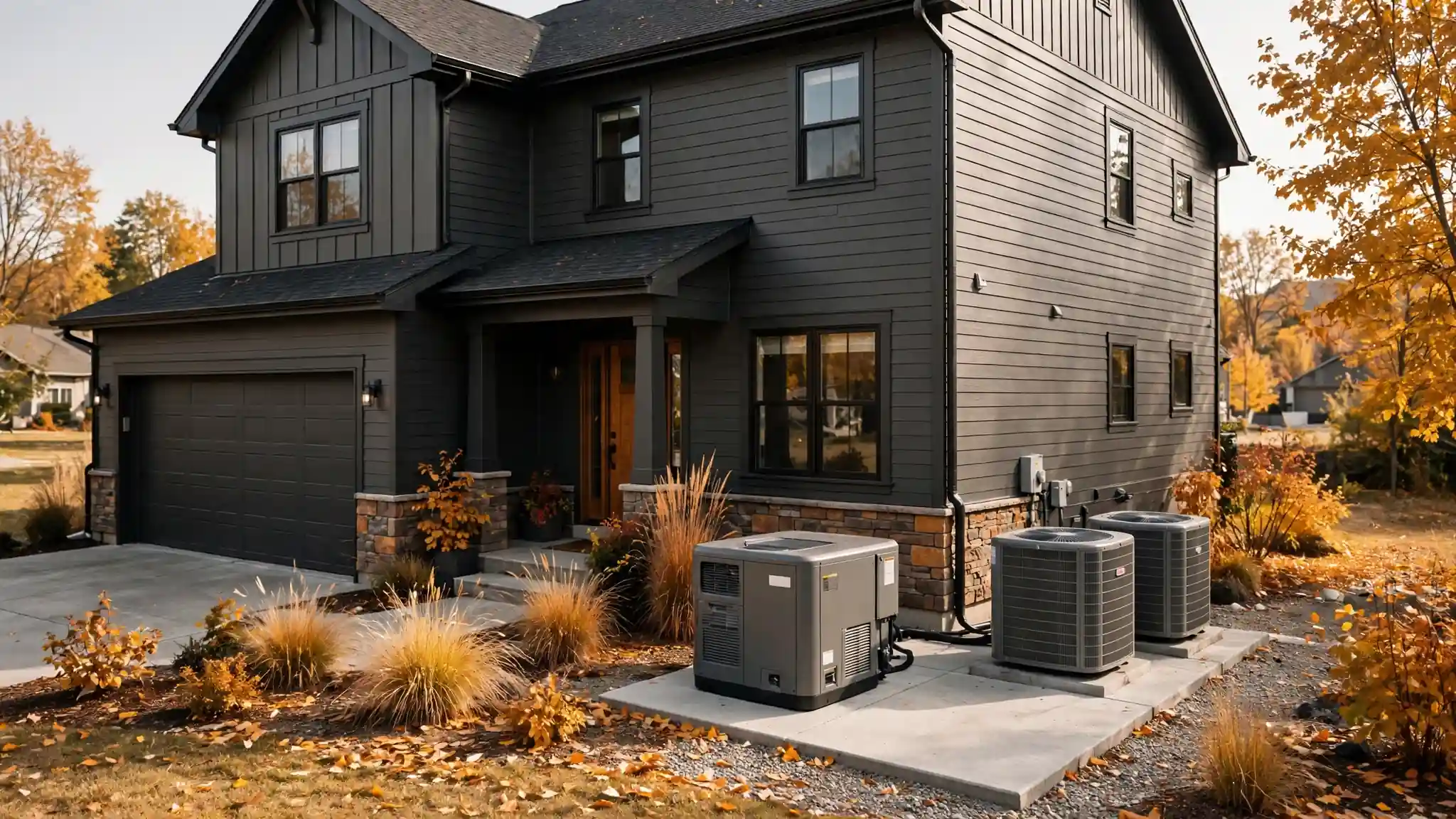
Quick answer: Most 2,000 sq ft homes fall into three tiers: 5,000–7,500 watts for essentials only, 10,000–14,000 watts for most of the house with a little load management, and 18,000–22,000 watts in a standby unit for everything including central air. Which tier is yours depends on your AC tonnage and whether heat, hot water and cooking are gas or electric — not on square footage alone.
Ask me what size generator for a 2000 sq ft house and I’ll give you the answer every electrician gives, because it’s the only honest one: it depends — but on things I can walk you through in about ten minutes. Two houses with identical floor plans can need generators that differ by 10,000 watts, and I’ve sized both kinds in the same subdivision.
Here’s the range up front. Essentials only: 5,000–7,500 watts. Most of the house with a little discipline: 10,000–14,000 watts. Everything, including central air, without thinking about it: 18,000–22,000 watts in a standby unit. The rest of this article is figuring out which of those three houses is yours.
Why doesn’t square footage size a generator?
Because a generator doesn’t power square feet. It powers loads — motors, heating elements, compressors — and square footage is only a rough proxy for how many of those you own. Three variables matter far more than the tape measure:
Insulation and construction era. A 2000 sq ft house built in 2019 to modern code might need a 2.5-ton AC. The same footprint built in 1974 with original single-pane windows can need 4 tons. That difference alone is roughly 1,500 running watts and several thousand surge watts — a whole generator class.
Climate. A 2000 sq ft house in Minneapolis and one in Houston have the same floor plan and completely different electrical lives. Houston’s house runs a big AC eight months a year; Minneapolis’s house may have electric resistance backup heat that draws 10,000 watts by itself. Phoenix adds a pool pump. Seattle might not have AC at all.
Fuel type for the big three. This is the one people miss. Heat, hot water, and cooking are the largest energy consumers in any home. If yours are gas, they’re nearly free during an outage — a gas furnace needs only 300–800 watts for its blower and controls. If they’re electric, they’re enormous: heat strips, an electric water heater, and an electric range can add 15,000+ watts of potential load.
Square footage does predict one thing reliably: the AC tonnage — and the AC is usually the biggest single load in the house. That’s why the sq-ft question is a decent starting point, just not a finish line.
What size AC does a 2000 sq ft house usually have?
In most of the US, a 2000 sq ft house runs a 3 to 3.5-ton central AC (or a heat pump of the same size). Older, poorly insulated homes in hot climates push to 4 tons; tight new construction can get away with 2.5 tons. Here’s what that means in watts:
| AC size | Running watts | Starting surge (typical) |
|---|---|---|
| 2.5 ton | 2,500–2,900W | 11,000–14,000W |
| 3 ton | 3,000–3,500W | 13,000–17,000W |
| 3.5 ton | 3,500–4,000W | 15,000–19,000W |
| 4 ton | 4,000–4,600W | 17,000–22,000W |
That surge column is why AC dominates generator sizing. For the deep dive on tonnage, LRA numbers, and soft starters, see my guide to generator sizing for central AC.
What loads does a typical 2000 sq ft house actually have?
Here’s a realistic load inventory for a 2000 sq ft, 3–4 bedroom house — the numbers I use on service calls before I ever look at a nameplate:
| Load | Running watts | Starting watts |
|---|---|---|
| Refrigerator | 150–250 | 800–1,200 |
| Chest/upright freezer | 100–200 | 600–900 |
| Gas furnace blower + controls | 300–800 | 900–1,600 |
| Well pump (1/2–1 HP) | 750–1,500 | 2,200–4,000 |
| Sump pump (1/3–1/2 HP) | 800–1,300 | 1,300–2,150 |
| Central AC, 3 ton | 3,000–3,500 | 13,000–17,000 |
| Electric water heater | 4,500 | 4,500 (no surge) |
| LED lighting, whole house | 200–400 | 200–400 |
| TV, router, laptops, chargers | 200–400 | 200–400 |
| Microwave | 1,000–1,500 | 1,000–1,500 |
| Electric range (one burner + oven element cycling) | 2,000–3,500 | 2,000–3,500 |
| Electric dryer | 4,800–5,700 | 5,700 |
| Washing machine | 400–800 | 1,100–1,600 |
| Dishwasher (with heated dry) | 1,200–1,800 | 1,200–1,800 |
Nobody runs all of that at once. Sizing is about a realistic worst moment, not the theoretical maximum. This is the same room-by-room method I lay out in the general house generator sizing guide; here I’m applying it to this specific house size.
Tier 1: Can a 5,000–7,500W portable cover a 2000 sq ft house?
Yes — if your goal is riding out the outage, not forgetting there is one. This is the tier for people who lose power a few times a year for a few hours and mainly worry about the fridge, frozen pipes, and the basement flooding.
A 7,500-watt portable comfortably runs: fridge (200W), freezer (150W), gas furnace blower (600W), sump pump when it cycles (1,050W), lights (300W), TV and internet (300W) — about 2,600 watts steady, with surge headroom for the pumps and fridge. Add a microwave in short bursts. That’s a livable house: warm, lit, food cold, basement dry.
What you give up: central AC (a bedroom window unit, 500–1,200W, is the classic workaround and fits fine in this tier), the electric dryer, and cooking a big meal on an electric range. If your water comes from a well, a 5,000-watt unit gets tight — the pump’s surge eats a third of it — so well-pump homes belong at the 7,500 end of this tier.
Cost reality: a decent 7,500W dual-fuel portable runs $700–1,100, plus $500–1,500 for an inlet box and interlock or manual transfer switch installed. Connection is manual — you wheel it out, plug it in, flip the interlock. In a February ice storm at 2 a.m., that matters to some people and not to others. Be honest about which one you are.
Tier 2: What does a 10,000–14,000W generator add?
This is the tier most 2000 sq ft houses should actually buy. At 10,000–14,000 watts you stop triaging: everything from Tier 1 runs without rotation, plus the microwave whenever you want it, a second freezer, the washing machine, and — with a soft starter — possibly the central AC.
The honest framing: this tier runs the whole house except one big thing at a time. You manage the peaks, not the loads. Don’t start the electric dryer while the AC and water heater are both recovering after the outage — that’s the whole discipline. Standby units in this range come with load management modules that do that thinking for you, shedding the AC or water heater for a few minutes when the generator gets busy, then restoring them. I’ve watched 14kW units carry houses that “should” need 18kW without a single complaint from the homeowner.
This tier comes in two forms: big portables (12,000–15,000W peak dual-fuel units, $1,200–2,000) on an inlet, or smaller standbys (10–14kW, roughly $3,500–5,500 for the unit before installation). The portable is cheaper; the standby starts itself in 10 seconds whether you’re home or not. For a house with a sump pump and an owner who travels, that difference is the whole ballgame.
Tier 3: When does a 2000 sq ft house need 18,000–22,000W?
When you want the AC, the electric water heater, the range, and the well pump to run in any combination, with automatic transfer and zero load discipline from you. That’s a legitimate want — it’s also the most expensive way to buy it.
For a 2000 sq ft house, the sizing usually lands here:
- Gas heat, gas water heater, gas range, 3-ton AC: 18kW is plenty — honestly, a 14kW with load management will do it.
- Heat pump with electric backup strips, or any all-electric house: 22kW, because the heat strips alone can demand 10,000–15,000 watts on the coldest night of the year — which, not coincidentally, is when the power fails.
- Two AC systems (some two-story homes have one per floor): 22kW with load management so they never start simultaneously.
Unit prices for 18–22kW standbys run roughly $5,000–6,500 before installation; a full installed job typically lands between $11,000 and $14,500. I break down where every dollar goes in the whole house generator cost guide.
What are the starting-watt traps in a house this size?
Two of them bite constantly.
The AC’s locked-rotor amps (LRA). Your AC’s nameplate lists LRA — often 75–95 amps on a 3-ton unit. Multiply by 240 volts and the theoretical surge reaches 22,800 watts. Real-world surges land lower, but even 14,000 watts of surge will stall a generator already carrying 4,000 watts of house load. This is why a “10,000-watt generator” sometimes can’t start a “3,500-watt AC.” The fix that changes everything is a soft starter (MicroAir EasyStart and similar, $300–400 plus install): it ramps the compressor up gently and cuts the surge by 50–70%. I’ve started 3.5-ton units happily on 12kW standbys with one fitted. Best money in the whole project, and it’s not close.
The well pump nobody counted. A lot of 2000 sq ft homes are on wells — and a 1 HP submersible pump surges 3,000–4,000 watts from 200 feet down, and cycles whenever anyone flushes. People size for the loads they can see, forget the one underground, and find out when the generator trips at 6 a.m.
The discipline: size the running watts for everything on at once, then check the single biggest surge on top of everything else already running. Not on top of nothing. That’s the arithmetic error behind most undersized installs I get called to fix.
Can we work a real example, start to finish?
A house I sized last year — details changed slightly, numbers real. 2,050 sq ft, built 2008, Ohio. Gas furnace, gas water heater, electric range, 3-ton AC, city water, sump pump. The owner’s must-run list:
| Load | Running | Surge |
|---|---|---|
| Fridge | 200W | 1,000W |
| Freezer (garage) | 150W | 800W |
| Gas furnace blower | 650W | 1,300W |
| Sump pump | 1,050W | 2,150W |
| Lights, TV, router, office | 600W | 600W |
| Microwave | 1,200W | 1,200W |
| Essentials subtotal | 3,850W | — |
Worst realistic moment without AC: sump pump starts while everything else runs — peak lands around 5,000 watts. A 7,500W portable covers it with room to spare. Tier 1 confirmed.
Now add the 3-ton AC: roughly 6,000W running, but the AC’s ~15,000W surge on top of the other loads means the generator momentarily sees close to 18,000 watts. Without help, that’s a 22kW install. With a soft starter cutting the surge to ~5,500W, the peak drops to about 10,000 watts — and a 14kW standby with load management handles the house, AC included, without drama. The owner spent $350 on a soft starter instead of $1,800 stepping up a generator size. That’s the single most useful paragraph in this article, if I’m honest.
Does gas versus electric change the answer?
Enormously — it’s the biggest branch in the whole decision tree:
- All-gas house (furnace, water heater, range, dryer): outage loads shrink to blowers, pumps, fridge, and lights. A 2000 sq ft all-gas house can live whole-house-happy on 14kW, AC included with a soft starter.
- Mixed house (gas heat, electric water heater and range): add 4,500W of water heater and up to 3,500W of cooking. 18kW is the comfortable answer.
- All-electric house, especially with a heat pump: backup heat strips are the silent budget-killer — 10kW of strip heat plus a water heater is 14,500W before the fridge even cycles. 22kW, plus load management that locks out one heat stage during outages. Many all-electric customers also find it’s cheaper to let the strips stay dark and heat two rooms with space heaters — 1,500W each is a rounding error next to 10kW of strips.
What about the transfer switch and installation?
The generator is only half the purchase. Any hardwired setup needs a transfer switch so the generator and the grid can never feed the house at the same time — this is code, and it’s also what keeps your generator from backfeeding a line a utility worker thinks is dead. Portables use either a manual transfer switch ($300–600, plus install) or an inlet box with a panel interlock kit ($100–250 in parts), legal in most jurisdictions and what I install most often on Tier 1 and 2 jobs. Standbys come with an automatic transfer switch, usually 200-amp service-rated for a house this size. Budget the electrical work honestly: $800–2,500 depending on panel location, distance, and permits.
So what’s my recommendation for a 2000 sq ft house?
If you’re asking me as the guy who has to come back when it doesn’t work: most 2000 sq ft houses should buy the 10,000–14,000 watt tier, and all-electric or two-AC houses should go 22kW and stop second-guessing. Whatever tier you choose, spend the soft-starter money before you spend generator-size money, count the well pump, and size for the surge on top of the load — not instead of it.
Keep reading
Frequently asked questions
What size generator do I need for a 2000 sq ft house?
It depends on what you want to run, not the floor plan. For essentials only — fridge, lights, furnace blower, well pump — a 5,000–7,500 watt portable works. To run most of the house with some load management, plan on 10,000–14,000 watts. For true whole-house coverage including central air, a 2000 sq ft home typically lands on an 18,000–22,000 watt standby. Your actual loads set the generator size.
Will a 10,000 watt generator run a 2000 sq ft house?
A 10,000 watt generator will run most of a 2000 sq ft house comfortably — lights, fridge, freezer, well pump, furnace blower, TV, microwave — as long as you don't fire up a big central AC, an electric range, and an electric water heater at the same time. A 3-ton central AC can surge past 15,000 watts on startup. Skip the central AC or add a soft starter, and 10,000 watts is a sweet spot for this house size.
Is a 22kW generator too big for a 2000 sq ft house?
Usually not, if the house has all-electric appliances or a 3.5–4 ton AC. The 22kW class (Generac's best-selling size) covers a 2000 sq ft all-electric home with margin. If your heat, water heater, and range are gas, an 18kW will do the same job for less money and less fuel. Oversizing by two classes just burns cash.
How many watts does a 2000 sq ft house use during an outage?
With everything essential running at once, most 2000 sq ft homes draw 4,000–6,500 watts steady-state. Add a 3-ton central AC and the running total jumps to roughly 8,000–10,000 watts, with startup surges of 15,000 watts or more. The generator has to cover both numbers.
How much does a generator for a 2000 sq ft house cost?
The tier sets the price. A decent 7,500W dual-fuel portable runs $700–1,100, plus $500–1,500 for an inlet box and interlock or manual transfer switch installed. Bigger portables in the 12,000–15,000W peak class run $1,200–2,000, while smaller 10–14kW standbys cost roughly $3,500–5,500 for the unit before installation. At the top, 18–22kW standby units run about $5,000–6,500 before installation, and a full installed job typically lands between $11,000 and $14,500, with the electrical work alone budgeted at $800–2,500.