What Size Generator for a 5000 Sq Ft House? The Honest Ladder
**Quick answer:** Most 5,000 sq ft homes need 26–38kW — gas-heated, gas-water-heater homes with good load management sit at the bottom of that range, while all-electric homes sit at the top and sometimes above it. What decides the size is how many air conditioners you have, how your water gets hot and whether there's a pool out back, not the floor plan alone.
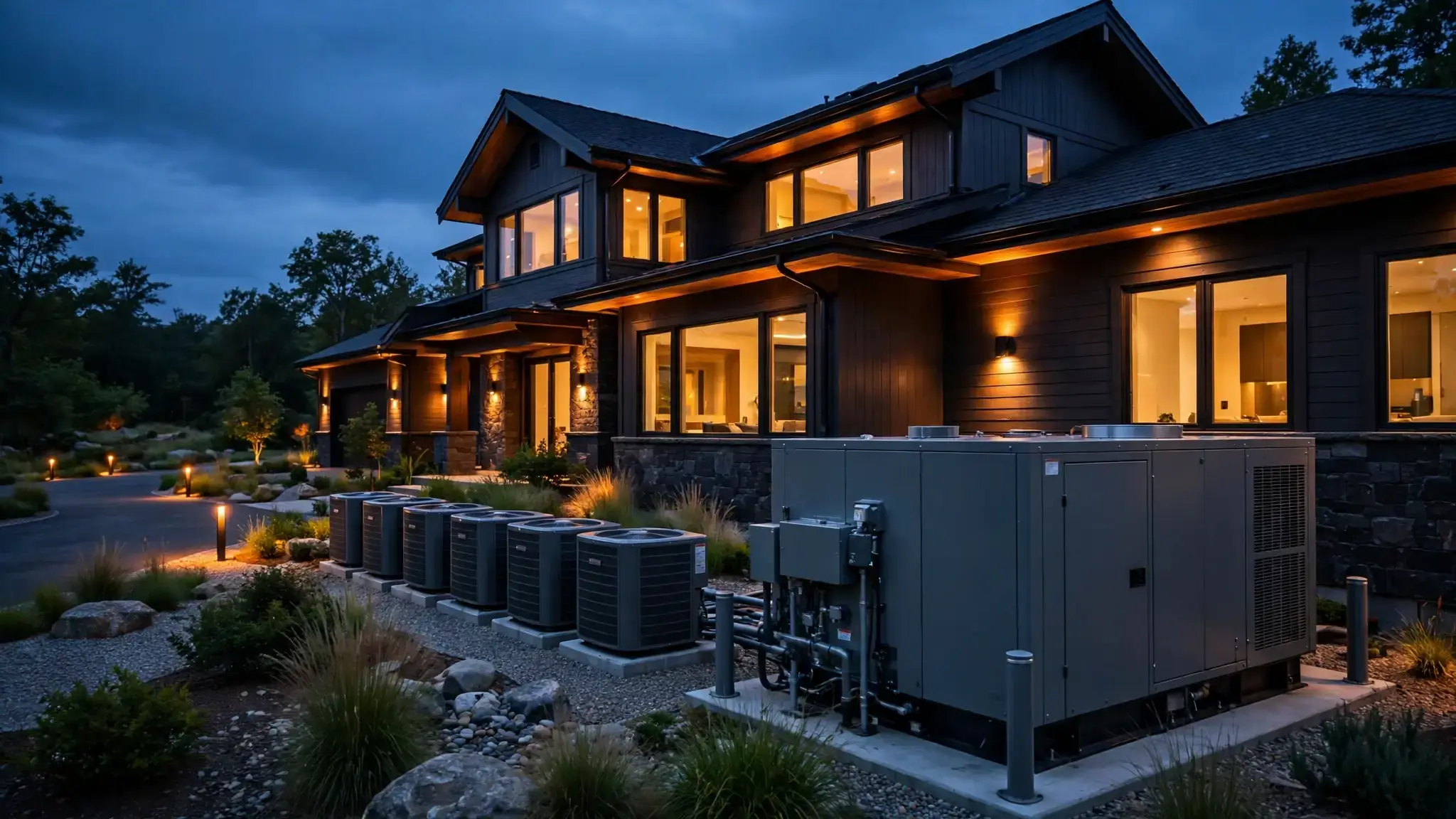
Quick answer: Most 5,000 sq ft homes need 26–38kW — gas-heated, gas-water-heater homes with good load management sit at the bottom of that range, while all-electric homes sit at the top and sometimes above it. What decides the size is how many air conditioners you have, how your water gets hot and whether there’s a pool out back, not the floor plan alone.
Ask me what size generator for a 5000 sq ft house and I’ll tell you the truth most sales quotes skip: square footage stopped being the deciding number about 2,000 square feet ago. At 5,000 square feet — roughly 465 m² — what decides your generator size is how many air conditioners you have, how your water gets hot, and whether there’s a pool out back. I’ve sized standby systems for homes this size for years, and two houses with identical floor plans can honestly land 15kW apart.
Here’s the short version, then the reasoning. Most 5,000 sq ft homes need 26–38kW. Gas-heated, gas-water-heater homes with good load management sit at the bottom of that range. All-electric homes, or homes where the owners refuse to think about what’s running, sit at the top — and sometimes above it.
What does a 5,000 sq ft house actually run?
Before any sizing ladder makes sense, look at what’s actually inside a house this size. It’s a different animal from the 2,000 sq ft homes most generator guides are written for:
- Two or three HVAC systems. A single system can’t push air across 5,000 sq ft efficiently, so builders split the house: typically two 4–5 ton units, or three 3-ton zones. Each 5-ton compressor draws roughly 3,500–5,000 watts running — and a locked-rotor starting surge of 15,000–25,000 watts for a fraction of a second unless you’ve added soft starters.
- Serious water heating. Either two 50-gallon tank heaters or one tankless unit. A gas tank heater draws almost nothing electrically. An electric tank draws 4,500 watts. And a tankless electric unit — this is the landmine, and I’ll come back to it — draws 18,000–27,000 watts.
- A pool, often with a spa. Pool pump: 1,500–2,500 watts running, more on startup. A gas spa heater sips electricity for its blower and controls; an electric spa heater eats 5,500–11,000 watts.
- A real kitchen. Double ovens (up to 8,000 watts together), an induction or radiant cooktop (7,000–11,000 watts), sometimes a second fridge in the garage or a wine fridge that nobody counts until the outage.
- The extras nobody lists. EV charging at 7,700–11,500 watts, a well pump if you’re outside city water (1,500–3,000 watts with a hard surge), a septic or sewage pump, a guest house or casita on the same service, heated bathroom floors, a sauna. Big houses accumulate loads the way garages accumulate paint cans.
Add the nameplate numbers and you’ll blow past 60kW of connected load in a hurry. That’s normal, and it’s not what you buy. Nobody runs everything at once — the whole game at this size is managing what overlaps.
Wait — do you have a tankless electric water heater?
I’m putting this before the sizing ladder on purpose, because in my experience it’s the single most common reason a big-house generator install goes wrong.
A tankless electric water heater doesn’t sip power the way a tank heater does. It fires every element it has the instant hot water is called for. A Rheem RTEX-18 pulls 18kW. The common RTEX-24 pulls 24kW. The RTEX-27 pulls 27kW across three 40-amp breakers — it needs three breakers just for itself. One teenager taking a shower during an outage can demand more power than a 26kW generator makes in total.
Your options, in the order I’d recommend them:
- Lock it out during outages. A load-shed contactor keeps the tankless unit off while the generator runs, and you shower after the power comes back — or before. Costs a few hundred dollars in parts and labor. This is what most of my customers with tankless electric end up doing, and none of them have regretted it.
- Size around it. Add its full draw to your generator size. That’s how a house that needed 30kW ends up with a 48kW liquid-cooled unit and a quote that makes the owner sit down.
- Replace it with tankless gas (if you have gas service). A tankless gas unit draws about 100 watts for its fan and controls. Problem deleted permanently, outage or not.
If a salesperson sizes your generator without asking how your water is heated, get a second quote. Seriously.
What size generator for a 5,000 sq ft house? The ladder
Here’s how I actually walk customers through it, in three honest tiers.
Tier 1: Essentials with aggressive load management — 22–26kW
A 26kW air-cooled unit (the top of the air-cooled class — Generac and Kohler both cap out around 26kW) can protect a 5,000 sq ft home surprisingly well if the house is gas-heavy and you’re willing to let a load-management system play traffic cop. One AC system runs; the second is locked out or rotated. The electric dryer waits. The pool pump runs on a timer window. Everything that keeps people safe and food cold stays on.
This tier makes sense when: gas furnace, gas water heat, gas cooking, and an owner who says “I just don’t want to be in the dark or lose the freezers.” Installed cost typically runs $13,000–$17,000 for the unit, transfer switch, pad, gas work, and permits. I wrote up the full cost picture in our whole house generator cost guide — the generator itself is barely half the installed price at any size.
Tier 2: True whole-house — 30–38kW
This is where most 5,000 sq ft homes honestly belong if the goal is “the outage is a non-event.” A 30–38kW liquid-cooled generator carries both (or all three) AC systems with soft starters, the kitchen, laundry, pool, and normal life simultaneously, with load management only handling freak overlaps. Nobody in the house has to think about anything.
The jump from Tier 1 isn’t just capacity — it’s a different class of machine. More on that in the next section, because it drives the price: installed, expect $22,000–$32,000 depending on fuel, distance from the panel, and local labor.
Tier 3: All-electric, everything, no compromises — 40kW and up
All-electric 5,000 sq ft house, tankless electric water heat you refuse to lock out, EV charging during outages, pool and spa, guest house on the same panel? You’re in 40–60kW liquid-cooled territory, and at that point I start asking whether we should shed or sub-panel some loads instead of buying our way out — a 60kW residential install with the gas or propane infrastructure to feed it can pass $40,000 installed. It exists, and for a medical-equipment household it can be the right answer. Just go in with your eyes open.
For stepping down a size class, compare the numbers in what size generator for a 3000 sq ft house — the gap between the two house sizes is smaller than most people expect, precisely because the big loads (kitchen, laundry, water heat) don’t scale with floor area. And if you haven’t done the basic load math yet, start with what size generator to run a house before reading any of this as a shopping list.
Is air-cooled enough, or do you need liquid-cooled?
At 5,000 sq ft you’ll hit the breakpoint whether you plan to or not, so understand it:
| Air-cooled (up to ~26kW) | Liquid-cooled (28kW+) | |
|---|---|---|
| Engine | Air-cooled V-twin, like a big lawn tractor | Automotive-style engine with a radiator, like a small car |
| RPM | 3,600 rpm | 1,800 rpm (most models) |
| Noise | ~65–70 dB at 23 ft under load | ~60–65 dB — noticeably calmer |
| Duty | Fine for outages of hours to a couple of days | Built for multi-day continuous runs |
| Lifespan | Roughly 2,000–3,000 hours typical | 3,000–5,000+ hours with car-like maintenance |
| Unit cost | $5,500–$6,500 for 24–26kW | $13,000–$18,000 for 30–38kW |
Two things in that table matter more than the rest. First, 1,800 rpm is half the engine speed — half the wear per hour, half the mechanical stress, and a sound your neighbors will tolerate through a three-day outage. Second, the cost jump is real: you are not paying a little more for a little more power, you’re buying a different machine. That’s why Tier 1 with smart load management is a legitimate engineering answer and not a cheapskate move. If your managed load genuinely fits in 26kW, the air-cooled unit will serve you well. If it doesn’t fit, no amount of wishing makes 26kW into 32kW during a heat wave with both compressors calling.
How does load management work at this scale?
Load shedding is what makes Tier 1 possible and Tier 2 comfortable. The idea is simple: a controller watches total demand and temporarily disconnects (“sheds”) pre-selected big loads before the generator bogs down, then restores them when capacity frees up.
At 5,000 sq ft, a typical priority list looks like this:
- Never shed: refrigeration, one AC system, well/sump, medical, lights and outlets, garage doors, security.
- Shed last: second AC system, pool pump.
- Shed first: electric dryer, electric range/oven, EV charger, tankless water heater (locked out entirely, per the earlier discussion), third AC zone, spa heater.
Modern systems (Generac’s load-shed modules, Kohler’s load control, and third-party units) can manage 4–8 circuits this way, and soft starters on the AC compressors — a $300–$450 part per unit installed — cut compressor startup surge by 50–70%, which is often the difference between “needs 38kW” and “runs fine on 32kW.” One caution that ties into service size: houses this big usually have 320- or 400-amp service, or dual 200-amp panels, and the transfer-switch architecture follows the panels, not the square footage. If you’re not sure what’s in your house, what size generator for 200-amp service explains the panel side of it — and your installer may end up speccing two transfer switches on a dual-panel home.
How much does it cost to run a 30kW+ generator all day?
Fuel is where big generators humble people, so run the numbers before you buy, not during the first outage.
A 30–38kW liquid-cooled unit on propane burns roughly 2.8–3.6 gallons per hour at half load and 4.5–5.5 gallons per hour near full load. At a typical delivered propane price of $2.50–$3.50 a gallon:
- Half load, 24 hours: 65–85 gallons → $170–$290 per day
- Heavy load, 24 hours: 110–130 gallons → $280–$450 per day
That burn rate is why homes this size install 500- or 1,000-gallon propane tanks — a 250-gallon tank at a safe 80% fill gives you barely two to three days at half load. I ran the tank math in detail in how long a generator runs on a 250-gallon propane tank, and the same ratios scale straight up: at these loads, tank size is outage endurance. On natural gas the same day costs roughly $60–$130 in most markets, with no tank to refill — which is why, if you have a gas main on your street, it’s the automatic choice at this generator size despite the lower energy density.
Also budget the boring stuff: liquid-cooled units want coolant service, hoses, and belts on a car-like schedule, and annual maintenance on a 30kW+ system typically runs $400–$600, versus $300–$400 for air-cooled.
A worked example: one real 5,000 sq ft house
Let me put a real-shaped example together — a composite of houses I’ve actually quoted, two-story, gas furnace and gas tank water heaters, in a hot climate:
| Load | Running watts | Managed? |
|---|---|---|
| AC #1 — 5 ton, with soft starter | 4,800 | No |
| AC #2 — 4 ton, with soft starter | 3,900 | Shed #2 |
| Two refrigerators + freezer | 700 | No |
| Pool pump (variable speed) | 1,800 | Shed #1 window |
| Gas furnace blowers (both) | 1,600 | No |
| Kitchen (gas range; oven electric, in use) | 4,000 | Shed #3 |
| Laundry — gas dryer + washer | 900 | No |
| Well pump | 2,200 | No |
| Lights, outlets, electronics, misc. | 2,500 | No |
| EV charger | 9,600 | Locked out on generator |
Unmanaged peak if everything overlaps: about 31,900 watts plus compressor surge. But the EV charger is locked out, the pool pump is on a midday window, and AC #2 sheds if the total climbs — which puts the realistic managed peak around 24,000–27,000 watts, with surge headroom for compressor starts.
The honest recommendation for this house: a 32kW liquid-cooled unit if the owners want zero thought, or a 26kW air-cooled if they’ll accept AC #2 rotating off on the hottest afternoons. Note what did the work in this example — gas water heat, gas cooking assist, soft starters, and shedding the EV. Change the water heater to a 27kW tankless electric and this same house needs 45kW or a lockout. The floor plan never changed.
Is two smaller generators ever smarter than one big one?
I get asked this on almost every large-house quote, usually by someone engineering-minded, and the redundancy argument is genuinely good: one 32kW unit is a single point of failure, while two 16kW units mean a breakdown still leaves you half a house. In principle, I agree. In practice, paralleling two standby generators requires synchronization controls, matched units, double the pads, double the gas plumbing, and double the maintenance contracts — it prices out well above one 32kW liquid-cooled machine, and almost nobody residential actually does it.
Where two units do win, and where I recommend them without hesitation, is the two-structure property: main house on one panel, guest house / workshop / barn on another. Two independent right-sized systems — say a 26kW on the main house and a 14kW on the guest house — cost about the same as one giant install, need no sync gear, and if one unit is down for service, the other building is fully powered and you can quite literally move into the guest house for a weekend. Redundancy without the complexity. What I talk people out of is paralleling two units into one panel to save money over a liquid-cooled machine — it doesn’t save money, and it doubles the things that can beep at 3 a.m.
So what should you actually buy?
If you’ve read this far, you probably already know which house you have:
- Gas appliances, one AC you truly care about, budget-conscious: 26kW air-cooled + load management + soft starters. Roughly $13,000–$17,000 installed.
- The typical 5,000 sq ft home that wants the outage invisible: 30–38kW liquid-cooled, natural gas if you have it, 500-gallon propane tank if you don’t. Roughly $22,000–$32,000 installed.
- All-electric with tankless water heat: decide on the water heater first (lockout, or gas conversion), then size — usually 32–38kW with the lockout, 45kW+ without.
Whatever tier you choose, get the load calculation in writing from your installer, with the managed-load list spelled out. A quote that just says “38kW — trust me” is a quote from someone who didn’t do the math. And if your home is a step smaller than this one, the ladder in what size generator for a 3000 sq ft house will fit you better than the numbers here.
Frequently asked questions
What size generator do I need for a 5,000 sq ft house?
Most 5,000 sq ft homes land between 26kW and 38kW. With gas appliances and disciplined load management, a 26kW air-cooled unit can carry the essentials plus most of the house. A true run-everything setup — multiple AC systems, pool, electric cooking — usually takes 30–38kW, which means liquid-cooled. An all-electric 5,000 sq ft home with a tankless electric water heater can need 40kW or more.
Can a 22kW generator run a 5,000 square foot house?
It can run the essentials of one, not the whole house at once. A 22kW unit with load-shed modules can keep one or two AC zones, refrigeration, well or sump pumps, lights, and outlets alive by rotating the big loads. What it cannot do is run two or three AC systems, an electric range, the dryer, and a pool pump simultaneously — the load management will shed loads constantly and you'll feel it.
Why does a tankless electric water heater change generator sizing so much?
Because a single tankless electric unit draws 18–27kW all by itself — as much as an entire mid-size standby generator. A Rheem RTEX-27, for example, pulls 27kW (three 40-amp elements) whenever anyone opens a hot-water tap. On generator power, that one appliance can overload a 26kW unit instantly. Homes with tankless electric heat almost always need load-shed lockout of the water heater or a much larger generator.
Is it better to buy one big generator or two smaller ones for a large house?
For most 5,000 sq ft homes, one properly sized liquid-cooled unit is simpler and cheaper than paralleling two smaller standby generators, which needs synchronization gear and two of everything to maintain. The exception is a property with two separate structures or panels — main house plus guest house, for example — where two independent units, one per panel, give real redundancy without the complexity.
What size propane tank does a 5000 sq ft house generator need?
Bigger than most people expect. A 30–38kW liquid-cooled unit burns roughly 2.8–3.6 gallons of propane per hour at half load and 4.5–5.5 gallons per hour near full load, so homes this size typically install 500- or 1,000-gallon tanks. A 250-gallon tank filled to its safe 80% gives you barely two to three days at half load. At these burn rates, tank size is outage endurance — which is why natural gas, at roughly $60–$130 per day with no tank to refill, is the automatic choice when a gas main is available.