How Long Will a Generator Run on a 250-Gallon Propane Tank?
**Quick answer:** A typical home standby runs about 4 to 6 days continuously on a 250-gallon propane tank — but plan on roughly 180 usable gallons, not 250: the tank is only filled to 80% (about 200 gallons) and you keep a reserve at the bottom. At a steady 50% load that works out to about 5 days for a 10 kW unit, 4.2 days for a 14 kW, and 3.3 days for a 22 kW, with real-world cycling stretching each of those a little further.
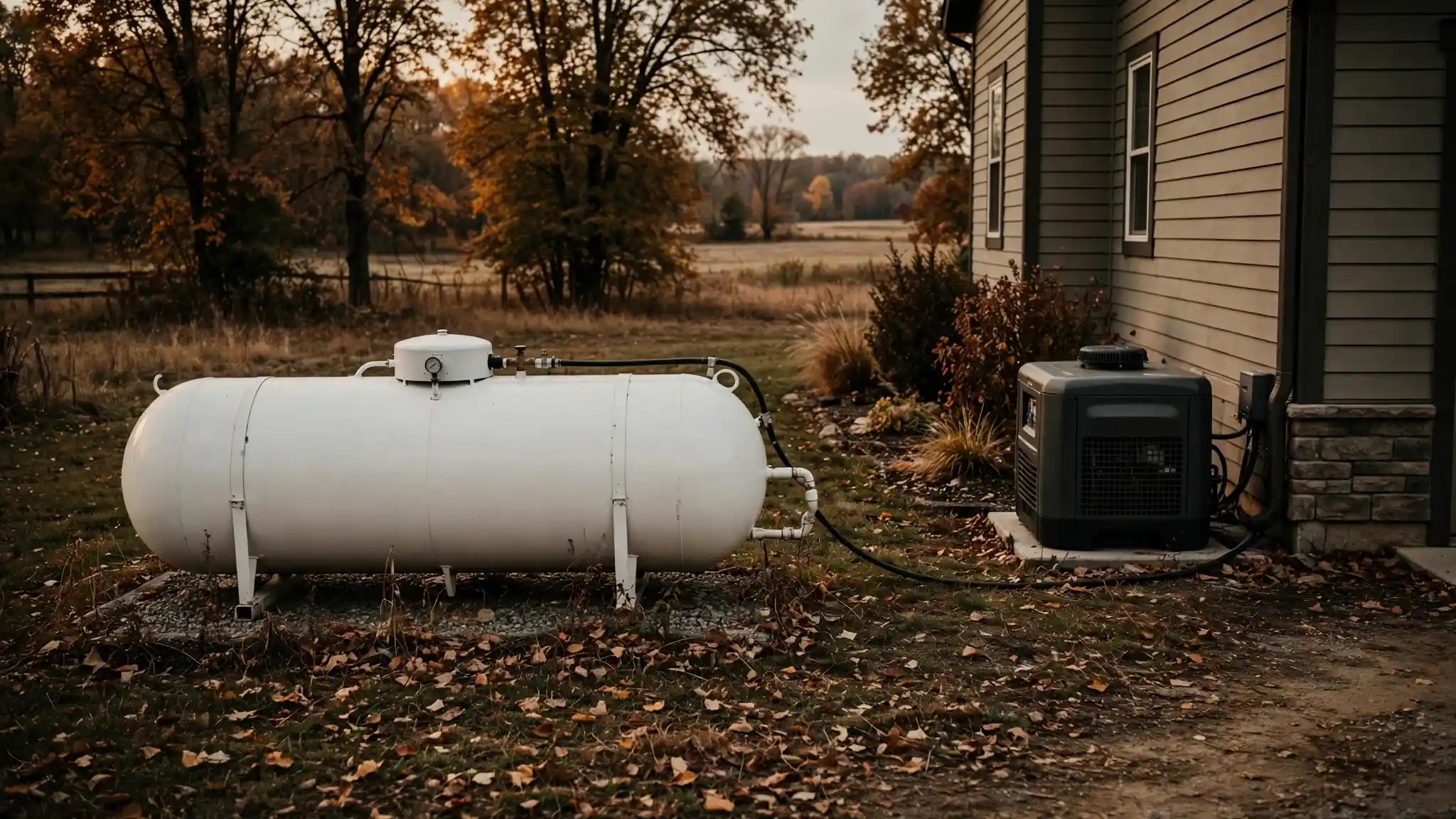
Quick answer: A typical home standby runs about 4 to 6 days continuously on a 250-gallon propane tank — but plan on roughly 180 usable gallons, not 250: the tank is only filled to 80% (about 200 gallons) and you keep a reserve at the bottom. At a steady 50% load that works out to about 5 days for a 10 kW unit, 4.2 days for a 14 kW, and 3.3 days for a 22 kW, with real-world cycling stretching each of those a little further.
If you’re sizing a standby generator on propane, this is the question that decides the whole installation: how long will a generator run on a 250 gallon propane tank before you’re dark again? The short answer for a typical home standby is about 4 to 6 days of continuous outage running — but that range hides a trap that catches almost everyone the first time they do this math. The trap is in the tank itself, so let’s start there.
Why doesn’t a 250-gallon tank hold 250 gallons?
Because it’s not allowed to. Propane expands as it warms, and a tank filled to the brim in January would be venting gas through its relief valve on a hot July afternoon. So every propane tank — from your grill cylinder to a 1,000-gallon underground vessel — is filled to 80% of its water capacity. The “250 gallons” on the nameplate is the tank’s total volume, not its fuel load.
Do the arithmetic once and it sticks:
- 250-gallon tank, filled correctly: ~200 gallons of propane
- A 500-gallon tank: ~400 gallons
- A 100-lb portable cylinder: ~23.6 gallons — which is why the runtime math on small tanks feels so brutal by comparison
And 200 isn’t your planning number either. You never run a tank to zero, for three reasons I give every customer:
- Gauges lie at the bottom. A percentage gauge that’s off by 5 points is off by 12 gallons on this tank. At the low end, that’s the difference between “one more night” and silence at 3 a.m.
- Vapor pressure sags. The generator drinks vapor off the top of the liquid. As the liquid level drops, there’s less surface area boiling off fuel, and on a big draw — say the well pump and the AC starting together — a nearly empty tank can starve a large generator even with a few gallons left.
- You need a landing strip. Propane companies schedule deliveries by route, not by your emergency. If you hit true empty on day four of a regional outage, you may wait days for a truck that’s serving a whole county in the same shape.
So the honest planning figure for a 250-gallon tank is 170–190 usable gallons. I’ll use 180 gallons for every runtime number below. If your math only works at the full 200, your plan doesn’t work.
How much propane does a standby generator actually burn?
Consumption is where the brochure and reality part ways. Manufacturer spec sheets quote burn rates at 50% and 100% load, and homeowners tend to read the 50% number and assume that’s their life. It’s a decent starting point — here are realistic propane figures for the common residential sizes:
| Generator size | At ~25% load | At ~50% load | At full load |
|---|---|---|---|
| 10 kW standby | ~1.1 gal/hr | ~1.5 gal/hr | ~2.0 gal/hr |
| 14 kW standby | ~1.3 gal/hr | ~1.8 gal/hr | ~2.6 gal/hr |
| 22 kW standby | ~1.6 gal/hr | ~2.3 gal/hr | ~3.5–3.9 gal/hr |
Two things worth knowing about these numbers. First, a standby engine burns a surprising amount of fuel just to spin itself — the jump from 25% load to 50% load costs far less than the jump from off to 25%. Idling a big engine to power a fridge and three lights is inherently wasteful, which is why the 22 kW looks thirsty at light load. Second, propane carries about 91,500 BTU per gallon versus roughly 114,000 for gasoline, so any generator burns more gallons of propane to do the same work — the full fuel-by-fuel breakdown is in my generator fuel consumption guide.
Brands vary by a few tenths either way — a Kohler, Generac, and Cummins of the same rating won’t post identical numbers — but if a salesman quotes you a burn rate far below this table, ask to see the spec sheet.
So how many days is that, really?
Here’s the table people actually want. It assumes a full 250-gallon tank (200 gallons in it), 180 usable gallons, and the generator running continuously — which is how an automatic standby behaves in an outage unless you intervene:
| Generator | Steady 50% load | Realistic outage average* |
|---|---|---|
| 10 kW | ~120 hrs ≈ 5 days | ~6–7 days |
| 14 kW | ~100 hrs ≈ 4.2 days | ~5–6 days |
| 22 kW | ~78 hrs ≈ 3.3 days | ~3.5–4.5 days |
*The “realistic average” column is the one I plan around, and here’s why it’s longer than the steady-load math. A house does not draw 50% of a 22 kW generator around the clock. Your real load profile looks like this: morning peaks (water heater recovering, coffee maker, well pump), a midday lull at maybe 15–25% load, an evening peak (cooking, AC, laundry), and overnight — the longest stretch — often sitting at 10–20% while everyone sleeps and only the fridge, freezer, and furnace blower cycle. Averaged over 24 hours, most homes I service land at an effective burn 15–30% below the steady 50% figure.
That’s also where your behavior buys real time. Every load you shed is runtime in the tank. Turning the electric water heater breaker off overnight, cooking on the grill instead of the electric range, and letting the house drift a few degrees on the thermostat can pull a 22 kW household’s average burn from 2.0 toward 1.6 gal/hr — and that difference is a full extra day on this tank. Load discipline on a whole-house system isn’t a moral exercise; it’s gallons.
One more honest caveat: if your home is all-electric with a heat pump on auxiliary strip heat in cold weather, your “average” load is not average. Strip heat alone can pull 10 kW. In that house, plan on the steady-load column, not the optimistic one.
What about portable generators on propane?
Briefly, because it’s a different arrangement: dual-fuel portables drink from cylinders — 20-lb grill tanks, 40-lb, or 100-lb cylinders — not from a stationary 250. A 5,000-watt dual-fuel portable at half load burns roughly 0.5–0.7 gal/hr of propane, so it would sip from a big tank for weeks in theory. In practice, tying a portable into a stationary tank requires the right two-stage regulation and hose setup, and that’s a licensed gas technician’s job, not a Saturday project — the pressures and regulators are different from what ships in the portable’s box. If portables are your setup, the cylinder math in the 20-lb tank runtime guide is the one that applies to you.
How does a 500-gallon tank compare?
It roughly doubles everything, exactly as you’d expect — and the doubling is worth pricing, because the tank is one of the cheaper lines in a standby installation:
- Fuel aboard: ~400 gallons at an 80% fill; ~360–380 usable with the same reserve discipline
- Runtime: a 22 kW at realistic outage average runs about 7–9 days; a 14 kW, 10–12 days; a 10 kW can pass two weeks
- Refill rhythm: most 500 owners refill once or twice a year outside of major outages; 250 owners in outage-prone areas watch the gauge a lot more
The installed-cost difference between the two sizes is usually a few hundred dollars on the tank itself plus the same trench, pad, and regulator work either way — small money next to the generator and transfer switch. Where the 500 earns its keep isn’t the daily math; it’s the bad week. If your area’s realistic worst case is a 5–7 day outage with impassable roads for the first three, a 250 on a big generator is a plan that fails on day four. The fuel-choice side of this decision — tank ownership, leased versus purchased, price per gallon — is covered in my natural gas vs. propane standby comparison.
My rule for customers: size the tank for your worst historical outage plus two days, not for your average outage. Averages are for the utility’s annual report. You’re buying for the storm with a name.
What does it cost to keep a 250-gallon tank full?
Residential propane prices swing with region, season, and whether you own or lease your tank, but a sane planning range is $2.50–$4.00 per gallon, with summer fills usually at the cheap end and mid-winter at the expensive end. Against those numbers:
- Full fill from empty (200 gal to the 80% mark): roughly $500–$800
- Typical top-off from 30% back to 80% (~125 gal): roughly $315–$500
- Cost per outage day: at a realistic 35–48 gallons burned per day by a mid-to-large standby, you’re spending roughly $90–$190 a day to keep a whole house lit during an outage
That daily figure surprises people, but compare it honestly with the alternatives: a spoiled fridge and freezer, a hotel at outage-inflated rates, frozen pipes. Nobody I know has ever regretted the propane bill after a four-day outage. Plenty have regretted the undersized tank.
Two money habits that matter: fill in late summer when prices dip, and never let the tank sit below 30% going into your storm season — you’ll pay whatever the spot price is when you order in a panic, and you’ll wait the longest for it.
Can cold weather shorten your runtime?
Yes, and not because the generator burns more — because the tank delivers less. Propane has to boil into vapor before the generator can use it, and cold liquid boils slowly. A tank’s ability to vaporize fuel depends on temperature and on its wetted surface area — how much of the tank wall is in contact with liquid. Two consequences:
- Low level + deep cold + big generator is the bad combination. At 15% full on a 0°F night, a 250-gallon tank may not vaporize fast enough to feed a 22 kW unit at heavy load. The generator starves, hunts, or faults out — with fuel still in the tank. You’ll see frost on the tank shell; that’s the liquid inside refrigerating itself as it boils.
- A bigger tank is also the fix. A 500 at 20% still has more wetted area than a 250 at 50%, which is one more reason cold-climate, big-generator installs belong on the larger tank.
Practical defenses are simple: keep the tank above 30% all winter, tell your propane company your generator size when the tank is set (they size regulators and sometimes the tank itself to your peak draw), and if you’re in genuinely cold country — regular sub-zero nights — raise the vaporization question with your installer before the tank goes in, not after the first January outage.
When should you upsize the tank instead of planning refills?
Refill logistics work fine until they don’t, and they fail in a predictable pattern: the same storm that knocks your power out for five days also fills your propane company’s order book for five days, drops trees across the roads their trucks use, and sends every other generator owner in the county to the phone at the same time. During a regional event, “we’ll just get a delivery on day three” is a hope, not a plan.
Upsize to a 500-gallon tank (or larger) if any of these are true:
- Your generator is 22 kW or bigger and your house has meaningful electric loads
- Your worst outage in the last decade ran 5 days or longer
- You’re on a well pump — no water is a much harder deadline than no TV
- Someone in the house depends on powered medical equipment (the math changes completely here; runtime is not a convenience)
- Your propane supplier is small, distant, or known to run allocation during shortages
Stay with the 250 if your outages are measured in hours-to-two-days, your generator is 14 kW or under, and your supplier is local with a good storm record. In that world the 250’s 4–6 days is already generous headroom, and the money saved belongs in the maintenance fund instead.
Either way, the habit that actually protects you costs nothing: glance at the gauge every month and after every outage day, and order at 30%, not at 10%. Every runtime number in this article assumes you started the outage with a full tank. The most common way a 250-gallon tank “only lasts two days” is that it started at half.
Keep reading
Frequently asked questions
How many usable gallons are in a 250-gallon propane tank?
About 170–190 gallons in real planning terms. A 250-gallon tank is only filled to 80% of its water capacity, so a "full" tank holds roughly 200 gallons. You also never run it to zero — below about 10% the gauge gets unreliable, vapor pressure sags on big draws, and you have no reserve if the delivery truck is late. Start from a full 200, leave 15–25 gallons as your floor, and budget around 180 usable gallons.
How long will a 22 kW generator run on a 250-gallon propane tank?
Roughly 3.5 to 4.5 days of continuous running in a real outage. At a steady 50% load a 22 kW standby burns around 2.3 gallons per hour, which empties your ~180 usable gallons in about 3.3 days. Real houses don't sit at 50% around the clock — loads cycle and overnight draw is low — so the average burn is closer to 1.7–2.0 gal/hr, which stretches the same tank to about 4 to 4.5 days.
How much does it cost to fill a 250-gallon propane tank?
Filling from empty to the normal 80% mark takes about 200 gallons. At typical residential propane prices of $2.50–$4.00 per gallon, that's roughly $500–$800 for a full fill. Most fills are top-offs, not from-empty fills — refilling from 30% to 80% takes about 125 gallons, or roughly $315–$500 at the same prices.
Is a 250-gallon tank big enough, or do I need a 500?
A 250 is enough if your worst realistic outage is 3–4 days and your generator is 14 kW or smaller. Step up to a 500-gallon tank if you run a 22 kW unit, heat with electricity (heat pump with strip heat, electric range, electric water heater), or live somewhere week-long outages actually happen — hurricane coast, ice-storm country, remote rural service. The 500 roughly doubles your runtime for a modest difference in installed cost.
When should I order a propane refill so I don't run dry mid-outage?
Order at 30%, not at 10%. Glance at the gauge every month and after every outage day, and never let the tank sit below 30% going into your storm season. Below about 10% the gauge gets unreliable — a 5-point error is 12 gallons on this tank — vapor pressure sags on big draws, and if you hit true empty mid-outage you may wait days for a truck serving a whole county. Filling in late summer also helps: residential prices in the $2.50–$4.00 per gallon range usually sit at the cheap end then.