How Much Gas Does a 5500 Watt Generator Use? (By Load)
**Quick answer:** A 5500-watt generator burns about **0.4 gallons per hour at quarter load and 0.6 at half load** — roughly 0.75 at 75% load and 0.85–1.0 at full load. A typical 6–7.2 gallon tank therefore lasts 10–12 hours at the half load most outages actually run at, and a full 24 hours takes about 14–15 gallons — $43–$58 at $3.00–$4.00 a gallon. On propane, budget roughly 25% more gallons for the same watts.
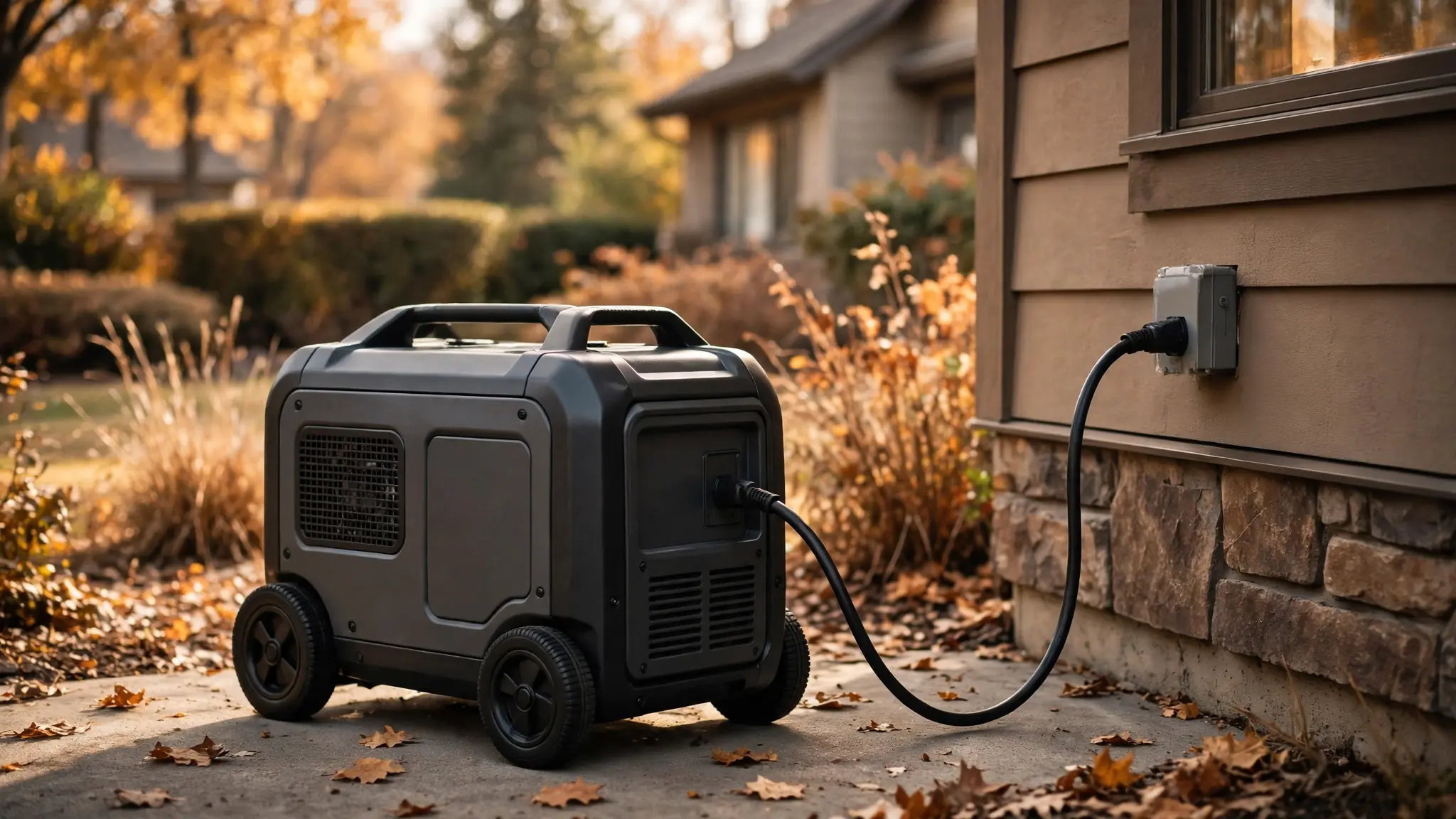
Quick answer: A 5500-watt generator burns about 0.4 gallons per hour at quarter load and 0.6 at half load — roughly 0.75 at 75% load and 0.85–1.0 at full load. A typical 6–7.2 gallon tank therefore lasts 10–12 hours at the half load most outages actually run at, and a full 24 hours takes about 14–15 gallons — $43–$58 at $3.00–$4.00 a gallon. On propane, budget roughly 25% more gallons for the same watts.
People ask me “how much gas does a 5500 watt generator use?” like there’s one number. There isn’t — there’s a range, and where you land in it depends almost entirely on how hard the machine is working, not on the sticker. But I can give you the numbers I use when I’m planning fuel for customers before a storm, because a 5500 is the most common size I see in garages: big enough for a furnace blower, fridge, and lights, small enough to wheel around by hand.
Short version: figure about half a gallon an hour for real-world outage duty. Here’s the full picture.
How much gas does a 5500 watt generator burn at each load?
These are figures for a typical conventional (non-inverter) 5500-watt portable — the Generac GP5500, Champion, and Predator class of machine, with a single-cylinder engine in the 300–420cc range spinning at a governed 3,600 RPM.
| Load | Watts delivered | Gas use (gal/hr) | Hours on a 6.5-gal tank |
|---|---|---|---|
| 25% | ~1,375 W | 0.35–0.45 | 14–16 |
| 50% | ~2,750 W | 0.55–0.65 | 10–12 |
| 75% | ~4,125 W | 0.70–0.80 | 8–9 |
| 100% | 5,500 W | 0.85–1.0 | 6.5–7.5 |
Sanity-check that against what manufacturers print: a 5500 with a 6–7 gallon tank almost always claims 10–14 hours of runtime at 50% load. Run the math backwards — 6.5 gallons over 11 hours is 0.59 gal/hr — and you land right on the half-load figure above. When a brand claims dramatically better, they’ve tested at 25% load and put the small print somewhere you won’t read it.
One thing that surprises people: the engine doesn’t sip proportionally at light load. Drop from half load to quarter load and you save maybe a third of the fuel, not half. A conventional generator’s engine turns 3,600 RPM whether it’s making 5,000 watts or 500, and a good chunk of every gallon goes to spinning the engine itself, not your house. That’s the physics you can’t shop your way around in this class of machine. (Inverters are the exception — they throttle down at light load — which is why the comparison further down isn’t flattering to the big conventional units.)
If you want the same tables for every size and fuel type, our full generator fuel consumption guide has them.
How long will a tank actually last during an outage?
Tank sizes on 5500s run from about 6 gallons on the budget end to 7.2 gallons on something like a Generac GP5500. Call it 6.5 for planning. If you’re working from a standard 5-gallon can rather than a full tank, our breakdown of how long a generator runs on 5 gallons of gas does that same math by size and load.
- Overnight essentials only (fridge, a few lights, phones, router — around 25% load): 14–16 hours. This is the scenario where a 5500 feels almost economical.
- Normal outage living (fridge, furnace blower or window AC cycling, lights, TV, microwave in bursts — averaging near 50%): 10–12 hours. This is the honest planning number. Fill it in the morning, top it off before bed.
- Working it hard (well pump or central AC in the mix, sustained 75%+): 7–9 hours, and you’re refueling mid-day whether you like it or not.
Two practical warnings from eighteen years of outage calls. First, never refuel a hot generator — shut it down, give it ten minutes, then pour. I have seen the scorched side panel and heard the story too many times. Second, that last gallon in the tank isn’t really usable in sloshing, real-world conditions; treat your effective capacity as about half a gallon less than the spec and you won’t get an unpleasant 3 a.m. surprise.
What does a 5500 cost to run for 24 hours?
Take the half-load figure — 0.6 gal/hr × 24 hours = 14.4 gallons. At $3.00–$4.00 a gallon, that’s $43–$58 a day, and a three-day outage runs $130–$175 in fuel alone, plus roughly 43 gallons you need to have on hand or be able to fetch. That’s the number that makes people rethink running the machine around the clock.
Most households don’t need to. Your fridge holds temperature for hours with the door shut, so cycling the generator — four hours on, two hours off during the day, off overnight if the house is holding heat — cuts daily burn to 8–10 gallons, around $25–$40 a day, and roughly halves engine wear and noise complaints from the neighbors. The machine doesn’t care about being cycled; your fuel cans will notice the difference.
Why is the 5500 the sweet spot, then?
Because of where a real house’s load actually sits. Add up honest outage loads:
- Refrigerator: 100–200 W running (with defrost spikes)
- Furnace blower: 500–800 W, intermittent
- LED lighting for the rooms you’re in: 60–120 W total
- Router, TV, chargers, laptop: 150–250 W
- Sump pump: 800–1,050 W when it’s actually pumping, which is minutes per hour
Steady-state, most homes idle along at 1,500–2,500 watts — that’s 27–45% of a 5500. The machine spends its life loafing in the efficient-enough zone, burning about half a gallon an hour, with surge headroom left over for the fridge compressor, the pump, and a microwave (1,000–1,200 W) all kicking at once. Go smaller and you’re tripping breakers at breakfast. Go bigger and you’re feeding a bigger engine to make the same 2,000 watts. We walk through the surge math appliance-by-appliance in what a 7500-watt generator can run — the same logic applies, just scaled down.
My honest opinion, and I tell customers this even when they came in wanting the big one: for a house on city water with gas heat, a 5500 is the largest generator that still makes economic sense, and fuel burn is exactly why.
How does a 5500 compare on fuel with a 7500 and a 2000 inverter?
The fair comparison isn’t each machine at its own 50% — it’s all three feeding the same load. Here’s a 2,750-watt load and a light 1,000-watt load on each:
| Machine | At 1,000 W load | At 2,750 W load |
|---|---|---|
| 2,000 W inverter | ~0.20 gal/hr | Can’t — that’s over capacity |
| 5,500 W conventional | ~0.35–0.40 gal/hr | ~0.60 gal/hr |
| 7,500 W conventional | ~0.45 gal/hr | ~0.75 gal/hr |
Two lessons. First, the 7500’s bigger engine (typically 420cc+) costs you roughly 0.15 gal/hr extra at the same load — over a 72-hour outage that’s about 10 gallons, two extra gas cans, for capacity most homes never use. Our by-the-hour breakdown for the big unit is in how much gas a 7500W generator uses.
Second, look at the inverter at light load. An inverter like a 2,000-watt unit throttles its engine down when demand drops, so sipping along at 1,000 watts it burns half what the 5500 does — and its little 1-gallon tank still lasts 4–5 hours. If your outage plan is fridge, lights, and internet and nothing with a motor bigger than a box fan, the inverter wins on fuel and it isn’t close; our 2000W consumption numbers show a full day on under 5 gallons. The 5500 earns its fuel bill the moment a furnace blower, well pump, or sump pump enters the picture — those starting surges are what the small machines can’t swallow.
What if yours is dual fuel — how much propane does it burn?
Propane carries less energy per gallon than gasoline — about 91,500 BTU versus roughly 114,000 — so expect to burn about 25% more gallons for the same watts, and note that most dual-fuel 5500s are derated on propane to around 4,950 running watts.
- At 50% load on propane: roughly 0.75–0.85 gal/hr
- A standard 20-lb grill tank holds about 4.6 gallons of propane, so you’re looking at 5–6.5 hours at half load per tank — versus 10–12 hours from the gasoline tank the machine came with.
That sounds like a loss, and on runtime it is. But propane doesn’t go stale, doesn’t gum a carburetor, and a spare tank stores forever in the corner of the garage. My usual advice: run gasoline as the primary fuel during an outage, keep propane as the reserve you never have to worry about, and start the machine on propane every few months so the regulator and hoses stay honest. The full fuel-by-fuel comparison is in the fuel consumption guide.
How can you measure what your 5500 actually burns?
The tables get you close, but individual machines vary — a tired engine with a neglected filter can burn 15% more than a fresh one making the same watts, and cold weather and altitude both push consumption up a bit. If you want your machine’s real number before you build a fuel-storage plan around it, do this one-hour test on a Saturday, not during an actual outage:
- Fill the tank to the brim and note the time. Load the generator the way you’d honestly run it in an outage — fridge plugged in, furnace blower connected, some lights on. Not everything you own, and not nothing.
- Run it for exactly two hours (one hour is enough, but two smooths out the fridge compressor cycling and halves your measurement error).
- Shut down, let it sit five minutes on level ground, then refill the tank to the exact same brim level using a measuring jug or a marked gas can. What you poured in is what it burned.
- Divide by the hours. That’s your number — write it inside the generator’s lid with a paint marker, because you will not remember it the night the power actually fails.
For most customers who do this, the result lands between 0.5 and 0.65 gal/hr, and it changes the fuel conversation from guessing to arithmetic: your number times the hours you plan to run per day times three days is the storage target. Ten minutes of measuring in October beats a midnight gas run in February, every single time.
Can you make a 5500 burn less gas?
A few things that genuinely work, in order of payoff:
- Cut the load, not the hours. Every sustained 500 watts you remove saves roughly 0.05–0.08 gal/hr. The electric water heater and the dryer are the two loads that quietly eat a fuel can; skip both during an outage.
- Cycle it. As above — the fridge doesn’t need the compressor fed 24/7 to stay cold. This is the single biggest saver.
- Keep the air filter clean and the oil fresh. A clogged filter richens the mixture and I regularly see 5–10% worse consumption on neglected machines. It’s a two-minute check in our generator maintenance checklist.
- Don’t chase an inverter’s numbers. If you find yourself consistently under 1,000 watts, the right answer is a smaller second machine for light duty, not tricks to make a 5500 sip.
What doesn’t work: fuel additives promising big efficiency gains, and “economy” throttle switches on conventional units that mostly just lower your voltage headroom. Spend that money on another gas can instead — stored with stabilizer, rotated into your car every six months so it never goes stale.
The bottom line: plan a 5500 at half a gallon an hour, 12–15 gallons a day if you run it flat out, and 8–10 if you cycle it like most sensible people do. Size your fuel storage to the three-day number — about 30–40 gallons — and the fuel question stops being the stressful part of an outage.
Keep reading
Frequently asked questions
How much gas does a 5500 watt generator use per hour?
A typical 5500-watt conventional generator burns about 0.35–0.45 gallons per hour at 25% load, 0.55–0.65 at 50% load, roughly 0.75 at 75%, and 0.85–1.0 at full load. Most real outage use sits between quarter and half load, so plan on about half a gallon an hour — call it 12 gallons for a full day of typical running.
How long will a 5500 watt generator run on a full tank?
Most 5500-watt portables carry a 6–7.2 gallon tank. At 50% load (about 0.6 gal/hr) that's 10–12 hours, which matches the runtimes manufacturers print on the box. At a light 25% load you can stretch a tank to 14–16 hours; at full load you'll be refueling in about 7 hours.
How much does it cost to run a 5500 watt generator for 24 hours?
At half load, a 5500-watt generator burns roughly 14–15 gallons in 24 hours. At $3.00–$4.00 a gallon for regular gasoline, that's about $43–$58 a day. Run lighter — quarter load, cycling it off overnight — and you can hold a day to 8–10 gallons, or roughly $25–$40.
Does a 5500 watt generator use less gas than a 7500 watt?
At the same electrical load, yes. Feed both machines a 2,750-watt load and the 5500 burns about 0.6 gal/hr while the 7500 burns closer to 0.75 — the bigger engine carries more friction and pumping loss at part throttle. The gap isn't huge, but over a three-day outage it's 8–10 extra gallons you have to store and haul.
How much propane does a 5500 watt generator burn?
About 25% more gallons than gasoline for the same output — propane carries roughly 91,500 BTU per gallon against gasoline's ~114,000, and most dual-fuel 5500s are derated to about 4,950 running watts on propane. At 50% load expect roughly 0.75–0.85 gallons per hour, so a standard 20-lb grill tank (about 4.6 gallons) lasts 5–6.5 hours, versus 10–12 hours from the machine's gasoline tank. The trade: propane never goes stale and never gums a carburetor, so it makes an excellent stored reserve.