How Much Gas Does a 7500 Watt Generator Use? (Load Table + Costs)
**Quick answer:** A 7,500-watt generator burns about 0.5 gallons per hour at quarter load, 0.75 at half load, about 1.0 at three-quarter load and around 1.2 running flat-out — the load you run is the whole story. At the half-load cruise most homes actually sit at, a typical 6.6–7.5-gallon tank lasts roughly 9–10 hours, and a full 24 hours burns about 18 gallons.
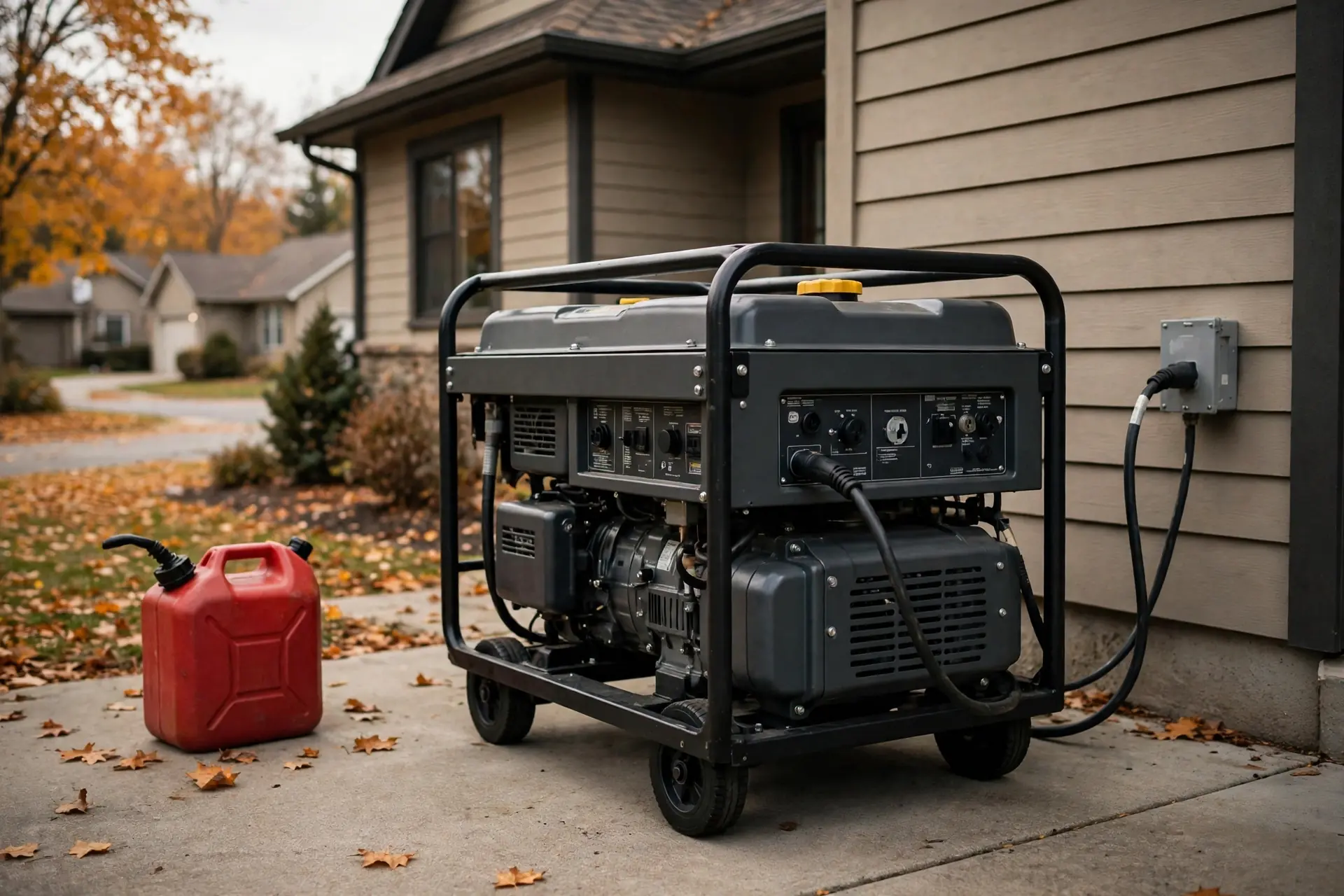
Quick answer: A 7,500-watt generator burns about 0.5 gallons per hour at quarter load, 0.75 at half load, about 1.0 at three-quarter load and around 1.2 running flat-out — the load you run is the whole story. At the half-load cruise most homes actually sit at, a typical 6.6–7.5-gallon tank lasts roughly 9–10 hours, and a full 24 hours burns about 18 gallons.
Ask a room of generator owners how much gas does a 7500 watt generator use and you’ll get answers from “barely any” to “it drank my whole emergency fund.” Both people are telling the truth. They were just running different loads. A 7,500-watt portable loafing along with a fridge and some lights burns about half a gallon an hour. The same machine with a well pump, a water heater, and two space heaters stacked on it burns well over a gallon an hour. Load is the whole story, so let’s put real numbers on it.
I’m a licensed electrician, and the fuel conversation is the one I have with every customer after their first long outage. Nobody believes the burn rate until they’ve made their third gas station run in two days. Here’s the table I wish came stapled to the box.
How much gas does a 7500 watt generator use at each load?
These are planning numbers for a typical conventional 7,500-watt portable — the 420–439cc single-cylinder engine you’ll find in a Generac GP7500E, a Champion 7,500-watt unit, a Westinghouse WGen7500, and a dozen store-brand cousins. Individual models wander a bit, but not enough to change your fuel plan.
| Load | Watts being drawn | Gas consumption | Planning number |
|---|---|---|---|
| 25% load | ~1,875W | 0.45–0.55 gal/hr | 0.5 gal/hr |
| 50% load | ~3,750W | 0.7–0.8 gal/hr | 0.75 gal/hr |
| 75% load | ~5,625W | 0.9–1.05 gal/hr | 1.0 gal/hr |
| 100% load | 7,500W | 1.1–1.3 gal/hr | 1.2 gal/hr |
Three things to notice. First, the burn never drops to zero at light load. A conventional generator spins at a governed 3,600 RPM whether it’s powering a house or a phone charger, so even at 25% load it’s burning half its half-load rate just keeping the engine turning. Second, the jump from half to full load is smaller than people expect — roughly 0.75 to 1.2 gallons — because so much of the baseline burn is the engine itself. Third, sustained full load is a place you shouldn’t live anyway. I tell customers to plan continuous loads at no more than 80% of rating, which is also where the what a 7,500-watt generator can run guide lands.
For the same table across every size from 2,000 watts up, the generator fuel consumption guide has the full grid, gasoline, propane, and natural gas side by side.
Why won’t manufacturers just give you one number?
Because there isn’t one, and the number they do print is chosen by the marketing department. When a box says “up to 11 hours runtime,” that’s at 50% load, on the largest tank in the model line, under test conditions that do not include your 15-year-old well pump cycling on a cold morning. Divide the tank by the claimed hours and you usually get a half-load burn around 0.6–0.7 gallons per hour — believable in a lab, optimistic in a driveway.
Engines in this class also vary. A thrifty 420cc and a thirstier 439cc can differ by 10% at the same output. Altitude steals efficiency. An engine that’s overdue for an air filter and a valve check burns more to make the same watts. My rule on customer fuel plans: use 0.75–0.8 gallons per hour at expected cruising load, and if the generator sips less, you’ve got extra gas at the end of the outage instead of an empty tank in the middle of it. Nobody has ever called me angry that the outage ended with fuel left over.
How long will a full tank actually last?
Tank sizes in this class run from about 6 to 8 gallons — 6.6 gallons on a WGen7500, 7.5 on a Generac GP7500E, right around there on most others. Here’s what those tanks buy you:
| Tank size | At 25% load (0.5 gph) | At 50% load (0.75 gph) | At 100% load (1.2 gph) |
|---|---|---|---|
| 6 gallons | ~12 hours | ~8 hours | ~5 hours |
| 6.6 gallons | ~13 hours | ~8.5–9 hours | ~5.5 hours |
| 7.5 gallons | ~15 hours | ~10 hours | ~6 hours |
| 8 gallons | ~16 hours | ~10.5 hours | ~6.5 hours |
The practical translation: at a realistic whole-house cruising load, you refuel once in the morning and once before bed. That’s the rhythm of a 7,500-watt outage, and it’s why I push people to own at least two 5-gallon cans beyond the tank itself. One can is a trip to the gas station waiting to happen.
Two refueling rules that are not optional. Never refuel a running generator, and never refuel a hot one — let it sit 15–20 minutes. Gasoline vapor and a hot muffler is the combination that puts people in burn units every single hurricane season. And keep the machine at least 20 feet from the house with the exhaust pointed away while you’re at it; the fuel math doesn’t matter if the CO gets you first.
What does 24 hours of runtime cost?
Now multiply. At the gas prices most of the US has seen lately — call it $3.20 to $3.60 a gallon, your local number will wander — a full day of 7,500-watt backup power costs:
| Duty pattern over 24 hours | Gallons burned | Cost at $3.20–$3.60/gal |
|---|---|---|
| Light discipline, ~25% average load | ~12 gallons | $38–$43 |
| Typical whole-house cruise, ~50% average | ~18 gallons | $58–$65 |
| Heavy use, ~75% average | ~24 gallons | $77–$86 |
| Flat-out, near 100% | ~29 gallons | $93–$104 |
Sit with the middle row for a second. Eighteen gallons a day. A three-day outage at a normal cruising load burns about 54 gallons — that’s the generator’s tank plus ten 5-gallon can fill-ups, roughly $175–$195 in fuel. I watched a customer learn this in real time during an ice storm, doing the math on a gas station receipt with a look on his face I usually see during panel-upgrade quotes. The generator itself cost him $850. The fuel habit is the part nobody budgets for.
This is also why storage matters. Fifty gallons of gasoline is a lot of flammable liquid to keep around, it goes stale in 3–6 months without stabilizer, and rotating it through your car every couple of months is the only honest way to keep the stock fresh. The generator maintenance checklist has the storage and stabilizer routine I give my own customers — follow it and storm-week fuel is a solved problem instead of a scramble.
Does a 7500 watt inverter generator burn less?
Yes — at the loads where you’ll spend most of an outage, and it’s the main reason the big inverters cost what they cost. A conventional generator’s engine is locked at 3,600 RPM. An inverter generates raw power, converts it to DC, then inverts it back to clean AC electronically, which frees the engine to slow down when demand drops. At a 25% load, a 7,500-class inverter (Generac’s GP7500iE, Champion’s 8,500-watt inverter, and similar) will typically burn around 0.35–0.45 gallons per hour — call it 20–30% less than the conventional’s 0.5. At half load the gap narrows to a coin toss. At full load it vanishes: making 7,500 watts takes the same fuel either way, and the inverter’s engine is spinning just as hard.
So the inverter’s fuel advantage is real but situational. If your outage profile is long stretches of fridge, lights, furnace blower, and Wi-Fi — with short heavy pushes for the well pump or microwave — the inverter saves you real gallons and a lot of noise doing it. If you’re genuinely running at 6,000 watts around the clock, buy either style and the fuel bill won’t care. Don’t pay the inverter premium for fuel savings you’ll never collect; pay it for clean power and quiet if those matter to you, and let the light-load savings be a bonus.
One caveat: compare running watts to running watts, and read the fine print on any runtime claim for the load it assumes.
What happens to consumption on propane?
If your 7,500-watt unit is a dual-fuel, propane changes two numbers at once. Propane carries about 91,500 BTU per gallon against gasoline’s roughly 114,000–120,000, so the engine burns more gallons to make the same watts — figure 1.1–1.3 gallons of propane per hour at half load, against 0.75 on gasoline. It also derates: most dual-fuel engines give up about 10% of their peak wattage on propane, so your “7,500-watt” machine is really a ~6,750-watt machine on LP.
Run that through a tank and the trade gets stark. A 20-lb grill tank holds 4.6 gallons of propane, which is roughly 3.5–4 hours at half load on a generator this size. The 20-lb propane tank runtime guide walks through the math and the bigger-tank options. My take for this size class: propane is a superb storage fuel — it never goes stale — and a poor endurance fuel in grill tanks. If propane is your plan for a 7,500, you want a 100-lb cylinder or a plumbed tank, not a stack of grill bottles. Gasoline for the heavy days, propane as the reserve that never expires, is the combination I set up most often.
How can you burn less without buying anything?
Here’s the section that actually saves you money, because the cheapest gallon is the one the generator never drinks.
Kill the electric heat. A single 1,500-watt space heater is 20% of this generator’s capacity and runs continuously — that’s your whole quarter-load burn in one appliance, all night. Two space heaters will drag you from the 0.5 gph row of the table to the 0.8 row and keep you there. During an outage, heat one room with bodies, blankets, and a door closed. If a space heater is medically necessary, fine — just know what it costs per hour.
Stagger the motor loads. Well pump, fridge, freezer, and furnace blower all surge on startup but sip between cycles. They rarely need to run in the same minute. The microwave and the well pump at once is a choice, not an accident.
Understand that a conventional has no eco mode. People ask me where the eco throttle is on their conventional portable, and the answer is that there isn’t one — that’s the whole point of the fixed 3,600 RPM design. Your right hand is the eco mode: the loads you choose to plug in are the throttle. The only genuine efficiency lever on a conventional is keeping average load in the 40–60% band where the engine converts fuel to watts most happily, instead of idling a 439cc engine to run 200 watts of lights.
Batch and shut down. The fridge holds safe temperatures for about 4 hours closed; a full freezer, 24–48. In a long outage, running the generator in blocks — two or three hours on to chill everything, charge everything, and run the pump, then off — can cut daily fuel use by a third or more compared with idling it around the clock. Sleep hours are the obvious off-block.
Should you run the big generator all night for small loads?
Usually no, and this is the opinion I’ll defend at any supply-house counter: a 7,500-watt conventional is the wrong tool for overnight duty. Between midnight and 6 a.m. your real load is a fridge cycling, maybe a CPAP, phone chargers, and a furnace blower in winter — 200 to 600 watts, most of it intermittent. The big conventional burns its ~0.5 gallons per hour floor to serve that, all night, at full volume, outside your bedroom window. Eight hours of that is 4 gallons and a neighborhood’s worth of noise for loads a suitcase inverter handles at a whisper.
The two-generator setup sounds extravagant until you price the fuel: a small 2,000–2,500-watt inverter on overnight duty burns roughly 0.15–0.2 gallons per hour at those loads — about 1.4 gallons for the whole night against the big unit’s 4. Across a four-night outage, that’s 10 gallons saved, plus sleep. I’ve watched more than one customer buy the little inverter during an outage, on day two, purely for the nights. If you only own the 7,500, use the batch-and-shutdown method above and let the house coast while you sleep.
And if you’re still shopping and sizing the job, the companion question comes first: how much gas a 5,500-watt generator uses — because plenty of houses discover their real cruising load fits the smaller, thriftier machine, and the fuel table is where that decision pays out for years.
The bottom line
A 7,500-watt generator uses about 0.5 gallons per hour at quarter load, 0.75 at half, 1.0 at three-quarter, and 1.2 flat-out. A full tank buys roughly 10 hours of realistic whole-house cruising. A full day costs 12 to 29 gallons and $40 to $100 depending on how disciplined your loads are. Plan fuel at the half-load number, own two spare cans, kill the space heaters, and let a smaller machine — or a shutdown schedule — carry the night. Do that and the gas station math never surprises you again.
Keep reading
Frequently asked questions
How much gas does a 7500 watt generator use per hour?
It depends entirely on load. A typical 7500 watt conventional generator burns about 0.5 gallons per hour at 25% load (roughly 1,875 watts), 0.7–0.8 at 50%, around 1.0 at 75%, and 1.1–1.3 running flat-out. Most homes on backup power cruise near half load, so 0.75 gallons per hour is the honest planning number.
How long will a 7500 watt generator run on a full tank?
Most 7500 watt portables carry a 6.6–7.5 gallon tank. At half load that works out to about 9–10 hours; at quarter load, 13–15 hours; running flat-out, 5.5–6.5 hours. When a brochure brags about 10 or 11 hours of runtime, that is always the half-load figure — and often the optimistic version of it.
How much does it cost to run a 7500 watt generator for 24 hours?
At half load you will burn roughly 18 gallons in 24 hours. With gasoline at $3.20–$3.60 a gallon, that is $58–$65 a day. Drop to quarter-load discipline and it falls to about $40 a day; run near full load around the clock and you are over $90 a day. A three-day outage at half load is a 50-plus-gallon problem.
Does a 7500 watt inverter generator use less gas?
At light loads, yes. An inverter can throttle its engine down, so its quarter-load burn can run 20–30% below a conventional unit's. Near full load the gap nearly disappears, because the inverter's engine has to spin at full speed anyway. The savings live at the low loads you run overnight — which is exactly where most outage hours are spent.
Why does a 7500 watt generator burn so much gas when almost nothing is plugged in?
Because a conventional generator never really idles down. Its engine is locked at a governed 3,600 RPM whether it is powering a whole house or a single phone charger, and it has no eco mode, so even at 25% load it still burns about 0.45–0.55 gallons per hour just keeping the engine turning. That baseline is also why the jump to full load, around 1.2 gallons per hour, is smaller than people expect. Inverter models can throttle down at light loads, which is why their quarter-load burn runs 20–30% lower.