What Size Generator for a 1500 Sq Ft House? (Skip the 22kW Pitch)
**Quick answer:** For most 1,500 sq ft homes, 7,500–10,000 watts covers a comfortable outage and a 14–18kW standby covers everything, central AC included, while 3,500–5,500 watts handles essentials only. Square footage alone doesn't size the generator — your AC tonnage, typically 2.5–3 tons at this size, and whether you heat with gas or electricity decide it.
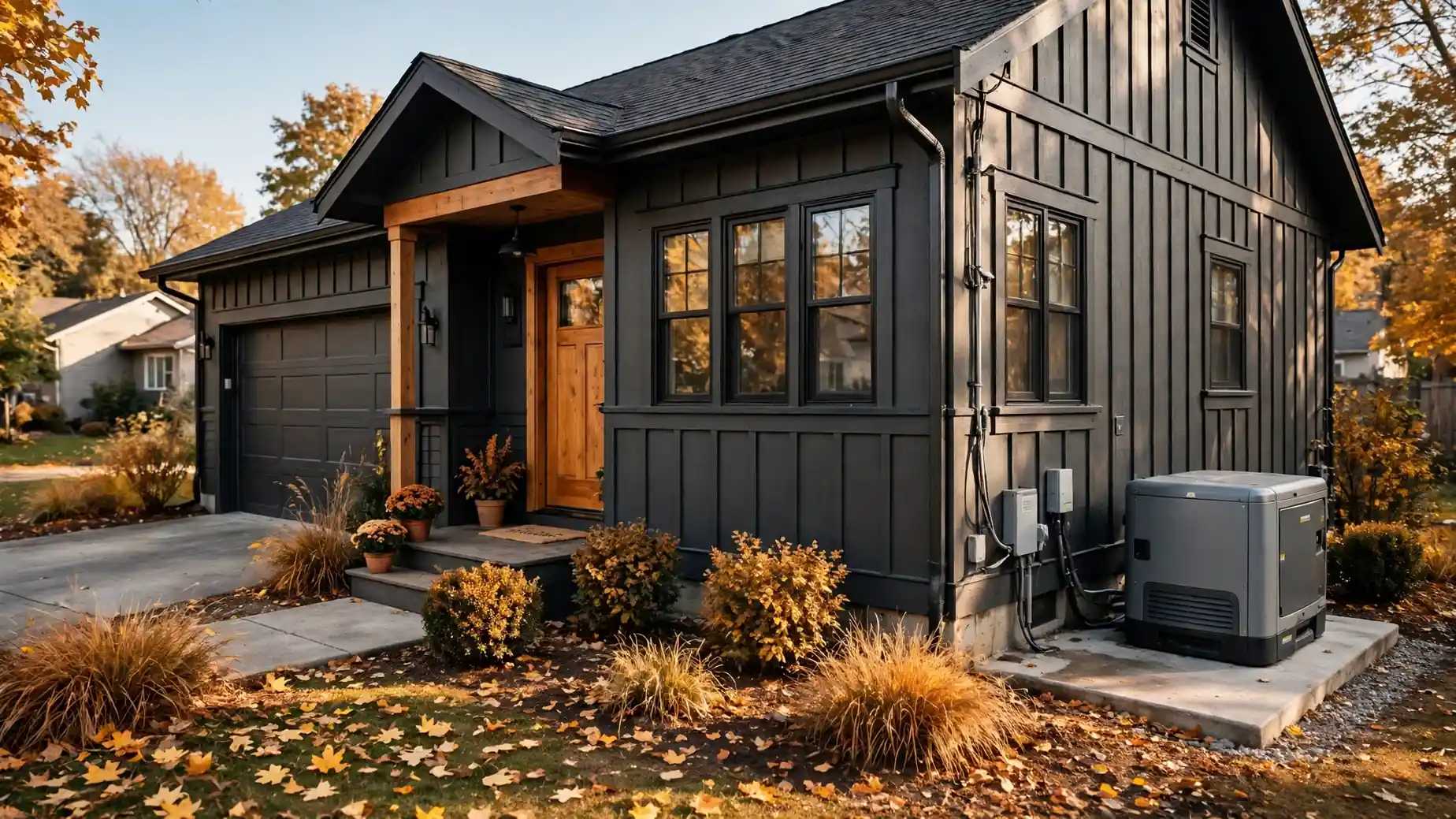
Quick answer: For most 1,500 sq ft homes, 7,500–10,000 watts covers a comfortable outage and a 14–18kW standby covers everything, central AC included, while 3,500–5,500 watts handles essentials only. Square footage alone doesn’t size the generator — your AC tonnage, typically 2.5–3 tons at this size, and whether you heat with gas or electricity decide it.
If you’re asking what size generator for a 1500 sq ft house, here’s the short answer I give on service calls: 7,500–10,000 watts covers a comfortable outage for most homes this size, and a 14–18kW standby covers everything, central AC included. The honest longer answer is that square footage doesn’t plug into anything. Your AC tonnage and whether you heat with gas or electricity decide this — the floor plan just gives us a good guess at both.
A 1,500 sq ft house is actually the easiest size to get right, because the load profile is predictable. It’s also the size where I see the most money wasted, because it’s exactly the house dealers love to hang a 22kW unit on. Let’s do the math properly.
Why doesn’t square footage size a generator by itself?
Because two 1,500 sq ft houses can differ by 8,000 watts of real load. A 1978 ranch in Ohio with a gas furnace, gas water heater, and a 2.5-ton AC is a modest load. A 2015 build in Florida with a heat pump, electric backup heat strips, an electric range, and a 3-ton AC is a different animal entirely. Same square footage, wildly different generators.
What square footage does predict reliably is AC size, and AC is the single biggest sizing factor in most homes. A 1,500 sq ft house in a moderate climate typically runs a 2.5 to 3-ton central AC. Hot-climate builds (Phoenix, Houston) sometimes push to 3.5 tons; well-insulated northern homes sometimes get away with 2 tons. That tonnage range is where we start.
What does a typical 1500 sq ft house actually draw?
Here’s the realistic load inventory for a home this size. These are numbers I’ve measured with a clamp meter on installs, not nameplate fantasies — nameplates list maximums, and appliances rarely run at maximum all at once.
| Load | Running watts | Starting watts | Notes for 1,500 sq ft |
|---|---|---|---|
| Central AC, 2.5-ton | 2,400–2,900 | 8,000–10,000 | Common in northern/mixed climates |
| Central AC, 3-ton | 3,000–3,500 | 9,000–12,000 | The most common size for this house |
| Gas furnace blower | 500–800 | 1,000–1,400 | ECM blowers sit at the low end |
| Heat pump (heating) | 3,000–4,000 | 5,000–7,000 | Plus 5,000–10,000W if aux strips kick in |
| Refrigerator | 150–250 | 800–1,200 | Runs about 40% of the time |
| Sump pump (1/2 HP) | 800–1,050 | 2,000–2,150 | Only if you have a basement |
| Well pump (1/2 HP, 240V) | 1,000–1,500 | 3,000–4,000 | Only on well water |
| Lights (LED, whole house) | 200–400 | — | Nobody lights every room at once |
| TV, Wi-Fi, laptops, chargers | 200–400 | — | The “life feels normal” loads |
| Microwave | 1,000–1,500 | 1,500 | Used in bursts, easy to schedule |
| Electric water heater (4,500W element) | 4,500 | 4,500 | The hidden budget-breaker |
| Electric range/oven | 3,000–8,000 | — | Rarely run during outages by choice |
Notice what’s not huge: everything except the AC, the electric water heater, and electric heat. A 1,500 sq ft home usually has one bathroom-plus, a modest kitchen, and no second AC zone. The base load of a house this size — fridge, lights, electronics, blower — sits around 1,200–2,000 watts most of the time. That’s why the tiers below shake out the way they do. For the full walk-through of adding loads this way on any house, see What Size Generator Do I Need to Run My House? — this article is that method applied to one specific size.
Tier 1: What will 3,500–5,500 watts run?
This is the essentials tier, and for a 1,500 sq ft house it’s a genuinely good life during an outage: fridge cold, furnace blower moving warm air (if you heat with gas), sump pump protecting the basement, lights on, phones charged, internet up, TV on. That’s 90% of what people actually suffer without.
A 5,000-watt portable or a quiet 4,500-watt inverter handles this tier without breaking a sweat, because the running total hovers near 2,000–2,800 watts and the biggest surge — the sump or well pump — is manageable. What you give up: central AC (window unit in the bedroom is the classic workaround, at 500–800 watts), the electric water heater, the dryer, and cooking on more than one burner at a time.
My honest take: if your outages are short (under 12 hours) and your climate is mild, this tier is the smart money. The generator costs $500–900, sips fuel, and stores in a corner. Don’t let anyone talk you out of it because it isn’t “whole house.”
Tier 2: What does 7,500–10,000 watts get you?
This is the comfort tier, and it’s the sweet spot for most 1,500 sq ft homes. Everything in Tier 1, plus:
- Real cooling — either two window units, or the central AC with a soft starter installed (more on that below)
- The microwave and a burner without playing load Tetris
- The well pump and sump pump cycling whenever they want, simultaneously
- A space heater or two in winter instead of just the furnace, if you’re on portable backup
The running load of a comfortable outage in this house size is typically 3,500–5,500 watts with the AC running — well inside a 9,000-watt portable’s continuous rating, with surge headroom left over. A dual-fuel 9,000–10,000-watt unit runs $900–1,400, and on propane it’ll go 8–10 hours at half load on a 40 lb tank setup. This is the configuration I recommend most often for this house size, and it’s not close.
Tier 3: When do you actually need 14,000–18,000 watts?
When the requirement is “the outage is a non-event and nobody manages anything.” A 14–18kW automatic standby with a whole-panel transfer switch runs the 3-ton AC without a soft starter, the electric water heater, the dryer, the range — everything, with standard load-shedding modules handling the rare moment when too much starts at once.
For a 1,500 sq ft house, 14kW is the right standby size in gas-heat homes, and 18kW if you have an electric water heater, electric range, or a heat pump with aux strips. Installed, you’re looking at roughly $11,000–14,500 for the 14kW and $12,500–16,000 for the 18kW in most markets — unit, pad, transfer switch, gas line, permits, and my labor. The full installed-cost breakdown lives in Whole House Generator Cost: What You’ll Actually Pay.
Above 18kW in a house this size, you’re buying capacity you’ll never use. Which brings us to the sales problem.
Why do dealers push 22kW on a 1500 sq ft house?
Because the math works for them, not you. The unit itself isn’t dramatically more expensive — maybe $800–1,500 more wholesale than a 14kW — but the ticket is bigger, the commission is bigger, and “you’ll never have to worry” is an easy pitch to a nervous homeowner sitting in the dark after a storm.
What they don’t mention: standby generators are happiest at 50–75% load. A 22kW loafing along at 5kW of load in your 1,500 sq ft house runs cool and dirty. On gasoline-engine standbys (which is what residential units are — air-cooled V-twins, usually), chronic light loading means incomplete combustion, carbon fouling, and oil dilution over time. It also burns roughly 2.4–2.8 gallons of propane per hour at the loads a house this size actually draws, versus about 1.8–2.2 for a 14kW doing the same job. Across a three-day outage, that’s a difference of around 40 gallons — which can be the difference between your 250-gallon tank lasting the outage and not.
An oversized generator is not a safety margin. It’s a recurring fuel bill and a maintenance headache wearing a safety margin’s clothes. If a quote for your 1,500 sq ft house says 22kW and the dealer can’t show you a load calculation that justifies it, get a second quote. There’s a deeper dive on what oversizing and undersizing do to AC starting in What Size Generator Do I Need to Run Central AC? — the surge physics are the same whatever the house size.
A worked example: the house I see most often
Let me run a real one. Three-bedroom 1,500 sq ft ranch, Midwest, built 1998: gas furnace, gas water heater, 3-ton AC, sump pump, city water, gas range. The family wants the AC in summer outages and no load management beyond common sense.
Running loads during a summer outage: AC 3,200W, furnace blower (for the air handler) 600W, fridge 200W, sump pump 900W when cycling, lights and electronics 400W. Running total ≈ 5,300W. The problem is never the total — it’s the AC’s startup surge of ~10,500W landing on top of ~2,100W of everything else. Peak demand ≈ 12,600W for a split second.
Two ways to cover it:
- 9,000–10,000W dual-fuel portable + soft starter ($300–450 installed). The soft starter drops that AC surge to roughly 3,500–4,000W. New peak ≈ 6,100W. The portable swallows it easily, and the family keeps about $10,000 in their pocket versus a standby. They wheel it out and plug into a 50-amp inlet with an interlock kit when the power fails.
- 14kW standby, no soft starter needed. Peak capacity covers the raw surge with room to spare, it starts itself in 10 seconds, and nobody touches anything. Costs the $10,000 more.
Same house, same loads, same comfortable outage. The difference is purely automation and convenience — which is a perfectly good reason to buy a standby, as long as that’s the reason you’re paying for.
Does your heat type change the answer?
Yes, and it’s the branch people miss. A gas furnace needs only its blower — 500–800 watts — to heat the whole house. That’s why gas-heat 1,500 sq ft homes are cheap to back up.
If you heat with a heat pump, winter changes everything. The heat pump itself draws 3,000–4,000 watts, and when outdoor temps drop below roughly 25–35°F, the auxiliary electric heat strips (5,000–10,000W) kick in. A portable that cruised through summer outages will buckle in a January ice storm. Heat-pump homes this size either step up to a 12,000W+ portable (and accept that aux heat gets locked out or managed), or go standby at 18kW with load shedding on the strips. If you have electric baseboard or a full electric furnace, a portable is essentially off the table for whole-house heat — back up one or two rooms, or go standby.
Portable or standby for a 1500 sq ft house?
Decide on these three questions, in order:
- How long and how often are your outages? Two short outages a year → portable, Tier 1 or 2, done. Multi-day outages every year, or a house that freezes fast → standby starts paying for itself.
- Is anyone home who can’t set up a portable? Standbys exist for medical equipment, elderly parents, and houses that sit empty. If someone in the home depends on powered medical gear, skip to Tier 3 and don’t apologize for it.
- Do you need the AC running unattended? Cooling for pets, a server closet, or a wine cellar while you’re away means automatic — standby.
Bigger house on the same decision? My sizing walk-through for the next size up is What Size Generator for a 2000 Sq Ft House? — the tiers shift up by roughly one notch.
My recommendation for most 1500 sq ft homes
If you forced me to spec one setup for the average 1,500 sq ft gas-heat house, it’s a 9,000-watt dual-fuel portable, a 50-amp inlet box with an interlock, and a soft starter on the AC — about $2,200–2,900 all-in, installed, and it covers everything except the dryer and simultaneous oven use. If the house is all-electric or the family needs automatic coverage, it’s a 14kW standby (18kW for heat pumps) — not a 22kW, no matter what the first quote says.
Whatever you buy, hold the sizing rule I use on every job: add up your realistic running loads, make sure your worst startup surge fits, then keep 20–25% headroom and stop. Headroom is wisdom. Doubling is waste.
Keep reading
Frequently asked questions
What size generator do I need for a 1500 sq ft house?
For most 1,500 sq ft homes: 3,500–5,500 watts covers essentials (fridge, lights, furnace blower, Wi-Fi, sump pump), 7,500–10,000 watts adds comfortable living plus window AC or a soft-started central AC, and a 14–18kW standby runs the whole house including central air. Square footage sets the AC size — the AC and your fuel type decide the generator size, not the floor plan.
Will a 7,500-watt generator run a 1500 sq ft house?
It will run most of one. A 7,500-watt portable handles the fridge, lights, furnace blower, sump pump, TV, and well pump in a typical 1,500 sq ft home with room to spare. What it won't do is start a 3-ton central AC on top of those loads — unless you add a soft starter ($300–450 installed), which cuts the AC's startup surge by roughly 60–70% and makes it realistic.
Is a 22kW generator too big for a 1500 sq ft house?
Usually, yes. A 22kW standby is sized for 2,500–3,500 sq ft homes with electric everything. In a 1,500 sq ft house it will spend outages loafing at 25–35% load, which wastes fuel (about 2.5–3 gallons of propane per hour even lightly loaded), risks wet stacking and carbon buildup on the engine, and costs roughly $2,000–4,000 more installed than a 14kW unit that would have run everything anyway.
Can a portable generator run central AC in a 1500 sq ft house?
Yes, with the right pairing. The typical 2.5–3 ton AC in a home this size runs at 2,800–3,500 watts but surges to 9,000–12,000 watts for a split second at startup. A 9,000–10,000-watt portable plus a soft starter on the AC is the budget-friendly combination I've installed most often; without the soft starter, you generally need 12,000+ watts just to survive the startup surge.
How much does a generator for a 1500 sq ft house cost?
It depends on the tier you pick. An essentials portable costs $500–900, a dual-fuel 9,000–10,000-watt comfort unit runs $900–1,400, and the recommended package of a 9,000-watt dual-fuel portable, a 50-amp inlet with interlock and a soft starter lands around $2,200–2,900 installed. Automatic coverage costs far more: a 14kW standby typically runs $11,000–14,500 installed and an 18kW $12,500–16,000, including the unit, pad, transfer switch, gas line, permits and labor in most markets.