What Size Generator to Run a 5-Ton AC Unit? Start With the Surge
**Quick answer:** A 5-ton AC runs at about 5,500–6,500 watts but throws a 31,000–38,000-watt surge at startup, so size for the surge, not the running load: a 12,000–14,000-watt portable plus a soft starter, or an 18–24kW standby, with 22kW the typical landing spot. A soft starter cuts that surge to roughly 8,000–10,000 watts, which is what makes the portable route genuinely workable.
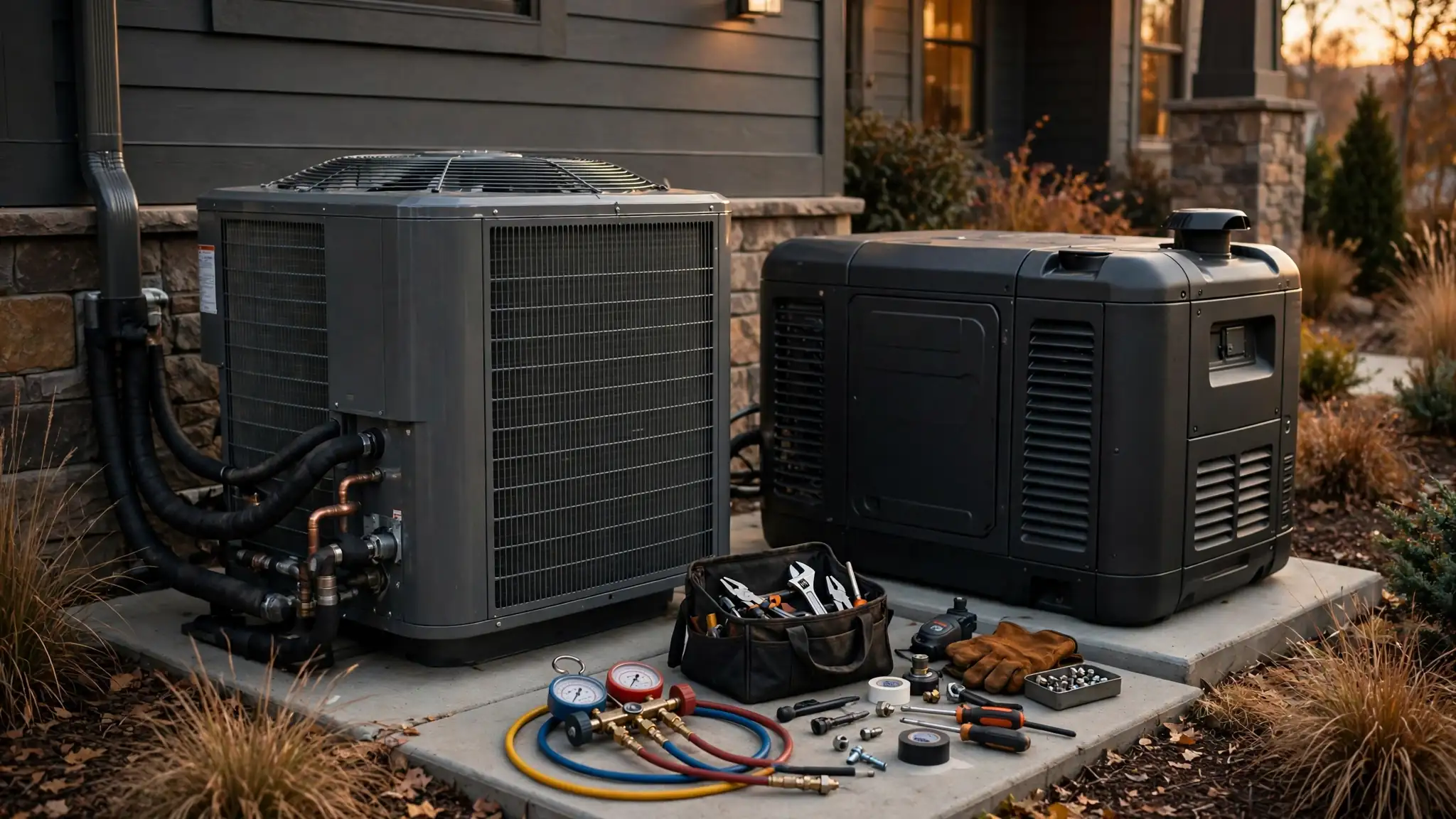
Quick answer: A 5-ton AC runs at about 5,500–6,500 watts but throws a 31,000–38,000-watt surge at startup, so size for the surge, not the running load: a 12,000–14,000-watt portable plus a soft starter, or an 18–24kW standby, with 22kW the typical landing spot. A soft starter cuts that surge to roughly 8,000–10,000 watts, which is what makes the portable route genuinely workable.
If you’re asking what size generator to run a 5 ton AC unit, here’s the uncomfortable truth I give every homeowner who calls me: the running watts are almost irrelevant. A 5-ton is the biggest residential AC most houses ever get, and its compressor doesn’t sip power when it starts — it throws a 30,000-watt punch for a split second. Size for that punch, or don’t bother.
I’ve watched people learn this the expensive way. One customer in a 2,900 sq ft two-story bought a 9,500-watt portable for hurricane season, proud it was “almost double” his AC’s running watts. First outage: generator fired up, AC breaker flipped, and the generator bogged down so hard it nearly stalled before the overload tripped. The AC never started — not once, in three tries.
So let’s do this properly — from your compressor’s nameplate numbers, not forum rules of thumb.
The short answers, up front:
- Portable route: a 12,000–14,000-watt dual-fuel portable plus a soft starter on the AC, and a strict rule that nothing else big starts while the compressor kicks on.
- Standby route: 18–24 kW, with 22 kW where most installers (myself included) land for a 5-ton house.
- No soft starter, no big generator? Then the honest answer is a window unit in the bedroom — about $150, and it actually works. I’ll get to it.
How many watts does a 5-ton AC actually use while running?
Let’s separate the two halves of your system, because people constantly quote only one of them.
The outdoor condenser — compressor plus condenser fan — draws roughly 4,800–5,800 watts running. A modern 16-SEER2 unit sits at the low end; a 15-year-old 10-SEER unit can push past the top of that range.
The indoor air handler (or furnace blower) isn’t free either: figure 500–800 watts for a typical blower, more on an old PSC motor at full speed.
Together, a 5-ton system runs at about 5,500–6,500 watts all-in. That’s the number people find online, and it’s real — as far as it goes. If running watts were the whole story, a 7,500-watt portable would handle a 5-ton AC with room to spare. Running watts are not the whole story.
Why does the startup surge wreck the math?
When a compressor starts, the motor is effectively stalled — the rotor isn’t turning yet, so nothing limits current. It draws its locked-rotor amps (LRA), typically 5–7 times running current, until it gets up to speed.
On a 5-ton unit, nameplate LRA usually runs 130–160 amps. Do the math at 240 volts:
- 130 A × 240 V = 31,200 watts
- 160 A × 240 V = 38,400 watts
That’s the punch. It lasts from a tenth of a second to over a second, and your generator has to absorb it while already carrying the house. A generator that can’t meet a surge lets voltage sag — and a compressor trying to start on 170 volts instead of 240 draws even more current, overheats, and either trips its internal overload or cooks a winding over repeated attempts. Low-voltage starts are genuinely how compressors die; I’ve condemned two killed by undersized generators, not old age.
Portable “starting watts” ratings don’t save you, either — that surge rating is a best-case number on a fresh engine, and a 30,000-watt demand is two to three times what even a big portable claims. No portable at a home center will start a stock 5-ton compressor. Full stop. Which is why the next two sections — reading your own numbers, then shrinking the surge itself — matter more than generator shopping.
How do you read RLA and LRA off your own nameplate?
Every number above is a range because every compressor is different. Yours is printed on a sticker — go get it. Four minutes replaces all the guessing in this article with your actual figures.
- Walk to the outdoor condenser. The nameplate is a metal plate or heavy sticker on the side or back of the cabinet, usually near the top — sun-faded on older units, so get close.
- Take a photo of the whole plate before you touch anything — you’ll want the model number later for parts and soft starter sizing.
- Find “LRA” — locked-rotor amps. This is your surge. Multiply by 240 for surge watts.
- Find “RLA” — rated-load amps for the compressor. Multiply by 240 for running watts. (Some plates say “Comp RLA.”)
- Find the fan motor line — usually “Fan Motor FLA,” around 1–2 amps. Add it to the compressor RLA.
- Now the indoor unit. The air handler or furnace has its own plate, inside the blower door or on the cabinet side. Find the blower motor amps (often 3–6 A at 120V, or listed in watts on newer ECM blowers). That’s your air handler share.
- Write down MCA and Max Fuse too while you’re there — your electrician will ask one day.
Worked example from a real plate I photographed last summer — a 2016 5-ton, 14-SEER unit: LRA 144, RLA 25.0, fan 1.6 A. Surge: 144 × 240 = 34,560 watts. Running: (25.0 + 1.6) × 240 = 6,384 watts, plus 650 for the blower — 7,000 watts all-in. That house’s “5,500-watt AC” from the internet was a 7,000-watt load with a 34,560-watt punch. Nameplates don’t care about internet averages.
One caution: if your plate shows LRA in the 90s, as some newer high-efficiency units do, your surge problem is a third smaller than assumed here. The method doesn’t change; your numbers are just kinder.
What do the numbers look like across all the tonnages?
Since a 5-ton question usually turns into a whole-family question (“my brother’s got a 3.5…”), here’s the full cluster in one table. Running watts include the air handler; surge is the stock LRA figure at 240V.
| AC size | Running watts (total) | Stock startup surge | Surge with soft starter | Minimum practical generator |
|---|---|---|---|---|
| 3-ton | 3,500–4,200 W | 22,000–26,000 W | 6,000–8,000 W | 10,000 W portable + soft start, or 14 kW standby |
| 3.5-ton | 4,200–5,000 W | 25,000–30,000 W | 7,000–9,000 W | 11,000–12,000 W portable + soft start, or 16 kW standby |
| 4-ton | 4,800–5,700 W | 28,000–34,000 W | 7,500–9,500 W | 12,000 W portable + soft start, or 18 kW standby |
| 5-ton | 5,500–6,500 W | 31,000–38,000 W | 8,000–10,000 W | 12,000–14,000 W portable + soft start, or 18–24 kW standby |
How does a soft starter change the math?
A soft starter — the MicroAir EasyStart is the one I install most — sits in the condenser’s control wiring and ramps the compressor’s voltage up over a fraction of a second instead of letting it slam across the line. The compressor starts gently, learns its own start profile over the first several starts, and the inrush falls by 65–75%.
On our photographed example: 34,560 watts of surge becomes, in practice, 8,000–10,000 watts once the EasyStart has learned the compressor. That is a surge a big portable can actually deliver — repeatedly, all outage long, without sagging into compressor-killing territory.
Cost: the unit runs $300–370, and installed by an HVAC tech or electrician, most people pay $300–450 total. About an hour’s work. Dollar for dollar it’s the highest-value upgrade in this article, because it doesn’t just enable the generator — it also ends the lights-dimming thump when the AC starts on utility power, and soft starts are measurably easier on compressor windings. I put one on my own 4-ton before upsizing anything else, and I’d do it again in that order.
Two caveats. A soft starter is not a hard-start kit — those cheap capacitor kits barely dent the inrush a generator sees; don’t let anyone sell you one as a substitute. And have the installer verify the reduced inrush with a clamp meter afterward. You want a measured number, not a hope, because your generator sizing depends on it.
Can a portable generator really run a 5-ton AC?
Yes — with the soft starter fitted, and with discipline. Here’s the realistic portable setup:
- Generator class: 12,000–14,000-watt dual-fuel portables — the Predator 13,000 and the Westinghouse and DuroMax machines in that class. On propane expect roughly 10–15% less than the gasoline rating, which is why you buy at the top of the class if propane is your plan.
- The surge check: a soft-started surge of 8,000–10,000 W against 12,000+ running watts and a surge rating a few thousand above that — workable, with headroom for the fridge and lights already on board.
- The discipline part: stagger everything else — if the water heater (4,500 W) and the well pump (3,000+ W starting) hit the same second as the compressor start, you’ll trip. Water heater breaker off during outages, or accept the occasional trip and reset.
- Connection: a 50-amp inlet box and interlock kit, proper cord, no suicide cords, ever. Our whole-house sizing guide walks the connection side in detail.
- Fuel reality: under a 6,500-watt AC load, a portable that size drinks roughly 1–1.5 gallons an hour. Three days of that is a lot of fuel runs — a 100-lb propane tank is how people actually live with it.
Without the soft starter, my answer doesn’t change no matter how the question gets rephrased: no portable runs a stock 5-ton. The broader tonnage picture is in our guide to generator sizing for central AC — the 5-ton is simply where the surge problem goes from “difficult” to “physics says no.”
What size standby generator handles a 5-ton house?
If you’re done with cords and fuel cans, this is where most 5-ton homes end up: 18–24 kW, and 22 kW is the quote you’ll get most often. It’s not upselling — here’s the reasoning.
A standby has to start that compressor while the house is already living on it — fridge, lights, blower, maybe a well pump. Even with the soft starter fitted (I spec one on every 5-ton standby install), the load-management modules in a modern Generac or Kohler shed the water heater and dryer during the start window, then hand them back. A 22 kW air-cooled unit does all that without the homeowner thinking about it. An 18 kW does it too, with tighter margins if the house has electric cooking or a pool pump. Below that — 14 to 16 kW — it’s active compromise: soft starter mandatory, load shedding aggressive, and in a long outage you’ll periodically choose between cooling and something else.
Could a 14 kW run just the AC and essentials? On paper, with the soft start, yes. In a real house during a three-day July outage it becomes a part-time job — the trade the price gap between 14 and 22 kW buys you out of. For what those installs cost all-in, see our whole-house generator cost breakdown. Homes of 2,500–3,000 sq ft carrying a 5-ton system reach the same answer via square footage — our generator size for a 2,000 sq ft house covers the neighboring bracket, and the method transfers directly.
Is there a cheaper way to stay cool in an outage?
Yes, and for portable owners I recommend it without embarrassment: don’t run the central AC at all. Run one small unit in one closed room.
A 5,000–8,000 BTU window unit draws 500–700 watts — a tenth of your central system’s running load, with a startup surge any 3,500-watt portable shrugs off. It costs about $150, installs in twenty minutes, and turns the master bedroom into a 72-degree refuge while the rest of the house sits at 85. A small inverter mini-split does the same job better and quieter, at $800–1,500 for a DIY-friendly kit.
Do the honest math on your actual goal. If it’s “the whole 2,900 sq ft house at 72 degrees through a three-day outage,” that’s the big portable plus soft starter, or the 22 kW standby — no shortcut, budget for it. If it’s “sleep comfortably and keep the fridge cold,” the $150 window unit on the generator you already own achieves it tonight. In eighteen years I’ve seen far more households happy with the second answer. Pride is expensive; cool sleep is cheap.
What’s the bottom line?
Size a generator for a 5-ton AC in this order:
- Read your nameplate. LRA × 240 is your surge; RLA × 240 plus blower is your running load. Four minutes, no guessing.
- Shrink the surge before you grow the generator. A $300–450 soft starter turns a 31,000–38,000-watt problem into an 8,000–10,000-watt one. Nothing else changes the math that much per dollar.
- Then pick your class. Portable: 12,000–14,000-watt dual-fuel, soft starter fitted, loads staggered. Standby: 18–24 kW, 22 kW typical, load management on.
- Or sidestep it. One window unit, one closed door, the generator you already own.
And the professional line, since this is my trade: the soft starter install, the inlet box and interlock, and anything inside your panel belong to a licensed electrician or HVAC tech. The nameplate reading, the math, and the decision — those are yours, and now you have the real numbers to make it.
Frequently asked questions
Can a 10,000-watt generator run a 5-ton AC unit?
Not a stock one. A 5-ton compressor pulls 130–160 locked-rotor amps on startup — over 30,000 watts for a split second — and a 10,000-watt portable cannot deliver that, so the compressor stalls and the breaker trips. Add a soft starter (cuts inrush 65–75%) and the surge drops to roughly 8,000–10,000 watts. Now the 10,000-watt unit is borderline workable if almost nothing else is running — but a 12,000–14,000-watt portable gives you headroom to actually live in the house while it runs.
How many amps does a 5-ton AC draw on startup?
Check the LRA figure on the outdoor unit's nameplate. Most 5-ton condensers show 130–160 locked-rotor amps at 240 volts — 31,000–38,000 watts for the fraction of a second the compressor starts. Running draw is far lower: an RLA of roughly 22–28 amps plus 1–2 amps for the condenser fan, about 5,000–6,000 watts for the outdoor unit alone. That 5-to-1 gap between starting and running is the whole sizing problem.
Will a soft starter let a smaller generator run my 5-ton AC?
Yes — it's the single best money you can spend here. A MicroAir-class soft starter (about $300–450 installed) ramps the compressor up instead of slamming it, cutting startup inrush by 65–75%. Your 30,000-watt-plus surge becomes 8,000–10,000 watts, which a large portable can genuinely handle. Bonus: gentler starts on utility power too — less light flicker, less compressor wear.
What size standby generator do I need for a 5-ton AC and the rest of the house?
Most installers quote 18–24 kW, and 22 kW is the common landing spot. That range runs the 5-ton AC — with load management shedding the water heater while the compressor starts — plus fridge, lights, well pump, and normal life without juggling. A 14–16 kW unit with a soft starter and aggressive load shedding can work, but you'll feel the compromises in a long outage. For most 5-ton homes, 22 kW is the honest recommendation.
How much fuel will a portable generator burn running a 5-ton AC?
Plan on roughly 1–1.5 gallons of gasoline per hour. Under a continuous air conditioning load of about 6,500 watts, a portable in the 12,000–14,000-watt class drinks at that rate, so three days of cooling adds up to a lot of fuel runs. That is why many owners keep a 100-lb propane tank on hand for long outages instead, accepting roughly 10–15% less output on propane than on gasoline in exchange for far fewer trips to refill.