How Often to Change Generac Generator Oil: The Real Schedule
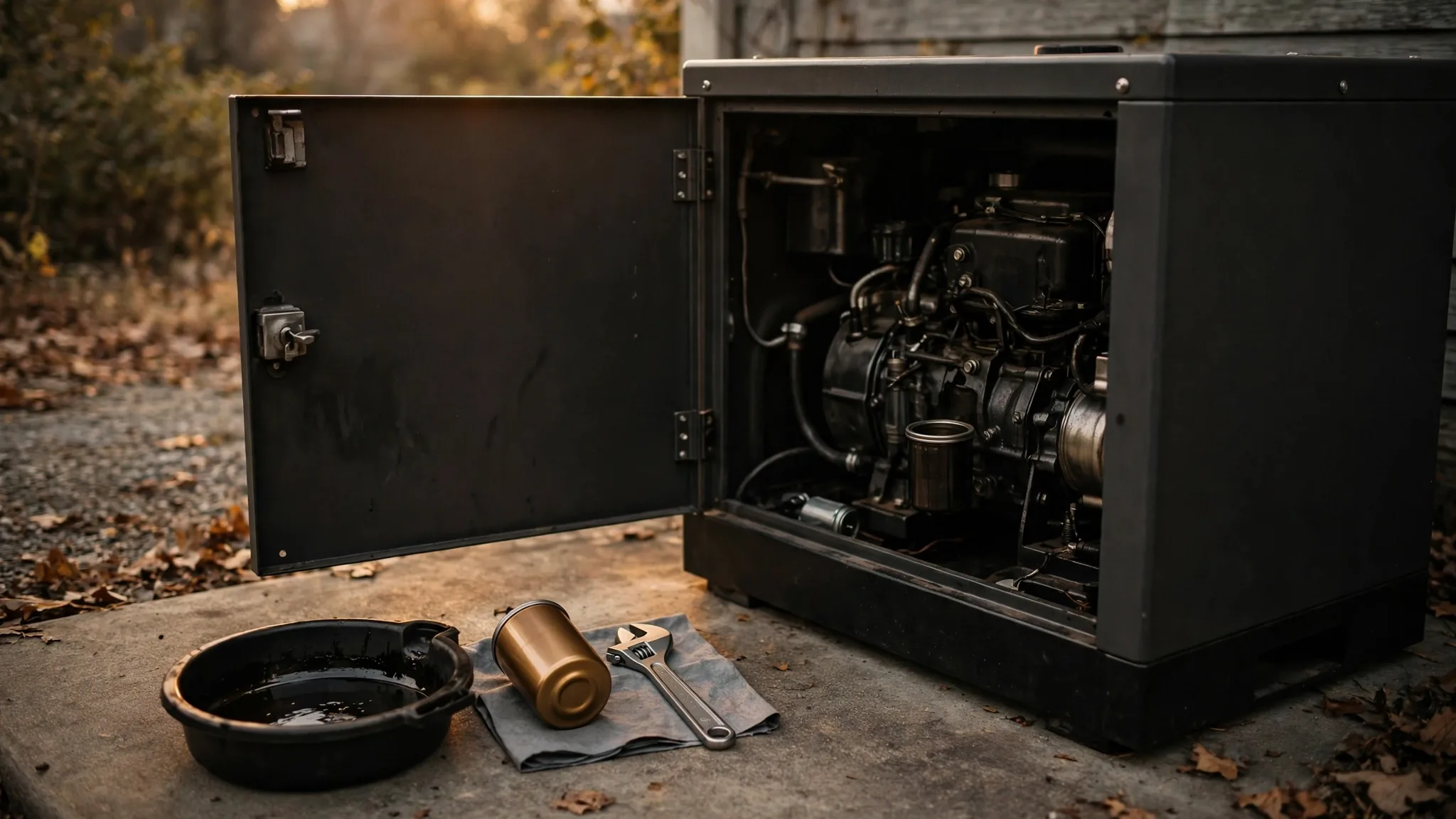
**Quick answer:** Change a Generac standby generator's oil and filter **first at 25 hours** (the break-in change), then **every 200 hours of runtime or every 2 years, whichever comes first** — that's Generac's published maintenance schedule for air-cooled home standby models. The 2-year limit applies even if the generator barely ran: oil degrades in the sump whether the engine turns or not. At the 25-hour change, you also switch oil types — out goes the factory conventional 5W-30, in goes full synthetic (Generac's 5W-20 GEO or 5W-30 synthetic; the full story is in our [Generac generator oil type guide](/articles/generac-generator-oil-type)).
Quick answer: Change a Generac standby generator’s oil and filter first at 25 hours (the break-in change), then every 200 hours of runtime or every 2 years, whichever comes first — that’s Generac’s published maintenance schedule for air-cooled home standby models. The 2-year limit applies even if the generator barely ran: oil degrades in the sump whether the engine turns or not. At the 25-hour change, you also switch oil types — out goes the factory conventional 5W-30, in goes full synthetic (Generac’s 5W-20 GEO or 5W-30 synthetic; the full story is in our Generac generator oil type guide).
Two clocks govern this interval — an hour meter and a calendar — and most owners only know about one of them. This guide explains both, the full Generac maintenance schedule the oil change lives inside, and the situations (marathon outages, exercise-only machines) where the printed schedule needs interpretation.
What is Generac’s official oil change schedule?
Here is the manufacturer’s maintenance schedule for air-cooled home standby generators, with the oil items in context:
| Service item | First time | Then | Why it exists |
|---|---|---|---|
| Oil + oil filter change | 25 hours (break-in) | Every 200 hours or 2 years | Removes break-in metal; then combats wear + moisture |
| Check oil level | — | Monthly, and daily during long runs | Low oil = shutdown or damage |
| Spark plugs: inspect / replace | — | Inspect at 400 hours or 4 years | Ignition reliability |
| Valve clearance check | — | 400 hours or 4 years | Keeps the valve train in spec |
| Air filter replacement | — | 400 hours or 4 years | Airflow and fuel mixture |
| Battery inspection | — | Annually | The #1 cause of no-starts |
The pattern to notice: everything on this schedule is hours-or-years, whichever first. Generac designs for two completely different owners with one schedule — the Florida home whose generator logs 150 hours in a single hurricane season, and the northern home whose unit exercises quietly for years and runs one 6-hour outage. The first owner hits the 200-hour limit; the second hits the calendar limit. Neither gets to skip.
This schedule is also a warranty document in disguise. Generac’s warranty expects documented maintenance, so keep the receipts, the dates, and the hour-meter readings in a log — a notebook in the enclosure beats a memory. Our generator maintenance checklist turns the whole schedule into a season-by-season routine.
Why is there a 25-hour break-in change?
New engines finish machining themselves. During the first hours of operation, piston rings bed into cylinder walls, and the fine metal from that seating process washes into the oil. It is expected, it is harmless if removed on schedule, and it is why the first change comes at 25 hours instead of 200.
Generac pairs this with a specific oil instruction: the unit ships filled with conventional 5W-30, and Generac’s support guidance says do not switch to synthetic until after the initial 25-hour oil change. The factory fill is a sacrificial break-in oil. At the 25-hour service you drain it, change the filter, and refill with the long-term oil — Generac’s full synthetic 5W-20 GEO by the book, or the accepted 5W-30 synthetic alternative, per our oil type guide.
25 hours sounds like a lot of runtime for a standby machine — until you realize a single nasty storm weekend can deliver half of it. Many new installations cross 25 hours in their first year; dealers often bundle the break-in service into the install contract, and it’s worth asking yours whether yours did.
Which clock wins: 200 hours or 2 years?
Both — whichever reaches its limit first. The math explains why the calendar side exists:
- Weekly exercise: Generac’s automatic exercise cycle runs about 5–12 minutes weekly depending on controller settings. That’s roughly 4–10 hours a year — call it a decade to reach 200 hours on exercise alone.
- Outages: A typical home might see 10–40 outage-hours in a year. A bad hurricane or ice-storm year can deliver 100+ hours in a week.
- The sump doesn’t care. Oil sitting in an outdoor enclosure absorbs moisture from condensation cycles, oxidizes, and accumulates acidic compounds — slowly, but on the calendar, not the hour meter. Two-year-old oil with 30 runtime hours on it is still two-year-old oil.
So the exercise-only generator — the most common kind — lives and dies by the 2-year rule, and the storm-belt generator lives by the 200-hour rule. When in doubt, the dealer’s answer is an annual service visit that changes oil and filter every year regardless; it overshoots Generac’s minimum on the calendar side, and it’s what I recommend for anyone who doesn’t want to track an hour meter. At $200–$450 a year for professional annual maintenance (the range from our standby generator cost guide), it’s cheap insurance on a five-figure system.
What about after a long continuous outage?
The schedule assumes ordinary duty. A generator that just ran continuously for 3–5 days under real load has done the hardest work of its life, and I treat that as an interval event on its own:
- During the run: check the oil level daily (these engines can consume oil under sustained load), top up with the same oil type that’s in the sump, and note the hours.
- After the run: if the event consumed 75–100+ hours, change oil and filter afterward even if the tally says 150 of 200 — heat-cycled, load-cycled oil has spent its additive life faster than the raw hours suggest.
- Log it. Write the outage dates and hours in the maintenance record. The next owner, dealer, or warranty claim will thank you.
How do you check the oil between changes?
The interval only protects you if the level stays right between services, and Generac puts level checks on the schedule for a reason — most oil-related shutdowns are level problems, not interval problems. My routine takes two minutes:
- Run the generator briefly first (a manual 5-minute run warms the oil and gives an honest reading), then switch it OFF at the controller and let it sit a few minutes so oil drains back to the sump. Checking immediately after shutdown reads low; checking stone-cold after months of sitting can read misleadingly too.
- Pull the dipstick, wipe, reinsert fully, pull again. The level belongs between the marks — near the top mark is the target on a machine that may run 100 hours unattended.
- Read the oil, not just the level. Darkening over the interval is normal. Milky or frothy oil means moisture contamination — shorten the interval and find out why (an exercise-only machine in a humid climate is the usual story). Gritty oil on the rag means the change is overdue regardless of what the calendar says.
- Top up with the same oil that’s in it — the 5W-20 GEO or 5W-30 synthetic from our oil type guide — never whatever is open in the garage. Mixing a conventional top-up into a synthetic fill quietly downgrades the whole sump.
Log the check with the date and hour-meter reading, same as a change. A generator that starts consuming oil between checks is telling you something early — a level that drops noticeably between monthly checks, on a machine with no visible leak, is worth a dealer’s eyes before storm season, not after.
How much does a Generac oil change cost?
DIY, the parts are modest: roughly 2 quarts of synthetic oil plus a Generac oil filter — typically $25–$45 in parts for an air-cooled model, and 30–45 minutes of your time once you’ve done it once. Dealer service runs $200–$450 for a full annual visit (oil, filter, plugs check, battery test, inspection), which buys you the documentation trail as much as the labor. Either route beats the alternative line item — a replacement engine — by orders of magnitude; a standby unit itself runs $10,000–$15,000 installed at the popular 22kW size, per our Generac generator cost guide. That same battery test is your best defense against Generac error code 1501, since a weak battery that cranks the engine too slowly is the most common trigger for that RPM-sense-loss alarm.
Worked examples: which clock runs out first?
Run the two clocks against three typical ownership patterns and the schedule stops being abstract:
The exercise-only house. A northern home exercises its generator weekly and rides out one short outage a year. At roughly 4–10 exercise hours a year plus a handful of outage hours, the hour meter might read only 25–30 hours when the calendar reaches two years. The 200-hour limit is a decade away — and irrelevant. The 2-year limit governs, because the oil has spent those two years absorbing condensation and oxidizing in the sump. This is the most common pattern in the country, and it is why “my generator barely runs” is never a reason to skip the change. Owners in this pattern are also exactly the ones the annual dealer visit was invented for: at $200–$450 a year from our standby generator cost guide, the oil and filter change rides along with the battery test and inspection, and nobody has to remember which clock said what.
The storm-belt house. A Florida home takes 100+ hours in a single hurricane week, on top of its weekly exercise. One more heavy season like it and the meter crosses 200 hours well before two calendar years pass. Here the hour limit governs, and the change happens on runtime — ideally right after the big event, per the 75–100+ hour guidance above, rather than waiting for the tally to finish. Log the storm dates and the meter reading before and after; without them, the next service visit has no way to know the oil’s real age.
The in-between house. A home with 60 logged hours takes a three-day outage — about 72 continuous hours. The tally now reads roughly 132 of 200 hours, so the printed schedule says the oil has life left. The post-outage rule says otherwise: a continuous multi-day run is the hardest service the engine sees, so the change happens now, the outage dates go in the log, and both clocks restart from a known point. That single decision also protects the warranty paper trail, since the log now shows a change ahead of schedule rather than an argument about one that came late. When the two rules point in different directions, follow the one that changes the oil sooner.
The bottom line
First change at 25 hours, then every 200 hours or 2 years, whichever comes first, with the oil-level checks in between — that’s the entire rule, straight from Generac’s published schedule. The owners who get bitten are never the ones who changed oil too often; they’re the ones who watched only the hour meter while the calendar quietly expired their oil, or who skipped the 25-hour break-in change because the machine “was basically new.” Set a recurring date, log every change with the hour reading, and pair this schedule with the right fill from our Generac oil type guide — the two together are the whole oil story for these machines. What that maintenance buys you, in starting reliability when the lights go out, is the entire reason the generator is sitting in your yard. Our natural gas generator guide covers the fuel side of keeping one ready, and the connection guide covers how it reaches your panel.
Frequently asked questions
How often should I change the oil in my Generac generator?
On Generac's published schedule: the first oil and filter change at 25 hours of runtime (the break-in change), then every 200 hours of runtime or every 2 years, whichever comes first. The 'whichever comes first' matters — a standby generator that only exercises and rides out two short outages may take a decade to reach 200 hours, but the oil still gets changed on the 2-year clock because it absorbs moisture and oxidizes sitting in the sump. Most owners find an annual dealer service visit the easiest way to never think about either clock.
Why does a Generac need an oil change at only 25 hours?
Because a new engine is still finishing its own machining. In the first hours, piston rings seat against cylinder walls and microscopic metal from that process ends up suspended in the oil — that's normal break-in wear, and the 25-hour change exists to get it out. It's also why Generac ships the unit with conventional 5W-30 and tells you not to switch to synthetic until this change: the break-in fill is sacrificial. Skipping it doesn't void your engine on the spot, but it leaves the dirtiest oil the engine will ever see circulating for the next 200 hours.
My Generac only runs its weekly exercise. Does the oil really need changing?
Yes — on the calendar, not the hour meter. A weekly exercise cycle of 5–12 minutes adds up to roughly 4–10 hours of runtime a year, nearly all of it at no load, which never gets the oil hot enough to boil off condensed moisture. Standby oil degrades by chemistry, not just mileage: water condensation, oxidation, and acidic byproducts accumulate whether the engine runs or not. That's precisely why Generac's schedule has a 2-year limit alongside the 200-hour one. Exercise-only generators are the case the calendar limit was written for.
Should I change the oil after a long outage?
If the generator ran continuously for several days — say 75–100+ hours in one event — I change the oil afterward even if the 200-hour mark hasn't arrived, and I check the level daily during any multi-day run. Continuous duty is the hardest service these engines see: sustained heat, real load, no rest. At minimum, tally the outage hours honestly against the interval; owners routinely forget a 3-day outage consumed half the oil's service life. And never let the level drop hoping to 'make it to the change' — top up with the same oil that's in it (see our Generac oil type guide) instead.
How do I reset the Generac maintenance reminder after an oil change?
Through the controller, no dealer required. On Evolution controllers, the maintenance reset lives in the Sub Menu; on older Nexus controllers, it's in the Edit menu — Generac's support documentation confirms homeowners can reset the standard maintenance timer themselves (the separate password-protected Dealer menu is for diagnostics, not this). Exact button sequences vary a little by firmware, so follow your controller's on-screen prompts or the owner's manual. Reset it at the change, not when the alarm annoys you — the reminder is your interval record, and resetting it early just lies to the next person servicing the unit.