Natural Gas Generator for Home: Hookup, Costs & Fuel Math
**Quick answer:** A natural gas generator for home backup is a standby (or tri-fuel portable) generator plumbed into your home's existing gas service — no tank, no refills, and the cheapest fuel per hour of any generator fuel. A typical whole-house installation costs **$8,000–$16,000 all-in**, of which the gas hookup itself is usually **$700–$2,000**. Once installed, a 22kW unit runs for about **$2.50–$3.50 per hour** at half load and can run indefinitely, as long as the utility gas supply holds. Below: how the system actually works, what the hookup requires (pipe size, meter capacity, licensed plumber, permits), the full cost picture, and the limits nobody puts in the brochure.
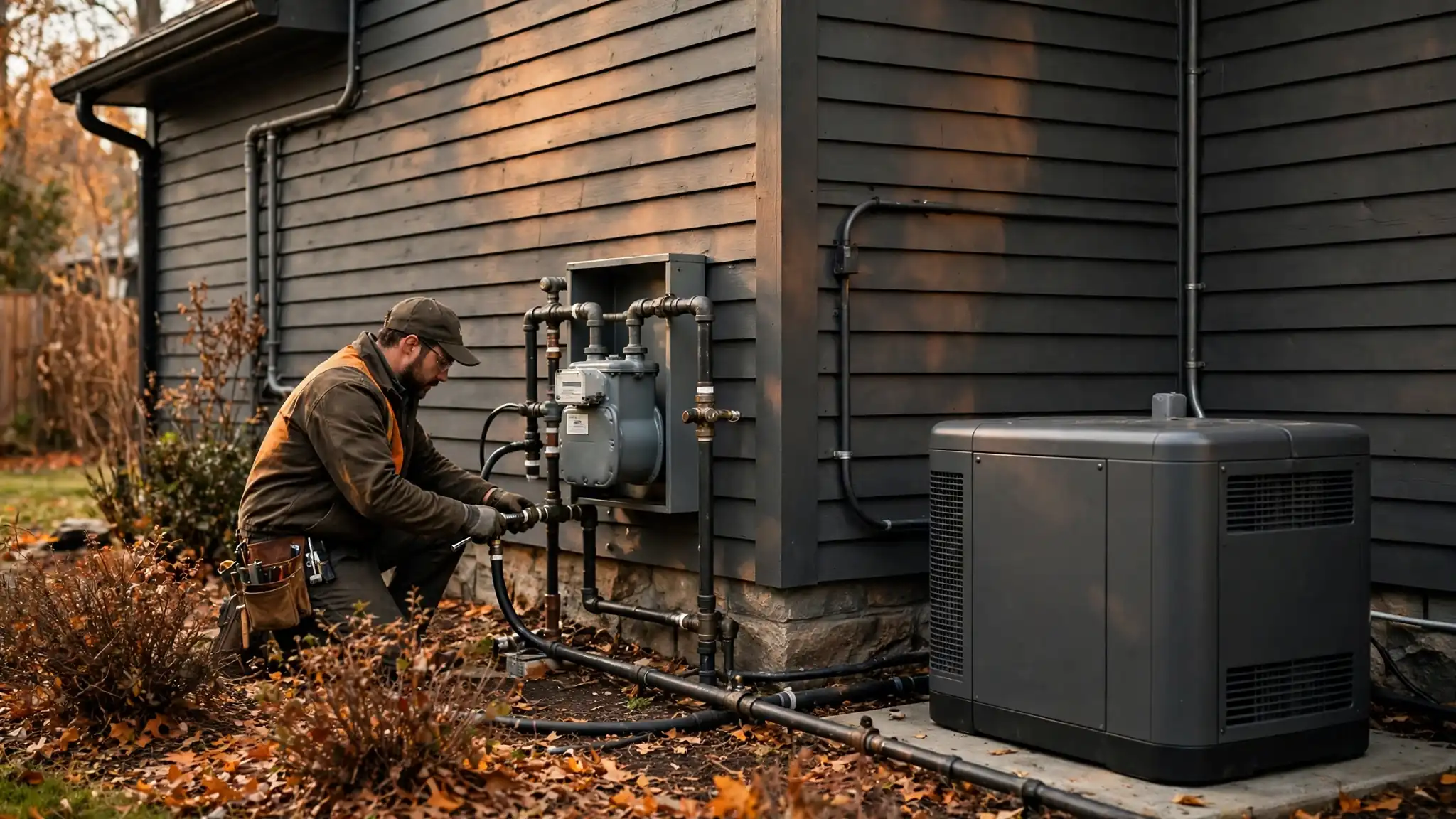
Quick answer: A natural gas generator for home backup is a standby (or tri-fuel portable) generator plumbed into your home’s existing gas service — no tank, no refills, and the cheapest fuel per hour of any generator fuel. A typical whole-house installation costs $8,000–$16,000 all-in, of which the gas hookup itself is usually $700–$2,000. Once installed, a 22kW unit runs for about $2.50–$3.50 per hour at half load and can run indefinitely, as long as the utility gas supply holds. Below: how the system actually works, what the hookup requires (pipe size, meter capacity, licensed plumber, permits), the full cost picture, and the limits nobody puts in the brochure.
Natural gas is the default fuel for residential standby power in the US — most Generac, Kohler, and Cummins home units leave the factory ready to run on it. If your house already has a gas meter on the wall, you’re most of the way there. What follows is the homeowner’s version of the story: not a brand comparison, and not the gas-vs-propane debate (we settled that in natural gas vs propane for standby generators — read it if you’re still choosing a fuel).
How does a natural gas generator work for a house?
The setup has four parts, and only one of them is the generator.
The generator sits on a pad outside your home, usually near the gas meter and electrical panel. When utility power fails, it starts automatically within about 10 seconds and runs until power returns. Most residential units are air-cooled, 10–26kW, and arrive from the factory jetted for natural gas (the same engine typically runs on propane with a fuel-system adjustment — that’s the installer’s call at setup time).
The automatic transfer switch (ATS) is wired into your main electrical panel. It senses the outage, tells the generator to start, and moves your home’s circuits onto generator power. It’s also what makes the system “automatic” — no extension cords, no one home required.
The gas line is a dedicated run from your gas meter to the generator, sized for the generator’s full-load appetite — which is much larger than most homeowners expect. A 22kW unit draws roughly 280,000–370,000 BTU/hr at full load. For scale, that’s more than a furnace, water heater, and gas range combined.
The utility supply is the quiet advantage. Natural gas arrives through underground pipelines at low pressure and is, for practical purposes, unlimited. There is no fuel level to check before a storm and no delivery truck to schedule after one. The weekly self-test (5–12 minutes) burns about 15–30 cubic feet — roughly $0.25–$0.50 a week.
One number to know before you fall in love with a model: generators make about 10–15% less power on natural gas than on propane. A “22kW” Generac is a 22kW machine on propane and about 19.5kW on natural gas. Size on the natural gas rating, not the headline.
Natural gas vs gasoline vs propane for home backup
Same job — keeping a house alive during an outage — three very different fuel logistics:
| Factor | Natural gas | Propane | Gasoline |
|---|---|---|---|
| Fuel cost per hour (22kW standby / comparable portable at half load) | $2.50–$3.50 | $5–$9 | $3.50–$6 (portable, per hour of similar load) |
| Fuel storage | None — utility pipeline | On-site tank (250–1,000 gal) | Cans / portable tank; ~5–20 gal practical |
| Runtime limit | Unlimited while gas service is up | ~4–7 days on a 500-gal tank | Hours per tank; refuel hot engine = fire risk |
| Hookup needs | Dedicated gas line + meter capacity check + permits | Tank, pad, setbacks, regulator, gas line | None (but a transfer inlet is strongly advised) |
| Fuel goes stale? | Never | Never | Yes — 3–6 months untreated; carburetor gum |
| Power output | ~10–15% derate vs propane rating | Full rated power | Full rated power (portables) |
| Automatic whole-house? | Yes (standby) | Yes (standby) | No — portables are manual |
The short version: natural gas wins on running cost and convenience, propane wins on independence from utilities, and gasoline only makes sense for portables you use a few hours a year. We do the full head-to-head, including cold-weather behavior and outage reliability, in natural gas vs propane for standby generators.
What does the hookup require?
This is the part that separates a natural gas install from dropping a portable in the driveway. Four requirements, in the order your installer will check them.
1. A dedicated gas line, sized for the generator
The generator gets its own line from the meter — never teed off an undersized branch. Line size is driven by the generator’s full-load demand and the distance from the meter: typical residential practice is a ¾” line for a 10kW unit, 1” for 14kW, and 1”–1¼” for 20–22kW, stepping up a size on long runs (30–100 feet) to prevent pressure drop. Undersizing is the classic failure: the generator starts fine, then starves and shuts down the first time it takes a real load. Line work runs $12–$25 per linear foot installed, or roughly $500–$1,500 for a typical 20–50 foot run — more with trenching or difficult routing.
2. A gas meter that can feed it
Most standard residential meters are rated around 250 cubic feet per hour (~250,000 BTU/hr). A 22kW generator alone can demand 310–390 cubic feet per hour at full load — before your furnace, water heater, and stove ask for anything. Your installer performs a gas load calculation; if the total exceeds the meter, the utility upgrades it (typically to a 400-class meter). Utilities often do this free or for $200–$600. If the service line from the street is also undersized, costs climb — confirm capacity before you sign a quote, not after the pad is poured.
3. A licensed plumber or gas fitter
The gas connection is licensed work everywhere that matters. Manufacturers require professional installation to keep the warranty valid, permit inspectors want a license number, and the failure mode of bad gas work is not “it doesn’t run” — it’s leaks, carbon monoxide, and fire. Expect the gas portion to be done by a licensed plumber/gas fitter (sometimes the same firm does electrical too). Budget the connection labor inside the $700–$2,000 hookup figure above.
4. Permits and inspections
Typically two permits: a gas/mechanical permit for the line and regulator, and an electrical permit for the transfer switch and wiring. Fees total roughly $100–$600 in most jurisdictions, followed by a pressure test and final inspection before commissioning. Add your local placement rules: generators must sit a set distance from windows, doors, and fresh-air intakes (manufacturer minimums are often 18 inches from the structure and 5 feet from openings — your local code governs). Skipping permits can void insurance coverage after a fire and will surface at resale.
How much does a natural gas home generator cost?
Two numbers: what the system costs, and what the natural-gas part of it costs.
The whole project. A professionally installed residential standby system runs $8,000–$16,000 including the generator, with the common 22kW whole-house setup at $10,000–$15,000. Equipment-only, a 22kW unit with transfer switch is roughly $6,100–$7,400. The full size-by-size and line-item math — including how Generac, the brand on ~70% of these installs, prices out — is in our Generac generator cost guide.
The gas portion specifically:
| Gas-side item | Typical cost |
|---|---|
| Dedicated gas line (20–50 ft, installed) | $500–$1,500 |
| Regulator, fittings, shutoff, pressure test | $150–$400 |
| Gas meter upgrade (if needed) | $0–$600 |
| Gas/mechanical permit + inspection | $100–$600 |
| Gas-side total | ~$700–$2,000 |
The comparison that matters: choosing propane instead would add a tank ($1,500–$2,500 purchased for 500 gallons) plus its own setbacks and first fill — natural gas is usually $2,000–$4,000 cheaper to install when service already exists. The exception is a home with no gas service at all: bringing a new service from a street main starts around $2,000 and main extensions can run $5,000–$20,000+, which flips the decision to propane or ends it.
Running cost is where natural gas quietly wins forever: at $1.20–$1.80 per therm, a 22kW at half load burns about 2.2 therms per hour — the $2.50–$3.50/hr figure above. A 24-hour outage costs roughly $60–$85 in gas. The same outage on propane is $120–$215.
Worked example: what a three-day outage actually costs
Take the 22kW whole-house setup above, running at half load through a three-day winter outage — furnace cycling, fridge, lights, and well pump, but nobody running everything at once. At about 221 cubic feet per hour, the unit burns roughly 5,300 cubic feet a day, or about 53 therms. At $1.20–$1.80 per therm, that is the same $60–$85 per day the running-cost section gives you, so three days lands around $180–$255 in gas. The same three days on propane, at $120–$215 per 24-hour outage, would run roughly $360–$645. Add the weekly self-test — about $0.25–$0.50 a week, or $13–$26 a year — and the picture is complete: the gas itself is almost never the reason to hesitate. Run the same outage on a smaller 10–14kW unit at $1.50–$2.80 per hour and the three days cost roughly $108–$202 instead — the pattern holds at every size: natural gas turns a multi-day outage from a fuel-logistics problem into a modest utility bill.
What are the honest limits of natural gas backup?
The utility can fail you — rarely, and at the worst moments. Gas networks are buried and grid-independent, so ordinary storms almost never interrupt them. But utilities proactively shut off gas in earthquake-damaged areas, floods can damage the network, and the February 2021 Texas freeze showed that extreme demand events can drop local pressure. Notice the pattern: gas fails in catastrophic, infrastructure-breaking disasters — precisely the ones where backup matters most. Propane in a tank doesn’t care about any of that (it just runs out in 4–7 days instead).
Lower energy density means less power and more volume. The 10–15% derate is real, and a gas system must move a lot of volume through pipes sized for it. There’s no workaround — size the unit and the line for natural gas numbers from the start.
Zero portability. A natural gas standby generator is a fixture of the house. It doesn’t go to a job site, a cabin, or the next house you buy (though it does add resale value in outage-prone areas). If your backup need is occasional and movable, a tri-fuel portable plumbed to a quick-connect gas fitting is the middle path: it can sip natural gas at home through an inlet box, but it still starts by hand and won’t run the whole house.
You’re tied to having gas service. No meter, no natural gas generator — and as noted, adding service can cost more than the generator. Roughly half of US homes have gas service; if yours doesn’t, this whole article is academic and propane is your standby fuel.
Is a natural gas generator right for your home?
Yes, if you already have gas service, your outages are storms and grid failures (not earthquakes or floods), and you want automatic, unlimited-runtime backup at the lowest running cost. That’s most suburban homeowners, and it’s why natural gas is the default.
Rethink it, if you have no gas service (propane wins by default), your disaster planning centers on quakes or floods (propane’s independence), or your outages are two hours a year (a portable and an interlock kit at $2,000–$4,000 solves your actual problem).
If natural gas is your answer, the sequence is: load calculation and sizing first, gas-capacity check second, then three itemized quotes that separate the generator, electrical, and gas work. Our complete home backup power guide walks the whole decision — sizing, fuel, batteries, and budget — in one place.
[END EXTERNAL CONTENT:
Frequently asked questions
Can you run a generator on natural gas at home?
Yes — it's the most common standby setup in the US. Any residential standby generator from Generac, Kohler, or Cummins can be configured for natural gas at installation, and tri-fuel portable generators can also run on it through a quick-connect line and an inlet box. The generator connects to your home's existing gas service through a dedicated line run by a licensed plumber or gas fitter. There's no tank and nothing to refill: the fuel comes straight from the utility pipeline under your street, so as long as gas service is up, the generator can run indefinitely.
How much does it cost to hook up a natural gas generator?
If your home already has gas service, the hookup itself — the gas-side work on top of the generator and electrical installation — typically costs $700–$2,000. A dedicated gas line runs $12–$25 per linear foot installed, so a typical 20–50 foot run lands at $500–$1,500. Permits add $100–$600 depending on jurisdiction. The variable that surprises people is the gas meter: a 22kW generator can draw more than a standard 250,000 BTU/hr residential meter supplies alongside your furnace and stove, so a utility meter upgrade may be needed — often free, sometimes $200–$600.
Do you need a plumber and a permit for a natural gas generator?
Yes to both, in almost every jurisdiction. The gas connection must be done by a licensed plumber or certified gas fitter — manufacturers require licensed installation to keep the warranty valid, and unpermitted gas work is a carbon monoxide and fire risk. Expect a gas/mechanical permit for the line and regulator work plus an electrical permit for the transfer switch, followed by inspections before the system is commissioned. Permit fees typically run $100–$600 total. Your installer usually pulls them as part of the job; confirm that in writing before work starts.
How much does a natural gas generator cost per hour to run?
A 22kW standby generator burning natural gas costs roughly $2.50–$3.50 per hour at half load — about $60–$85 for a full 24-hour outage. The math: the unit burns about 221 cubic feet of gas per hour at half load (327 at full load), and at typical residential prices of $1.20–$1.80 per therm (100 cubic feet), that's $2.20–$3.90 per hour depending on load and your local rate. Smaller 10–14kW units run about $1.50–$2.80 per hour. Per kilowatt-hour produced, natural gas is roughly 40–60% cheaper than propane and 50–70% cheaper than gasoline.
Can the natural gas supply fail during a disaster?
It can, though it's rare. Underground gas networks don't depend on the electric grid and stay pressurized through most storms, hurricanes, and ice events — that's natural gas's big reliability advantage. But service can be interrupted: utilities shut off gas proactively in earthquake-damaged areas to prevent fires, flooding can damage infrastructure, and extreme cold snaps with record demand (the February 2021 Texas freeze is the example everyone cites) have caused localized pressure losses. If your realistic disaster planning centers on earthquakes or floods, a propane tank's independence may matter more than natural gas's convenience.