Generac Generator Cost in 2026: Installed Prices by Size
**Quick answer:** A Generac home standby generator costs **$10,000–$15,000 fully installed** in the most common size (22kW, with automatic transfer switch), and **$8,000–$16,000** across typical residential installs overall. The generator itself — equipment only — runs about **$6,300–$7,400 for a 22kW** depending on whether the transfer switch is bundled. Everything in this guide is a 2025–2026 US market range, checked in October 2026, and the single most important thing to understand is that the online price and the installed price are two different numbers describing two different things.
Quick answer: A Generac home standby generator costs $10,000–$15,000 fully installed in the most common size (22kW, with automatic transfer switch), and $8,000–$16,000 across typical residential installs overall. The generator itself — equipment only — runs about $6,300–$7,400 for a 22kW depending on whether the transfer switch is bundled. Everything in this guide is a 2025–2026 US market range, checked in October 2026, and the single most important thing to understand is that the online price and the installed price are two different numbers describing two different things.
Generac owns roughly 70% of the US residential standby market, so “how much does a standby generator cost” and “how much does a Generac cost” are nearly the same question. Below: prices by size, the full line-item breakdown of where the installation money goes, what it costs to run and maintain one, and an honest verdict on whether it’s worth it.
How much does a Generac generator cost by size?
Generac’s air-cooled Guardian and Next Generation lines run from 10kW to 26kW. The “unit price” column below is the generator bundled with a whole-house automatic transfer switch — the package you’d actually buy — because a standby generator without the switch can’t do its job.
| Generac size | Unit + transfer switch | Fully installed range | Home it fits |
|---|---|---|---|
| 10 kW | $4,000–$4,800 | $7,500–$10,500 | Small home, essential circuits only |
| 14 kW | $4,900–$6,000 | $8,500–$12,000 | Small–mid home with gas heat; load management for AC |
| 18 kW | $5,700–$6,800 | $9,500–$13,000 | Mid-size home, 3-ton central AC |
| 22 kW | $6,100–$7,400 | $10,000–$15,000 | Most 2,000–3,500 sq ft homes — the best-selling size |
| 24 kW | $6,700–$7,900 | $11,000–$16,000 | Larger homes, 4–5 ton AC |
| 26 kW | $7,200–$8,300 | $12,000–$18,000 | Largest air-cooled option; heavy electric loads |
For reference, Generac’s own current catalog lists the newer cellular models with transfer switch at starting MSRPs of $4,619 (10kW), $5,949 (14kW), $6,769 (18kW), $7,369 (22kW), $7,789 (24kW), and $8,219 (26kW). Dealer street prices typically land a few hundred under MSRP; the previous-generation Guardian models still on shelves run a bit less (a Guardian 22kW with switch lists around $6,979).
Two things stand out in the table. First, the installed range is wide — a $5,000 spread on the same 22kW — because installation depends on your house, not the generator (more on that below). Second, stepping up a size costs surprisingly little once you’re paying for installation anyway: the jump from 18kW to 22kW is often only $500–$1,000 on the total project. That tempts people to oversize. Don’t buy capacity you don’t need — an oversized generator costs more to fuel and maintain forever — but do get a real load calculation so you don’t undersize either. Our sizing guide walks through the math.
Why is the installed price nearly double the unit price?
Three reasons, and understanding them will save you from both overpaying and misreading quotes.
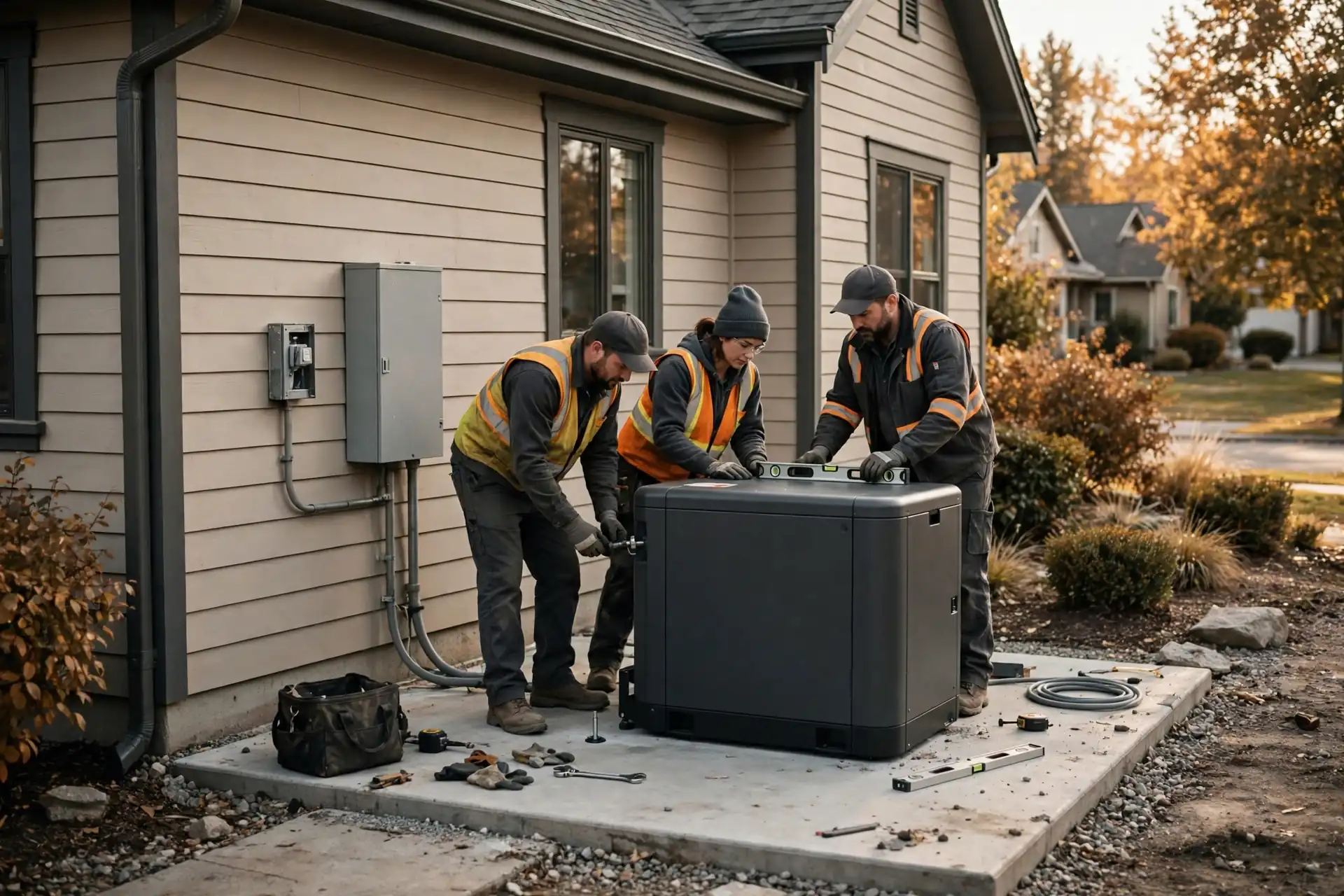
The generator is only about half the project. A standby generator becomes part of your home’s electrical and fuel infrastructure. It needs a transfer switch wired into your main panel, a dedicated gas line sized for a very thirsty appliance (a 22kW unit pulls roughly 280,000–330,000 BTU/hr at full load), a level pad, permits, and inspections. That work is done by licensed electricians and gas fitters, and it costs what skilled trades cost.
Two product generations are on sale at once. Generac sells the older Wi-Fi Guardian models alongside the newer cellular Next Generation models. Both are legitimate; both show up in search results with the same “22kW Generac price” label and prices $400+ apart. Compare model numbers, not headlines.
MSRP is not a quote. The $7,369 on Generac’s site is a starting equipment price. A dealer’s installed quote bundles equipment, materials, labor, permits, and startup/commissioning — and Generac’s own installation guidance puts the finished project at $8,000–$16,000 for most homes. When a quote looks “double the internet price,” it’s usually just honest scope.
What does the installation actually include? A line-item breakdown
Here’s where the money goes on a typical 22kW install — the same breakdown we’d want to see on any quote. (For the brand-neutral version across all standby generators, see our whole house generator cost breakdown.)
| Line item | Typical cost |
|---|---|
| Generac 22kW generator + 200A automatic transfer switch | $6,500–$7,400 |
| Electrical labor and materials (ATS wiring, conduit, control wiring, startup) | $1,800–$3,000 |
| Gas line work (dedicated run, regulator, meter check) | $700–$1,800 |
| Concrete pad or composite base + site prep | $300–$700 |
| Permits and inspection fees | $250–$600 |
| Load-management modules (if your loads require them) | $0–$800 |
| Battery, cold-weather kit, misc. materials | $150–$350 |
| Typical total | $10,500–$14,500 |
A few notes on the line items that surprise people. The transfer switch is sometimes priced separately from the generator ($800–$1,200 for a 200-amp service-rated switch), so confirm whether your quote bundles it. The gas line assumes a reasonably short run from an existing meter with enough capacity; if your meter needs upgrading by the utility, that’s sometimes free and sometimes $200–$600. And permits are not optional padding — most jurisdictions require electrical and gas/mechanical permits, and an unpermitted install can come back to bite you at resale or after an insurance claim.
What makes one quote $3,000 higher than another?
Same generator, same street, wildly different quotes — it happens constantly, and these are the usual causes:
Gas run distance and meter capacity. The biggest single swing factor. A generator placed near the meter with a short run might add $500 of pipe work. A 60-foot trenched run, a meter upgrade, and a second-stage regulator can add $2,500–$3,500. Placement is a cost decision: every foot from the meter and panel is pipe, wire, and labor.
Your electrical panel. A modern 200-amp panel with open space takes the transfer switch cleanly. A full panel, a 100-amp service, or an obsolete fuse box needs a panel upgrade first — $2,000–$4,000 on its own. This is the most common “surprise” line item, and a good installer flags it at the site visit, not mid-job.
Propane instead of natural gas. No gas service? A propane installation adds a tank: $1,000–$2,500 for the tank, pad, and first fill if you buy, or $50–$150/year if you rent from the propane company — plus the same line work.
Your loads. Central AC tonnage, electric water heaters, electric ranges, well pumps, and pool equipment all push sizing and load-management requirements. An all-electric home costs more to back up fully than a gas-heated one.
Local labor rates and permit fees. Labor is roughly half the installed price, so the same 22kW job costs more in New York or California than in Ohio or Texas. Permit fees alone range from $100 to $600+ depending on jurisdiction.
How much does a Generac cost to run?
Cheaper than most people fear. A 22kW Generac on natural gas burns about 221 cubic feet per hour at half load and 311 at full load. At typical residential gas prices, that’s roughly $2.50–$3.50 per hour — about $60–$85 to run a full 24-hour outage, and half that if your loads are light. On propane, the same unit burns roughly 2.5–3.7 gallons per hour, which at $2.00–$2.50/gallon works out to about $5–$9 per hour. Propane’s higher per-hour cost is the real long-term price difference between the two fuels; natural gas also never needs a tank refilled mid-outage.
The weekly self-test (5–12 minutes at low speed) adds a negligible amount — a few dollars a month at most. Fuel only becomes a serious line item in multi-day outages, which is exactly the scenario the generator exists for.
What does Generac maintenance cost per year?
Standby generators are engines, and engines need oil. Generac specifies service after a short break-in period and then at regular runtime intervals (roughly every 100–200 hours) or annually, whichever comes first. In practice:
- Professional annual service: $200–$450. Oil and filter change, spark plugs as needed, battery test, air filter, firmware/controller check, and a full inspection. Dealer maintenance plans in storm-prone regions sit at the higher end and include priority scheduling.
- DIY maintenance: $60–$100 in parts per service (oil, filter, plugs) if you’re comfortable doing it — keep records either way for warranty purposes.
- Battery: $120–$300 every 3–5 years. The most common cause of a no-start is a dead starting battery, not the generator itself.
- Extended warranty: $500–$1,500 for 7–10 year coverage beyond the standard 5-year limited warranty, if you want it.
Add it up over a decade at moderate outage exposure (~50 hours/year): roughly $1,500 in fuel, $2,000–$4,500 in service, and $300–$600 in batteries — call it $4,000–$6,500 of ownership cost over 10 years on top of the install. Anyone budgeting for a Generac should budget for that too. That routine service is also what keeps nuisance alarms away — a neglected battery and overdue service are the usual roots of Generac error code 1501, the RPM-sense-loss alarm that locks a standby out until it’s cleared.
Generac vs. Kohler and Cummins: what does the badge cost?
Generac is the value pick of the three premium brands, but the gap is smaller than the marketing suggests. At the same size, a Kohler (say, the 20–22kW class) typically installs for a few hundred to roughly $1,500 more than a comparable Generac; Cummins prices in the same premium band as Kohler. What the premium buys is mainly a heavier-duty engine reputation, somewhat quieter operation, and corrosion-resistant enclosures — not a different installation, because the electrician, gas line, pad, and permit costs are identical regardless of the badge on the box.
Where Generac claws the advantage back: the largest dealer network in the country, the cheapest and most available parts, and the deepest bench of technicians who know the product. In a widespread outage, service availability matters more than a decibel. We break the three brands down spec by spec in Generac vs Kohler vs Cummins.
Is a Generac generator worth the money? The honest verdict
Yes, if you lose power several times a year or for long stretches, you have a sump pump or well pump (a single flooded basement runs $5,000–$10,000), someone in the house depends on powered medical equipment, or you work from home and outages cost you income. In those cases the 22kW at roughly $11,000–$13,000 installed is the sweet spot of the whole standby market — it’s the best-selling size for a reason — and it will typically return 50–70% of its cost in resale value in outage-prone areas.
No, if your outages are rare and short. Then the honest recommendation is a large portable generator plus an electrician-installed interlock kit or manual transfer switch: $2,000–$4,000 all-in, no permits saga, no annual service contract. You give up automatic start and you have to be home to set it up — read our whole house generator cost guide for that comparison — but spending $12,000 to solve a $200 problem is how people end up resenting a perfectly good generator.
And if you do buy the Generac: get three itemized quotes, insist on a site visit and a written load calculation before the final number, and confirm the quote includes the transfer switch, gas work, pad, and permits. The generator is the easy part — it’s the installation you’re really buying.
Frequently asked questions
How much does a Generac generator cost installed in 2026?
Most homeowners pay $8,000–$16,000 for a professionally installed Generac standby generator, generator included — that's the range Generac itself publishes, and it matches real quotes. The most common setup, a 22kW air-cooled unit with a whole-house transfer switch, typically lands at $10,000–$15,000 installed. Straightforward installs near the panel and gas meter come in at the low end; long gas runs, panel upgrades, or propane tank work push you toward the top. The generator itself is only about half the bill — installation labor and materials are the rest.
How much is a 22kW Generac generator by itself?
Equipment-only, a current 22kW Generac lists at about $6,309 for the generator alone and $7,369 bundled with a 200-amp transfer switch (manufacturer starting MSRP, checked October 2026). The previous-generation Guardian 22kW with switch still sells around $6,979. Dealer street prices run a few hundred below MSRP, and online-only prices sometimes look lower still — but those numbers never include the electrician, gas line, pad, or permits. Budget roughly the same amount again for installation before you have power.
Why do Generac quotes vary by thousands for the same generator?
Because the generator is the only identical part. Everything else is your house: how far the unit sits from the gas meter and electrical panel, whether your gas meter can feed another 300,000 BTU/hr appliance, whether your panel has room for the transfer switch, and local labor rates and permit fees. A 15-foot gas run on a modern 200-amp panel is a one-day job. A 60-foot trenched gas line plus a $2,000–$4,000 panel upgrade is not. Get itemized quotes and the differences explain themselves.
How much does a Generac cost to run and maintain each year?
Fuel is the smaller cost: a 22kW Generac burns about 221 cubic feet of natural gas per hour at half load, which works out to roughly $2.50–$3.50 per hour — call it $60–$85 to ride out a 24-hour outage. Propane costs more, roughly $5–$9 per hour. Maintenance is the predictable cost: budget $200–$450 a year for professional annual service (oil, filters, inspection), or $60–$100 in parts if you do it yourself, plus a $120–$300 battery every 3–5 years.
Is Generac cheaper than Kohler or Cummins?
Usually, yes — at the same size, a Generac typically installs for a few hundred to about $1,500 less than a comparable Kohler, and Cummins prices similarly to Kohler. The installation half of the bill (electrician, gas line, pad, permits) is identical whichever badge is on the enclosure, so the brand gap is purely equipment price and dealer pricing. Generac also has the largest dealer and parts network in the US, which matters more than the badge when you need service during a storm week.