Kohler Generator Cost in 2026: Installed Prices by Size
**Quick answer:** A Kohler home standby generator costs **$10,500–$15,500 fully installed** in the most popular size class (20kW, automatic transfer switch included), and **$7,500–$16,500** across the residential range. Equipment only, Kohler's own starting MSRPs run **$5,098 (14kW) to $7,546 (26kW)**, with switch-bundled packages about $950 higher. Kohler is the premium alternative to Generac — but as the numbers below show, the premium is smaller, and more specific, than the marketing suggests. All figures are 2025–2026 US market ranges, checked October 2026.
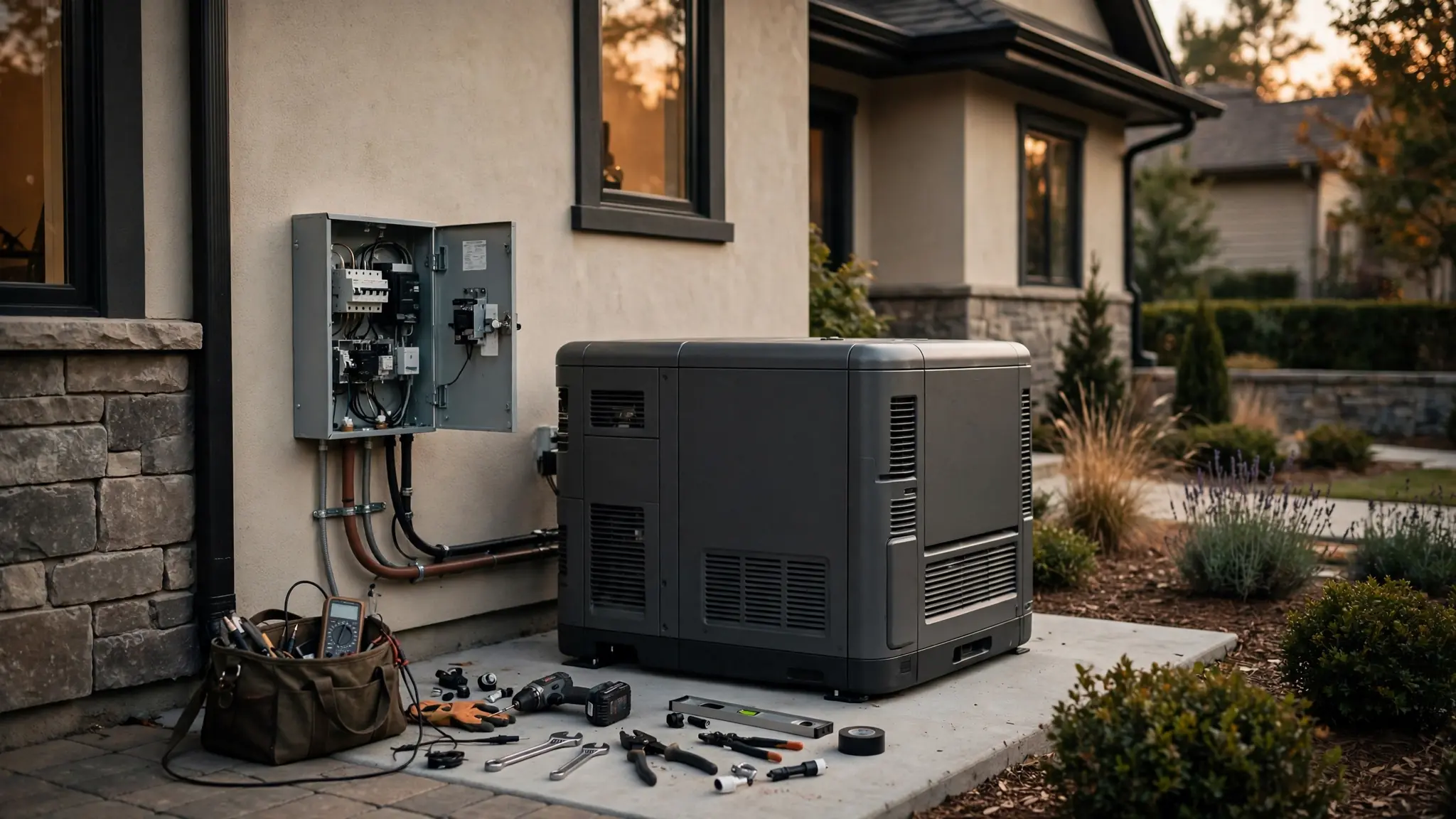
Quick answer: A Kohler home standby generator costs $10,500–$15,500 fully installed in the most popular size class (20kW, automatic transfer switch included), and $7,500–$16,500 across the residential range. Equipment only, Kohler’s own starting MSRPs run $5,098 (14kW) to $7,546 (26kW), with switch-bundled packages about $950 higher. Kohler is the premium alternative to Generac — but as the numbers below show, the premium is smaller, and more specific, than the marketing suggests. All figures are 2025–2026 US market ranges, checked October 2026.
This is the Kohler companion to our Generac generator cost guide. The two brands cover the same houses at similar money, so this guide focuses on where Kohler’s prices actually sit, what the extra money buys, and where Generac still wins. For the brand-neutral view, see our standby generator cost breakdown.
How much does a Kohler generator cost by size?
Kohler’s residential air-cooled line is the RCA series, 10kW to 26kW. A naming note that trips up quote comparisons: models ending in L (20RCAL, 26RCAL) bundle a 200-amp automatic transfer switch; the plain RCA models sell the switch separately. The “unit price” column uses Kohler’s published starting MSRP for the generator (plus the bundled-switch package where that’s the common way it’s sold).
| Kohler size | Unit price (MSRP / street) | Fully installed range | Home it fits |
|---|---|---|---|
| 10 kW (10RESV) | $3,946 MSRP | $7,500–$11,000 | Small home, essential circuits |
| 14 kW (14RCA) | $5,098 MSRP | $9,000–$12,500 | Small–mid home, gas heat, one AC with load management |
| 20 kW (20RCA / 20RCAL) | $6,016 / $6,984 MSRP | $10,500–$15,500 | Most 2,000–3,500 sq ft homes — Kohler’s best seller class |
| 24 kW (24RCA class) | ~$6,800–$7,500 street | $11,500–$16,000 | Larger homes, 4–5 ton AC |
| 26 kW (26RCA / 26RCAL) | $7,546 / $8,515 MSRP | $12,000–$16,500 | Largest air-cooled option; heavy electric loads |
Two reference points on street pricing, because MSRP is not what anyone pays: Norwall lists the 26RCA at about $7,699 and Home Depot and Northern Tool around $7,949, while online dealers list the 20kW RCA around $5,200. Dealer-installed packages then add the same installation block every brand pays — roughly $3,000–$6,000 for the transfer switch work, gas line, pad, permits, and startup (Angi’s national average for the installation job alone is about $4,520).
Read the table the same way you’d read the Generac one: stepping up a size is cheap once the installation is paid for. The jump from 14kW to 20kW is roughly $1,000–$1,500 on the total project. What should decide your row is a load calculation, not a price hunch — our sizing guide walks through it.
What are you actually paying Kohler extra for?
This is the part most Kohler-vs-Generac content gets wrong: at the equipment counter, Kohler is barely more expensive. A 20RCAL with switch lists at $6,984; Generac’s comparable 22kW package lists at $7,369. The premium shows up at the dealer level — Kohler sells through a smaller, more protected dealer network, so installed quotes carry more margin and there’s less discounting pressure. Expect a few hundred to about $1,500 more on the installed total for the same house.
Here’s what that premium buys, concretely:
An aluminum, corrosion-proof enclosure. Generac’s enclosures are powder-coated steel (their higher trims use aluminum). Kohler’s RCA line is aluminum across the board and marketed as corrosion-proof — a genuine advantage in coastal and road-salt climates, where enclosure rust is a real failure mode at year 10–15.
Motor-starting muscle (PowerBoost). Kohler rates the 20RCA at 41 kVA of peak motor-starting capacity and the 26RCA at 39 kVA — strong numbers for starting big AC compressors and well pumps without the voltage sag that browns out electronics. If your load list is motor-heavy, this is the spec that matters most, and Kohler plays it well.
A quieter weekly exercise. The 26RCA exercises at a rated 56 dB(A) against 67 dB(A) at full speed; the 20RCA runs about 69 dB(A) at full load. Neither brand is quiet at full song, but Kohler’s low-speed exercise mode is the one neighbors notice less.
One honest counterweight: Generac’s dealer and parts network is several times larger. In a regional outage, the brand with a technician on your street beats the brand with the better enclosure. Check which dealers actually serve your ZIP code before the badge decides anything. We spec the two brands head-to-head in Generac vs Kohler vs Cummins.
What does the installation include? The line items
Brand changes nothing here — the work is identical to a Generac install, item for item:
| Line item | Typical cost |
|---|---|
| Kohler 20RCAL generator + 200A automatic transfer switch | $6,300–$7,000 |
| Electrical labor and materials (ATS wiring, conduit, startup) | $1,800–$3,000 |
| Gas line work (dedicated run, regulator, meter check) | $700–$1,800 |
| Concrete pad or composite base + site prep | $300–$700 |
| Permits and inspection fees | $250–$600 |
| Battery, cold-weather kit, misc. materials | $150–$350 |
| Typical total | $10,500–$14,500 |
The swing factors are the same three as always: gas-run distance and meter capacity, your panel’s condition (a needed panel upgrade adds $2,000–$4,000), and propane instead of natural gas (a bought tank adds $1,000–$2,500). A quote that’s $3,000 above another for the same Kohler is a quote about your house, not about the generator — get it itemized and the difference explains itself.
How much does a Kohler cost to run and maintain?
Fuel. Kohler publishes consumption on its spec sheets, and the RCA line is competitive: the 14RCA burns about 124 cubic feet of natural gas per hour at half load, the 20RCA about 161, the 26RCA about 180. At typical residential gas prices that’s roughly $2–$3.50 per hour — $50–$85 to ride out a 24-hour outage, depending on size and load. Propane runs roughly $5–$9 per hour at meaningful loads, the same math as every brand.
Maintenance. Identical regime to Generac: professional annual service runs $200–$450 (oil, filters, plugs as needed, battery test, inspection), DIY parts run $60–$100, and a starting battery costs $120–$300 every 3–5 years. Kohler’s standard coverage is a 5-year limited warranty, matching Generac’s base term. Budget roughly $4,000–$6,500 of ownership cost over 10 years on top of the install at moderate outage exposure — the same honest number as the Generac guide, because the ownership math barely notices the badge.
How much does a Kohler cost per kilowatt?
Run the sanity check we use on every standby quote in our standby generator cost guide: divide the installed total by the kilowatts. A Kohler 20kW installed at $10,500–$15,500 works out to roughly $525–$775 per kW; the 26kW at $12,000–$16,500 lands around $460–$635 per kW; the 14kW at $9,000–$12,500 runs $640–$890 per kW. The pattern is the same one Generac shows — bigger machines cost less per kilowatt because the fixed installation block (switch, gas line, pad, permits) barely changes with size.
Two uses for this math. First, it exposes padded quotes: a standard 20kW Kohler install quoted at $900+/kW needs a site condition to justify it (panel upgrade, propane tank, a long trench) — if the dealer can’t name one, the number is margin. Second, it explains why stepping up a size is usually smart money: moving from 14kW to 20kW adds roughly $1,500 to the project but cuts the per-kW cost by about a quarter, and the extra capacity is headroom you’ll want the first time the AC starts while the well pump is running. Per-kW is a quote-checking tool, never a sizing tool — the load calculation still picks the size.
Worked examples: what three buyers actually pay
The 14kW on an easy site. A small home with gas heat, a short gas run, and a modern panel buys the 14RCA at its $5,098 MSRP starting point. Add the low ends of the installation table above — electrical work near $1,800, gas work near $700, a $300 pad, $250 in permits, and $150 of battery and miscellaneous materials — and the project lands around $9,000–$9,500, the low end of the $9,000–$12,500 installed range for this size. Nothing about the quote is discounted; the site is simply cheap to work on.
The typical 20kW. This is the table above, lived: a 20RCAL package at $6,300–$7,000, electrical at $1,800–$3,000, gas at $700–$1,800, pad, permits, and materials on top — $10,500–$14,500 all-in, inside the $10,500–$15,500 installed range. Most Kohler quotes in America look like this one, and the generator itself is only about half the check you write.
The 26kW with one complication. Start from street pricing — the 26RCA around $7,699 at Norwall or $7,949 at Home Depot, with the switch-bundled 26RCAL listing at $8,515 MSRP — then give the house a long gas run and a panel that needs work. The installation block climbs past its usual $3,000–$6,000, a needed panel upgrade alone adds $2,000–$4,000, and the project walks to the top of its $12,000–$16,500 installed range or just beyond it. The lesson repeats the one from the line-item table: the complication costs more than the flagship generator’s premium over the 20kW ever did.
The same 20kW, ten years on. Ownership decides whether the install price was the real price. Add the decade math from the running-cost section — professional maintenance at $200–$450 a year, a battery at $120–$300 every 3–5 years, and fuel at roughly $2–$3.50 an hour on natural gas — and the guide’s $4,000–$6,500 ten-year ownership figure takes the all-in decade cost of that typical 20kW to roughly $14,500–$21,000. That total, not the install quote, is the honest number to compare against a Generac quote built the same way — and built the same way, the two brands land within the same few-hundred-to-$1,500 gap the equipment prices predict. Three different houses, three different totals — and in each one, the generator itself was the predictable half of the bill; the site wrote the rest.
Kohler or Generac: which should you buy?
Buy the Kohler if you’re in a coastal or corrosive environment (that aluminum enclosure is a real 10-year advantage), your loads are motor-heavy and you want the PowerBoost starting capacity, a strong Kohler dealer serves your area, or the quieter exercise cycle matters because the unit sits near a bedroom or a neighbor’s fence line.
Buy the Generac if budget is the first filter (street-level discounting is deeper and quotes come in lower more often), you want the deepest possible service network for storm-week repairs, or you’re comparing at the 22–24kW size where Generac’s package pricing is most aggressive.
Either way: get three itemized quotes with a written load calculation, confirm the transfer switch is in the number, and ask who performs warranty service locally and how fast they respond during outages. The installer matters more than the badge — a meticulous Kohler install and a sloppy Generac install are not the comparison the brochures want you to make. Start from the full field in our standby generator cost guide, then decide.
Keep reading
Frequently asked questions
How much does a Kohler generator cost installed in 2026?
Most homeowners pay $10,500–$15,500 for a professionally installed Kohler standby generator in the popular 20kW class, transfer switch included in most dealer packages. Smaller 10–14kW systems land around $7,500–$12,500 installed, and the 26kW flagship runs $12,000–$16,500. The generator itself is roughly half the bill — Kohler's own MSRP for a 20kW with switch is $6,984 — and the rest is the electrician, gas line, pad, and permits, which cost the same for any brand.
How much is a 20kW Kohler generator by itself?
Equipment only, Kohler lists the 20RCA at a starting MSRP of $6,016 with the transfer switch sold separately, and the 20RCAL package — same generator with a 200-amp automatic transfer switch bundled — at $6,984. Dealer and big-box street prices run below MSRP: I've seen the 20kW listed around $5,200 at online dealers and the 26RCA around $7,700–$7,950 at Norwall and Home Depot. None of those numbers include installation, which typically adds $3,000–$6,000.
Is a Kohler generator worth the premium over Generac?
Sometimes. On paper the equipment gap is small — a Kohler 20RCAL with switch lists at $6,984 against $7,369 for a comparable Generac 22kW package — but dealer-installed Kohler quotes typically land a few hundred to about $1,500 higher overall. What you get for it: an aluminum corrosion-proof enclosure, strong motor-starting capacity (41 kVA on the 20kW), and a quieter weekly exercise. If you live on the coast or your dealer network is Kohler-strong, it's money well spent. If budget rules, Generac's larger service network wins.
How long does a Kohler home generator last?
A maintained air-cooled Kohler is a 20-plus-year machine in typical standby duty — most homes rack up only 50–200 run hours a year between outages and weekly exercise, and the engines are rated in thousands of hours. Kohler backs the RCA line with a 5-year limited warranty. Longevity comes down to maintenance discipline: annual oil, filters, and plugs ($200–$450 professionally), a battery every 3–5 years, and prompt attention to fault codes. Neglected standby generators of any brand die young; serviced ones routinely outlive two roofs.
How much does a Kohler generator cost to run?
On natural gas, a 20kW Kohler burns about 161 cubic feet per hour at half load per Kohler's spec sheet — roughly $2–$3 per hour at typical residential gas prices, or $50–$75 to ride out a 24-hour outage. The 26kW burns about 180 cubic feet per hour at half load. Propane costs more per hour, roughly $5–$8, because the same unit burns around 2 gallons an hour at meaningful loads. The weekly 10-second-to-few-minutes exercise cycle adds only a few dollars a month.