Standby Generator Cost in 2026: Installed Prices by Size
**Quick answer:** A home standby generator costs **$9,500–$15,000 fully installed** for the sizes most homes buy (14–22kW, automatic transfer switch included), and **$7,000–$18,000** across the full air-cooled residential range. The most common single setup — a 22kW-class unit wired to cover the whole house — anchors at **$10,000–$15,000 installed**. The generator itself is only about half the bill; installation is the other half, and that's true for every brand. All figures here are 2025–2026 US market ranges, checked in October 2026.
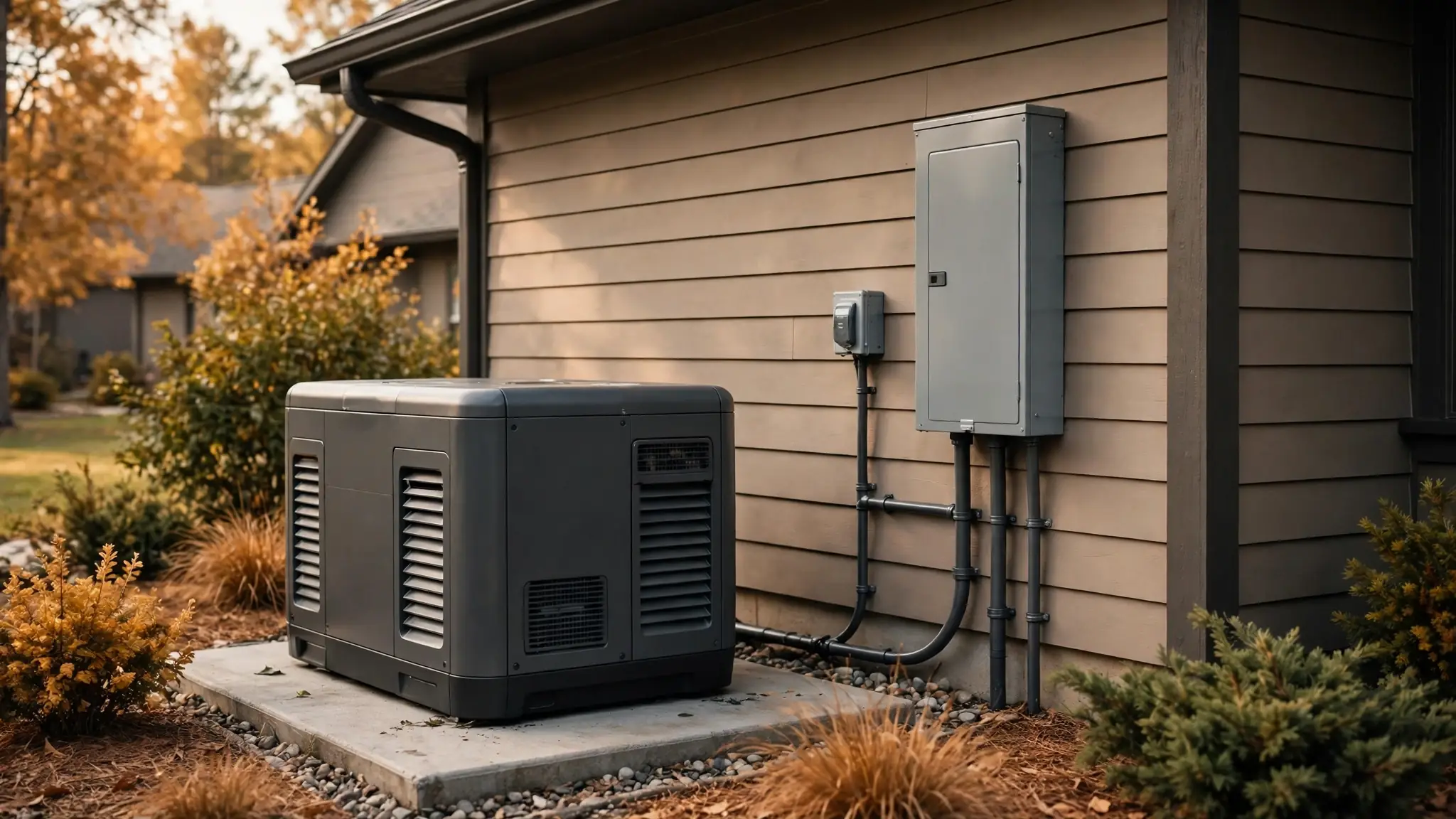
Quick answer: A home standby generator costs $9,500–$15,000 fully installed for the sizes most homes buy (14–22kW, automatic transfer switch included), and $7,000–$18,000 across the full air-cooled residential range. The most common single setup — a 22kW-class unit wired to cover the whole house — anchors at $10,000–$15,000 installed. The generator itself is only about half the bill; installation is the other half, and that’s true for every brand. All figures here are 2025–2026 US market ranges, checked in October 2026.
This is the brand-neutral version of the standby cost question. Generac owns roughly 70% of the US residential market, so Generac prices anchor the tables — but Kohler, Cummins, Briggs & Stratton, and Champion all sell into the same sizes, and their installed prices sit closer together than the marketing implies, because the installation half of every quote is brand-independent. If you’re shopping one brand specifically, start with our Generac generator cost guide; this page is for comparing the whole field.
How much does a standby generator cost by size?
Standby generators are priced by kilowatts, and the residential air-cooled range runs 10–26kW. The “unit + switch” column is the generator bundled with a whole-house automatic transfer switch — the package you actually buy, since a standby without the switch can’t do its job.
| Standby size | Unit + transfer switch | Fully installed range | Home it fits |
|---|---|---|---|
| 10 kW | $3,800–$5,000 | $7,000–$10,500 | Small home, essential circuits only |
| 14 kW | $4,500–$6,000 | $8,000–$12,000 | Small–mid home with gas heat; load management for AC |
| 18 kW | $5,200–$6,800 | $9,000–$13,000 | Mid-size home, 3-ton central AC |
| 22 kW | $5,800–$7,500 | $9,500–$15,000 | Most 2,000–3,500 sq ft homes — the best-selling class |
| 24 kW | $6,300–$8,000 | $10,500–$16,000 | Larger homes, 4–5 ton AC |
| 26 kW | $6,800–$8,500 | $11,500–$18,000 | Largest air-cooled option; heavy electric loads |
Two patterns matter more than any single row. First, installation is a nearly fixed cost: the transfer switch, gas line, pad, permits, and labor run roughly $3,000–$6,000 whether the box on top of them is 14kW or 26kW. That’s why the installed gap between sizes ($1,000–$3,000) is so much smaller than the capability gap. Second, the wide ranges are real — a $5,000 spread on the same 22kW — because houses differ, not because dealers invent numbers (the drivers are itemized below).
The cost-per-kW check. Divide a quote by the kilowatts and you get a quick sanity metric. Installed, a 22kW lands around $450–$700 per kW; a 10kW runs $750–$1,050 per kW, because the fixed installation cost is spread over fewer kilowatts. If a quote prices a standard install far above $700/kW at 22kW, ask what site condition justifies it — sometimes one does (panel upgrade, propane tank), and sometimes nothing does.
Above 26kW the residential market changes character. Liquid-cooled standby generators (30kW and up, running slower 1,800 RPM automotive-style engines) start around $12,000–$20,000 for the unit and land at $20,000–$35,000+ installed. They run quieter, tolerate longer continuous duty, and suit large or all-electric homes — but for a standard 2,500 sq ft house with gas heat, a dealer pushing liquid-cooled is usually upselling, not solving a problem. The air-cooled table above is where nearly every residential quote belongs.
Sizing still comes before pricing. Every number above assumes the generator matches your loads; our sizing guide walks through the load calculation that decides which row of this table is yours.
How much do the brands cost? Generac vs. Kohler vs. Cummins vs. the rest
Same size, same house, different badge — here’s what the 22kW class (20–22kW depending on brand lineup) typically costs installed on natural gas with a 200-amp transfer switch:
| Brand (22kW class) | Typical installed range | What you’re paying for |
|---|---|---|
| Generac | $10,000–$15,000 | The value benchmark; largest dealer and parts network in the US |
| Kohler | $11,000–$15,500 | A few hundred to ~$1,500 premium; quieter, corrosion-proof composite enclosure, strong engines |
| Cummins | $11,000–$16,000 | Premium band like Kohler; very quiet (about 65 dBA), commercial-grade engines, smaller dealer network |
| Briggs & Stratton | $10,000–$14,500 | Generac-level pricing with a 7-year comprehensive warranty (parts, labor, travel) |
| Champion (14kW max) | $8,000–$11,500 | The budget pick; tops out at 14kW, 10-year limited warranty, thinner dealer coverage |
The honest summary: brand moves the total by hundreds, installation moves it by thousands. The electrician, gas fitter, pad, and permits cost the same for every row in that table. What the premiums actually buy is quieter operation, enclosure materials, warranty structure, and dealer depth — real differences, but not different installation math. We spec the big three head-to-head in Generac vs Kohler vs Cummins.
One warning about hunting quotes online: equipment-only prices ($5,800–$7,500 for a 22kW with switch) are what search results advertise, and they never include installation. Compare installed quotes to installed quotes, itemized the same way.
What does the installation itself cost?
Angi’s national data averages about $4,520 for the installation job alone — permits, placement, wiring, and startup, generator not included. Here’s how that money breaks down on a typical project:
| Line item | Typical cost |
|---|---|
| Automatic transfer switch (if not bundled with the generator) | $700–$1,800 |
| Electrical labor and materials (ATS wiring, conduit, control wiring, startup) | $1,800–$3,500 |
| Gas line work (dedicated run, regulator, meter check) | $800–$2,500 |
| Concrete or composite pad + site prep | $300–$900 |
| Permits and inspection fees | $150–$800 |
| Load-management modules (if your loads require them) | $0–$800 |
| Typical installation total | $3,000–$6,000 |
The two swing items are the gas run and your electrical panel. A short gas run from a meter with spare capacity is a few hundred dollars of pipe; a 60-foot trenched run with a meter upgrade can add $2,500–$3,500. A modern 200-amp panel takes the transfer switch cleanly; a full or obsolete panel needs a $2,000–$4,000 upgrade before the generator work even starts. Propane instead of natural gas adds a tank — $400–$1,800 for the tank itself, up to $2,500 with pad and first fill if you buy rather than rent. None of these are padding; they’re the difference between a quote written from a site visit and one written from a phone call.
What else moves the total?
Beyond the gas run and the panel, four quieter factors separate a low quote from a high one:
Placement and code setbacks. Standby units must sit a code-defined distance from windows, doors, and fresh-air intakes (typically 5 feet) and at least 18 inches off the house wall. If the only legal spot is across the yard, every extra foot is trenching, conduit, and gas pipe you pay for — rock or concrete in the way adds more.
Retrofit vs. new construction. Dropping a standby into a house under construction, with open walls and trades already on site, can shave $1,000–$2,000 off the same system retrofitted into a finished home.
Options stacked on top. Cold-weather kits ($200–$400), cellular monitoring plans, extended warranties ($500–$1,500 for 7–10 years), and premium enclosures all arrive as separate lines. None are scams; together they quietly add $1,000–$2,500 to a “base” quote.
Regional labor. Labor is roughly half the installed price, so identical projects price differently by market — the same 22kW job commonly runs 15–25% more in the Northeast or coastal California than in the Midwest or Southeast.
How much does a standby generator cost to run and maintain?
Ownership costs are predictable and, next to the install, small:
Fuel. A 22kW unit on natural gas burns roughly 221 cubic feet per hour at half load — about $2.50–$3.50 per hour, or $60–$85 for a 24-hour outage. On propane, expect $5–$9 per hour. Angi’s running-cost data for the 16–22kW class spans $30–$220 per day depending on load and fuel, which brackets the same reality: a lightly loaded gas unit sipping through an outage is cheap; a fully loaded propane unit in a three-day storm is not. The weekly self-test costs a few dollars a month either way. Fuel only becomes a real line item in multi-day outages — the exact scenario the generator exists for.
Maintenance. Standby generators are engines: oil, filters, and plugs on an annual or runtime-based schedule. Professional annual service runs $200–$450 (HomeGuide’s range tops out near $650 for dealer plans); DIY parts are $60–$100. The starting battery — the number-one cause of no-starts — costs $100–$300 every 3–5 years.
Ten-year math. At moderate outage exposure (~50 hours a year), expect roughly $1,500 in fuel, $2,000–$4,500 in service, and $300–$600 in batteries over a decade: $4,000–$6,500 of ownership cost on top of the install. Budget for it when you budget for the generator.
Standby generator vs. whole house generator: is the price different?
No — because they’re the same hardware, and the two terms describe different things. Standby is the category: a permanently installed generator that starts automatically when the grid fails. Whole house is a coverage promise: a system sized and load-managed to run everything in the home. Every whole house generator is a standby generator; not every standby generator is set up for whole-house coverage.
The price follows the coverage, not the word. An essential-circuits standby — 10–14kW backing up the fridge, furnace, well pump, and a few circuits — installs for $7,000–$12,000. A whole-house configuration at 22–26kW with load management runs $9,500–$18,000. If a quote uses “whole house” to justify a premium over a same-size standby quote, that premium is marketing, not equipment.
Our whole house generator cost breakdown goes deeper on reading quotes line by line and spotting padding; this guide is the map, that one is the magnifying glass.
Worked example: why two quotes for the same 22kW differ by $4,000
Take two itemized quotes for the same 22kW-class generator on natural gas. The first house has a modern 200-amp panel and a meter with spare capacity a short run from the pad: the gas work prices as a few hundred dollars of pipe inside the standard $3,000–$6,000 installation block, and the project lands near the low end of the $9,500–$15,000 installed range. The second house needs a 60-foot trenched gas run with a meter upgrade — $2,500–$3,500 on its own — plus a $2,000–$4,000 panel upgrade before the generator work starts. Same generator, same switch, roughly $4,000–$5,000 more, and every extra dollar is in the site work, itemized where you can see it. That is the comparison to demand from any dealer: not a lower total, but the line items that explain the total.
The bottom line
Budget $9,500–$15,000 installed for a mainstream standby generator in the 14–22kW class, from any of the major brands. One timing note: quotes and wait times both climb in the weeks after a major storm, when every dealer in the region is booked out — the same system bought in a calm season is often scheduled faster, and occasionally priced keener, than one bought in a panic. Pick the brand on dealer quality, warranty structure, and noise — the installed prices overlap too much for brand to be a money decision. Pick the size from a written load calculation, not a guess. And judge every quote by its line items: the generator is the commodity, the installation is the purchase, and the gap between a $10,000 quote and a $15,000 quote for the same box is almost always sitting in the gas run, the panel, and the permits.
Frequently asked questions
How much does a standby generator cost to install?
Installation alone — electrician, gas line, pad, permits, and startup, not counting the generator — typically runs $3,000–$6,000, and Angi's national data puts the average install job at about $4,520. Add the generator and transfer switch and most homes land at $9,500–$15,000 fully installed for a 14–22kW system. Short gas runs on a modern 200-amp panel price at the low end; long trenches, panel upgrades, and propane tank work push a project toward $18,000 or beyond.
How much does a standby generator cost per kW?
On an installed basis, roughly $450–$700 per kW at the popular 22kW size, and $750–$1,050 per kW at 10kW — the per-kW price falls as the generator grows because the installation half of the bill (transfer switch, gas line, permits, labor) barely changes with size. Equipment-only, a 22kW-class generator with transfer switch works out to about $260–$340 per kW. Per-kW math is a useful sanity check on quotes, but never size a generator by it — a load calculation decides the size, and the per-kW figure follows from that.
How much does standby generator maintenance cost per year?
Budget $200–$450 a year for professional annual maintenance — oil and filter change, spark plugs, battery test, and a full inspection — with some dealer plans and high-cost regions reaching $650. Angi's data puts a typical service visit at $171–$395. If you do the work yourself, parts run $60–$100 per service, but keep records: most warranties require documented maintenance. Add a $100–$300 starting battery every 3–5 years. Skipping service is the classic false economy — most no-starts trace back to neglected oil or a dead battery.
Is a standby generator the same price as a whole house generator?
Yes — they are the same machine. 'Standby' describes how the generator works (permanently installed, starts automatically); 'whole house' describes how much of your home it covers. A standby unit sized with load management to run the whole house costs exactly what any same-size standby costs. Where the terms diverge in price is coverage: an essential-circuits standby at 10–14kW installs for $7,000–$12,000, while a true whole-house setup at 22–26kW runs $9,500–$18,000. Same hardware family, different size and scope.
Which standby generator brand is cheapest: Generac, Kohler, or Cummins?
Generac, in most quotes. At the 22kW class, a Generac typically installs for $10,000–$15,000, a comparable Kohler for $11,000–$15,500, and a Cummins for $11,000–$16,000 — a brand gap of a few hundred to about $1,500, because the installation half of the bill is identical whichever badge is on the enclosure. Briggs & Stratton prices close to Generac and counters with a 7-year comprehensive warranty; Champion undercuts everyone but tops out at 14kW. Generac also has the largest dealer and parts network, which matters when you need service in a storm week.