How to Connect a Generator to Your House: 3 Legal Ways
**Quick answer:** There are exactly three legal ways to connect a generator to your house's wiring, and they rank like this: **(1) a power inlet box with an interlock kit — $600–$1,200 installed** — the best value for a portable generator; **(2) a manual transfer switch — $800–$1,500 installed** — pre-selected circuits, one flip; **(3) a standby generator with an automatic transfer switch — $8,000–$16,000 for the whole project** — fully automatic, nothing for you to do. Running extension cords from the generator straight to individual appliances is also legal and costs nothing to install — it just doesn't power your house wiring. Everything else you've seen on the internet — dryer outlets, wall outlets, double-ended cords — is backfeeding, and it's illegal and dangerous. Details on each method below.
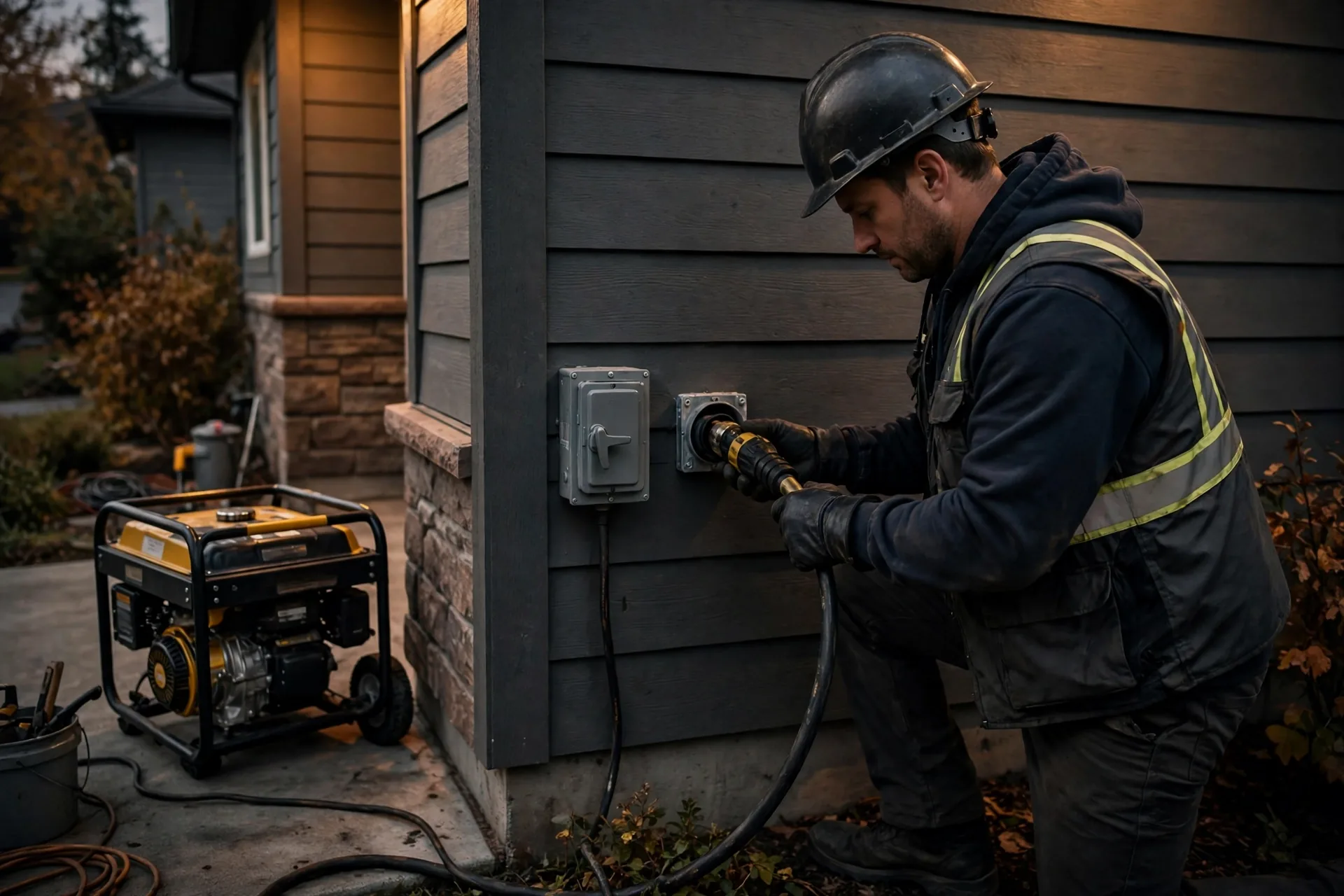
Quick answer: There are exactly three legal ways to connect a generator to your house’s wiring, and they rank like this: (1) a power inlet box with an interlock kit — $600–$1,200 installed — the best value for a portable generator; (2) a manual transfer switch — $800–$1,500 installed — pre-selected circuits, one flip; (3) a standby generator with an automatic transfer switch — $8,000–$16,000 for the whole project — fully automatic, nothing for you to do. Running extension cords from the generator straight to individual appliances is also legal and costs nothing to install — it just doesn’t power your house wiring. Everything else you’ve seen on the internet — dryer outlets, wall outlets, double-ended cords — is backfeeding, and it’s illegal and dangerous. Details on each method below.
Every method on this page shares one component in some form: a device that makes it physically impossible for generator power and utility power to reach your panel at the same time. That device is the entire ballgame. The methods differ in how automatic they are, how much of your house they power, and what the electrician’s visit costs.
What are the 3 legal ways to connect a generator to your house?
| Method | What it is | DIY-able? | Typical installed cost | Best for |
|---|---|---|---|---|
| Extension cords (no house connection) | Generator powers appliances directly, one cord per appliance | Yes — nothing to install | $0 install; $30–$350 for heavy-duty cords | A fridge, a sump pump, and a few lights for a short outage |
| Inlet box + interlock kit | Outdoor inlet wired to a breaker in your panel; a sliding plate keeps main and generator breakers from both being on | No — licensed electrician in most jurisdictions | $600–$1,200 | Portable generator owners who want the whole panel, cheaply |
| Manual transfer switch | Separate switch box pre-wired to 6–10 chosen circuits; flip from LINE to GEN | No — electrician installs the switch | $800–$1,500 | Portable owners who want a simple, fixed routine |
| Standby generator + automatic transfer switch (ATS) | Permanent generator that starts itself; ATS switches the whole house automatically | No — full professional install | $8,000–$16,000 total project (ATS portion $600–$2,500) | Frequent or long outages; nobody home to run a portable |
All three real methods also share the same supporting cast: an outdoor power inlet box (for portable setups) where the generator plugs in, the correct cord (30-amp L14-30 up to 7,500 watts, 50-amp up to 12,000 watts), and a generator sized for what you actually plan to run — if you haven’t done that math yet, start with our generator sizing guide, because the inlet, breaker, and wire all size off the generator.
How do you hook up a portable generator with an inlet box and an interlock kit?
This is the most common hookup in America, and for good reason: it’s the cheapest legal way to power your entire panel from a portable generator. The interlock is just a sliding metal plate on the front of your panel that physically prevents the main breaker and the generator breaker from being on at the same time — simple, mechanical, nothing to fail electronically.
What the electrician installs (one visit, typically 2–4 hours):
- Panel check and kit match. The interlock must be a UL-listed kit made for your exact panel brand and model. This is the step DIYers get wrong — a Square D kit does not go on a Siemens panel.
- Generator breaker + interlock plate. A dedicated 30- or 50-amp breaker goes in the panel, and the plate mounts so it slides between the main and generator breakers.
- Inlet box outside. A weatherproof inlet mounts on the exterior wall — usually near where the generator will sit — and is wired back to that breaker.
- Permit and inspection. Most jurisdictions require both; the inspector verifies the plate physically blocks both breakers from engaging together.
Your outage routine after that: set the generator at least 20 feet from the house with the exhaust pointing away (this is the rule that prevents carbon monoxide deaths — see our generator carbon monoxide safety guide), plug the cord into the inlet box, start the generator, then at the panel: main breaker off, slide the plate, generator breaker on. Turn your loads back on a few at a time so you don’t stall the generator with a startup surge, and manage the total load yourself — the interlock gives you the whole panel, which means it also gives you enough rope to overload a mid-size portable if you run the AC, dryer, and water heater at once. Before that first run, also sort out whether your particular setup needs a separate ground rod, as explained in our guide on how to ground a portable generator.
The honest tradeoff: you are the transfer switch’s brain. Nothing is automatic, you have to be home, and you have to remember the sequence. In exchange, the whole setup — generator included — often totals $1,500–$3,000.
How does a manual transfer switch hookup work?
A manual transfer switch is a separate box, mounted next to your panel, that is pre-wired to a fixed set of circuits — usually 6 to 10: the furnace, fridge, well or sump pump, some lights and outlets. The circuits are chosen once, at installation, based on what your generator can actually carry.
What the electrician installs: the switch box beside the panel, each chosen circuit rerouted through the switch, and (on most kits) an inlet box outside for the generator cord. The switch itself runs $400–$800 in parts for a typical 6–10 circuit model; figure $800–$1,500 all-in with labor.
Your outage routine: plug the generator into the inlet, start it, walk to the switch, and flip each circuit from LINE to GEN (or one master lever on some models). That’s the entire drill — no load decisions under stress, because the decisions were made when the circuits were picked.
The tradeoff is flexibility. A circuit that isn’t wired through the switch can never run on generator power — if you forgot the freezer in the garage, it’s dark until the next panel visit. And if your generator is small, 6–10 circuits may be all it could handle anyway; if it’s large, the interlock above uses more of it. The full head-to-head — cost, code details, and the neutral-bonding question — is in our transfer switch vs interlock kit comparison.
How does a standby generator connect to your house automatically?
A standby generator skips the routine entirely. It’s a permanent appliance — bolted to a pad outside, plumbed into your natural gas line or propane tank, and wired through an automatic transfer switch (ATS) that watches the utility line around the clock.
What the professional install involves: siting and setting the unit on a concrete or composite pad, mounting the ATS at your panel or service entrance, running the electrical and control wiring, a licensed gas fitter running and sizing the fuel line, permits and inspections for both trades, and a commissioning run where the installer tests the full cycle under load. The switch portion of that project runs $600–$2,500; the complete installation is the $8,000–$16,000 project we break down line by line in our Generac generator cost guide.
Your outage routine: there isn’t one. The ATS senses the outage, starts the generator, waits roughly 10–30 seconds for it to stabilize, and switches the house over. When utility power returns and stays stable, it switches back, runs a cool-down cycle, and shuts the generator off. It also exercises itself weekly so it’s ready. You’re paying for the absence of a 2 a.m. flashlight drill — and for it working when nobody is home, which is the scenario that floods basements when a sump pump sits idle.
Can you plug a generator into a wall outlet or dryer outlet?
No. This is the section that matters most in this article, because this shortcut — called backfeeding — is the one that injures and kills people.
Backfeeding means pushing generator power into your home’s wiring through an outlet, usually a 240V dryer or range outlet, using a cord with a plug on both ends. That cord is called a suicide cord for two literal reasons: its exposed prongs are live the instant the generator starts, and it’s the tool that does the damage below.
Here’s the physics. Your generator’s 240 volts flow into the panel, out through your meter, and into the transformer on the pole — which is a two-way device. It steps the utility’s ~7,200 volts down to 240 for your house, so your backfed 240 gets stepped back up to roughly 7,200 volts on the distribution line. A lineworker repairing storm damage, working on a line the utility has confirmed is de-energized, grabs a conductor that your generator has silently made live. Lineworkers are injured and killed this way, and “I turned my main breaker off” is not a defense — physically or legally. The breaker can be flipped back by anyone in the house, the suicide cord itself is unlisted for this use, and nothing protects you if utility power returns while you’re connected.
The law matches the physics: NEC 702.5 requires listed transfer equipment that prevents the interconnection of the two sources. Backfeeding through an outlet provides zero prevention — it’s a code violation everywhere in the US, and it hands your insurer a reason to deny the claim if anything goes wrong.
Do you need a permit to hook up a generator to your house?
Almost certainly yes for anything beyond extension cords. The National Electrical Code’s Article 702 (Optional Standby Systems) governs these installations, and its core demand is the one repeated throughout this article: listed transfer equipment that prevents the two power sources from ever interconnecting. On top of the NEC, your local authority having jurisdiction (AHJ) runs the permit desk, and the practical picture is:
- Electrical permit + inspection for an inlet box, interlock, or transfer switch in most jurisdictions — typically $50–$350, usually pulled by your electrician and passed in one quick visit.
- Listed equipment is non-negotiable. The interlock kit must be listed for your specific panel; generic universal plates are the most common reason these installs fail inspection.
- Local rules vary in real ways. Some jurisdictions restrict or ban third-party interlock kits (the panel manufacturer’s own kit only), and a standby install adds gas/mechanical permits and sometimes zoning or HOA review for placement and noise.
- Standby installs need two trades permitted — electrical for the ATS and a licensed gas fitter for the fuel line.
Skipping the permit saves a few hundred dollars and costs you exactly where it hurts: an unpermitted hookup discovered after a fire or injury claim is a denial waiting to happen, and home inspectors flag them at resale. The permit is the cheapest insurance in the whole project.
Which hookup method should you choose?
Work backwards from your outages, not from the hardware. If outages are rare and short and you own (or want) a portable, the inlet box + interlock at $600–$1,200 is the sweet spot — whole-panel flexibility, one electrician visit, done. If the idea of managing breakers in the dark puts you off, the manual transfer switch at $800–$1,500 buys you a fixed, flip-and-done routine for a few hundred more. If outages are frequent, long, or you’re often away, no portable setup protects the house while you’re gone — that’s the honest case for the standby + ATS, and it’s a bigger project with a bigger payoff.
Whichever route you take, the sequence is the same: size the generator first, then have the electrician size the inlet, breaker, and wire to match it, with the permit pulled and the inspection passed. Do those things and your hookup is legal, insurable, and boring — which is exactly what you want from the device standing between your generator and the grid.
Frequently asked questions
Is backfeeding a generator illegal?
Yes. Feeding generator power into your home's wiring without transfer equipment — backfeeding — violates NEC Article 702, which requires a transfer switch or listed interlock that makes it impossible for generator and utility power to connect at the same time. It is also genuinely lethal: backfed power passes through your meter and the pole transformer steps it back up to distribution voltage, energizing lines that utility crews believe are dead. Beyond the legal exposure, an injury or fire traced to an unpermitted backfeed setup can void your homeowner's insurance claim.
Can I plug my generator into a dryer outlet?
No — that is the most dangerous generator shortcut there is. It requires a double-male 'suicide cord' whose exposed prongs are live the moment the generator starts, and it feeds power straight into your panel with nothing preventing it from flowing out to the grid. Turning your main breaker off first does not make it safe or legal: anyone can flip that breaker back on, the cord is unlisted and unfused for this use, and you have no protection if the generator is connected when utility power returns. The legal version of the same idea — an inlet box with an interlock or transfer switch — costs $600–$1,500 installed.
Do I need a permit to install a generator inlet box?
In most jurisdictions, yes. An inlet box installation modifies your electrical panel, and most cities and counties require an electrical permit (typically $50–$350) plus an inspection for the inlet box, the generator breaker, and the interlock or transfer switch it connects to. A few areas let homeowners pull their own permit for work on their own home, but the inspection is still required. Your electrician normally handles the permit as part of the job — ask for the permit number and the passed inspection, because that paperwork is your proof of a legal install for insurance and resale.
How much does an electrician charge to hook up a generator to a house?
Electricians charge $50–$130 per hour in most of the US, and a generator hookup is usually quoted as a flat job rather than by the hour. An inlet box with an interlock kit typically runs $600–$1,200 installed (about 2–4 hours of work), a manual transfer switch $800–$1,500 installed, and the automatic transfer switch portion of a standby installation $600–$2,500 on top of the generator project itself. Long wiring runs between the panel and the inlet, a full panel, or a needed panel upgrade are the usual reasons a quote lands above these ranges.
Can I install a generator inlet box and interlock kit myself?
Physically, the hardware is simple; legally and practically, it's electrician territory in most places. The interlock kit must be UL-listed for your exact panel make and model — a kit for one brand does not legally fit another — and the work happens inside an energized panel. Many jurisdictions require a licensed electrician to pull the permit for panel modifications, and some don't allow third-party interlock kits at all. If your area allows homeowner permits and you have real panel experience, it's a careful half-day project; for most people, the $600–$1,200 professional install buys the listing, the permit, and the inspection in one visit.