How to Ground a Generator: When You Need a Rod (and When You Don't)
**Quick answer:** It depends entirely on how you use the generator. Plugging extension cords into its own outlets, the frame is the ground and no rod is needed; feeding your house through a transfer switch or interlock, it grounds through your home's existing electrode system, again with no rod at the generator. A rod is only required for separately derived setups, some jobsite rules, certain local codes, or when the manual demands it — and the question that actually matters for a house connection is whether the neutral is bonded or floating.
Quick answer: It depends entirely on how you use the generator. Plugging extension cords into its own outlets, the frame is the ground and no rod is needed; feeding your house through a transfer switch or interlock, it grounds through your home’s existing electrode system, again with no rod at the generator. A rod is only required for separately derived setups, some jobsite rules, certain local codes, or when the manual demands it — and the question that actually matters for a house connection is whether the neutral is bonded or floating.
Ask ten generator owners whether you need to drive a ground rod and you’ll get ten confident answers, most of them wrong in at least one direction. Learning how to ground a generator starts with a more useful question: how are you using it? In 18 years of residential work I’ve seen homeowners pound an 8-foot rod into the dirt next to a generator that never needed one — and transfer-switch installs where a well-meaning extra rod created a genuinely confusing mess. The honest answer depends on your setup, and once you see the logic, it’s not complicated.
There are two ways people use a portable generator:
- Standalone — the generator sits outside, extension cords plug into its outlets, and the cords run to your fridge, sump pump, and lights.
- Connected to the house — the generator feeds your electrical panel through a transfer switch or an interlock kit and an inlet box.
Each setup grounds differently, and neither automatically needs a rod in the ground. Let’s go through both — this is a safety issue, not paperwork.
Using your generator standalone? The frame is your ground
If your generator only powers things plugged into its own receptacles, the metal frame is the grounding reference for everything connected to it. The outlets’ ground pins are bonded to the frame inside the machine, so a fault — a hot wire chafing through and touching the metal case of your circular saw — has a path back that trips the breaker instead of making the case live and waiting for your hand to complete the circuit.
This isn’t a gray area. Both the National Electrical Code (NEC 250.34) and OSHA’s rules for portable generators accept the frame-as-ground arrangement when the generator supplies only equipment mounted on it or cord-and-plug equipment through its own receptacles, as long as the non-current-carrying metal parts are bonded to the frame. That’s essentially every modern portable generator sold in the US.
So if your outage routine is “wheel it out, plug in the fridge and a couple of cords,” stop worrying. No rod, no wire to a water pipe, and definitely no $40 “generator grounding kit” the internet keeps pushing. Spend that money on fresh fuel and a carbon monoxide detector instead — and keep the machine at least 20 feet from the house, which matters far more than grounding does, as our guide to how far a generator should be from your house covers.
One caveat: this assumes the generator is in decent shape. A quick continuity check between an outlet’s ground pin and a clean metal spot on the frame should beep on your multimeter. If it doesn’t, that’s a repair, not a grounding problem.
Feeding your house through a transfer switch? Your house does the grounding
When a portable generator connects to your panel through a transfer switch or interlock, the picture flips. Your house already has a grounding electrode system — typically one or two ground rods plus a bond to the metal water line — and the generator’s output ties into that system through the inlet box and panel. The generator gets grounded through the house, which is exactly how the code wants it.
Driving a separate rod at the generator in this setup ranges from pointless to actively wrong. A second earth connection at a different point can create different ground potentials during a fault or a nearby lightning event, and it’s one more connection to corrode. When customers tell me they added a rod “just to be safe,” my honest answer is that in a transfer-switch setup, safe was already handled — by the house.
The connection method matters far more than the rod question here. If you haven’t decided between the two legal ways to feed a panel, our comparison of transfer switch vs interlock kit covers cost, code, and safety for both. And never connect a generator with a male-to-male “suicide cord” into a dryer outlet — that bypasses every protection we’re discussing and endangers line workers.
What is a bonded neutral, and why does everyone argue about it?
This is where most grounding confusion actually lives, and it’s about the neutral, not the rod.
Inside your house panel, neutral and ground are bonded — connected together — at exactly one point: the main service disconnect. Everywhere else they stay separate. That single bond gives fault current its path back to trip breakers.
Generators come in two flavors:
- Bonded neutral. The neutral is connected to the frame (and therefore to the ground pins) inside the generator. Many conventional portables from Champion, Predator, Generac, and Westinghouse ship this way. Used standalone, the generator provides the system’s one bond. Correct and safe.
- Floating neutral. The neutral is not connected to the frame. Honda’s EU inverter series is the famous example. Used standalone there’s no bond at the source, which is why electricians like these units for panel connections.
Where it bites people: connect a bonded-neutral generator to a house through a standard transfer switch (one that doesn’t switch the neutral), and now neutral is bonded to ground in two places — the panel and the generator. The usual result isn’t dramatic; it’s nuisance GFCI tripping, small currents wandering onto grounding conductors, and a system that no longer matches what the code intends. The fixes are a transfer switch that switches the neutral, or having an electrician remove the generator’s bonding jumper (converting it to floating — after which it shouldn’t be used standalone without understanding that change).
Connect a floating-neutral generator to the same unswitched-neutral transfer switch and everything is correct: the house’s single bond does the job, and the generator borrows it. This is why, when a customer asks me which generator to buy specifically for an interlock setup, I point them at floating-neutral models or plan on a switched-neutral switch from the start.
How can you tell which neutral your generator has?
Two ways, and I recommend both, because labels lie.
Read the machine. Most manufacturers print it on the panel label or in the manual’s specs: “Neutral bonded to frame” or “Floating neutral.” If the manual PDF is on your phone, search it for “bonded.”
Test it. Kill the generator, unplug everything, and set a multimeter to continuity. Put one probe in the neutral slot of a 120V outlet (the wider slot) and the other on the ground pin or a clean, unpainted bolt on the frame.
- Beeps / near-zero ohms: bonded neutral.
- No continuity (OL): floating neutral.
Two minutes, no guessing. Write the result on a piece of tape on the frame, because you will not remember it during an outage at 11 p.m. in the rain. Ask me how I know.
Worth knowing: if your engine runs perfectly but the outlets deliver nothing, that’s not a grounding issue — work through our guide to a generator that runs but has no power output instead. Grounding problems almost never present as “no power.”
When is a ground rod actually required?
There are real cases — they’re just narrower than the internet suggests:
- Separately derived setups. If your arrangement electrically separates the generator from the house system — certain switched-neutral transfer configurations, or a generator powering a detached structure through its own panel — the generator can become a “separately derived source” in code language, and it must be grounded to its own electrode. This is design-level work; an electrician should make the call.
- Jobsite and OSHA rules. Construction use is stricter. OSHA focuses on GFCI protection or an assured grounding program for tools on site, and some site safety plans require a rod regardless of the NEC’s frame exception. If the generator works for a living, follow the site rules, not a blog post.
- Local amendments. Most jurisdictions adopt the NEC as written, but some amend it. If your transfer-switch install is permitted and inspected — and it should be — the inspector’s word is final in your zip code.
- The manual demands it. A few manufacturers, particularly for larger dual-fuel units, specify a frame ground connection. Manufacturer instructions are part of the listing, so “the code didn’t require it” is a weak answer if the manual did.
Notice what’s not on the list: “the generator was expensive,” “it’s raining,” and “a forum said so.”
How do you drive a ground rod and connect it, step by step?
If you’ve landed in one of the required cases — or your inspector simply wants one — here’s how to do it properly instead of decoratively.
What you need:
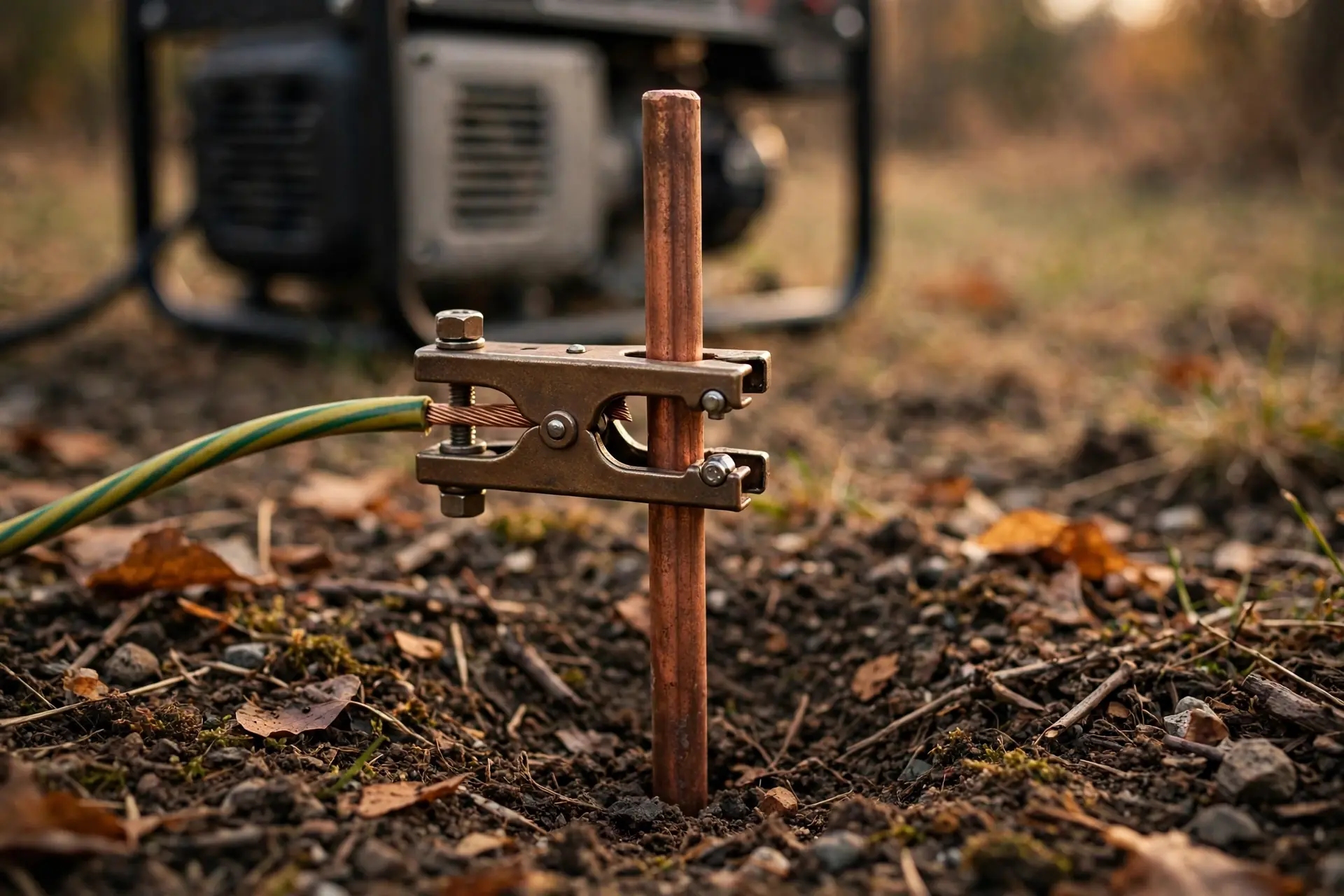
- A listed 8-foot, 5/8-inch copper-clad ground rod (about $15–25 at a home center). Not rebar, not a piece of pipe, not a tent stake.
- A listed acorn clamp sized for the rod ($5–10). Cheap screw clamps crack — they’re why half the rods I inspect are connected to nothing.
- 6 AWG copper wire, bare or green-insulated, from the generator’s ground lug to the rod. Roughly $1 a foot.
- A way to drive the rod: a rotary hammer with a ground-rod driver bit (rental, about $50–75 a day) does in four minutes what a sledgehammer does in twenty. A sledge works too; wear gloves and eye protection.
- Before you drive anything: call 811. Buried gas lines, water lines, and feeders do not care about your grounding project. This call is free and legally required in most states before you put a rod in the ground.
The process:
- Pick the spot. Close to the generator’s usual position, in soil that stays reasonably moist. Keep the wire run short and straight — fault current and lightning both dislike detours.
- Drive the rod until only 2–3 inches remain above grade — the entire 8 feet needs soil contact. A slight angle is acceptable where rock stops you; burying a half-driven rod horizontally is a code-defined method with specific trench requirements, not an improvisation.
- Attach the clamp to the clean top of the rod, run the 6 AWG wire, and land the other end on the generator’s ground lug — there’s almost always a wing-nut or hex lug on the frame, often marked with the ground symbol. Tighten both ends like you mean it.
- Protect the wire. Route it where mower wheels and feet won’t chew it up. A wire cut in June protects nobody in October.
- Resistance, if you’re being thorough. A single rod must measure 25 ohms or less to earth, or code calls for a second rod at least 6 feet away. Measuring that takes a ground-resistance tester most homeowners don’t own — one more reason panel-tied rod installs belong with an electrician.
A correctly installed rod is a fine thing. A decorative rod with a loose clamp and a severed wire is worse than no rod, because it makes you feel done.
Does a ground rod protect your electronics? (And other myths)
No. This is the myth that sells the most rods, so let’s be blunt:
- A ground rod does not stop surges. A surge is a voltage spike looking for any path, and 8 feet of rod in resistive soil is a mediocre one. What protects electronics is layered surge protection — a whole-house surge device at the panel plus point-of-use strips — and not running sensitive electronics off a cheap conventional generator with lousy voltage regulation. Our complete home backup power guide covers the options for loads that care about clean power.
- A ground rod does not make an unbonded frame safe. Frame safety comes from bonding metal parts together and back to the source, not from touching dirt. Current returning through soil takes a high-resistance path and does not reliably trip breakers.
- A ground rod does not replace GFCI protection. Different tools. Grounding gives fault current a path so breakers trip. A GFCI watches for current leaking where it shouldn’t — like through you — and cuts power in about 1/40th of a second, long before a breaker notices. For wet, outdoor, cord-and-plug use, the GFCI is the device standing between you and a very bad day. Most modern portables include GFCI outlets; if yours doesn’t, a GFCI adapter is a good $25 purchase — unlike the grounding kit.
So what’s the bottom line for your setup?
- Cords into the generator’s outlets: no rod. Frame is the ground; code and OSHA agree.
- Transfer switch or interlock into your panel: no rod at the generator. The house’s electrode system grounds everything — but do confirm your neutral situation, because bonded-versus-floating is the question that actually affects this install.
- Detached structure, derived system, jobsite rules, or a manual that demands it: drive the rod properly — 8-foot listed rod, acorn clamp, 6 AWG copper, 811 call first.
- Either way: GFCI protection outdoors, bonding intact, generator 20-plus feet from the house, exhaust pointed away.
If the neutral question has you stuck mid-install, bring in an electrician for an hour — it’s the one part of this topic where a wrong guess has real consequences. Everything else here, a careful homeowner can verify with a $15 multimeter and ten minutes.
Keep reading
Frequently asked questions
Do I need to ground my portable generator with a rod?
Usually not. Plugging extension cords directly into the generator's outlets? The frame is the grounding reference, and NEC and OSHA both accept that with no rod. Feeding your house through a transfer switch or interlock? It grounds through your home's existing grounding electrode system. A rod is mainly needed for separately derived setups, some jobsite rules, and certain local codes.
What is the difference between a bonded and a floating neutral?
On a bonded-neutral generator, the neutral wire is connected to the frame and the ground pins inside the machine. On a floating-neutral unit, neutral is isolated from the frame. Standalone use works fine with either. The distinction matters when you connect to a house panel, because a home already bonds neutral to ground in exactly one place — adding a second bond through a bonded-neutral generator can cause nuisance GFCI trips and objectionable current on grounding wires.
How can I tell if my generator has a bonded neutral?
Check the label on the control panel or the manual — many units state 'neutral bonded to frame' or 'neutral floating.' To verify with a multimeter, unplug everything, turn the generator off, and test continuity between the neutral slot of a 120V outlet and the ground pin (or a bare metal spot on the frame). A beep means bonded. No continuity means floating.
What size wire do I use to ground a generator to a rod?
Use 6 AWG bare or green-insulated copper for most portable-generator rod connections — the common code-friendly choice, and cheap insurance. The rod should be a listed 8-foot, 5/8-inch copper-clad rod driven fully into the earth, with a listed acorn clamp. If a single rod measures over 25 ohms to earth, code wants a second rod at least 6 feet away.
What happens if I add my own ground rod to a transfer-switch setup just to be extra safe?
In a transfer-switch or interlock setup it adds nothing, because the generator already grounds through the inlet box and panel into your home's existing grounding electrode system — typically one or two rods plus a bond to the metal water line. A separate rod at the generator creates a second earth connection at a different point, which can produce different ground potentials during a fault or a nearby lightning event, and it is one more connection to corrode. If you want to spend money on safety, GFCI protection and an intact bond beat a decorative rod.