Can a Portable Generator Charge an EV? Speeds, Gotchas & Fuel Math
**Quick answer:** Yes — a portable generator can charge an EV, adding 3–5 miles of range per hour at Level 1 (120V), or 20–30 miles per hour on 240V Level 2 from a large generator with the charger dialed down to 24–32 amps. It only works reliably with clean power from an inverter generator and, on most portables, a neutral-ground bonding plug that lets the car pass its ground check.
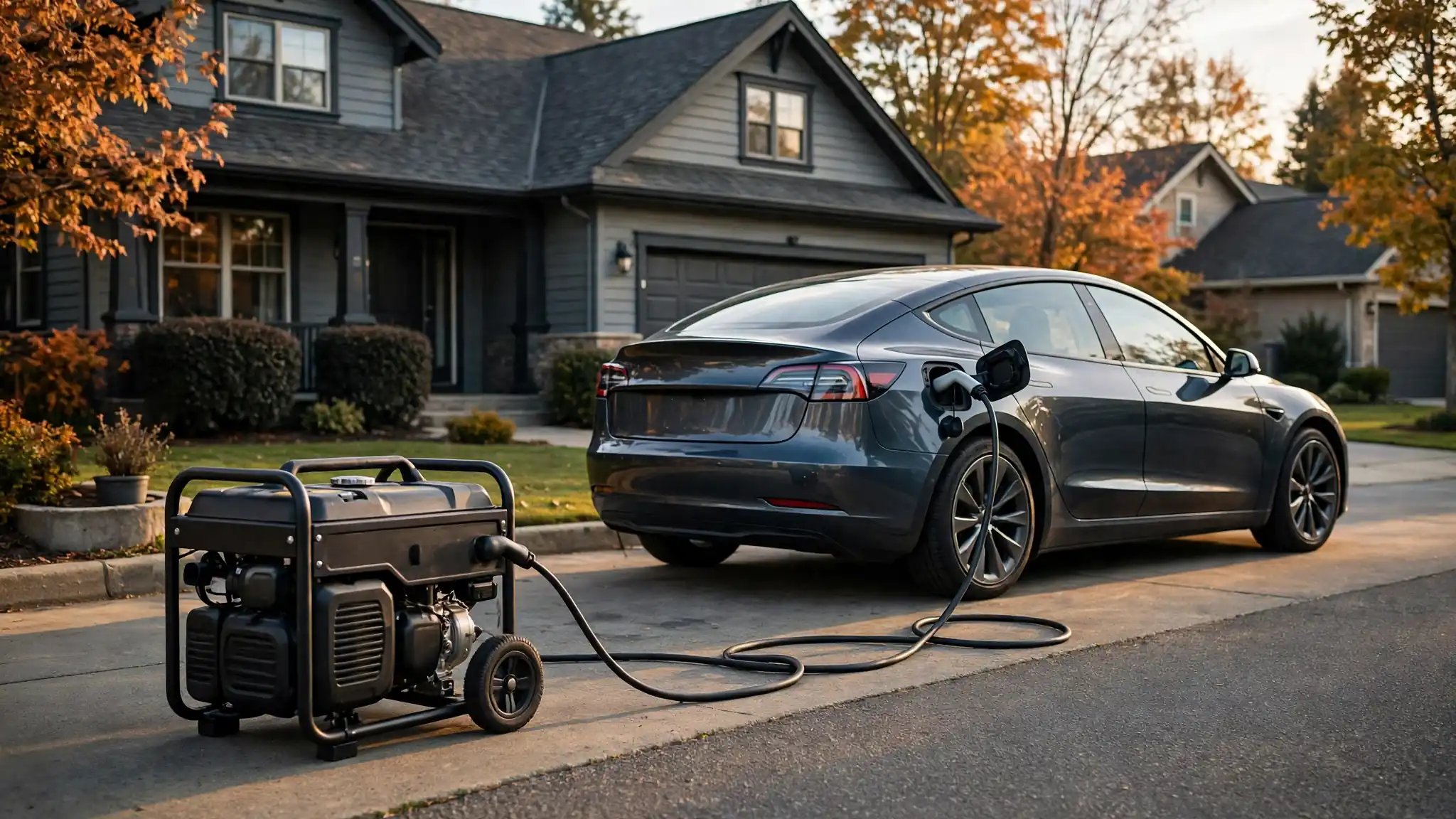
Quick answer: Yes — a portable generator can charge an EV, adding 3–5 miles of range per hour at Level 1 (120V), or 20–30 miles per hour on 240V Level 2 from a large generator with the charger dialed down to 24–32 amps. It only works reliably with clean power from an inverter generator and, on most portables, a neutral-ground bonding plug that lets the car pass its ground check.
The storm takes the power out, the car is sitting at 35%, and it’s a 28-mile drive to your in-laws — who have power. So: can a portable generator charge an EV well enough to get you there? I’ve been asked this on service calls more times in the last two years than in the previous eighteen combined, and my answer is always the same: yes, it works, it’s slower than you hope, and there are two traps that stop most people cold on the first try.
This is the generator-specific version of the problem. For the full outage picture — batteries, standby units — see my guide to charging an EV during a power outage. Here we’re talking strictly about the portable in your garage, and how to set it up so the car accepts the charge instead of throwing an error and going dark.
Can a Portable Generator Actually Charge an EV?
Yes — because as far as the car is concerned, a generator is just a wall outlet with an engine attached. Every EV sold in the US supports a mobile charge cord that plugs into a standard 120V receptacle, and every portable generator has one of those. The car doesn’t care that the electricity was gasoline ten seconds ago.
But “can” hides three conditions, and skipping any of them is why people conclude it doesn’t work:
- The power has to be clean enough for the car’s onboard charger to accept it.
- The grounding has to look right to the car’s safety checks — this is the famous neutral-ground bond problem, and it stops more first attempts than everything else combined.
- Your expectations have to be set to “emergency ration,” not “fill-up.” The speeds below explain why.
Get those three right and the setup is genuinely useful. Get them wrong and you’ll spend a blackout evening watching a red error light blink on the charge cord.
How Fast Is Level 1 Charging From a Generator?
Level 1 is the default path, and the math is not complicated. A mobile cord on a standard outlet draws 12 amps continuous at 120V:
120V × 12A = 1,440 watts — call it 1.2–1.4 kW delivered after losses.
That power goes into the battery at whatever efficiency your car manages, which translates to:
| Vehicle type | Miles of range per hour | Miles in a 10-hour overnight run |
|---|---|---|
| Efficient sedan (Model 3, Ioniq 6) | 4–5 | 40–50 |
| Mid-size crossover (Model Y, Mach-E, EV6) | 3–4 | 30–45 |
| Full-size truck (F-150 Lightning, R1T) | 2–3 | 20–30 |
My rule of thumb for planning: one hour of generator run ≈ 4 miles, one overnight run ≈ 40–60 miles in a typical EV. That’s a commute. That’s getting to a DC fast charger two towns over. That’s an evacuation buffer. It is not a road trip, and no generator purchase makes it one — if you need a refresher on why Level 1 is what it is, I broke down the speeds in Level 1 vs Level 2 charging.
One practical tip: the car pulls a continuous 12 amps for hours — a real, sustained load, not a fridge cycling on and off. A little 2,000-watt inverter will do it, but it’ll sit at 70%+ load the whole time, loud and thirsty. A 3,500–4,500-watt inverter generator is the sweet spot for Level 1 EV duty: loafing at a third of capacity, quieter, and much better on fuel.
Can You Run Level 2 Charging From a Portable Generator?
Yes, if the generator has a 240V outlet (the twist-lock L14-30 or 14-50 receptacle on bigger units) — and this is where the game changes from “ration” to “actually useful.”
A 240V session at 24–32 amps delivers 5.8–7.7 kW, which is 20–30 miles of range per hour. Three hours of that is a real charge: 60–90 miles. Now you’re refilling, not sipping.
The catch is sizing, and here I need you to think in running watts, not surge watts, and respect headroom:
- A charge session is a continuous load for hours. A generator making exactly what the charger draws, with nothing left over, runs hot and unhappy — and voltage sag when the charger ramps can fault the session.
- For a 32-amp (7.7 kW) session, I want a continuous rating of 9,000W or more on gasoline. For a 24-amp (5.8 kW) session, a 7,500W-class unit is fine.
- Almost every portable EVSE and wall connector lets you dial the amps down — in the car’s charge settings, the charger’s app, or DIP switches. Dial it down. A steady 24-amp session that finishes beats a 40-amp session that trips the generator’s breaker at minute six.
- Propane derates you. On dual-fuel generators, expect roughly 10–15% less output on propane than gasoline. Size for the fuel you’ll actually burn.
Pairings I’ve seen work: a Champion 10,000-watt inverter running a 32-amp session comfortably; a Predator 9500 or Honda EU7000is (a genuinely superb machine) running 24 amps all night. What does not work: a 5,000-watt generator with a 240V outlet feeding a 40-amp charger at full tilt. The outlet being there doesn’t mean the engine behind it can hold the load.
Why Does the Car Refuse to Charge? The Clean Power Problem
Here’s trap number one. A conventional open-frame generator — the contractor style — makes rough electricity. Its total harmonic distortion (THD) commonly runs 15–25%; utility power is under 5%. Your EV’s onboard charger watches the incoming waveform, and many will derate, cycle, or refuse outright when it’s that ugly. Teslas are famously picky; other brands are more forgiving. None of them love it.
Inverter generators are the fix. They generate DC and invert it to a clean sine wave, typically under 3% THD — frequently cleaner than what comes out of your wall. Honda EU series, Yamaha EF series, and the inverter lines from Champion, Westinghouse, and Predator all live in this category. If EV charging during outages is even part of why you own a generator, buy the inverter. The premium over a conventional unit of the same size is a few hundred dollars, and it’s the difference between “works every time” and “works on my neighbor’s car but not mine.”
Voltage stability matters too: a conventional generator’s voltage wanders with RPM, and a load cycling on can dip it enough to abort a session. Inverters hold voltage steady — one less way for the charge to silently stop at 2 a.m.
What Is the Neutral-Ground Bond Problem — and the Bonding Plug Fix?
Trap number two, and the famous one. Almost every EV and mobile charge cord performs a ground check before charging: it verifies that neutral and ground are bonded — tied together at one point — as they are in your home’s main panel. A sensible safety check.
Most portable generators, though, ship with a floating neutral: neutral and ground are deliberately not connected at the generator, so the bond can live in your house panel when the generator feeds the home through a transfer switch. So you plug the car into a perfectly good generator, and the cord flashes a ground-fault error and refuses. The generator is fine. The car is fine. The check just can’t see a bond that isn’t there.
The fix is a neutral-ground bonding plug — a dummy plug with neutral and ground jumpered inside, sold for about $15–$30, or DIY-able with a replacement plug and a short wire between the neutral and ground blades. Push it into a spare 120V outlet on the generator and it creates the bond the car is looking for. Charging starts. I’ve watched this $20 part go from “snake oil” to “genius” in one customer’s eyes in ninety seconds.
Three cautions, and I mean them:
- Check both manuals first. Some generators are already bonded-neutral from the factory (an outlet tester can confirm it), and a bonding plug on an already-bonded unit is unnecessary. Some EV makers have official guidance here, too. Two minutes of reading beats guessing.
- Bonding plug in = standalone use only. If that generator is also connected to your house through a transfer switch, the bond belongs in the panel and the plug comes out — double bonds can put current on ground paths where it doesn’t belong. My habit: when the plug goes in, the transfer-switch cable gets coiled and hung where I can see it.
- The plug only fixes the bond. It does nothing for dirty power. If your conventional generator faults the car for THD, you need the inverter, not the plug.
How Do You Ground the Generator Itself While Charging?
Short version: for a generator in your driveway powering a car through cords — a standalone system, not wired into the house — the generator’s frame is the ground reference, and the bonding plug plus the cord’s own ground pin give the car what it’s checking for. The EVSE’s built-in GFCI is the layer that actually protects you.
The longer, honest version: the NEC does not generally require driving a ground rod for a portable generator used as a standalone system with cord-connected loads, and most manuals say exactly that — frame grounding suffices. What I do on my own setup:
- Set the generator on dry, level ground, frame contact solid — not perched on a plastic pallet.
- Keep every connection dry. No cords lying in puddles; if it’s raining, the generator belongs under an open-sided canopy, never “just inside” the garage.
- If your manual does call for a grounding electrode — some larger units do — follow it; a driven rod is a 20-minute job.
When in doubt, the manual for your unit outranks any article, including this one.
What’s the Real Fuel Math? (It’s Not a Money Saver)
People do this calculation hopefully, so let me do it honestly. A generator making Level 1 power — about 1.4 kW under load — burns roughly 0.4–0.6 gallons per hour in a mid-size unit (a smaller inverter sips less; a big conventional drinks more). At 4 miles of range per hour, that’s:
≈ 25–30 miles per gallon — the fuel economy of an ordinary gasoline sedan.
Which makes sense when you think about it: you’ve built a gasoline car out of two machines, with conversion losses at every step. Compare the cost side: a gallon at $3.20 buying you ~28 miles is about 11–12 cents a mile in fuel, versus roughly 4–5 cents a mile charging from the grid at typical US residential rates — the numbers I used in what it costs to charge an EV at home make the gap obvious. A Level 2 session off a big generator lands in the same neighborhood per mile, sometimes a bit worse.
So the use case is not savings. It’s this: charge just enough to reach a working charger. Thirty or forty generator-miles gets you to the fast charger in the next county, where the car fills at grid prices. Burning ten gallons to “fill” the car at home is the expensive way to feel self-sufficient. I’ve done the overnight thing once, in a three-day outage with nowhere open to go — and that’s exactly the scenario it’s for.
Worth knowing, in the other direction: many EVs can now give power back. If your car supports vehicle-to-load, it may be the better tool for the house side — I covered that in can an EV power a house (V2H)?. Generator charges car, car powers fridge: during a long outage, that loop is sometimes the smartest arrangement of the equipment you already own.
How Do You Set It Up Safely? The Non-Negotiables
This part goes in every generator article I write, because carbon monoxide kills people during outages every year:
- The generator runs outdoors, at least 20 feet from the house, exhaust pointed away from doors and windows. Not in the garage with the door cracked. Not on the porch. Twenty feet, outside — so the car gets charged in the driveway, and you plan cord lengths around that.
- Never charge from a generator inside a closed garage, and never move it “just inside” because of rain. Open-sided generator canopies exist for exactly this.
- Let it cool before refueling. Ten minutes off before the cap comes off, every time — especially at hour six, when you’re tired.
- One heavy load at a time. The EV session is the generator’s job during that run. Don’t hang the fridge, a space heater, and the car off a 4,500-watt unit and wonder why the breaker tripped.
- Check on it hourly — oil, fuel, and cord temperature at the plugs (warm is normal, hot is a stop-now).
So, Should You Count on a Generator for Your EV?
My honest take: a portable generator charging an EV is an emergency bridge, and a very good one. Level 1 off a clean inverter buys you 40–60 miles overnight — enough to matter in almost any outage. A big 240V inverter buys a genuine recharge at 20–30 miles an hour. Neither replaces the grid, and the fuel math says you shouldn’t try to make them.
Setting this up before storm season? My list is short: an inverter generator sized for the session you actually plan (4,500W class for Level 1, 9,000W+ for Level 2), a bonding plug in the toolkit, cord long enough to keep the machine 20 feet from the house, and one practice run on a Saturday afternoon. The time to discover the floating-neutral error is not by flashlight during the real thing.
Keep reading
Frequently asked questions
Can a portable generator charge an EV?
Yes. Any EV will charge at Level 1 (120V) from a portable generator, adding 3–5 miles of range per hour — roughly 40–60 miles overnight. A large 240V generator (7,500W class or bigger) can run a Level 2 charger dialed down to 24–32 amps for 20–30 miles per hour. The conditions: clean power from an inverter generator, and a neutral-ground bond many portables don't have by default.
Why does my EV refuse to charge from my generator?
Two usual reasons. Dirty power: conventional generators produce 15–25% THD, and many EVs fault out on it — an inverter generator (under 3% THD) fixes that. And grounding: most portable generators have a floating neutral, so the car's ground check fails. A neutral-ground bonding plug ($15–$30) inserted into a spare generator outlet is the standard fix, but check both manuals first.
How many miles of EV range does a gallon of gasoline buy?
About 25–30 miles per gallon, all-in. A generator burning roughly half a gallon per hour to make 1.4 kW of Level 1 power puts 3–5 miles per hour into an average EV, which works out to the fuel economy of a modest gasoline sedan. Generator charging is an emergency bridge to a working charger, not a cheap way to drive.
What size generator do I need to charge an EV?
For Level 1, almost anything 2,000W and up works, but a 3,500–4,500W inverter generator is the sweet spot — it holds the load without straining and sips fuel. For Level 2 at 240V you need a generator with a 240V outlet and a continuous (running) rating of at least 7,500W, and you'll still dial the charger down to 24–32 amps so the generator isn't running flat-out.
Can I charge my EV and power my house from the same generator at the same time?
Only if the generator is big enough, because an EV session is a continuous load for hours, not a cycling appliance. Level 1 alone draws 1.2–1.4 kW for the whole session, and a 240V Level 2 session at 24–32 amps draws 5.8–7.7 kW, which is why a 32-amp session wants a continuous rating of 9,000W or more. On a smaller unit, follow the one-heavy-load-at-a-time rule: the charging session is the generator's job during that run, and dialing the charger down keeps a steady session from tripping the breaker.