Best Portable Generator for Home Backup: 4 Picks for 2026
**Quick answer:** For most homes, buy the **Westinghouse WGen9500DFc** — 9,500 running watts on gasoline (8,500 on propane), a 50-amp outlet for an inlet box or transfer switch, remote start, and a typical price of $1,000–$1,400. If quiet matters more than raw watts, the **Honda EU3200i** inverter (2,600 running watts, 54–58 dBA, $2,400–$3,000) is the pick; under $900, the **WEN GN625i** delivers 5,000 running watts of inverter power with 240V output. Size to motor surge, not running watts, and connect only through an interlock kit or transfer switch — never a backfeed cord.
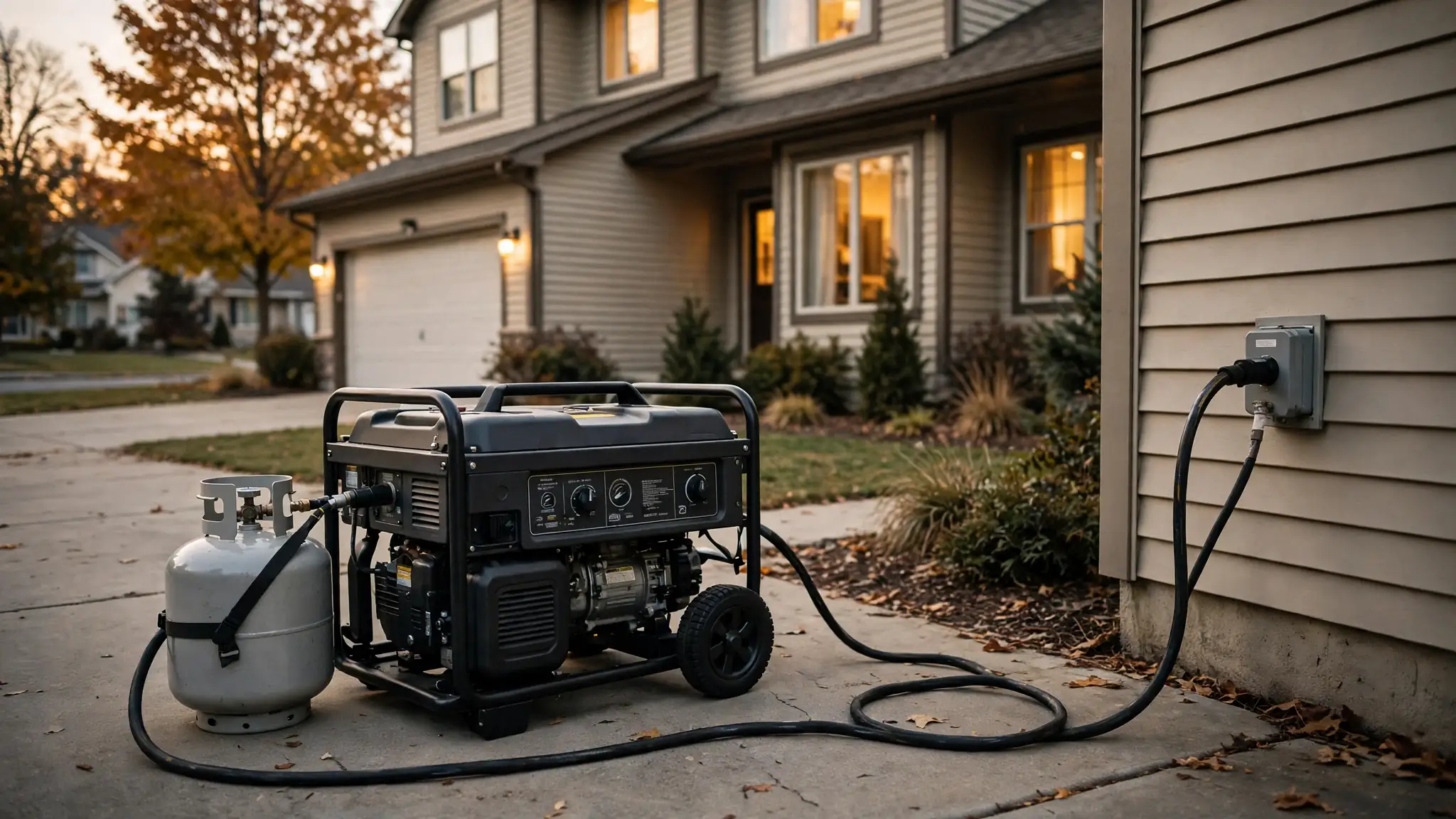
Quick answer: For most homes, buy the Westinghouse WGen9500DFc — 9,500 running watts on gasoline (8,500 on propane), a 50-amp outlet for an inlet box or transfer switch, remote start, and a typical price of $1,000–$1,400. If quiet matters more than raw watts, the Honda EU3200i inverter (2,600 running watts, 54–58 dBA, $2,400–$3,000) is the pick; under $900, the WEN GN625i delivers 5,000 running watts of inverter power with 240V output. Size to motor surge, not running watts, and connect only through an interlock kit or transfer switch — never a backfeed cord.
Quick picks: The best portable generator for home backup for most households is the Westinghouse WGen9500DFc (dual-fuel, 9,500 running watts, 50-amp outlet, typically $1,000–$1,400). The best inverter pick is the Honda EU3200i (2,600 running watts, 54–58 dBA, typically $2,400–$3,000 street). The best budget pick is the WEN GN625i (5,000 running watts of clean inverter power with 240V output, typically $830–$900). The whole-home-class pick is the DuroMax XP12000HX (9,500 running watts, 8.3-gallon tank, typically $1,300–$1,500). Specs below are manufacturer ratings; prices are typical US street bands checked October 2026 — these brands discount constantly, so treat any single price as fiction.
A portable generator is the budget answer to backup power: no permits saga, no $10,000 install, and it can live in the garage between outages. The catch is choosing the right class. Buy too small and the sump pump trips it; buy a loud open-frame when you needed quiet inverter power and you’ll hate it by the second night. These four picks cover the four jobs people actually hire a portable to do.
The quick-picks table
| Pick | Model | Running watts (gas / propane) | Noise | Best for | Typical price |
|---|---|---|---|---|---|
| Dual-fuel | Westinghouse WGen9500DFc | 9,500 / 8,500 | ~74 dBA | Most homes; transfer-switch backup | $1,000–$1,400 |
| Inverter | Honda EU3200i | 2,600 (gas only) | 54–58 dBA | Quiet essentials, electronics, RV | $2,400–$3,000 |
| Budget | WEN GN625i | 5,000 (gas only) | Moderate (open-frame inverter) | Essentials + 240V on a budget | $830–$900 |
| Whole-home class | DuroMax XP12000HX | 9,500 / 9,025 | ~74 dBA class | Big loads, long runtime, 50A hookup | $1,300–$1,500 |
Two numbers decide everything before brand names enter it: running watts (what it sustains) versus starting watts (the seconds-long surge it survives when motors kick on), and whether the machine makes inverter power (clean, electronics-safe, quiet) or conventional open-frame power (cheap watts, ~74 dBA, higher distortion). Size first with our sizing guide, then pick the class.
Best dual-fuel: Westinghouse WGen9500DFc
The WGen9500DFc is the default recommendation because it does the whole home-backup job without a weakness that matters. You get 12,500 starting / 9,500 running watts on gasoline and 11,200 / 8,500 on propane, a 6.6-gallon tank good for about 8 hours at half load on gas (up to 12 at quarter load), and the outlet that makes it a home generator rather than a jobsite tool: a 50-amp 14-50R alongside a 30-amp L14-30R, both ready for an inlet box and interlock or transfer switch. Remote electric start means starting it from the porch in the rain at 2 a.m., and the CO sensor shuts it down if exhaust pools where it shouldn’t.
The dual-fuel capability is the strategic feature. Gasoline is the cheap, dense fuel while stations are open; propane is the reserve that stores forever without stabilizer or a gummed carburetor. Run gas first, keep two 20-lb propane tanks as the can’t-spoil backup.
The honest limits: at about 74 dBA and 211+ lbs it’s loud and heavy — a wheel-it-out-of-the-garage machine, not a carry-it one — and its power is conventional, not inverter-clean, so sensitive-electronics purists should note the higher THD. Westinghouse backs it with a 3-year limited warranty.
Best for: most households — panel-connected backup for essentials plus one big appliance, with propane insurance.
Best inverter: Honda EU3200i
The EU3200i is what the inverter class is for. 3,200 max / 2,600 rated watts of clean, stable power, at 54–58 dBA — quieter than the fridge it will be running — in a 59.1 lb package one person can genuinely carry. Honda’s fuel injection (no carburetor to gum up, easier cold starts, better fuel economy) is the real differentiator over cheaper inverters: it runs 8.6 hours at quarter load on a 1.2-gallon tank, has CO-MINDER shutdown, Bluetooth app monitoring, and parallel capability — two EU3200is link to 6,400 max watts when you outgrow one.
It will run a fridge, furnace blower, lights, router, TV, and a 13,500 BTU RV or window AC — the essentials list, quietly, all night on a gallon and change. That’s the outage experience most people actually want.
The honest limits: price and ceiling. Street prices run $2,400–$3,000 — Honda money — and 2,600 watts is 120V-only essentials territory: no well pump, no central AC, no panel connection without paralleling a second unit. Honda’s 3-year residential warranty and dealer network are part of what the premium buys. Its little brother, the EU2200i (2,200/1,800 watts, 48–57 dBA, about 47 lbs, typically $1,100–$1,300), is the pick if 1,800 running watts covers your list.
Best for: quiet overnight essentials, electronics safety, apartments-with-a-balcony rules aside — anyone who values sleep and clean power over raw watts.
Best budget: WEN GN625i
The GN625i breaks the class rules, which is why it’s here: 6,250 surge / 5,000 rated watts of inverter power with 120/240V output at a street price around $830–$900. Inverter-clean output (WEN rates THD under 0.5% at no load) plus a transfer-switch-ready L14-30R outlet plus an RV TT-30 — at this price, that combination used to not exist. The 4.2-gallon tank runs about 8.1 hours at half load, eco-mode throttles the engine down for light loads, and at roughly 110–120 lbs with the wheel kit it’s manageable.
That wattage covers the honest essentials list with surge headroom: fridge, furnace blower, sump pump, lights, router, and a microwave in bursts. It’s the machine I point people to when the budget is firm and the loads are real.
The honest limits: it’s an open-frame inverter, so it’s quieter than a conventional open-frame but not Honda-quiet; it’s gasoline-only (no propane reserve); and WEN’s warranty is 2 years against Honda’s 3 and the big frames’ 3. The GN625iX variant adds a CO shutdown sensor — worth the small premium where it’s offered.
Best for: firm budgets under $900 that still need 240V and electronics-safe power.
Best whole-home class: DuroMax XP12000HX
When “essentials” stops being the brief — you want the AC, the well pump, and the water heater in rotation — the XP12000HX is the portable that plays in that league: 12,000 peak / 9,500 running watts on gasoline and 11,400 / 9,025 on propane, an 8.3-gallon tank for about 8.8 hours at half load (7.2 hours on a 40-lb propane tank), a 50-amp outlet for panel connection, all-copper windings, CO Alert shutdown, and push-button electric start. DuroMax backs it with a 3-year limited warranty, and it lists around $1,499, with street prices typically $1,300–$1,500.
Against the Westinghouse above, the DuroMax trades remote start for a bigger tank and longer legs; both are legitimate whole-home-class answers at nearly the same money. Pick the Westinghouse for the fob and EFI variants, the DuroMax for runtime.
The honest limits: same class truths — about 74 dBA, 200+ lbs, conventional (not inverter) power, and manual everything. It powers most of a house; it does not manage a house. For automatic, walk-away coverage, compare what you’re really asking for against standby generator cost before spending up.
Best for: large homes, wells and AC in the load list, and buyers who accept manual operation in exchange for standby-class watts at a tenth of the installed price.
How do you connect a portable to your house safely?
Whichever pick you buy, the connection matters more than the brand. The legal, safe routes are a power inlet box with an interlock kit or a transfer switch, installed by an electrician for roughly $600–$1,500 depending on method — our guide to connecting a generator to your house compares all three legal methods with costs. The illegal route — a male-to-male “suicide cord” into a dryer outlet — backfeeds the grid, can kill line workers, and voids your insurance. Never.
How much fuel does a three-day outage actually take?
Runtime figures are quoted per tank; outages run per day, so here is the fuel plan behind the picks, built only from the runtimes already listed above. The working pattern for a big open-frame machine is not 24-hour running — it is block running: power the house for a few hours while the fridge gets properly cold, the water heater recovers, and every device charges, then shut down and coast on insulation and battery gadgets. On that pattern, the Westinghouse’s 6.6-gallon tank — about 8 hours at half load, up to 12 at quarter load — covers roughly two to three days of block running per fill, and the propane side stretches the plan further: the two 20-lb reserve tanks from the dual-fuel section above are the hours you spend after the gasoline runs out. The DuroMax plays the same game with a bigger purse: 8.3 gallons for about 8.8 hours at half load, or about 7.2 hours on a single 40-lb propane tank, so one tank of either fuel is most of a long weekend of blocks.
The inverter pick runs a completely different strategy. The Honda’s 1.2-gallon tank lasts 8.6 hours at quarter load precisely because essentials-only running is quarter load for it — so a quiet overnight of fridge, furnace blower, lights, and router costs the EU3200i roughly a gallon a night, night after night, with no block scheduling and no shutdown decisions at all. The WEN sits between the two patterns: 4.2 gallons and about 8.1 hours at half load works out to roughly a tank a day on a block schedule, at the lowest purchase price in this guide. Whichever pattern fits your house, store fuel for the pattern rather than the headline runtime: gasoline rotated every few months with stabilizer, propane effectively forever — which is the dual-fuel argument from the top of this guide, restated as a shopping list. One last check before storm season: run your pick under your real load for one evening and time it against this math, because a generator whose true runtime you have measured beats a spec sheet you are trusting.
Portable or standby: which is the honest buy?
Portables win on price by an order of magnitude: $830–$1,500 buys any machine in this guide, versus $9,500–$15,000 installed for a standby system. Standbys win on everything else — automatic start in 10 seconds, no refueling in the storm, no 2 a.m. trip to the garage, fuel from the gas line instead of a can. The deciding questions are outage length and who’s home: frequent multi-day outages, medical equipment, or an empty house half the year argue for standby (see the whole-house cost guide); a few outages a year with someone home to roll the machine out argues for everything on this page. And if noise is your deciding factor across all generators, our quietest generators guide ranks the whole field by verified decibels. Even a loud open-frame model can be tamed noticeably with placement, barriers, and muffler choices, which our guide on how to make a generator quiet covers step by step.
Keep reading
Frequently asked questions
What is the best portable generator for home backup?
For most homes, the Westinghouse WGen9500DFc: 9,500 running watts on gasoline, a 50-amp outlet for a transfer switch or inlet box, dual-fuel propane backup, remote start, and a street price that typically lands between $1,000 and $1,400. If your priority is quiet, clean power for electronics instead of raw watts, the Honda EU3200i inverter is the better machine. And if your budget is under $900, the WEN GN625i delivers 5,000 running watts of inverter power with 240V output — an unusual combination at that price.
How many watts do I need for home backup?
Add up what must run at once. Essentials-only — fridge, lights, furnace blower, sump pump, router, phone charging — totals roughly 2,000–4,000 running watts, which a 5,000W-class machine covers with surge headroom. Whole-home ambitions (central AC, electric water heater, well pump together) need 9,000+ running watts and a 50-amp connection. The trap is motor surge: a sump pump running at 1,050W can spike past 2,100W at startup, so size to the surge, not the running draw. Our sizing guide walks the full calculation.
Is a dual-fuel generator worth it for home backup?
Usually, yes. Propane never goes stale — gasoline degrades in 3–6 months without stabilizer — so a dual-fuel machine paired with a couple of 20-lb tanks (or a 100-lb tank) is ready after a year in the garage in a way a gas-only machine often isn't. The trade: propane output drops about 10% (the Westinghouse in this guide falls from 9,500 to 8,500 running watts), and propane costs more per hour. My pattern: run gasoline while it's fresh and stations are open, propane as the reserve that can't spoil.
How loud is a portable generator, really?
Open-frame portables like the Westinghouse and DuroMax in this guide are rated around 74 dBA — roughly a vacuum cleaner, clearly audible through walls and across property lines. Inverter generators are the quiet class: the Honda EU3200i is rated 54–58 dBA, normal-conversation territory, and our testing of the class generally confirms the ratings at quarter load. If the generator will run overnight near bedrooms — yours or the neighbors' — the inverter's noise advantage is not a luxury spec. It's the difference between sleeping and not.
Can a portable generator power a whole house?
A big one can power most of one — with management. A 9,500-running-watt portable through a 50-amp inlet and interlock or transfer switch will carry a typical home's essentials plus a 3-ton AC, as long as you don't start the electric dryer, range, and water heater simultaneously. What it can't do is start itself: no auto-start, no automatic switchover, and you refuel every 8–12 hours. For fully automatic whole-house coverage you're in standby territory at $9,500–$15,000 installed — a different product for a different budget.