How to Make a Generator Quiet: 7 Methods That Work
**Quick answer:** Distance first — sound drops **~6 dB every time you double it**, and it's free. Then a **ventilated quiet box (5–10 dB)**, an **aftermarket muffler (2–5 dB)**, **anti-vibration mounting and a soft ground surface** to kill rumble, and an **exhaust deflector** to aim what's left away from ears. Stacked honestly, that's 10–15 dB off a conventional portable. Nothing here makes an airtight box, a blanket, or a garage safe — carbon monoxide rules come before noise rules, always.
Quick answer: Distance first — sound drops ~6 dB every time you double it, and it’s free. Then a ventilated quiet box (5–10 dB), an aftermarket muffler (2–5 dB), anti-vibration mounting and a soft ground surface to kill rumble, and an exhaust deflector to aim what’s left away from ears. Stacked honestly, that’s 10–15 dB off a conventional portable. Nothing here makes an airtight box, a blanket, or a garage safe — carbon monoxide rules come before noise rules, always.
“How to make a generator quiet” is the question I get from two kinds of owners: the ones whose new open-frame portable is shaking the windows at 74 dB, and the ones whose neighbors have started a group chat about them. Both want a number, so here’s the honest one up front: stacking every legitimate method in this article buys a typical open-frame portable roughly 10–15 dB — from vacuum-cleaner loud to something closer to a loud conversation at the property line. It does not buy Honda EU2200i silence. Below is each method with its realistic decibel cut, what it costs, and the safety lines that outrank all of it.
How much quieter is each method, really?
| Method | Realistic reduction | Typical cost | The catch |
|---|---|---|---|
| Distance (double it) | −6 dB per doubling | Free | CO rules set a 20-ft minimum anyway |
| Ventilated quiet box / enclosure | 5–10 dB | $200–600 commercial; less DIY | Must breathe — airtight is lethal |
| Aftermarket muffler / silencer | 2–5 dB | $30–150 | Must not choke exhaust flow |
| Anti-vibration pads / mounts | Small measured, big on rumble | $15–60 | Mostly kills structure-borne vibration |
| Soft ground (grass/dirt vs concrete) | ~1–3 dB reflected sound | Free | Keep the unit level and dry |
| Exhaust deflector | Directional, not rated in dB | $25–80 | Aims noise up/away; doesn’t absorb it |
| Sound barrier (fence, shed wall) | A few dB in the shadow zone | Varies | Blocks line of sight, not low rumble |
Two physics facts govern everything below. First, decibels are logarithmic: −10 dB sounds roughly half as loud and represents a tenth of the sound intensity, so a 10 dB total cut is a bigger deal than it looks on paper. Second, a generator makes noise from four places — exhaust, intake, cooling fan, and the engine/alternator vibrating through its frame and the ground — and every method only attacks some of them. That’s why the cuts stack instead of one method doing everything. The full ratings picture is in our quietest generators guide; this article is about closing the gap with the machine you already own.
Does distance actually make a generator quieter?
Yes — it’s the only method that’s both free and guaranteed, because it’s not a product, it’s geometry. Sound spreads as it travels, losing about 6 dB each time the distance doubles:
| Distance from generator | A 60 dB unit reads as | A 74 dB open-frame reads as |
|---|---|---|
| 23 ft (the rating distance) | 60 dB | 74 dB |
| 46 ft | ~54 dB | ~68 dB |
| 92 ft | ~48 dB | ~62 dB |
| 184 ft | ~42 dB | ~56 dB |
The working move: put the generator at the far corner of the property — as far from your bedrooms and the neighbors’ as the lot allows — with the exhaust pointing away from every house. The safety floor is fixed: at least 20 feet from the house, exhaust away from windows and doors, because carbon monoxide is the hazard that outranks noise every time. Our placement guide on how far a generator should be from the house covers the CO reasoning and the cord-sizing math for long runs (voltage drop is real: use heavier-gauge cord past 50 feet). Take all the distance you have, then keep reading — the methods below are for the dB that distance couldn’t give you.
What does a generator quiet box actually do?
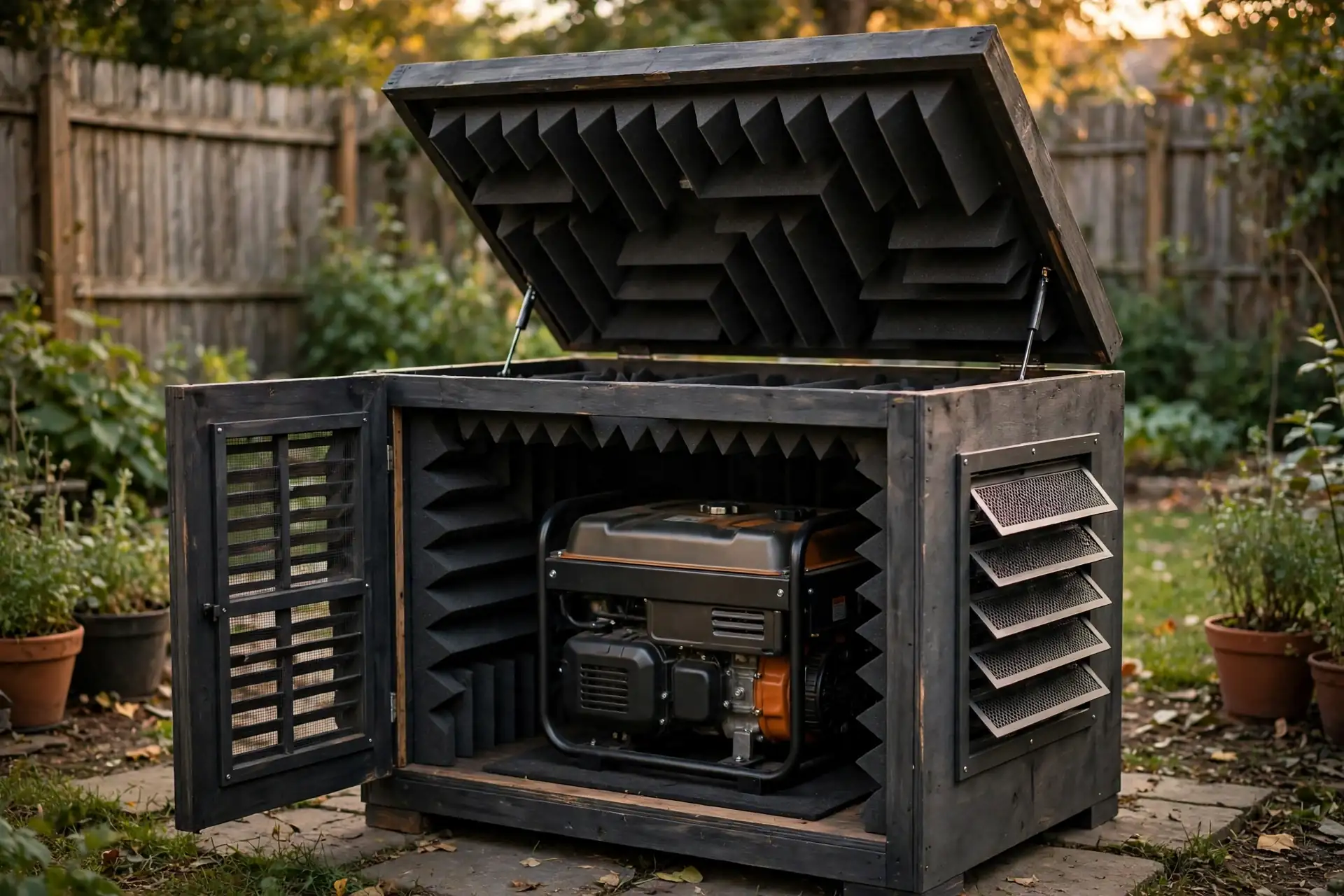
A quiet box — a ventilated enclosure around the generator — is the biggest single intervention after distance: 5–10 dB, because it attacks radiated noise in every direction at once. Commercial versions are steel or composite cabinets with acoustic lining, baffled intake and exhaust vents, and a duct that routes the engine’s exhaust out. The baffles are the whole trick: air and exhaust get a maze to travel through; sound, which travels in straight lines, keeps hitting walls.
Building one yourself is legitimate if you respect the engineering:
- Ventilation is not optional. The engine needs combustion air, cooling air, and an exhaust exit. Undersized vents overheat the engine and can shut it down mid-outage — or worse.
- Never airtight, never blanket-substitutes. A sealed box concentrates heat and carbon monoxide. This is the line between a quiet box and a coffin, and it’s not a figure of speech.
- Line it, don’t just box it. Mass-loaded vinyl or acoustic foam on the inner walls does the absorbing; a bare plywood box mostly reflects sound around until it leaks out the vents.
- Keep access. You’ll refuel every 7–10 hours and check oil. A box you dread opening is a box you’ll leave open — at 0 dB of benefit.
Can a bigger muffler make a generator quiet?
Partly — budget 2–5 dB and you’ll be pleasantly accurate. On a conventional portable, the exhaust is the loudest single source, and the stock muffler is a cost-engineered part. A larger automotive-style muffler or an add-on silencer in the exhaust path takes the bark off, particularly the low-frequency thump that carries across a neighborhood.
Three fit rules matter more than the muffler you pick. First, flow: the muffler must pass the engine’s full exhaust volume without back-pressure — an undersized silencer costs power and cooks the engine. Second, heat: exhaust components run at several hundred degrees; mounts and nearby materials must be rated for it, and nothing flammable comes near the tailpipe. Third, expectations: after the muffler, the fan, intake, and mechanical noise are still there, now simply more audible. A muffler is how you trim a generator that’s almost acceptable. It is not how you fix one that’s 20 dB too loud.
Do anti-vibration pads and placement surfaces matter?
More than their price suggests — for the noise you feel as much as hear. A generator bolted by its own weight to a concrete pad, a deck, or a patio slab turns that surface into a sounding board, and low-frequency rumble travels through structures into the house, where it reads as noise even when a meter outside disagrees. The fixes are cheap:
- Anti-vibration pads or rubber mounts under the frame feet decouple the engine from the surface. Expect a small change on a meter and a large change in rumble transmitted through a deck or wall.
- Ground beats slab. Setting the unit on grass or dirt instead of concrete removes the reflector under it and soaks up roughly 1–3 dB of reflected sound. Keep it level, on a stable base, and out of standing water.
- Break the line of sight. A fence, a shed wall, or even dense landscaping between the generator and the listener’s window shaves a few dB off the direct sound in the shadow zone — the high and mid frequencies that carry intelligible “generator drone.” It does little for low rumble, which is what the pads are for.
What does an exhaust deflector do?
A deflector is a simple angled fitting on the tailpipe that redirects the exhaust stream — usually upward. It doesn’t absorb sound, so there’s no honest dB rating to quote; what it does is aim the loudest, most directional component of the noise away from ground-level ears and toward the sky, where it disperses. Combined with pointing the exhaust away from houses in the first place (already mandatory for CO), a deflector is a cheap directional improvement — the last few percent of politeness, not a foundation. Some owners pair it with the muffler upgrade above, since both live on the same exhaust path.
A worked example: quieting a 74 dB portable, step by step
Start with the open-frame portable from the table, rated 74 dB at 23 feet. Move it from the patio to the far corner of the lot at 92 feet and distance alone does the first job: two doublings, roughly −12 dB, for a reading near 62 dB before you spend a cent. Add the ventilated quiet box for another 5–10 dB of radiated-noise cut, then an aftermarket muffler for 2–5 dB off the exhaust bark. Put anti-vibration pads under the frame and set the unit on grass instead of the concrete slab, and the rumble your walls were amplifying fades even where the meter barely moves.
Notice what that stack does not do: the reductions overlap, because each method attacks a different noise source, so you cannot simply add the headline numbers and promise 50 dB. The honest landed result for this machine is the 60–64 dB at 23 feet range given below — conversation-level at the property line, and as far as accessories take an open-frame portable. Everything past that point is a different generator, which is exactly the decision the next section walks through.
When should you stop quieting and just buy quiet?
Do the stack honestly first: distance (−6 dB per doubling), box (5–10 dB), muffler (2–5 dB), pads and surface for rumble. On a 74 dB open-frame portable, a realistic landed result is around 60–64 dB at 23 feet — neighborhood-tolerable, ordinance-plausible, and a genuine achievement. If your requirement is below that — nighttime running near bedrooms, campground quiet hours, an HOA with a meter — the answer is a different machine, not another accessory. Inverter generators start where these methods end: the Honda EU2200i is rated 48 dB at quarter load, the Westinghouse iGen2200 52 dB, the Champion 2500 dual-fuel 53 dB — at 23 feet, out of the box, with no construction project. Our quietest generators ranking has all six verified picks with prices.
And one maintenance note that costs nothing: a generator gets louder as it ages — a rusted-out muffler, loose panel screws, and a clogged air filter all add noise. Before you spend on quieting, spend twenty minutes with a wrench and the maintenance checklist. Sometimes the quiet you lost is just a loose bolt.
The stack in order, then: distance, surface and pads, box, muffler, deflector. Noise handled in that order costs the least and risks nothing — and the safety rules in the box above outrank every decibel in this article.
Keep reading
Frequently asked questions
What is the quietest generator I can buy?
The Honda EU2200i — Honda rates it at 48 dB(A) at quarter load and 57 dB(A) at full rated load, measured at 23 feet, which is quieter than normal conversation when it's loafing. The Westinghouse iGen2200 (52 dB) and Champion 2500 dual-fuel (53 dB) are next at about half the Honda's price. For context, that's the floor of the whole market: no method in this article turns a 74 dB open-frame portable into a 48 dB Honda, which is why buying quiet beats building quiet when silence is the actual requirement.
Does a generator quiet box actually work?
Yes — a purpose-built, ventilated enclosure is worth roughly 5–10 dB, the largest single cut available after distance. The box must breathe: intake and exhaust airflow sized for the engine, heat-resistant lining, and the generator's own exhaust routed out. What doesn't work is anything airtight. A sealed box overheats the engine and concentrates carbon monoxide, which is destructive and lethal respectively. Commercial ventilated enclosures exist for exactly this reason; a DIY box that ignores airflow is worse than no box.
Can I put a bigger muffler on a generator to make it quieter?
You can, and a quality aftermarket muffler or add-on silencer is worth about 2–5 dB — noticeable, not transformational. Exhaust noise is only part of a generator's sound; intake noise, cooling-fan noise, and mechanical noise from the engine and alternator remain untouched. Fit matters more than size: a muffler that chokes exhaust flow costs power and overheats the engine. Match the muffler to the engine size, keep the exhaust path smooth, and expect a supporting role, not the headline act.
How much quieter does distance make a generator?
About 6 dB every time you double the distance — the most reliable number in this article, and it's free. A generator rated 60 dB at 23 feet reads roughly 54 dB at 46 feet and 48 dB at 92 feet. An open-frame portable at 74 dB drops to about 62 dB at 92 feet. The limit is safety, not physics: carbon monoxide rules keep the generator at least 20 feet from the house with the exhaust pointed away, so you take the distance that's available and stack the other methods on top.
Is it safe to run a generator inside an enclosure?
Only inside an enclosure designed for it — ventilated, with the exhaust routed out and clearances the manufacturer allows. It is never safe to run one in a garage, basement, or carport, with the door open or not: carbon monoxide reaches lethal levels in minutes and gives no warning you can smell. Blankets and mattresses over a running generator are a fire hazard on top of a CO hazard. If you build or buy an enclosure, put a battery CO alarm in the nearest indoor room as a backstop, and read the full safety picture before you start.