Generator Carbon Monoxide Safety: Never in the Garage, Ever
**Quick answer:** Never run a generator indoors — not in a garage, even with the door open. Run it outdoors only, at least 20 feet from the house with the exhaust pointed away from every door, window, and vent, and keep working, battery-backed CO detectors on every floor. Carbon monoxide is colorless and odorless, a single portable generator produces as much of it as hundreds of cars, and it accounts for roughly 100 deaths a year in the United States.
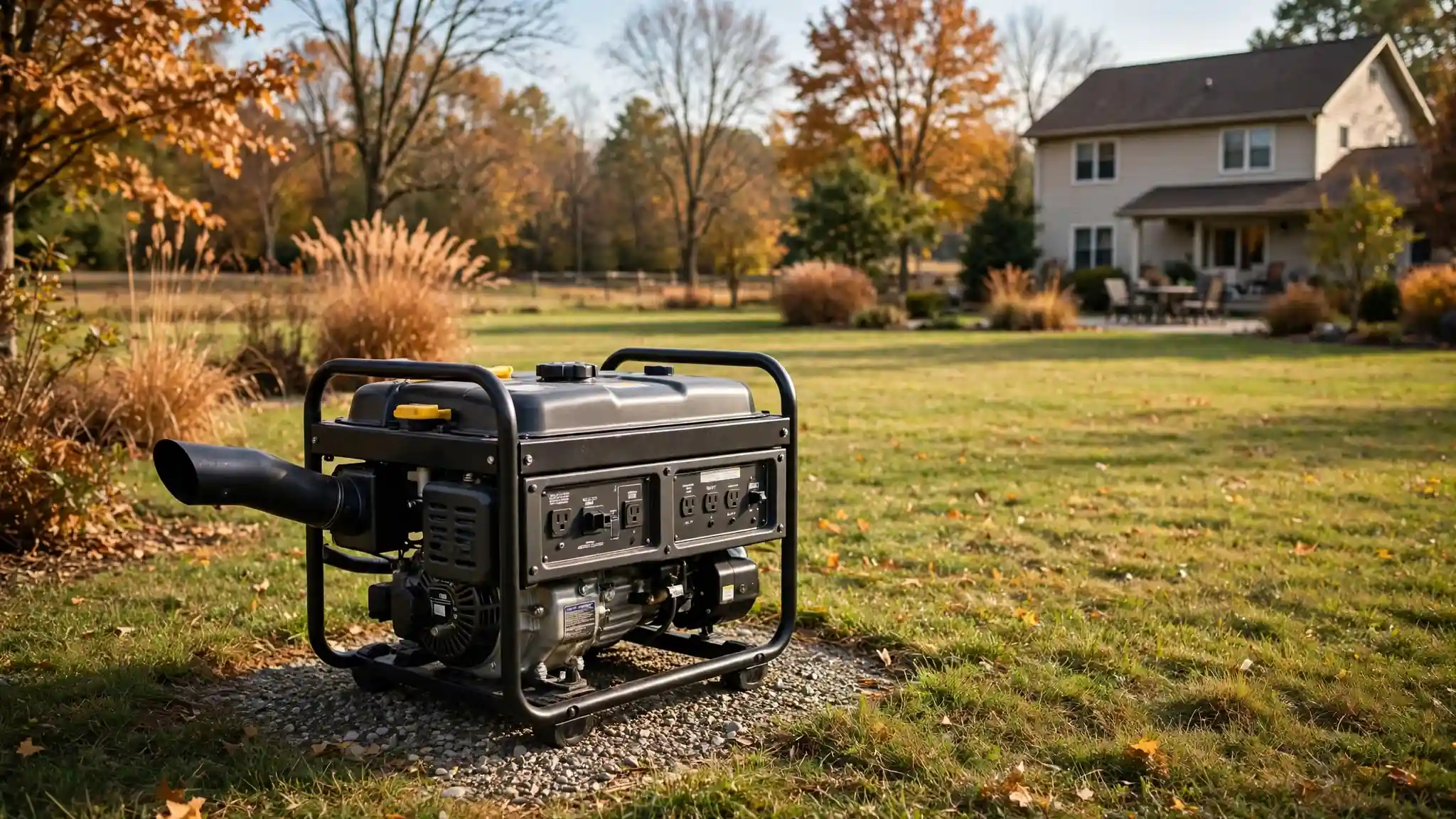
Quick answer: Never run a generator indoors — not in a garage, even with the door open. Run it outdoors only, at least 20 feet from the house with the exhaust pointed away from every door, window, and vent, and keep working, battery-backed CO detectors on every floor. Carbon monoxide is colorless and odorless, a single portable generator produces as much of it as hundreds of cars, and it accounts for roughly 100 deaths a year in the United States.
I’m a licensed electrician, and I’ve spent 18 years wiring houses and installing standby generators. I’ll be blunt in a way I usually am not in these guides: generator carbon monoxide safety has no clever workaround hiding somewhere in this article. There’s one rule, it’s absolute, and every year people die because they treated it like a suggestion.
Here are the hard numbers. The U.S. Consumer Product Safety Commission (CPSC) attributes roughly 100 deaths a year in recent years to carbon monoxide from portable generators — some years closer to 85, bad storm years higher — plus thousands of people treated in emergency rooms for CO poisoning from the same source. A single portable generator puts out as much carbon monoxide as hundreds of cars. Not a typo. Hundreds.
And most of those deaths don’t happen during the storm. They happen after it, in the first night or two of the outage, to people who were tired, cold or hot, and in a hurry to get the fridge cold and the lights on. I’ve never met a homeowner who thought they were taking a risk. Every one of them thought they’d found the reasonable middle option. There isn’t one.
Can you run a generator in a garage if the door is open?
No. Not with the door open, not with the door open and a box fan blowing out, not with it parked right at the doorway, not “just for twenty minutes while the rain passes.”
This is the single most lethal generator setup in America, for physical reasons — not because a regulator wanted a scary label:
- The output overwhelms the opening. A 5,000-watt portable under load can push CO concentrations inside an attached garage past 1,000 ppm — deep into lethal territory — in minutes. A garage door opening dilutes that some. It does not come close to keeping up.
- CO doesn’t politely leave. Exhaust leaves the muffler hot and under pressure, hits walls and ceiling, and circulates. Garages are full of dead-air corners that break up airflow, so the gas pools and spreads instead of streaming out the door.
- Your garage is connected to your house. The door between them is not a gas seal — the gap under it, shared attic space, and ductwork are paths. Open it once to check on the generator and you’ve let a concentrated slug of CO inside.
- People have died with the door wide open. That’s not my opinion; it’s in the CPSC’s incident reports, year after year.
The same logic covers carports, screened porches, and breezeways. If the space can trap air, it can trap CO.
What does carbon monoxide actually do to you?
CO is colorless and odorless, and it attacks in a nasty way: your blood grabs it roughly 200–250 times more readily than oxygen. Every breath of contaminated air replaces oxygen-carrying capacity with carboxyhemoglobin, and your body can’t tell the difference — you don’t gasp, you don’t panic, you just get stupid and sleepy. The early symptoms feel like the flu, or like being tired after a storm — which is exactly what everyone in the house already is.
Roughly how it progresses with concentration:
| CO level | What happens |
|---|---|
| 35 ppm | OSHA’s 8-hour workplace limit neighborhood — no symptoms for most people |
| 200 ppm | Headache and fatigue after 2–3 hours |
| 400 ppm | Headache and nausea in 1–2 hours; life-threatening after ~3 hours |
| 800 ppm | Dizziness, convulsions; death within 2–3 hours |
| 1,600 ppm | Death within about an hour |
| 3,200+ ppm | Death in under 30 minutes |
Near a generator’s exhaust, concentrations can run far past the top of that table. And the sequence matters: headache, then impaired judgment — by the time the air is bad, the person who would decide to go outside is no longer thinking clearly. Then sleep. Outage CO deaths very often happen to people who simply went to bed.
The practical takeaway: you cannot self-diagnose CO poisoning reliably, and you cannot smell your way out of it. Detection has to be automatic — more on detectors below.
How far from the house does a generator need to be?
The CPSC rule, and the one I give every customer: at least 20 feet from the house, exhaust pointed away from every door, window, soffit vent, dryer vent, and fresh-air intake. I break placement down fully in our guide on how far a generator should be from the house — but distance alone isn’t the whole rule. Three conditions have to hold at once:
- 20 feet minimum — measured from the nearest opening CO could enter through, not just the nearest wall.
- Exhaust pointed away from the house and your neighbor’s windows too. The muffler is the source; aim it like it matters, because it does.
- Open air on all sides. A generator wedged between the house and a fence, or under a low deck, sits in a pocket where CO accumulates and drifts. Flat, open, uncovered ground is the spot.
Does wind direction really change things?
Yes, and this is the piece people skip. A steady breeze blowing from the generator toward the house can carry exhaust to a window or soffit vent even at 20 feet. On a windy outage night, check which way the air is moving before you pick the spot, and if the exhaust ends up upwind of an open window, close that window. After any big wind shift during a long outage, step outside and confirm the setup still makes sense. Generators also walk — vibration creeps a portable across concrete over hours, slowly changing its distance and exhaust angle. Chock the wheels or set it on a mat.
One more placement conflict I see constantly: rain. People pull the generator under an eave or into the garage doorway to keep it dry — trading a weather problem for a CO problem. Don’t. Our guide on running a generator in the rain covers the options that don’t kill you, including purpose-built ventilated canopies made for exactly this.
What are the symptoms of CO poisoning — and what do you do?
Know this list before you ever need it:
- Dull headache
- Dizziness or feeling lightheaded
- Nausea or upset stomach
- Shortness of breath
- Confusion, poor judgment, irritability
- Blurred vision
- Loss of consciousness
The pattern that should set off alarms: several people (or pets) feeling sick at the same time, and feeling better outside. Flu doesn’t hit the whole house in the same hour, and it doesn’t lift on the porch.
If you suspect CO — symptoms like that during an outage, or a detector alarm — the procedure is short and not negotiable:
- Get everyone outside into fresh air immediately. Don’t open windows first, don’t grab belongings, don’t go find the source. Out.
- Call 911 from outside (or from a neighbor’s house).
- Do not re-enter until fire department personnel with a CO meter say it’s clear. “It smells fine now” is not a measurement.
- Do not go move or shut off the generator yourself if it’s in a contaminated space — would-be rescuers get felled this way. The fire department deals with the source.
- Anyone with symptoms gets evaluated, even if they feel better outside. Pregnant women, infants, and anyone with heart disease are at higher risk at lower levels.
Do CO detectors actually protect you?
Yes — they’re the only layer of this defense that works while you’re asleep, which is when CO kills. But they have to be the right devices, in the right places, and alive:
- Install CO alarms on every level of the house and outside each sleeping area, per NFPA guidance. Bedrooms split across floors means detectors on both floors, not one unit in a hallway somewhere.
- Battery-backed, always. Hardwired units without battery backup go dark in exactly the outage you’re running a generator through. The $25–50 per detector is the cheapest insurance in this entire article.
- Placement: follow the manufacturer’s height guidance (CO mixes evenly with air, so most units are rated for wall or ceiling). What matters is being near where people sleep — not in the garage itself, and not within about 15 feet of fuel-burning appliances, where nuisance readings trigger false alarms and get units unplugged.
- They expire. CO sensor elements age out — most alarms have a 5–10 year life and an end-of-life signal. A yellowed detector from 2014 is furniture, not protection. Check the date on the back when you check the batteries, twice a year.
- Know the alarm pattern. UL 2034 alarms sound at sustained levels — 70 ppm over 1–4 hours, faster at higher concentrations. They’re tuned to catch dangerous accumulation, not whiffs, so a silent detector is not a guarantee the air is clean right now.
Test them the same weekend you check the generator — our storm preparedness checklist has them on it for exactly this reason.
Do automatic CO shutoff sensors make a generator safe indoors?
Modern generators increasingly ship with a CO sensor that shuts the engine down when carbon monoxide accumulates around the unit — Champion markets it as CO Shield, Generac and others as CO-SENSE, and the underlying standards are ANSI/PGMA G300 and UL 2201. If you’re shopping, buy a unit that has it. The CPSC has estimated shutoff-equipped generators could prevent the great majority of generator CO deaths, because they attack the garage scenario directly: CO builds up, sensor trips, engine stops.
But understand precisely what the sensor is:
- It samples air at the generator. It cannot know what’s happening inside your house or at a bedroom window the exhaust is drifting toward.
- It is a backup for correct placement, designed to catch a setup that’s already gone wrong. “It has a sensor” never moves the generator one foot closer to the house.
- The sensors have a service life (typically 5–7 years) and can be thrown off by exhaust recirculation in odd wind. An older unit’s sensor is not a lifetime guarantee.
- Never, ever defeat one. If your generator keeps shutting off on CO faults, it’s telling you exhaust is accumulating somewhere it shouldn’t — I wrote about exactly that in our guide on why a generator keeps shutting off. The fix is to move the generator farther out and re-aim the exhaust. People have bypassed sensors to stop “nuisance” trips; some of them are in the CPSC data now. If it trips repeatedly in a genuinely open location, that’s a service issue — take it in.
Why do most generator CO deaths happen after the storm?
Because the storm is when you’re careful, and the outage is when you’re human. The pattern repeats in investigation after investigation — the Texas freeze in 2021, hurricane outages in Louisiana and Florida, ice storms in the Midwest:
- The power’s been out for hours. The house is cold, or brutally hot. Food is spoiling. Kids can’t sleep.
- It’s dark and raining, and dragging a 150-pound generator 20 feet into the open feels miserable. The garage is right there, dry, door already open.
- The generator runs. Everyone feels better. People go to bed — the most dangerous combination, because sleeping people don’t notice headaches, and detectors, if they exist, have last year’s dead batteries.
None of that changes the physics. So decide now, in daylight, with the power on: pick the spot 20 feet out, stage the cords or the transfer switch connection, and test your CO detectors. Our storm preparedness checklist walks through that pre-storm setup. The version of you choosing at midnight in a blackout is not the version you want designing this system. That same daylight setup is also the right time to check the electrical side, including how to ground a portable generator for the way yours will be connected.
What about apartments, balconies, and RVs?
Shorter answers, same physics:
- Apartments and condos: A gasoline generator on a balcony is a garage scenario with neighbors. Balconies are enclosed on multiple sides, exhaust enters through the sliding door and into the units above and beside you, and most leases and fire codes prohibit it outright. There is no safe balcony placement. The realistic renter option is a battery power station indoors — no combustion, no CO — covered in our guide to generators for an apartment and our guide to portable power stations for home backup.
- RVs and camping: Never run a generator inside an RV, a tent, or a truck bed with a camper shell, and never sleep with one running next to an open RV window — exhaust drifts in at concentrations that don’t care that you’re “outdoors.” A portable beside the rig needs the same distance-and-direction respect as at home, aimed away from the rig and the next campsite.
The bottom line
Generator carbon monoxide safety reduces to five lines you can tape inside the garage door:
- Outdoors only. Never a garage, porch, carport, or basement — door open or not.
- 20 feet from the house, exhaust pointed away from every opening.
- Open air on all sides, and re-check after wind shifts.
- Working CO detectors on every floor and outside the bedrooms, with live batteries and a sensor that hasn’t expired.
- If people feel sick together, get out and call 911. Don’t investigate. Don’t re-enter.
Do those five and a generator is one of the best outage tools you can own. Skip the first one and it’s the most dangerous appliance in your house. The generator isn’t the problem, and being cold and in the dark isn’t the problem. The problem is only ever the distance between “inside” and “far enough out.” Take the extra walk.
Frequently asked questions
Can I run a generator in the garage with the door open?
No. An open garage door does not make it safe. Carbon monoxide builds up faster than a wide-open door can clear it, pools in the enclosed space, and migrates into the house through the connecting door, wall gaps, and attic. The CPSC has documented fatal poisonings in exactly this setup — garage, door open, generator running. There is no door position, fan arrangement, or cracked window that changes the answer.
How far should a generator be from the house?
At least 20 feet from the house, with the exhaust pointed away from doors, windows, and vents. That distance comes from the CPSC, and it assumes open outdoor air on all sides. A generator 20 feet away but tucked against a wall, under a deck, or in an alcove where exhaust can pool is not actually following the rule — the point is distance plus free airflow plus exhaust direction.
Can you smell carbon monoxide from a generator?
No. Carbon monoxide is completely colorless and odorless — that's why the CPSC calls it the invisible killer. What you smell near a running generator is unburned fuel and other exhaust compounds, not CO itself, and a generator that smells 'clean' can still be producing lethal concentrations. Your only reliable warning is a CO detector, which is why every home running a generator needs working detectors on every floor.
Does a generator with a CO shutoff sensor make it safe to run in a garage?
No. CO shutoff sensors (CO-SENSE, CO Shield, and similar, built to the ANSI/PGMA G300 and UL 2201 standards) shut the engine down when CO accumulates around the unit. They're a last-resort backup for a generator that's already outdoors, not a license to move it closer. They sample air at the generator, age out after 5–7 years, and do nothing about CO that has already drifted inside. The sensor is a seatbelt, not permission to crash.
How often do CO detectors need to be replaced?
Check the date on the back of every alarm: the CO sensor element ages out, and most alarms have a 5–10 year life with an end-of-life signal when they are done. A yellowed detector from 2014 is furniture, not protection. Fit battery-backed alarms — $25–50 each — on every level of the house and outside each sleeping area, because hardwired units without battery backup go dark in the very outage you are running a generator through. Check the date and the batteries twice a year, the same weekend you check the generator.