Generator for an Apartment: Why Fuel Is a No — and What Actually Works
**Quick answer:** No fuel-burning generator can run in an apartment — not indoors, not on a balcony, and not in the parking garage — because it must sit at least 20 feet away outdoors with the exhaust pointed away, and carbon monoxide kills roughly 85–100 people a year in the US in exactly these improvised setups. The apartment-safe alternative is a battery power station: a 1 kWh unit (around $500–800) runs a fridge overnight plus phones, lights, and Wi-Fi, while a 2 kWh unit (around $1,200–1,800) stretches fridge runtime past a full day, silently and legally in a bedroom.
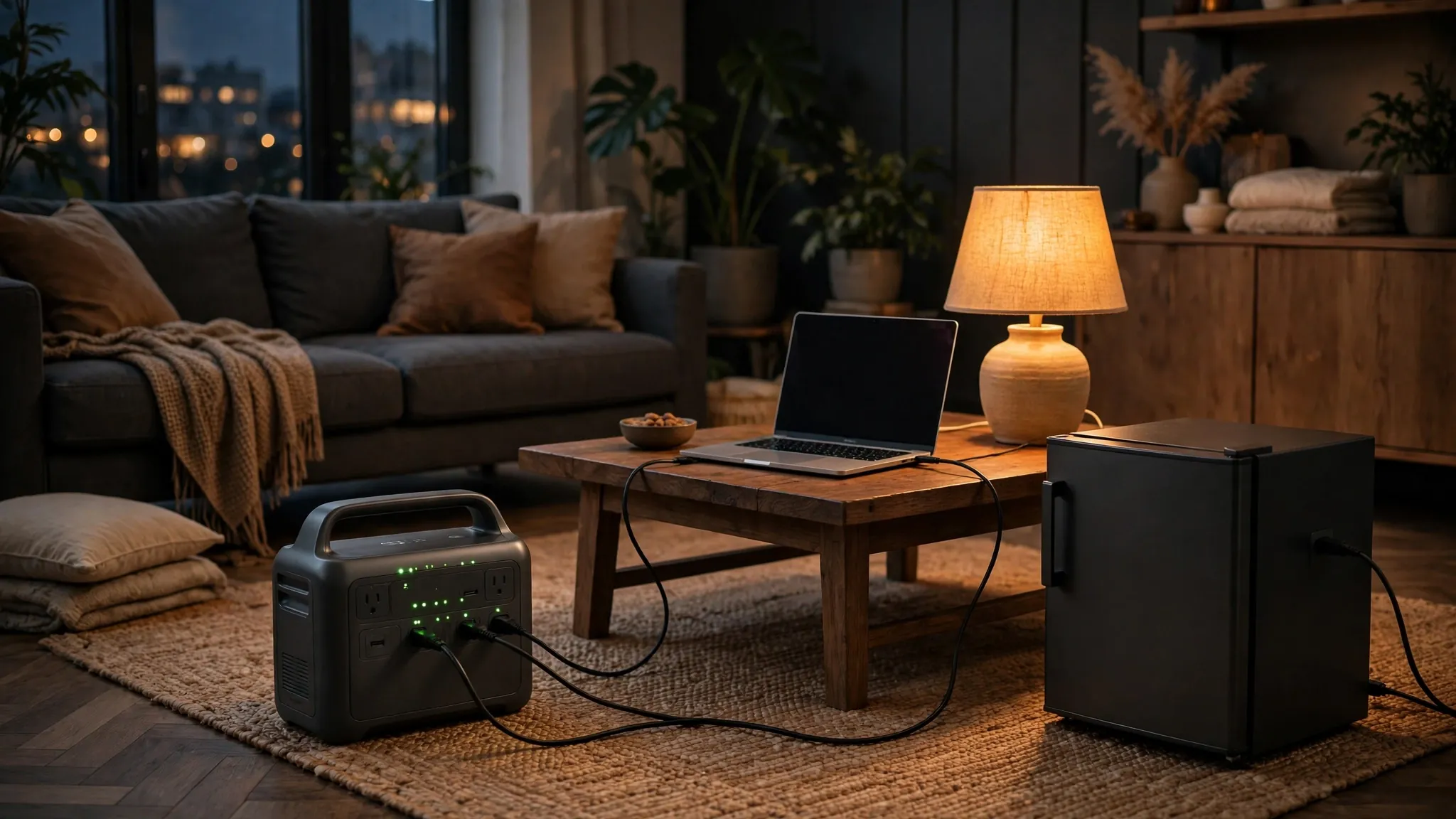
Quick answer: No fuel-burning generator can run in an apartment — not indoors, not on a balcony, and not in the parking garage — because it must sit at least 20 feet away outdoors with the exhaust pointed away, and carbon monoxide kills roughly 85–100 people a year in the US in exactly these improvised setups. The apartment-safe alternative is a battery power station: a 1 kWh unit (around $500–800) runs a fridge overnight plus phones, lights, and Wi-Fi, while a 2 kWh unit (around $1,200–1,800) stretches fridge runtime past a full day, silently and legally in a bedroom.
Every time a big storm knocks out power to a city, I get the same call a few days later from someone in an apartment building: “Mike, what generator should I buy so this doesn’t happen again?” They’ve been looking at a 3.500-watt generator for an apartment outage, and want to know if the balcony is big enough.
Here is the answer I give them, in the same order: a fuel-burning generator cannot be used in an apartment — not inside, not on the balcony, not in the parking garage. Not “shouldn’t.” Cannot, if you want everyone in the building to wake up. But you are not out of options. The apartment version of a generator exists, works well, and for most renters is genuinely better than the gas unit they were about to buy.
Can a generator run in an apartment or on a balcony?
No — and here’s exactly why, because “carbon monoxide is dangerous” is too vague to change anyone’s behavior at 11 p.m. during a blackout.
A portable generator’s exhaust contains carbon monoxide at concentrations hundreds of times higher than a car’s. The CPSC’s comparison that sticks with me: one running portable generator produces as much CO as hundreds of idling cars. CO is colorless and odorless. You don’t smell it, you don’t cough on it — you get a headache, get confused, sit down, and don’t get up. It kills roughly 85–100 people a year in the US, almost always in exactly the setups people improvise during outages.
The official guidance — CDC, CPSC, Red Cross, all of them — is that a generator must run at least 20 feet from the home, with the exhaust pointed away, outdoors. Twenty feet is not padded for lawyers: CO pools and drifts, and at 10 feet with a breeze toward the house, indoor levels can still climb into the danger zone. At balcony distance — three feet from a sliding door — it’s not a gray area at all.
Now count the ways an apartment fails this:
- Distance is impossible. A balcony puts the exhaust 2–6 feet from your own doors and windows, and often closer to your neighbor’s windows than to yours. You’re not just risking your household.
- CO comes through the building. It seeps under doors, through bathroom exhaust vents, through the wall penetrations for plumbing and HVAC. People have been poisoned by a generator running in a different unit or on a lower balcony. Walls are not a defense.
- The parking garage is not a loophole. Enclosed or partially enclosed garages concentrate exhaust and put everyone in the structure at risk. Same for hallways, stairwells, and laundry rooms.
- It’s not just CO. A generator on a wooden balcony or near vinyl siding is a fire a few feet from the building — and refueling a hot generator, the most common generator burn scenario, above other people’s homes is unthinkable.
In 18 years of post-storm walkthroughs, the generators I’ve seen chained to balcony railings scare me more than any panel I’ve ever opened. Please don’t.
Won’t a CO detector or an open window make it safe?
No. This comes up every time, so let me be blunt about both ideas.
A CO detector is a last-resort alarm, not a permission slip. Near a running generator, CO levels rise so fast that by the time a residential alarm sounds — they’re calibrated to trigger over time, not instantly — the air in a small apartment can already be at incapacitating levels. Detectors also don’t help your neighbors, whose units may fill while yours reads lower.
As for ventilation: no amount of open windows makes an indoor or balcony generator safe. Wind direction changes; CO doesn’t politely exit, it mixes. Every safety agency that has studied actual deaths lands in the same place: outdoors, 20 feet, exhaust away, or not at all. If your living situation can’t provide that, the fuel generator is simply not your tool.
For the full picture on distances, symptoms, and detector placement, see our guide to generator carbon monoxide safety — it will cure any remaining temptation.
What do your lease and the fire code say?
- Your lease. Most apartment leases prohibit storing or operating fuel-burning equipment and flammable liquids in the unit. Running a generator on the balcony is typically a lease violation serious enough for eviction — and the first fact insurers and lawyers reach for if anything goes wrong.
- Fire code. Fire codes based on the International Fire Code sharply restrict flammable-liquid storage inside dwelling units and prohibit fuel-fired equipment that endangers the structure. Local rules vary in detail, not in direction.
- HOA rules and noise ordinances. Condo and HOA documents almost universally ban balcony generators outright, and noise alone would do it: an open-frame portable makes 70–80 dB at 20 feet — louder than a vacuum cleaner, all night, through your neighbors’ walls. (And “I’ll just run it during the day” doesn’t rescue the idea — CO doesn’t care what time it is.)
Can you at least store gasoline in an apartment?
No — even if you imagine running the generator somewhere else.
Gasoline storage is the quiet killer in apartment fire statistics. A single gallon of gasoline vapor, mixed with air in a closet, has the explosive potential of roughly 14 sticks of dynamite. Fire codes limit in-unit flammable liquid storage to very small quantities in approved containers at most, most leases ban it entirely, and a standard 20 lb propane tank is prohibited indoors under NFPA 58 rules (the little 1 lb camping cylinders are the exception, with quantity limits).
The honest summary: apartment living is incompatible with fuel storage, and a generator without stored fuel is a sculpture. The battery route below isn’t a compromise — it’s the only route that fully works.
So what is the apartment version of a generator?
A battery power station — sold as a “solar generator,” though the solar part is optional. It’s a big lithium battery, an inverter, and outlets in a box with a handle. No exhaust, no CO, no noise beyond a cooling fan, legal in a bedroom, and it recharges from a wall outlet when power returns. Our portable power stations home backup guide covers the category in depth; what follows is the apartment-specific version.
The mental shift: a gas generator is sized in watts (how much it can run at once) and runs as long as it has fuel. A power station is sized in watt-hours (Wh) — the total energy in the tank. Your outage plan is an energy budget:
- Refrigerator: 100–200 W while running, compressor cycles about half the time → ~1,0–1,5 kWh per day. The most important load in your home.
- CPAP: 30–60 W with the heated humidifier off → ~250–400 Wh per night (more below).
- Wi-Fi router: ~10 W → 240 Wh per day. The load everyone forgets.
- LED lights, laptop, phones: 5–10 W per light, 50–65 W for a laptop, pocket change for phones. A few hundred Wh a day covers all of it.
- Window air conditioner: 450–1.500 W, running hard. The budget-killer — see below.
- Microwave or coffee maker: 1.000–1.500 W, but only for minutes. Fine in short bursts; it’s sustained loads that drain you.
So a typical outage day — fridge cycling, router on, lights, phones, laptop, CPAP at night — adds up to roughly 1,3–1,6 kWh of demand. A 1 kWh station covers most of that day; a 2 kWh station covers it comfortably, with margin for a second night. The fridge math in detail is in can a solar generator run a refrigerator.
Can a power station run air conditioning?
Basically no, and I’d rather disappoint you here than in a heat wave. Even a small 5.000 BTU window AC draws around 450–600 W continuously, and a 2 kWh station — a big, $1.500+ unit — gives you about three hours of AC, then it’s empty, with nothing left for the fridge.
The realistic heat plan is: a battery fan (USB or 20 V tool-battery fans sip power), cold water, blackout curtains drawn before the rooms heat up, and the fridge prioritized over everything. In genuinely dangerous heat, the right answer is a cooling center or a friend’s couch, not a bigger battery.
Can you recharge from a solar panel on the balcony?
Yes, with managed expectations:
- Practical panel size is 200–400 W — a rigid panel on the railing (check your lease first) or a folding panel you deploy during the outage.
- Expect 40–60% of nameplate on a good day. The angle is rarely ideal, the railing shades the bottom cells at some hour, and partial shade hurts disproportionately — one shaded corner can cut a cheap panel’s output in half.
- Real daily harvest: roughly 400–700 Wh from a 200 W panel on a decent summer day, 800–1.200 Wh from 400 W. In winter or facing north, halve it.
Read that against the fridge’s 1,0–1,5 kWh/day appetite: balcony solar won’t make you energy-independent, but it can stretch a 2 kWh station from one day of fridge runtime to two or three — often the difference between riding out an outage and throwing away $200 of food.
What does a good apartment setup actually cost?
Three tiers I recommend to renters:
~$300 — the essentials kit. A 300–500 Wh station (EcoFlow River-class, Jackery 300-class): phones, lights, the router for a day, most of a CPAP night. The “never sit in the dark with a dead phone again” tier, and it fits in a closet.
~$800 — the fridge tier. A ~1 kWh station with a 1.000+ W inverter. The fridge runs overnight and through most of a day, the CPAP is covered with margin, and you can microwave dinner. For most apartment dwellers this is the sweet spot — the tier I point my own family members to.
~$1.800 — the two-day tier. A ~2 kWh station plus a 200–400 W folding solar panel. Fridge past the 24-hour mark, a second night of CPAP, solar topping up by day. Hurricane-country and medically-dependent-household territory.
Compare honestly with the gas generator you didn’t buy: a decent 3.500 W portable costs $350–500, plus fuel storage you can’t legally have, plus maintenance on an engine you run twice a year — and it still can’t run where you live. The battery needs nothing beyond a top-up charge every few months. For renters, it’s not close.
You rent a house, not an apartment — does that change things?
Yes, completely. If you rent a single-family house with a yard, a fuel generator run outdoors, 20+ feet from the house, exhaust pointed away is physically fine — the 20-foot rule exists precisely for that setup. Your remaining homework: landlord permission in writing, fuel stored in a detached shed, and the same CO detector discipline as any homeowner. But in an attached unit, a townhome with a postage-stamp patio, or anything with a balcony, you’re back in apartment rules: if you can’t honestly pace off 20 feet between the exhaust and the nearest window — yours or a neighbor’s — it’s battery time.
What if someone in the home depends on a medical device?
Then this is not about comfort for you, and I’d plan a level more seriously than the tiers above:
- Dedicate capacity. A CPAP user’s station is not the household’s phone charger. Size a battery for the medical load first — our CPAP backup power guide walks the watt-hour math with the humidifier on and off — and treat everything else as a bonus.
- Register with your utility. Most utilities keep a medical/critical-care registry: advance notice of planned outages and, in many areas, priority restoration consideration, plus medical baseline rates at some. Registration is free and takes ten minutes, but it has to be done before the storm, usually with a doctor’s note.
- Tell your building. Larger buildings often keep a list of residents who need elevator access or wellness checks during long outages. Get on it.
- Have a leave plan. A battery buys hours to a day or two. For multi-day outages with a ventilator, oxygen concentrator, or refrigerated medication, the plan has to end at a powered location — family, hospital, shelter — and the battery’s job is to get you there safely.
The bottom line for apartment dwellers
You can’t run a fuel generator in an apartment. Not indoors, not on the balcony, not “just for an hour,” not with the window open and a detector on the shelf. The people who die from generator CO every year were, almost to a person, improvising one of those exact setups during an outage just like yours.
But the renter’s version of backup power is arguably better than the homeowner’s: silent, legal, maintenance-free, and sized exactly to the loads that matter — fridge, CPAP, router, lights, phones. Budget by watt-hours, spend the AC money on capacity instead, add a folding panel if you have sun, and register with your utility if a medical device is in the picture. That’s the whole playbook.
Keep reading
Frequently asked questions
Can I run a portable generator on my apartment balcony?
No. A balcony fails every safety test at once: it's far less than the 20 feet a fuel generator needs, the exhaust drifts into your windows and your neighbors', and carbon monoxide seeps through sliding doors, vents, and wall penetrations. It's also one of the most common setups in fatal CO cases after storms. If it burns fuel, it does not belong on a balcony — ever.
What is the best generator for an apartment?
A battery power station — the device marketed as a 'solar generator.' No exhaust, almost no noise, and legal to run in a bedroom. A 1 kWh station (around $500–800) covers a fridge overnight plus phones, lights, and Wi-Fi; a 2 kWh station (around $1,200–1,800) stretches fridge runtime past a full day. Size it by watt-hours, not watts.
Can a power station run a refrigerator during an apartment outage?
Yes. A full-size fridge draws 100–200 watts while the compressor runs and cycles on roughly half the time, so it uses about 1,0–1,5 kWh per day. A 1 kWh station gets you through the night and most of a day if you keep the door closed; a 2 kWh station covers a day and a half to two days. It cannot run an air conditioner for long — a small window AC drains 2 kWh in about three hours.
Can I store a gas can in my apartment for emergencies?
You shouldn't, and in most places you legally can't. Fire codes severely limit flammable-liquid storage inside dwelling units, most leases ban gasoline outright, and a gallon of gasoline has the explosive energy of roughly 14 sticks of dynamite. Standard 20 lb propane tanks are also prohibited indoors under NFPA rules. Batteries have none of these problems.
Can I recharge a power station with a solar panel on my balcony?
Yes, with modest expectations. A 200–400 W panel — rigid on the railing if your lease allows it, or a folding panel deployed during the outage — is the practical size. Expect only 40–60% of nameplate on a good day, because the angle is rarely ideal and partial shade cuts output sharply: roughly 400–700 Wh a day from 200 W, or 800–1,200 Wh from 400 W. Against a fridge's 1,0–1,5 kWh daily appetite, that will not make you independent, but it can stretch a 2 kWh station from one day of fridge runtime to two or three.