Can a Solar Generator Run a Refrigerator? The Real Math
**Quick answer:** Yes — a solar generator can run a refrigerator if its inverter surge rating clears the compressor spike and its battery is sized for the day, not the hour. A modern fridge runs at 100–200 watts but surges to 600–1,200 watts at startup and uses 1–2 kWh per day. After the inverter's 10–15% efficiency loss, a 1 kWh station runs it about 8–14 hours, a 2 kWh station roughly a full day, and a 3.6 kWh station 1.5–2.5 days. Keeping it running indefinitely generally takes 400W or more of solar panels.
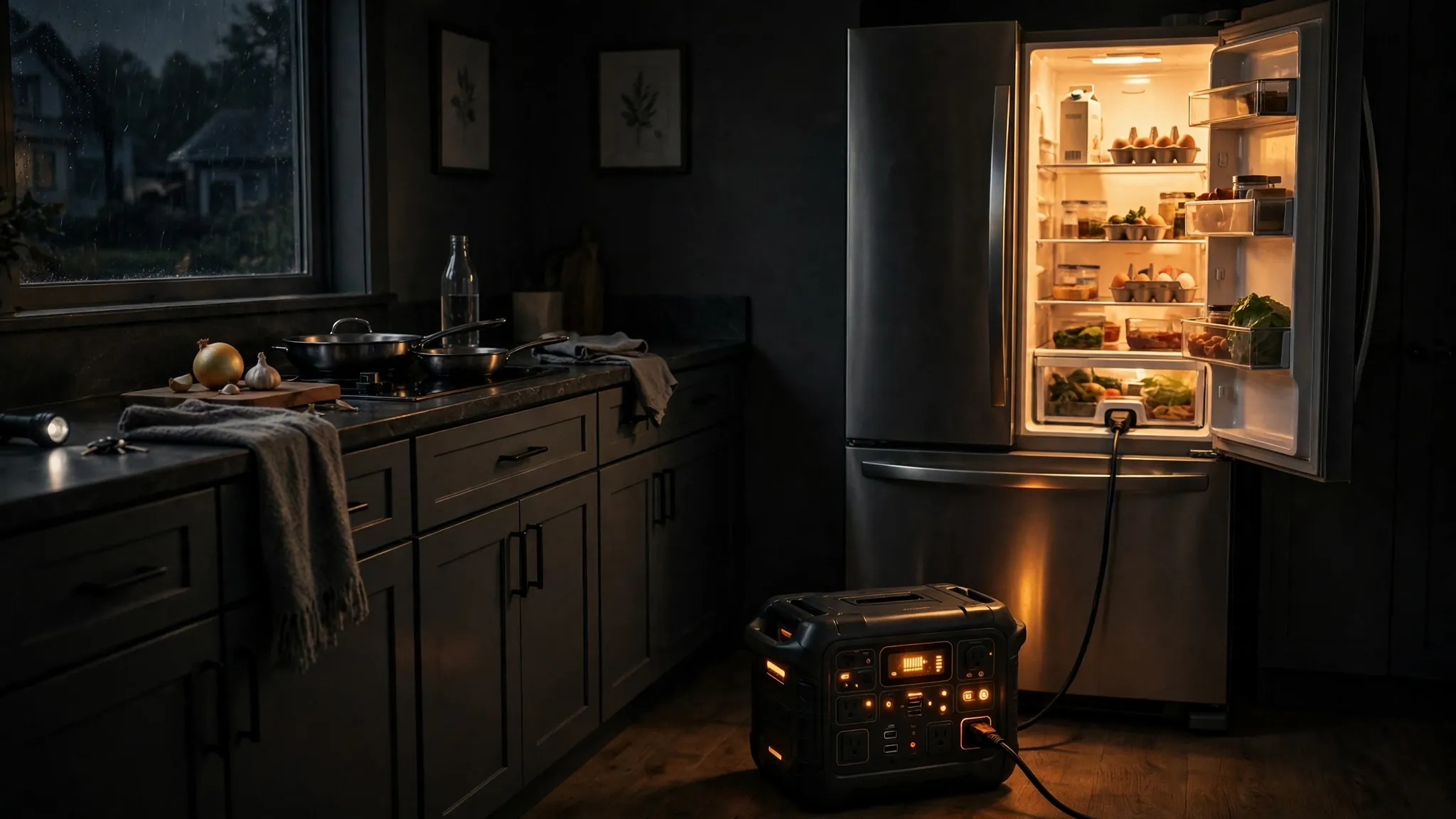
Quick answer: Yes — a solar generator can run a refrigerator if its inverter surge rating clears the compressor spike and its battery is sized for the day, not the hour. A modern fridge runs at 100–200 watts but surges to 600–1,200 watts at startup and uses 1–2 kWh per day. After the inverter’s 10–15% efficiency loss, a 1 kWh station runs it about 8–14 hours, a 2 kWh station roughly a full day, and a 3.6 kWh station 1.5–2.5 days. Keeping it running indefinitely generally takes 400W or more of solar panels.
Every time a storm knocks out a neighborhood, I get the same two calls. The first is about the generator that won’t start. The second, usually a day later, is from someone staring at a warming refrigerator full of groceries asking: can a solar generator run a refrigerator, or did I waste my money on this battery box? Eighteen years of installing backup power and I can tell you the honest answer is yes — but the fridge is the one appliance that exposes sloppy math faster than any other in the house.
A refrigerator is not a hard load. It’s a tricky one. It sips power most of the time, gulps it for a split second every time the compressor kicks on, and it never stops needing you — day and night, for as long as the outage lasts. Get two numbers right and almost any decent power station handles it. Get them wrong and you’ll have a station that beeps, shuts down, and leaves you with spoiled food anyway.
Can a solar generator actually run a refrigerator?
Yes. A modern refrigerator is well within the ability of most power stations sold today as “solar generators” — the battery-plus-inverter boxes from EcoFlow, Bluetti, Jackery, and the rest. If three conditions are met, the fridge runs:
- The inverter’s continuous rating exceeds the fridge’s running watts (almost always true — even small stations offer 300–600W continuous).
- The inverter’s surge rating exceeds the fridge’s startup spike (this is where cheap, small stations fail).
- The battery holds enough energy to cover the hours you need — the one people underestimate, because a fridge’s appetite is measured per day, not per hour.
Meet all three and the only remaining question is runtime. Miss the second and the station faults out the moment the compressor tries to start, even with a full battery. Miss the third and everything works beautifully — for four hours.
How many watts does a refrigerator actually use?
Here’s where most buying guides wave their hands. Real numbers, from real units I’ve metered in customers’ homes:
- Modern full-size fridge (18–25 cu ft, Energy Star, last 10 years): 100–180 watts while the compressor runs.
- Older full-size fridge (15+ years, or a big side-by-side with an ice maker): 200–300+ watts running. A 1990s garage fridge can be worse — I’ve measured one at 340 watts, running nearly all the time because its door seals were shot.
- Mini fridge: 50–100 watts running.
- Chest freezer: 80–150 watts running, and it cycles less often than a fridge once it’s cold.
- Upright freezer: 120–220 watts running.
The nameplate inside the door lists amps and volts — multiply them and you get a worst-case number (including defrost heaters), not a typical one. If you want to know what your fridge uses, buy a plug-in watt meter for about $25, leave it connected for 24 normal hours, and read the kilowatt-hours. That single measurement is worth more than any sizing chart on the internet, including mine.
Why does the startup surge matter more than running watts?
This is the number that actually matters, and it’s the one most product pages bury. A refrigerator’s compressor is an induction motor: when it starts, it draws a brief spike — typically 3 to 7 times its running draw — for a fraction of a second. A fridge that cruises at 150 watts kicks on at 600–1,200 watts. A warm, fully loaded fridge on a hot day pushes toward the top of that range.
Your inverter has two ratings: continuous (what it can deliver all day) and surge or peak (what it can deliver for a few seconds). The surge rating is the gatekeeper. If the compressor’s kick exceeds it, the inverter faults and shuts off, trips into an overload warning, or — on the cheapest no-name boxes — browns out and leaves the compressor humming and heating up, which is genuinely bad for it.
This is why a little 300Wh camping station with a 300W inverter (600W surge, if you’re lucky) is a coin flip on a full-size fridge, even though 150 running watts sounds comfortably inside its rating. And it’s why mid-size stations with surge ratings of 2,000–3,000W start a fridge without blinking. When you shop, read the surge rating first and the battery size second. Most shoppers do it backwards.
One more wrinkle: newer inverter-driven refrigerators (common on Samsung and LG models) ramp the compressor up gently instead of slamming it on. Those surge far less — sometimes barely above running watts. If your fridge has “inverter compressor” on the badge, your life just got easier.
How much energy does a fridge use in a day?
Watts tell you if the fridge will start. Watt-hours tell you how long it keeps running, and this is where the duty cycle saves you. A fridge compressor doesn’t run 24 hours a day — in a 70°F kitchen it cycles on roughly 30–50% of the time. So a fridge drawing 150 watts while running averages about 60 watts across the day:
- Modern efficient fridge: 1.0–1.5 kWh per day
- Typical full-size fridge: 1.5–2.0 kWh per day
- Old, large, or garage fridge in summer: 2.0–3.0 kWh per day, sometimes more
Conditions move these numbers hard — a fridge in a 90°F garage during a summer outage might cycle 60–70% of the time. When I size for an outage, I assume the bad end of the range. Groceries are expensive; optimism is not a sizing strategy.
How long will each size of power station run a fridge?
Here’s the table I wish was printed on every power station box. It assumes a typical full-size fridge using about 1.5 kWh/day (a ~60W average draw) and already accounts for the inverter losses I’ll explain next. Efficient fridges stretch these numbers; old ones shrink them.
| Power station class | Example size | Realistic fridge runtime |
|---|---|---|
| Small / camping | ~500Wh | 5–8 hours |
| Mid | ~1 kWh (1,000Wh) | 8–14 hours |
| Large | ~2 kWh (2,000Wh) | 18–28 hours — about a full day |
| Extra-large | ~3.6 kWh (EcoFlow Delta Pro / Bluetti AC300 class) | 1.5–2.5 days |
Read the table the way an electrician reads it. A 500Wh station is an overnight bridge — it keeps the fridge cold while you sleep through a short outage. It is not a fridge solution for a two-day outage, and no folding panel will make it one.
A 1 kWh station — the most popular size sold — genuinely runs a fridge through the night and a workday. That’s the sweet spot for “the power company says it’ll be back by tomorrow.” (Check the Wh on whatever model you’re eyeing, not the marketing name.)
At 2 kWh and above you’re into full-day territory, and the 3.6 kWh class behaves like a real backup system: a day and a half to two and a half days of fridge, with enough left for lights and phones if you’re disciplined. That class is also where whole-house thinking starts — see can a solar generator power a whole house and our portable power stations for home backup guide.
Don’t forget the inverter efficiency haircut
Every runtime claim on every box quietly assumes you get all the watt-hours you paid for. You don’t. Converting battery DC into household AC costs energy: the inverter typically runs 85–90% efficient, so a 1,000Wh station delivers roughly 850–900 usable watt-hours to your fridge. Call it a 10–15% haircut, every time — plus a few watts the inverter sips just being awake, and worse efficiency at the light loads a cycling fridge presents most of the time.
The table above already has the haircut baked in. Any table that doesn’t is lying to you by about 15%. Doing your own math? Divide the station’s capacity by 0.85 first.
Can solar panels keep a fridge running indefinitely?
This is the question that separates a fridge backup from a fridge system. The honest answer: only if the panel math beats the fridge math. A fridge needs 1,000–2,000Wh per day, and a panel’s rating is its output under perfect lab conditions. In a real yard:
- A 200W panel produces roughly 600–800Wh on a good sunny day — 3 to 4 effective sun hours is typical across most of the US, more in Arizona, fewer in Seattle or in winter.
- A 400W setup delivers roughly 1,200–1,600Wh/day in decent sun.
- Clouds, a bad angle, a tree’s afternoon shadow, or a panel lying flat can cut those numbers by a third or more.
So one 200W panel does not keep a fridge alive forever. It covers maybe half the fridge’s daily appetite — enough to stretch a 1 kWh station from “dead by morning” to “dead sometime tomorrow,” which is the difference between saving the food and tossing it. But indefinite running needs roughly 400W+ of panel in a sunny climate, an efficient fridge, and at least 1–2 kWh of battery to carry the night, because the fridge doesn’t stop eating at sunset and the panel doesn’t start at sunrise. There’s a gap every single day, and the battery bridges it.
If you’re weighing a big station against a gas generator or a whole-home battery for repeated long outages, the honest comparison is in our home battery vs generator breakdown. Batteries win on silence and indoor safety. They lose on one brutal fact: gasoline is refillable energy, and sunlight is weather.
Is a freezer or a mini fridge easier to run?
Easier, both of them — for different reasons.
Mini fridges draw so little (50–100W running, tiny surges, 0.3–0.6 kWh/day) that even a 500Wh station runs one for a day or more. If your outage plan is “keep the insulin and the baby formula cold,” a mini fridge on a small station is one of the best-value setups there is.
Freezers are the marathon runners. A chest freezer’s thick insulation and top-opening design mean the cold stays put, the compressor cycles less, and daily consumption often lands at 0.8–1.5 kWh even for a big unit. The catch is the same startup surge — a big chest freezer can still kick at 800W+ — and the consequence when you lose: once a freezer full of meat thaws past 40°F for two hours, that food is done. For how long frozen food survives with no power at all, see how long food lasts in a freezer without power.
Side-by-side fridge-freezers and garage units sit at the hard end: bigger compressors, ice makers, defrost heaters, and brutal duty cycles in the heat. Budget 2 kWh/day.
How do you stretch a fridge’s runtime on a battery?
The cheapest watt-hour is the one you never use. Tricks I give customers before selling them a bigger battery:
- Pre-chill before the storm. If an outage is forecast, turn the fridge down to 34–35°F and the freezer to 0°F the night before. Cold-soaked food coasts for hours while you’re still figuring things out.
- Freeze water bottles in advance. A freezer packed with frozen bottles holds temperature far longer than a half-empty one — full is efficient, and a packed fridge cycles less than an empty one.
- Don’t open the door to check. Every opening dumps the cold air. Put a $10 appliance thermometer inside, and if you must look, look once.
- Duty-cycle on long outages. On day two with a draining battery, run the fridge for an hour, then unplug it for two to three hours with the door shut. A closed, full fridge holds safe temperatures through those gaps, and you can cut total energy use by a third or more. The single most effective trick on a multi-day outage.
- Keep everything out of the heat. A battery cooking in a 100°F garage loses capacity and the fridge beside it works harder. Coolest room, vents unblocked.
- Shed the extras. Ice maker off, other loads unplugged, and don’t charge the neighborhood’s phones off your fridge battery.
So which setup should you actually buy?
Here’s my honest verdict, by scenario:
- Short outages (a few hours to overnight), a few times a year: A 1 kWh station with a 1,500W+ surge rating runs your fridge with room to spare, plus lights and phones. The right spend for most people.
- Overnight, and you already own a 500Wh station: It’ll carry a modern fridge through the night if the door stays shut. Plan on a recharge or a generator by morning.
- One-to-three-day outages: 2 kWh minimum, 3.6 kWh comfortable — plus 400W of panels if the sun cooperates. Or accept duty-cycling as your way of life.
- Frequent multi-day outages (hurricane country, unreliable rural grid): A battery alone is the wrong primary tool. A gas or dual-fuel generator for bulk energy, with the station as the quiet overnight fridge keeper, beats either one alone — station silent at night, generator recharging everything in a few loud morning hours. I install that hybrid more than any other setup now.
Can a solar generator run a refrigerator? Yes. Just buy for the surge, size for the day, shave 15% off every promise on the box, and you’ll be the house on the street eating cold leftovers while everyone else is throwing food away.
Keep reading
Frequently asked questions
Can a solar generator run a refrigerator?
Yes — most mid-size and large portable power stations run a modern refrigerator without trouble. The two numbers that decide it are the inverter's surge rating (a fridge compressor kicks on at 600–1,200 watts, so the station must handle that spike) and the battery size (a typical fridge uses 1–2 kWh per day, so a 1 kWh station buys you roughly 8–14 hours, a 2 kWh station about a full day).
How many watts does a refrigerator use?
A modern full-size refrigerator runs at 100–200 watts once the compressor is going, and older or larger models can draw 300 watts or more. The startup surge is the bigger deal: for a fraction of a second, the compressor can pull 600–1,200 watts. Check the energy label inside the door or test with a $25 plug-in watt meter — your fridge's real numbers beat any chart.
How long will a 1,000Wh power station run a refrigerator?
Plan on 8–14 hours. A fridge doesn't run constantly — the compressor cycles on 30–50% of the time, so a typical modern fridge averages 40–80 watts across the day. After the inverter's 10–15% efficiency loss, a 1,000Wh station delivers roughly 850–900 usable watt-hours — about half a day of fridge duty. Hot garages and frequent door openings push it toward the low end.
Can a 200-watt solar panel keep a refrigerator running?
Not by itself in most cases. A 200W panel in real sun produces roughly 600–800Wh on a good day, while a fridge needs 1,000–2,000Wh per day. The panel slows the drain and adds hours, but running a fridge indefinitely generally takes 400W or more of panel in a sunny climate, an efficient fridge, and a battery big enough to bridge the night.
What size solar generator should I buy to run a refrigerator during an outage?
For short outages of a few hours to overnight, buy a 1 kWh station with a surge rating of 1,500 watts or more — it runs a typical fridge with room left for lights and phones. A 500Wh station you already own can bridge one night if the door stays shut. For one-to-three-day outages, step up to 2 kWh minimum or 3.6 kWh for comfort, ideally with 400 watts of panels, and for frequent multi-day outages pair the station with a fuel generator in a hybrid setup.