How Long Will Food Last in a Freezer Without Power?
**Quick answer:** With the door kept closed, a full freezer keeps food safe for about 48 hours and a half-full one for about 24 hours, while a refrigerator only buys you about 4 hours. Everything turns on one line — 40°F: food at or below it is safe, and perishable food that spends more than 2 hours above it should be discarded. Filling the freezer's empty spaces with frozen water bottles before an outage is the free way to stretch that clock.
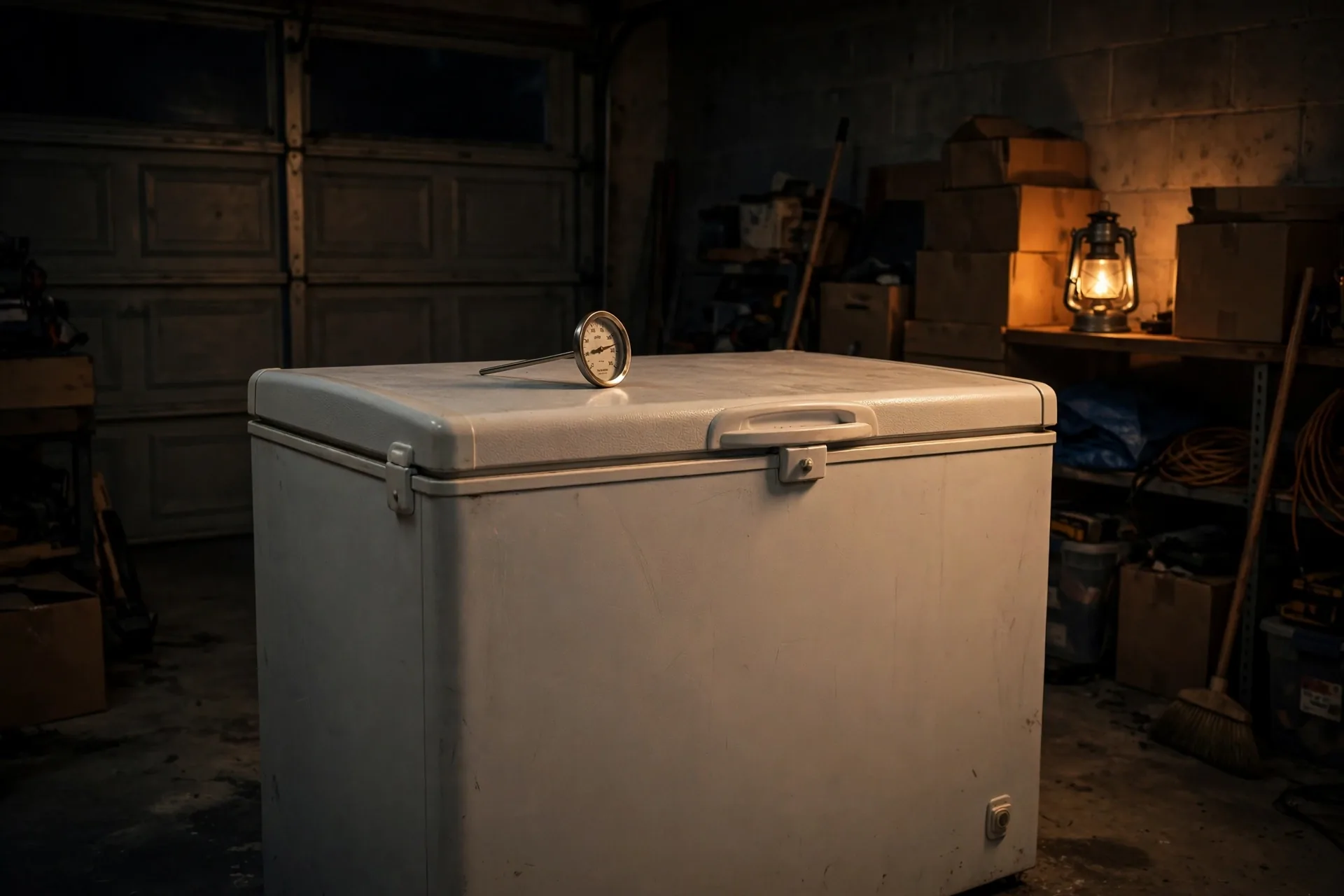
Quick answer: With the door kept closed, a full freezer keeps food safe for about 48 hours and a half-full one for about 24 hours, while a refrigerator only buys you about 4 hours. Everything turns on one line — 40°F: food at or below it is safe, and perishable food that spends more than 2 hours above it should be discarded. Filling the freezer’s empty spaces with frozen water bottles before an outage is the free way to stretch that clock.
The storm knocks the power out at 9 p.m., and by 9:05 everyone is asking the same question: how long will food last in a freezer without power before we throw away a few hundred dollars of groceries? I’ve taken that phone call for 18 years, usually from a customer whose generator I installed, and the honest answer is: longer than you fear, shorter than you hope, and mostly decided by what you do in the first hour.
The USDA numbers behind this article are simpler than the arguments on social media. Learn three numbers and one temperature and you can make every keep-or-toss decision yourself.
What are the official numbers? 48 hours, 24 hours, 4 hours
The USDA and FDA guidance comes down to this:
| Appliance | Safe hold time (door closed) |
|---|---|
| Full freezer | ~48 hours |
| Half-full freezer | ~24 hours |
| Refrigerator | ~4 hours |
| Fridge-freezer compartment (kitchen combo) | ~24 hours, often less |
Those hold times assume the door stays closed. Every peek costs you — warm air rushes in, cold air spills out, and the clock accelerates. I tell my customers to treat the freezer door during an outage the way they’d treat the door of a submarine.
The second half of the rule is the temperature line: 40°F (4°C). Food held at or below 40°F is in the safe zone. Between 40°F and 140°F is what food-safety people call the danger zone, where bacteria like salmonella and listeria can double every 20 minutes or so. The working rule: perishable food that has spent more than 2 hours above 40°F gets discarded, no matter how it looks or smells. More on why smell is a liar in a minute.
Notice what the numbers are really measuring. A freezer full of food frozen solid at 0°F doesn’t jump to 41°F the moment the compressor stops. It warms slowly, degree by degree. The 48 hours is roughly how long a packed freezer takes to drift from 0°F up to that 40°F line. Everything in the next section is about slowing that drift down.
What actually changes the clock?
Two neighbors, same outage, same model freezer — one saves everything, the other loses it all in a day. The difference is almost always these four variables.
How full is it? A packed freezer is a giant block of thermal mass — frozen food keeps other frozen food cold, the way ice keeps a drink cold long after one cube would have melted. That’s the whole reason a full freezer gets 48 hours and a half-full one gets 24. A quarter-full freezer is mostly cold air, and air holds almost no cold. This is the single biggest factor, and it’s the one you can fix for free, below.
How often does the door open? Each opening dumps a share of the cold air and pulls in kitchen air at 75°F or worse. Five “just checking” peeks a day can cut your hold time by a third. Tape a note on the door: Do not open. The food is fine. It will not be fine if you open this.
How warm is the room? A freezer in a 60°F basement warms far more slowly than one in a 95°F garage in August. Summer outages in a hot garage are the worst case — take the low end of every estimate here. A winter outage in an unheated northern garage can stretch the same freezer for most of a week.
What kind of freezer is it? Chest freezers beat uprights, every time. Cold air sinks, so opening an upright dumps the cold onto your feet; in a chest freezer it sits in the box like water. Chest freezers also tend to have thicker insulation. The little freezer compartment of a kitchen fridge is weakest of all — small, opened with the fridge, sharing a thin wall with a warming refrigerator. Treat its contents as 24-hour food at best, and eat from it first.
How can you stretch 24 hours into 3 or 4 days?
This is the part I wish every one of my customers did before storm season, because most of it costs nothing.
Fill the empty space with ice before you need to. Fill plastic bottles, jugs, and zip bags (leave headspace for expansion) with water and freeze them in every gap. A half-full freezer stuffed with frozen water bottles behaves almost like a full one — you’ve just replaced expensive thermal mass (food) with free thermal mass (ice). And unlike food, nobody grieves melted water. I keep about eight gallon jugs frozen in my own chest freezer for exactly this reason.
Group the food together. If the freezer is half empty, pull everything into one tight pile in the middle and pack your ice bottles around it. A concentrated block thaws from the outside in, and the center stays frozen far longer than the same items spread out in a single layer.
Throw blankets over it. Drape moving blankets or sleeping bags over the top and sides. It looks ridiculous and it works — you’re adding insulation the manufacturer didn’t. Leave the vents at the back uncovered, and pull the blankets off once it’s running again.
Block ice beats bagged cubes. A 10-pound block has far less surface area than 10 pounds of cubes, so it melts much more slowly. Buying ice mid-outage, blocks or frozen jugs are the smarter buy for the freezer; save cubes for the cooler.
Dry ice is the heavy artillery. At -109°F (-78.5°C), it’s cold enough to keep food frozen solid, not just slow the thaw. Math that holds up in practice: 25 pounds buys about 24 hours, 50 pounds gets you closer to 48, door closed. Lay it on cardboard over the food — directly against packages it can crack plastic. Three safety rules, none optional: gloves only (it burns skin on contact), ventilate the room because the CO₂ it gives off displaces oxygen, and never store it in an airtight container, including a latched cooler — the pressure will blow it open. Buy it last, and know it vanishes at 5–10 pounds a day no matter what.
When the power comes back, how do you know what’s still safe?
You don’t guess. You measure.
The $5 appliance thermometer is the whole game. Put one in your freezer and one in your fridge today, while nothing is wrong. When power returns, check it promptly: if the food is still at 40°F or below, or still holds visible ice crystals, it’s safe by USDA rules. Ice crystals are your friend — they mean that food never left the safe zone.
Ice cream is the telltale. The trick every appliance tech knows: check the ice cream first. It melts early and refreezes into a dense, shrunken brick that’s obviously wrong. If it’s still creamy and normal, the freezer never got warm. If it’s a sad brick, the freezer spent real time above freezing and everything else gets judged more harshly.
Smell and taste are not instruments. The bacteria that make people genuinely sick are mostly odorless. Food can smell fine and be loaded; food can smell off from freezer burn and be harmless. Never taste something to “check” it — one bite is a full dose. When the thermometer and the clock say it’s questionable, the answer is the trash. I’ve never heard a customer regret throwing food out. I have heard the other story.
Food by food: what keeps, what goes
Assuming the food thawed completely or sat above 40°F for more than 2 hours, here’s the USDA-based rundown I give people standing in front of an open freezer with a trash bag:
| Food | Verdict after full thaw / >2 hrs above 40°F |
|---|---|
| Raw beef, pork, lamb (roasts, steaks, chops) | Discard if fully thawed and warm; cook immediately if still ≤40°F or icy |
| Ground meat, raw poultry, seafood | Discard — highest risk category, no exceptions |
| Cooked meats, leftovers, pizza, soups, casseroles | Discard |
| Milk, cream, yogurt, soft cheeses (brie, ricotta) | Discard |
| Hard cheeses (cheddar, parmesan), butter | Keep — can be refrozen; trim any mold from hard cheese |
| Eggs in shell, egg dishes | Discard egg dishes; shell eggs that stayed cold keep briefly in fridge |
| Ice cream and frozen yogurt | Discard if melted — and it melts early |
| Frozen vegetables and fruits | Discard if warm >2 hrs; fine to refreeze if still icy (quality drops) |
| Bread, rolls, cakes without cream filling | Keep — refreeze freely, quality is the only casualty |
| Frozen dinners, entrees | Discard if thawed and warm |
Two carve-outs worth knowing. First, fruits and vegetables that still have ice crystals can be cooked and eaten even late in the game — heat rescues a lot that cold couldn’t. Second, anything with an off odor, slimy film, or swollen packaging goes in the trash regardless of what any table says. The table is for food that crossed the temperature line but otherwise looks normal.
Can you refreeze thawed food, or is that a myth?
It’s mostly a myth, and an expensive one. The USDA position is plain: food that still contains ice crystals or has stayed at 40°F or below can be safely refrozen. You will lose quality — thawed-and-refrozen meat comes back drier and tougher, ice cream never recovers, bread goes stale faster — but it will not hurt you.
The rule people garble is this: refreezing doesn’t fix anything. If bacteria multiplied while the food sat warm, freezing just pauses them; they wake up at the next thaw. That’s why the 2-hour line is the line. Practical advice: partially thawed meat that’s still cold is usually better cooked now and frozen as a finished dish — a pot of chili from borderline ground beef is safe, keeps for months, and tastes better than refrozen raw meat ever will.
Can a small generator or power station actually save the freezer?
Yes — and this is the part most outage advice leaves out. A refrigerator or freezer is one of the cheapest loads in your house to run on backup power. A typical fridge-freezer draws only 100–200 watts running. A chest freezer is often under 100 watts. The catch is the compressor’s startup surge: 800–1,200 watts for a split second each time it kicks on. Any inverter generator or power station rated for that surge — which is nearly all of them, including little 1,000-watt-class stations — can run your cold boxes.
Even better, you don’t have to run it continuously. The strategy I set up for customers is duty cycling: run the generator or station for about 1 hour, then let the fridge and freezer coast, doors closed, for 2–3 hours, then repeat. You cut fuel burn by two-thirds while keeping food comfortably below 40°F — on a small inverter generator, a full day of food protection costs less than a gallon of gas. Compare that with the $200–400 of food the average household I visit keeps in the freezer.
A priority note from wiring houses through real outages: think in order of consequence. A sump pump protecting a finished basement outranks everything — our guide to what size generator you need for a sump pump covers that math — but the cold boxes come right after and ask for so little that there’s rarely a conflict. The what a 7,500-watt generator can run breakdown shows the headroom a mid-size unit leaves, the storm preparedness checklist covers the pre-storm routine, and a modest unit from our portable power stations for home backup guide is genuinely enough if food is your main worry.
Does insurance pay for spoiled food?
Sometimes, and it’s worth a phone call. Many homeowners and renters policies include food-spoilage coverage — commonly $250–500 — for outage losses, and many insurers waive the deductible specifically for food claims. Some utilities also reimburse after long outages caused by their own equipment failures. Photograph what you’re throwing out and jot a rough list with values before it goes in the bin; those five minutes are the difference between a paid claim and a denied one. Don’t let a possible claim delay the toss, though — photograph it, bag it, gone.
The short version to tape inside a kitchen cabinet
Keep the door shut and a full freezer buys you 48 hours, a half-full one 24, the fridge 4. Everything turns on 40°F and the 2-hour rule above it. Fill the gaps with frozen water bottles now, put a $5 thermometer in both boxes, and remember the cold boxes sip so little power that a small generator cycling a few hours a day carries them through almost any outage. People who lose a freezer of food in a storm rarely lose it to the storm — they lose it to peeking, guessing, and hoping. Don’t guess. Measure.
Keep reading
Frequently asked questions
How long will food last in a freezer without power?
Per the USDA, a full freezer keeps food at a safe temperature for about 48 hours if the door stays closed, and a half-full freezer for about 24 hours. A refrigerator only buys you about 4 hours. The deciding number is 40°F: food that stays at or below 40°F is safe, and food that spends more than 2 hours above 40°F should be discarded.
How long can a refrigerator go without power before food spoils?
About 4 hours with the door closed. After that, perishables like milk, eggs, meat, leftovers, and soft cheeses move into the danger zone as the temperature climbs past 40°F. Hard cheeses, butter, unopened shelf-stable items, and whole fruits and vegetables last considerably longer. When in doubt, a $5 appliance thermometer tells you the actual temperature instead of a guess.
Can you refreeze food that thawed during a power outage?
Yes — if the food still contains ice crystals or has stayed at 40°F or below, the USDA says it can be safely refrozen or cooked, though quality (texture, moisture) will suffer. If it has been above 40°F for more than 2 hours, throw it out; refreezing doesn't kill bacteria that grew while it was warm. Partially thawed raw meat is often best cooked first, then frozen as a cooked dish.
How much dry ice do I need to save a freezer during an outage?
A rough rule is 25 pounds for about 24 hours in an average home freezer, and 50 pounds stretches that to roughly 48 hours with the door kept shut. Dry ice sits at -109°F, so handle it with gloves, never bare hands, keep the room ventilated, and never seal it in an airtight container. Buy it as late as possible — it sublimates about 5–10 pounds a day even sitting in a cooler.
Does a chest freezer keep food cold longer than an upright in an outage?
Yes. Cold air sinks, so when you open an upright freezer the cold dumps out onto your feet, while in a chest freezer it sits in the box like water and stays put. Chest freezers also tend to have thicker insulation, so the same outage clock runs slower. The weakest option of all is the little freezer compartment of a kitchen fridge-freezer — small, opened with the fridge, and sharing a thin wall with a warming refrigerator. Treat its contents as 24-hour food at best, and eat from it first.