What Can a 5000 Watt Generator Run? Real Loads, Real Math
**Quick answer:** A true 5,000-running-watt generator (about 6,250 starting watts) keeps a house livable through an outage — refrigerator, freezer, sump or well pump, furnace blower, lights, internet and a window AC — as long as the big heating appliances are gas. Plan steady loads at no more than about 4,000 watts, because electric water heaters, electric dryers and standard central AC are what push past what this size can run together.
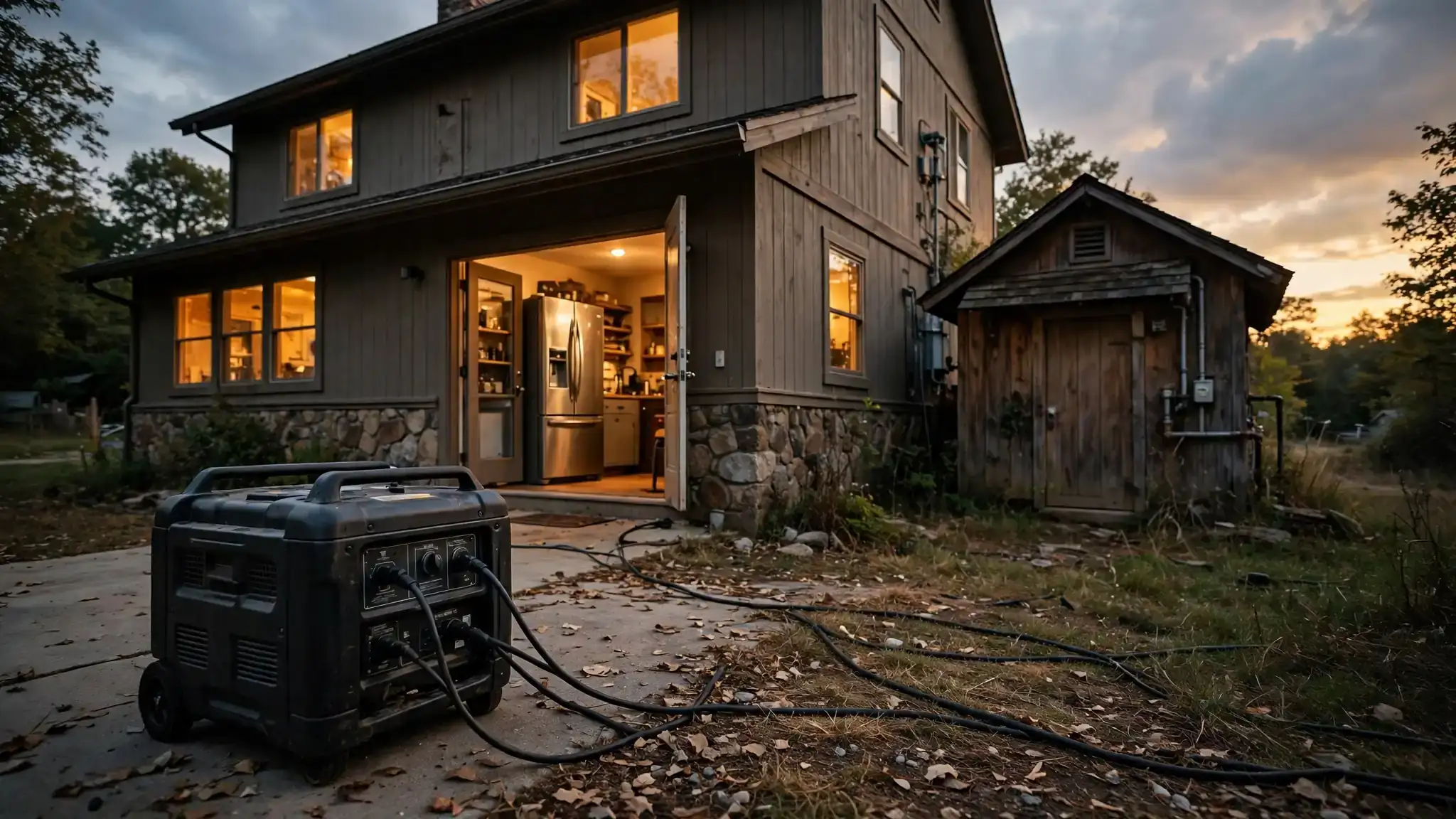
Quick answer: A true 5,000-running-watt generator (about 6,250 starting watts) keeps a house livable through an outage — refrigerator, freezer, sump or well pump, furnace blower, lights, internet and a window AC — as long as the big heating appliances are gas. Plan steady loads at no more than about 4,000 watts, because electric water heaters, electric dryers and standard central AC are what push past what this size can run together.
“What can a 5000 watt generator run?” is the question I get from homeowners who want real backup power without paying for capacity they’ll never use — and honestly, 5,000 watts is the size I point most of them to. It’s enough to keep a house genuinely livable through an outage: food cold, basement dry, furnace blowing, lights on, phones charged, and a window AC in the bedroom. What it won’t do is run an all-electric house like the grid never left. The difference between happy owners and frustrated ones is almost never the generator. It’s whether somebody did the load math before the storm. So let’s do it.
Is that 5,000 watts running or starting?
Read the box carefully, because this class is where manufacturers play the shell game hardest. A true 5,000W generator delivers 5,000 running watts and around 6,250 starting (peak) watts. But half the machines advertised as “5000 watt” are actually 5,000 starting watts and only 3,900 running — most of the quiet inverter models are rated this way. Those are fine machines, but they’re not the same machine. Everything in this article is about the true 5,000-running-watt class. If the unit you’re eyeing is 3,900 running, scale every combo below down by about a fifth.
The two numbers, quickly:
- Running watts (5,000): what it produces continuously, all day. This is your budget.
- Starting watts (~6,250): a few seconds of surge for motor startups. This is your emergency fund.
And the rule I give every customer: plan your steady load at no more than 80% of running watts — 4,000 watts on this size. An engine loafing at 60–75% load runs cooler, quieter, and sips fuel. An engine pinned at 98% all night is wearing itself out and burning oil to prove it. For the full sizing method, see What Size Generator Do I Need to Run My House?.
How many watts does everything in your house actually use?
Same table I use for the bigger sizes, because the appliances don’t care what generator you bought. Two numbers per item: running watts and the starting surge when a motor kicks on. Resistive loads (heaters, kettles, ovens) have no surge.
Kitchen
| Appliance | Running watts | Starting watts |
|---|---|---|
| Refrigerator (modern, 18–25 cu ft) | 150–250 | 800–1,200 |
| Chest freezer | 100–200 | 600–1,000 |
| Microwave | 1,000–1,200 | none |
| Coffee maker | 800–1,200 | none |
| Toaster oven | 1,200–1,500 | none |
| Electric kettle | 1,200–1,500 | none |
Comfort and climate
| Appliance | Running watts | Starting watts |
|---|---|---|
| Gas furnace blower (1/2 HP) | 600–900 | 1,500–2,200 |
| Window AC (8,000–10,000 BTU) | 900–1,200 | 2,200–3,000 |
| Window AC (12,000 BTU) | 1,200–1,500 | 3,000–3,600 |
| Portable space heater | 1,500 | none |
| Ceiling fan (each) | 50–100 | 150–250 |
Water and essentials
| Appliance | Running watts | Starting watts |
|---|---|---|
| Well pump (1/2 HP) | 1,000 | 2,000–3,000 |
| Well pump (1 HP) | 2,000 | 4,000–6,000 |
| Sump pump (1/3 HP) | 800 | 1,500–2,000 |
| Sump pump (1/2 HP) | 1,050 | 2,000–2,500 |
| Electric water heater (40–50 gal) | 4,500 | none |
| Electric dryer | 4,500–5,500 | none |
Electronics and misc
| Appliance | Running watts | Starting watts |
|---|---|---|
| LED lights (whole house) | 150–250 | none |
| Wi-Fi router + modem | 20–40 | none |
| TV + streaming box | 120–200 | none |
| Laptop / home office setup | 150–300 | none |
| Washing machine | 500–800 | 1,500–2,300 |
| Garage door opener | 500–700 | 1,000–1,400 |
Two items should jump out. The electric water heater at 4,500 watts is 90% of this entire generator by itself — that’s the single appliance that decides whether 5,000 watts is “plenty” or “not enough” for your house. And the 1 HP well pump’s 6,000-watt starting surge nearly maxes out the peak rating before anything else draws a watt.
Combo 1: The essentials load (~2,100 watts)
This is the outage most people actually live through: keep the food safe, the basement dry, and the house warm or tolerable.
| Load | Running watts |
|---|---|
| Refrigerator | 200 |
| Chest freezer | 150 |
| Sump pump (1/3 HP, cycling) | 800 (intermittent) |
| Gas furnace blower (winter) | 800 |
| 10 LED lights | 100 |
| Wi-Fi + modem | 30 |
| Phone and laptop charging | 70 |
| Total steady load | ~2,100 |
That’s 42% of capacity. The worst moment — sump pump starting (2,000W surge) while the furnace blower and fridge are both running — peaks around 4,300 watts, nowhere near the 6,250-watt ceiling. At this load the generator burns roughly 0.35–0.45 gal/hr and will run 11–14 hours on a typical tank. If this combo is all you need, frankly, you could even step down a size — but the headroom here is what lets you add comfort loads without doing arithmetic in the dark. That step down is usually the 4,000-watt generator class, which still covers this essentials list while trimming cost and fuel use. Sump sizing details live in What Size Generator Do You Need for a Sump Pump?.
Combo 2: Essentials plus real comfort (~3,800 watts)
Summer version — this is the load that makes people say the outage “wasn’t bad, actually.”
| Load | Running watts |
|---|---|
| Everything in Combo 1 (minus furnace blower) | ~1,300 |
| Window AC (10,000 BTU, bedroom) | 1,000 |
| Window AC (8,000 BTU, living room) | 900 |
| TV + streaming | 150 |
| Home office (laptop, monitor, router) | 250 |
| Ceiling fans ×2 | 150 |
| Total steady load | ~3,750 |
Right at the 80% target, and it works — with one discipline: the two window AC compressors must not start in the same second as the sump pump. In practice they cycle on their own schedules and collisions are rare and brief; the 6,250-watt peak absorbs a two-motor overlap. What trips people up is adding the microwave (1,200W) on top of everything at the exact moment a compressor kicks. If the breaker pops once during a three-day outage, that’s almost always why. Drop one AC while you cook. Problem solved.
Winter version swaps the two window ACs for the furnace blower (800W) and lands closer to 2,900 watts, leaving room for a 1,500-watt space heater in one closed-off room — still under 4,400 total. That’s a genuinely warm house.
Combo 3: The rotation load (~4,000 watts, managed)
Want to run the washing machine, the microwave, and keep everything in Combo 2? You can — just not simultaneously. This is the combo nobody prints on the box, and it’s how 5,000W owners actually live through week-long outages:
- Morning: essentials + coffee maker (1,000W) + furnace — ~3,900W.
- Laundry hour: one window AC off, washer on (700W running, 2,300W surge on agitation start) — ~3,600W.
- Dinner: ACs back on, microwave instead of the oven — peaks ~4,600W while the microwave runs, for ten minutes.
Nothing here exceeds the generator. It just requires the one skill this size demands: knowing that two big intermittent loads at once is the limit. If that sounds like a chore, it’s not — after the first day the rotation is habit.
What can’t a 5000 watt generator run together?
Let me be blunt about the failures, because these are the returns and angry reviews:
- Central AC, 3-ton: running draw (~3,500W) looks fine on paper, but the compressor needs 9,000–12,000 watts to start. The generator can’t. Voltage collapses, the compressor strains, and you’re risking a four-figure compressor to save nothing. A soft starter cuts that surge 60–70%, which makes a small 1.5–2-ton system borderline on this size — and leaves you almost nothing else. My honest advice: if central AC is non-negotiable, buy the 7,500W class instead — the full comparison is in What Can a 7,500-Watt Generator Run?.
- Electric water heater + anything meaningful: 4,500 watts alone. You can run it solo for a 45-minute recovery cycle with everything else off — a legitimate rotation trick — but paired with a dryer or AC it’s a non-starter.
- Electric dryer: 4,500–5,500 watts. Many units exceed this generator outright. Line-dry for two days; you’ll survive.
- Electric range/oven: one burner (1,200–2,500W) is fine. The oven element plus burners is not.
- Well pump 1 HP + window ACs: the pump’s 6,000W start surge, landing on top of two running ACs, will trip the breaker. Deep-well homes with 1 HP pumps should size up.
Notice the pattern: everything on the “can’t” list is a big electric heating or cooling load. Gas appliances are what make this size work.
How much gas will it burn while doing all this?
At the Combo 2 load (~3,800W, roughly 75%), expect about 0.5–0.6 gal/hr; at essentials-only, closer to 0.4. A three-day outage at comfort load is roughly 30–40 gallons — plan your cans and your stabilizer accordingly, because that’s four trips to the gas station if you only own two five-gallon cans. The per-size burn tables, including the 5,500W class that shares these engines, are in How Much Gas Does a 5,500W Generator Use? and the broader generator fuel consumption guide.
Which 5000 watt generators should you actually look at?
Three classes, three different ownership experiences:
- Conventional open-frame (the workhorse): Westinghouse WGen5000 (5,000 running / 6,250 peak,
$550–700) and Champion’s 5,000-running-watt open frames ($600–750). Loud — low-to-mid 70s dB — mechanically simple, cheap to fix, and the best watts-per-dollar in the class. If it’ll live in a shed 30 feet from the house, this is my default recommendation. - Dual-fuel versions: Champion’s 6250/5000 dual-fuel open frame (~$700–850) runs 5,000 watts on gasoline, about 4,500 on propane. Propane stores forever and runs cleaner; if your load plan fits in 4,500 watts, never buying stale-gas anxiety again is worth the premium.
- Open-frame inverters: Champion’s 6,250-watt open-frame inverter (5,000 running, ~$800–950) is quieter (mid-60s dB), sips fuel at light load with eco mode, and makes clean power for electronics without a second thought. If the generator will sit near a bedroom window or a neighbor’s fence, this is the one.
Skip any “5000W” unit whose running watts are under 4,500 unless the price reflects it — you’re buying Combo 1, not Combo 2.
Who is a 5000 watt generator perfect for?
After eighteen years of sizing these for people: the 5,000W class is the sweet spot for a small-to-medium home where heat, hot water, and cooking are gas. That household gets everything in Combo 2 with headroom, burns modest fuel, and paid half what the 9,000W crowd paid. It’s also the right size for a well-and-septic home with a 1/2 HP pump, for renters running cords to the essentials (no panel work needed at this scale), and for anyone whose outage plan is “comfortable, not identical.”
Size up if: your water heater or dryer is electric and non-negotiable, your well pump is 1 HP, or central AC is the whole point. Size down if: it’s an apartment balcony situation… which it isn’t, because generators never belong on balconies — 20 feet from the building, outdoors, exhaust away. That rule has no exceptions, and neither does the transfer-switch rule: cords to appliances, or a proper interlock/transfer switch installed by someone licensed. Never a plug into a dryer outlet. Ever.
Get the load list right and a 5,000-watt generator is the best money in backup power. Get it wrong and it’s an expensive lesson in arithmetic — the good news is you just did the arithmetic.
Keep reading
Frequently asked questions
Can a 5000 watt generator run a whole house?
It can run the essentials of most houses — refrigerator, freezer, sump or well pump, furnace blower, lights, internet, and a window AC — as long as the big heating appliances are gas. It cannot run a whole house with electric water heating, an electric dryer, and central AC all in play. Think of 5,000 watts as 'live comfortably with management,' not 'flip every breaker and forget it.'
Can a 5000 watt generator run a central air conditioner?
Not a standard 3-ton unit: the compressor's starting surge (9,000–12,000 watts) is roughly double what a 5,000W generator can deliver even at peak. A small 1.5–2-ton system with a soft starter fitted is borderline possible, but it leaves almost nothing for anything else. The realistic cooling answer at this size is one or two window AC units.
How long will a 5000 watt generator run on a tank of gas?
Most 5,000W portables carry 4–6.6 gallons and burn roughly 0.4–0.55 gal/hr at half load, so expect about 9–12 hours per tank at the moderate loads most people actually run. Light essentials-only loads stretch that further; running near the 4,000-watt ceiling shortens it noticeably.
Is a 5000 watt generator enough for a well pump and refrigerator?
Yes, comfortably — that pairing is exactly what this size is built for. A 1/2 HP well pump runs at about 1,000 watts (2,000–3,000W surge at startup) and a modern fridge runs at 150–250 watts. Even with both surging in the same second, you're well inside a 5,000W unit's 6,250-watt peak.
Can a 5000 watt generator run a microwave and other kitchen appliances at the same time?
Yes, if you run them one at a time instead of stacking them. A microwave draws 1,000–1,200 watts, a coffee maker 800–1,200 watts, and a toaster oven or electric kettle 1,200–1,500 watts, with no starting surge on any of them. Against a sensible steady budget of about 4,000 watts — 80% of the 5,000 running watts — one kitchen appliance fits easily alongside the essentials. The trap is adding the microwave on top of an already full comfort load just as an air conditioner compressor starts, so drop one window AC while you cook and the rotation works.