What Can a 12000 Watt Generator Run? Big Loads, Real Math
**Quick answer:** A 12,000-watt generator runs a whole large house — fridge, freezer, 1 HP well pump, furnace, lights, electronics — plus a 5-ton central AC with a soft starter, plus the electric water heater and dryer **together**. It still cannot run a tankless electric water heater, a full electric furnace, or all three big loads at once.
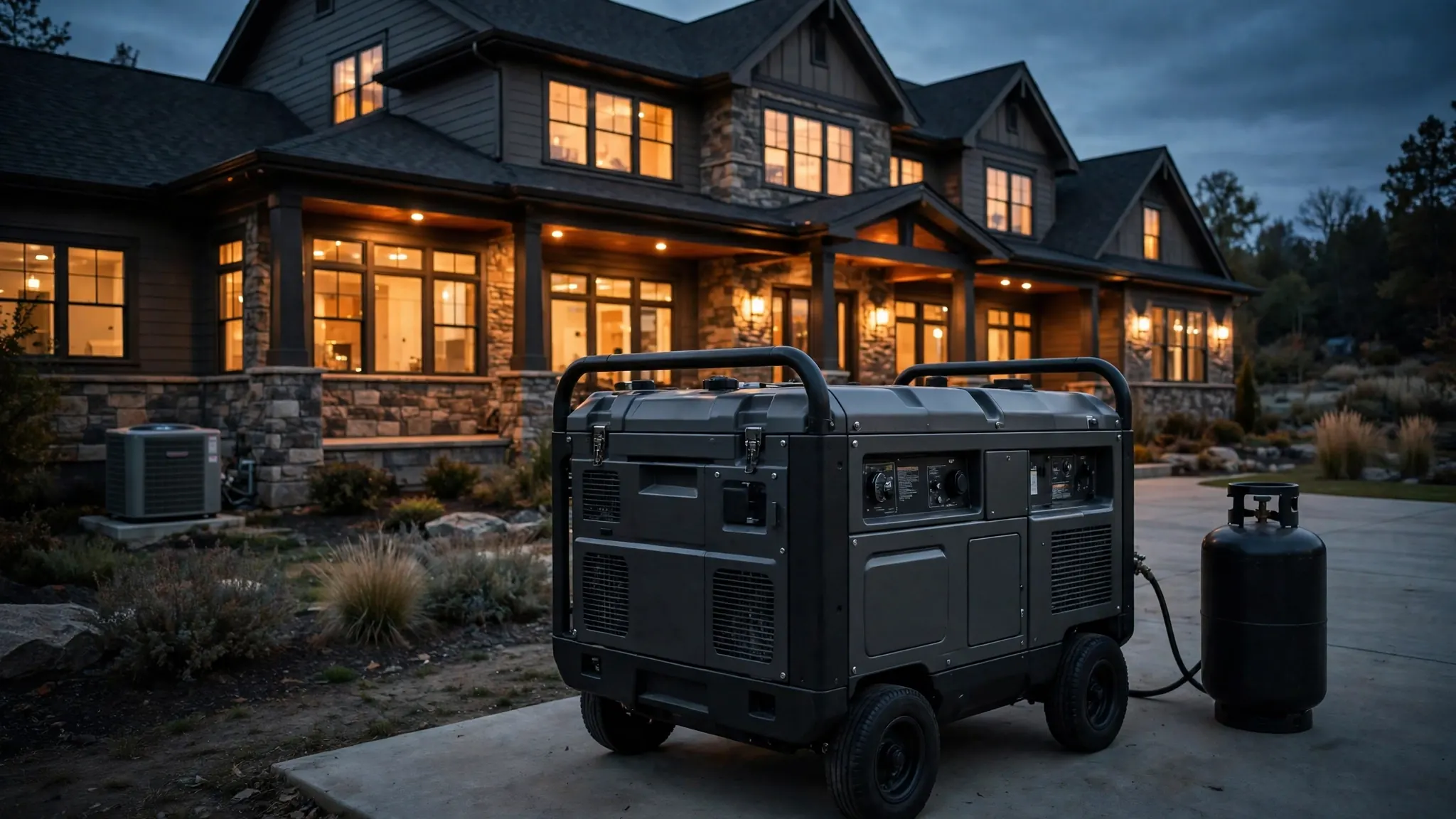
Quick answer: A 12,000-watt generator runs a whole large house — fridge, freezer, 1 HP well pump, furnace, lights, electronics — plus a 5-ton central AC with a soft starter, plus the electric water heater and dryer together. It still cannot run a tankless electric water heater, a full electric furnace, or all three big loads at once.
“What can a 12000 watt generator run?” is the question I get from homeowners with big houses, big AC units, and no interest in load management as a lifestyle — plus a healthy suspicion of five-figure standby quotes. The short version: this is the top of the portable range, and it shows. A soft-started 5-ton AC joins the plan. The water heater and dryer — the pair that every smaller class rotates — run together. What remains off the table is a short, specific list, and below it I’ll show you exactly where the portable ceiling sits and what lives above it. The difference between happy owners and frustrated ones is still arithmetic. At this size, the arithmetic is mostly about combinations of the biggest loads. So let’s do it.
Is that 12,000 watts running or starting?
Read the box carefully, because at the top of the portable range the naming games get theatrical. A true 12,000W generator delivers 12,000 running watts and around 15,000 starting (peak) watts. The shelf also holds “15000 watt” machines that run 12,000 (fine — that’s this class), and “12000 watt” machines that are 12,000 peak and 9,500 running (not this class — that’s the 10,000-watt article’s bigger sibling). Everything here is about true 12,000 running watts. One more wrinkle unique to this class: most of these are tri-fuel, and each fuel has its own running-watt rating — gasoline highest, propane about 10% lower, natural gas roughly 15–20% lower. The combos below are gasoline numbers; on natural gas, size against about 10,000 running watts.
The two numbers, quickly:
- Running watts (12,000): what it produces continuously, all day. This is your budget.
- Starting watts (~15,000): a few seconds of surge for motor startups. This is your emergency fund.
And the rule I give every customer: plan your steady load at no more than 80% of running watts — 9,600 watts on this size. Even here, the headroom is what lets a well pump start land on top of a running AC without drama. For the full sizing method, see What Size Generator Do I Need?.
How many watts does everything in your house actually use?
Same table I use for every size, because the appliances don’t care what generator you bought. Two numbers per item: running watts and the starting surge when a motor kicks on. Resistive loads (heaters, dryers, water heaters) have no surge.
Kitchen
| Appliance | Running watts | Starting watts |
|---|---|---|
| Refrigerator (modern, 18–25 cu ft) | 150–250 | 800–1,200 |
| Chest freezer | 100–200 | 600–1,000 |
| Microwave | 1,000–1,200 | none |
| Coffee maker | 800–1,200 | none |
| Toaster oven | 1,200–1,500 | none |
| Electric stove (one burner) | 1,200–2,500 | none |
| Dishwasher (heating cycle) | 1,200–1,800 | 1,500–2,000 |
Comfort and climate
| Appliance | Running watts | Starting watts |
|---|---|---|
| Central AC, 3-ton | 3,000–3,500 | 9,000–12,000 (3,500–4,500 with soft starter) |
| Central AC, 4-ton | 4,000–4,500 | 11,000–14,000 (4,500–5,500 with soft starter) |
| Central AC, 5-ton | 5,000–5,500 | 13,000–16,000 (5,500–7,000 with soft starter) |
| Gas furnace blower (1/2 HP) | 600–900 | 1,500–2,200 |
| Window AC (12,000 BTU) | 1,200–1,500 | 3,000–3,600 |
| Portable space heater | 1,500 | none |
Water and essentials
| Appliance | Running watts | Starting watts |
|---|---|---|
| Well pump (1/2 HP) | 1,000 | 2,000–3,000 |
| Well pump (1 HP) | 2,000 | 4,000–6,000 |
| Sump pump (1/2 HP) | 1,050 | 2,000–2,500 |
| Electric water heater (40–50 gal) | 4,500 | none |
| Electric dryer | 4,500–5,500 | none |
Electronics and misc
| Appliance | Running watts | Starting watts |
|---|---|---|
| LED lights (whole house) | 150–250 | none |
| Wi-Fi router + modem | 20–40 | none |
| TV + streaming box | 120–200 | none |
| Laptop / home office setup | 150–300 | none |
| Washing machine | 500–800 | 1,500–2,300 |
| Garage door opener | 500–700 | 1,000–1,400 |
The reading at this size: every individual line fits, and most pairs fit. The water heater plus the dryer is 9,000–10,000 watts — the pair that defines the ceiling of the 10,000-watt class is a normal Tuesday here. The 5-ton AC’s softened surge (5,500–7,000W) is an ordinary event against a 15,000-watt peak. What’s left to plan around is only the triple stack, below.
Combo 1: The essentials load (~2,400 watts)
The overnight baseline — included for completeness, and to make a fuel point.
| Load | Running watts |
|---|---|
| Refrigerator | 200 |
| Chest freezer | 150 |
| Sump pump (1/2 HP, cycling) | 1,050 (intermittent) |
| Gas furnace blower (winter) | 800 |
| 10 LED lights | 100 |
| Wi-Fi + modem | 30 |
| Phone and laptop charging | 70 |
| Total steady load | ~2,400 |
Twenty percent of capacity, and the fuel tax is real: a 713cc engine idling through the night at this load burns roughly 0.8–1.0 gal/hr — three to four times what a 2,000-watt inverter sips doing the same job. This is the standing argument for pairing a big portable with a small inverter for overnights, a combination more prepared households than you’d expect quietly run. If Combo 1 is your entire plan, though, you bought three sizes too many.
Combo 2: The full-house day (~8,500 watts)
A big all-electric house living normally through an outage day. The water heater and dryer overlap briefly; the AC is a 3-ton in this version.
| Load | Running watts |
|---|---|
| Refrigerator + chest freezer | 350 |
| Well pump (1 HP, cycling) | 2,000 (intermittent) |
| Central AC, 3-ton (soft-started) | 3,500 |
| Electric water heater (recovery cycles) | 4,500 (intermittent) |
| Washing machine / dryer rotation | 700–5,000 (intermittent) |
| 15 LED lights | 150 |
| Wi-Fi, TVs, chargers, home office | 550 |
| Realistic steady load | ~6,900–8,900 |
The choreography is down to one rule: the water heater’s recovery cycle and the dryer’s cycle don’t overlap with the well pump under pressure if you can help it — and if they do, the worst-case math (8,900 + 6,000W pump surge = ~14,900) still lands inside the 15,000-watt peak. Read that again: at this size, even the bad-luck stack fits. That sentence is not true of any other portable class, and it’s the whole reason this one exists.
Fuel across this day: roughly 1.2–1.5 gal/hr. For the full fuel math, see How Much Fuel Does a Generator Use?.
Combo 3: Five-ton mode (~7,900 watts)
The headline capability. A 5-ton central AC with a soft starter, on the hottest day of the year, with the house alive around it:
| Load | Running watts |
|---|---|
| Central AC, 5-ton (soft-started) | 5,500 |
| Refrigerator + chest freezer | 350 |
| Well pump (1 HP, cycling) | 2,000 (intermittent) |
| 15 LED lights | 150 |
| Wi-Fi, TVs, chargers, home office | 550 |
| Total steady load | ~8,550 |
Call it 7,900 with the pump off, 8,550 with it cycling — inside the 9,600-watt planning target either way. The soft starter does the heavy lifting: it turns a 13,000–16,000-watt brute-force start into a 5,500–7,000-watt event this generator’s peak swallows without blinking. What sits out during five-ton mode: the dryer and the water heater’s recovery cycle (either can run the moment the AC cycles off, which it does regularly even on hot days). The complete soft-starter breakdown is in What Size Generator Do I Need to Run Central AC?.
If your house is a 5-ton AC on a 4,000 sq ft footprint with an all-electric kitchen, this combo — plus a transfer switch — is the portable ceiling, and it’s a genuinely livable ceiling. Above it lives exactly one category: standby, priced in the whole-house generator cost guide.
What can’t a 12000 watt generator run?
The shortest list in the series, and the most specific:
- Tankless electric water heater: 18,000–28,000W. Still not close. No portable runs one, full stop.
- All three big loads at once: water heater (4,500) + dryer (5,500) + 5-ton AC (5,500) = 15,500 watts. Two of three is the rule at the top of the range, same as it was at 9,000 — the pairs are just bigger now.
- Whole-house electric heat: full furnace strip arrays run 15–20kW. A single 10kW strip would technically fit alone — and heat one zone badly while the rest of the house sits dark. That’s not a heating plan; electric-heat homes need standby sizing.
- A 5-ton AC without a soft starter: 13,000–16,000W of surge against a 15,000W peak is a coin flip weighted by compressor age and ambient temperature. The soft starter is a $300–400 part. The compressor is a $3,000+ part. Choose accordingly.
- An electric range at full tilt, during five-ton mode: oven plus all burners (8,000–10,000W) has nowhere to go while the big AC runs. Rotate it in when the AC cycles off.
How much gas will it burn while doing all this?
More than any other portable: 1.2–1.5 gal/hr at whole-house loads, roughly 0.8–1.0 even at overnight essentials. A three-day outage at Combo 2 intensity is 85–100 gallons of gasoline — a logistics problem, not a shopping trip. This is why the class is dominated by tri-fuel models: propane stretches storage indefinitely, and a natural gas line removes the fuel question entirely (at about 10,000 running watts on NG — still whole-house money). Per-size tables are in the generator fuel consumption guide.
Which 12000 watt generators should you actually look at?
Two classes, and the split is about fuel strategy more than brand:
- Tri-fuel conventional open-frames (the default): the DuroMax and Westinghouse 12,000-class tri-fuels (~$1,500–2,100). Gasoline for full wattage, propane for storage, natural gas for unlimited runtime; electric start; 713cc-class engines; loud — mid-70s dB — because at this size everything is. Verify each fuel’s running-watt rating on the spec sheet before you plan around it.
- Dual-fuel versions: (~$1,300–1,800) skip the natural gas option and cost less. The right buy if a gas line will never reach the generator pad and propane storage is your resilience plan.
- Large inverters barely reach this class and cost $2,800+ when they do; what they buy is mid-60s dB and clean power. Worth it beside close neighbors; hard to justify otherwise, since a transfer-switched conventional at 30+ feet is a solved noise problem — the distance math is in our quietest generators guide.
At 230+ pounds, none of these is portable in the camping sense. They’re movable standby alternatives: wheeled, stored in the garage, rolled to a prepared pad, connected to a transfer switch. Buy them as infrastructure, not as equipment.
Who is a 12000 watt generator perfect for?
The large home with a 5-ton central AC, an all-electric kitchen and laundry, a 1 HP well pump, and an owner who has read a standby quote and declined it. Properties where the generator also serves a workshop, a barn, or a second structure. Households in outage-prone regions who are home to manage fuel and want standby-class capability at portable-class cost.
Go 10,000 watts if your AC is 4 tons — the capability you lose is the five-ton combo and the water-heater-plus-dryer overlap, and the money you save is real. Go standby if nobody’s home during outages, if the heat is electric, or if “it just starts” is worth five figures to you. Both of those are respectable answers. What’s not respectable is buying a “12000 watt” badge without checking the running watts — at this price, read the spec sheet twice.
Keep reading
Frequently asked questions
Can a 12000 watt generator run a whole house?
Yes — a 12,000-watt portable is as close as wheels get to standby behavior. Refrigerator, freezer, 1 HP well pump, furnace, lights, electronics, electric water heater, electric dryer, and a 5-ton central AC with a soft starter all belong to this machine. The remaining limits are the extreme corners: no tankless electric water heater, no full electric furnace, and not every big load in the same minute. For the large majority of houses, the load math simply stops being the constraint.
Can a 12000 watt generator run a 5-ton air conditioner?
Yes, with a soft starter — and this is the class that makes it a plan instead of a stunt. Soft-started, a 5-ton draws 5,000–5,500 running watts with a 5,500–7,000-watt start, leaving room for the essentials and one more load. Without a soft starter its 13,000–16,000-watt surge straddles this generator's 15,000-watt peak: it might start on a good day, and 'might' is how compressors die. Budget the soft starter into the purchase.
Can a 12000 watt generator run a water heater and dryer together?
Yes — this is the first class where the pair runs together legitimately, not as a stunt. Water heater (4,500 watts) plus dryer (about 5,000) plus the refrigerator and lights lands around 10,000 watts: above the 80% planning line of 9,600, so keep the well pump's start from stacking on top, but genuinely sustainable. What still doesn't work is adding the central AC to that pair — 13,000-plus watts exceeds the machine. Two of the big three at a time remains the ceiling; it's just a much roomier ceiling.
Should I buy a 12000 watt portable or a standby generator?
Price the whole system, not the box. A 12,000-watt tri-fuel portable plus a transfer switch installation typically lands at a third or less of a 14–22kW standby's installed cost, and it can serve a second property or move with you. The standby wins on automation (it starts itself, mid-storm, whether you're home or not), fuel (natural gas line instead of cans), and noise discipline. If you're home for your outages and they're measured in days per year, the big portable's math wins. If outages are a lifestyle, the standby does.
How long will a 12000 watt generator run on a tank of gas?
At whole-house loads, roughly 6–8 hours on the typical 8-gallon tank — these engines burn about 1.2–1.5 gal/hr when they're working hard, which is the honest price of 12 kilowatts. The tri-fuel versions change the planning entirely: on a 40-lb propane tank expect about 9–11 hours, and on a natural gas line the runtime is unlimited (at roughly 15–20% less wattage, so size combos against about 10,000 running watts on NG). Always refuel a gasoline engine off and cooled for 15 minutes.