What Can a 10000 Watt Generator Run? Whole-House Loads
**Quick answer:** A 10,000-watt generator runs a whole house — fridge, freezer, 1 HP well pump, furnace, lights, electronics — plus central AC up to 4 tons with a soft starter (5 tons with discipline), plus the electric water heater and dryer in light rotation. It still cannot run a tankless electric water heater, whole-house electric heat, or every big load in the same minute.
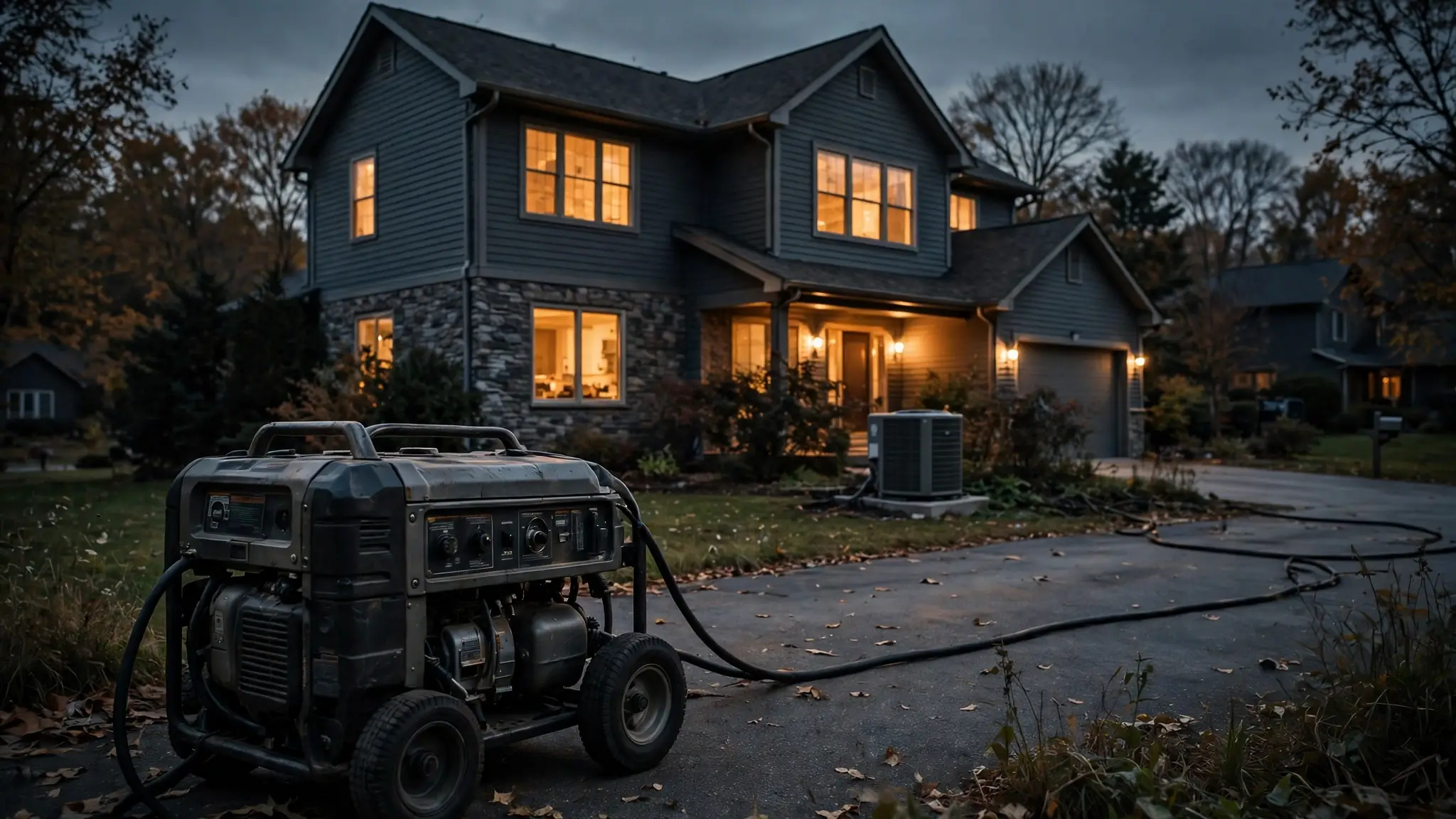
Quick answer: A 10,000-watt generator runs a whole house — fridge, freezer, 1 HP well pump, furnace, lights, electronics — plus central AC up to 4 tons with a soft starter (5 tons with discipline), plus the electric water heater and dryer in light rotation. It still cannot run a tankless electric water heater, whole-house electric heat, or every big load in the same minute.
“What can a 10000 watt generator run?” is the question I get from homeowners who have done the smaller math, want central AC without an asterisk, and are standing at the fork between the biggest portables and a permanently installed standby. Here’s the honest framing: 10,000 watts is the first portable class where the answer to almost every individual load is “yes” — including a 4-ton AC with a soft starter, the electric water heater, and the dryer. The limits that remain are about combinations, not items. The difference between happy owners and frustrated ones is still arithmetic, but at this size the arithmetic mostly forgives you. Let’s do it anyway.
Is that 10,000 watts running or starting?
Read the box carefully, because this is the class where peak-rating marketing is at its most aggressive. A true 10,000W generator delivers 10,000 running watts and around 12,500 starting (peak) watts. But the shelf is full of machines wearing “12500” or “13000” badges that run 10,000 — and machines wearing “10000” badges that are 10,000 peak and 8,000 running. Everything in this article is about the true 10,000-running-watt class. If the unit you’re eyeing is 8,000 running, the 9,000-watt article is closer to your machine — scale accordingly.
The two numbers, quickly:
- Running watts (10,000): what it produces continuously, all day. This is your budget.
- Starting watts (~12,500): a few seconds of surge for motor startups. This is your emergency fund.
And the rule I give every customer: plan your steady load at no more than 80% of running watts — 8,000 watts on this size. At this capacity the 80% line isn’t about protecting the engine from your house; it’s about keeping surge headroom so a well pump start never coincides badly with an AC start. For the full sizing method, see What Size Generator Do I Need?.
How many watts does everything in your house actually use?
Same table I use for every size, because the appliances don’t care what generator you bought. Two numbers per item: running watts and the starting surge when a motor kicks on. Resistive loads (heaters, dryers, water heaters) have no surge.
Kitchen
| Appliance | Running watts | Starting watts |
|---|---|---|
| Refrigerator (modern, 18–25 cu ft) | 150–250 | 800–1,200 |
| Chest freezer | 100–200 | 600–1,000 |
| Microwave | 1,000–1,200 | none |
| Coffee maker | 800–1,200 | none |
| Toaster oven | 1,200–1,500 | none |
| Electric stove (one burner) | 1,200–2,500 | none |
| Dishwasher (heating cycle) | 1,200–1,800 | 1,500–2,000 |
Comfort and climate
| Appliance | Running watts | Starting watts |
|---|---|---|
| Central AC, 3-ton | 3,000–3,500 | 9,000–12,000 (3,500–4,500 with soft starter) |
| Central AC, 4-ton | 4,000–4,500 | 11,000–14,000 (4,500–5,500 with soft starter) |
| Central AC, 5-ton | 5,000–5,500 | 13,000–16,000 (5,500–7,000 with soft starter) |
| Gas furnace blower (1/2 HP) | 600–900 | 1,500–2,200 |
| Window AC (12,000 BTU) | 1,200–1,500 | 3,000–3,600 |
| Portable space heater | 1,500 | none |
Water and essentials
| Appliance | Running watts | Starting watts |
|---|---|---|
| Well pump (1/2 HP) | 1,000 | 2,000–3,000 |
| Well pump (1 HP) | 2,000 | 4,000–6,000 |
| Sump pump (1/2 HP) | 1,050 | 2,000–2,500 |
| Electric water heater (40–50 gal) | 4,500 | none |
| Electric dryer | 4,500–5,500 | none |
Electronics and misc
| Appliance | Running watts | Starting watts |
|---|---|---|
| LED lights (whole house) | 150–250 | none |
| Wi-Fi router + modem | 20–40 | none |
| TV + streaming box | 120–200 | none |
| Laptop / home office setup | 150–300 | none |
| Washing machine | 500–800 | 1,500–2,300 |
| Garage door opener | 500–700 | 1,000–1,400 |
Read the table with new eyes at this size: there is no single line item this generator can’t run. The electric water heater is 45% of capacity. The dryer’s worst case is 55%. Even the 5-ton AC’s running draw fits. The only column that still bites is a raw (un-softened) big-AC surge: 13,000–16,000 watts for a 5-ton exceeds the 12,500-watt peak, which is why the soft starter stops being optional advice at this size and becomes part of the purchase.
Combo 1: The essentials load (~2,400 watts)
The overnight baseline — food cold, basement dry, house warm, everything big asleep.
| Load | Running watts |
|---|---|
| Refrigerator | 200 |
| Chest freezer | 150 |
| Sump pump (1/2 HP, cycling) | 1,050 (intermittent) |
| Gas furnace blower (winter) | 800 |
| 10 LED lights | 100 |
| Wi-Fi + modem | 30 |
| Phone and laptop charging | 70 |
| Total steady load | ~2,400 |
Twenty-four percent of capacity. The generator loafs, and even loafing it burns more fuel than a 5,000-watt unit working at the same load — that’s the standing tax of owning capacity, roughly 0.7–0.9 gal/hr at this light load for an open-frame conventional. If this combo is your whole plan, you bought two sizes too many; if it’s your overnight plan inside a bigger day, it’s exactly right.
Combo 2: The everything day (~7,300 watts)
A normal day at home during an outage, all-electric house, laundry included. One big resistive load at a time is the only choreography left.
| Load | Running watts |
|---|---|
| Refrigerator + chest freezer | 350 |
| Well pump (1 HP, cycling) | 2,000 (intermittent) |
| Electric water heater (recovery cycles) | 4,500 (intermittent) |
| Washing machine | 700 (intermittent) |
| Microwave | 1,200 (intermittent) |
| 15 LED lights | 150 |
| Wi-Fi, TVs, chargers, home office | 550 |
| Realistic steady load (one big load active) | ~5,300–7,300 |
The swing factor is which intermittent load is on: water-heater recovery pushes the total toward 7,300; laundry or microwave time sits around 4,000–5,000. The dryer (5,000W) substitutes for the water heater’s slot in the afternoon — the pair together (9,500W plus the fridge) is technically under the rating and practically over the planning line, so the rotation habit survives even here. The well pump’s 6,000-watt surge lands on a 7,300-watt load for a worst-case 13,300 momentary — above the 12,500 peak on paper, which is why you don’t run the water heater recovery during laundry: keep the coincident steady load at or under about 6,500 watts and every surge fits.
Fuel burn across this day: roughly 1.0–1.3 gal/hr averaged. For the full fuel math, see How Much Fuel Does a Generator Use?.
Combo 3: Big-AC mode (~7,000 watts)
The combo that justifies the class. A 4-ton central AC with a soft starter fitted — the size that made the 9,000-watt class sweat — runs here with the house attached:
| Load | Running watts |
|---|---|
| Central AC, 4-ton (soft-started) | 4,500 |
| Refrigerator + chest freezer | 350 |
| Well pump (1 HP, cycling) | 2,000 (intermittent) |
| 15 LED lights | 150 |
| Wi-Fi, TVs, chargers, home office | 550 |
| Total steady load | ~7,550 |
Inside the 8,000-watt planning target. The soft starter keeps the compressor’s start around 4,500–5,500 watts of surge — absorbed even with the pump mid-cycle. The water heater and dryer rotate in when the AC cycles off, which in most weather is several times an hour.
A 5-ton with a soft starter (running 5,000–5,500W) fits the same table with the pump as the only other allowed load and the resistive pair fully benched — possible, honest, and the practical ceiling of portable power. Past this, you’re pricing standby units, and the whole-house generator cost guide is the right next read. The soft-starter math itself is in What Size Generator Do I Need to Run Central AC?.
What can’t a 10000 watt generator run?
The shortest “can’t” list in this series — but it still has entries:
- Tankless electric water heater: 18,000–28,000W. Not close, not partial, not in rotation. No portable generator runs one; if tankless electric is your water heating, your outage plan is cold showers or a standby far up the kW range.
- Whole-house electric heat: a single 10kW furnace strip equals the entire generator; most electric furnaces run 15–20kW of strips. Electric-heat homes are standby homes.
- Everything at once: water heater (4,500) + dryer (5,500) + 4-ton AC (4,500) = 14,500 watts. The generator is big; it is not the grid. Two of the three, any two, is the standing rule.
- A 5-ton AC without a soft starter: 13,000–16,000W of surge against a 12,500W peak. It won’t start, and repeated attempts are how compressors die.
- An electric range at full tilt: oven element plus all burners sums past 8,000–10,000W. One or two burners in rotation is fine forever.
How much gas will it burn while doing all this?
At Combo 2 and 3 loads, roughly 1.0–1.3 gal/hr — call it 25–30 gallons for a three-day outage at whole-house comfort, which is why dual-fuel matters more at this size than any other: propane versions lose about 10% of wattage (9,000 running on propane) and gain fuel that stores indefinitely, runs cleaner, and comes in 40-lb tanks that last 10–12 hours each. The per-size burn tables are in the generator fuel consumption guide.
Which 10000 watt generators should you actually look at?
Three classes, three different ownership experiences:
- Conventional open-frame (the workhorse): the DuroMax, Westinghouse, and Champion 10,000-class open frames (~$1,100–1,500). Loud — low-to-mid 70s dB — mechanically simple, electric start standard, and the cheapest honest route to whole-house portable power. At 200+ pounds with wheels, “portable” is a generous word; plan its parking spot before it arrives.
- Dual-fuel versions: (~$1,300–1,700) are the default recommendation at this size for the fuel reasons above. Size your combos against the ~9,000-watt propane number if propane is your primary fuel.
- Large inverters: (~$2,000–2,800) bring the noise down to the mid-60s dB, clean power for everything, and eco-mode sipping at the overnight load. If the generator pad sits near bedrooms or a close neighbor, this premium is the product. Our quietest generators guide explains the dB math.
Whatever the class, verify the running watts on the spec sheet. In this class the gap between the carton number and the continuous number is where the returns come from.
Who is a 10000 watt generator perfect for?
The medium-to-large home with a 4-ton central AC, an electric water heater, a dryer that matters, and a 1 HP well pump — the household that needed three asterisks at 7,500 watts and one at 9,000. Farms and workshops that also run a welder outlet or big power tools on the same machine. Anyone choosing deliberately against a standby because the house might be sold, the outages are annual, or the budget is real.
Go 9,000 watts if your AC is 3 tons and the rotation habit is fine. Go standby if outages are monthly, you’re away from home for them, or the AC is 5 tons with an all-electric house behind it — the portable ceiling is honest, and this article just showed you where it is.
Keep reading
Frequently asked questions
Can a 10000 watt generator run a whole house?
Yes — this is the first portable class where 'whole house' needs almost no asterisk. Refrigerator, freezer, 1 HP well pump, furnace, lights, electronics, electric water heater, electric dryer, and central AC all belong to this generator; the only remaining skill is not running the three biggest loads in the same minute. An all-electric house at full simultaneous demand still exceeds it, but that demand profile exceeds most standby installations too.
Can a 10000 watt generator run a 4-ton or 5-ton central AC?
A 4-ton, comfortably, with a soft starter: 4,000–4,500 running watts and a soft-started surge around 4,500–5,500 watts leave genuine room for the house. A 5-ton is possible with a soft starter and discipline — its 5,000–5,500 running watts fit, but the water heater and dryer sit out while it runs. Without a soft starter, even the 3-ton's 9,000–12,000-watt surge sits uncomfortably against this generator's 12,500-watt peak; the soft starter remains the right call at every size here.
Can a 10000 watt generator run a water heater and dryer at the same time?
Technically yes, practically 'briefly.' The pair draws about 9,500 watts — 4,500 for the water heater, roughly 5,000 for the dryer — which leaves only the refrigerator's 200–350 watts of headroom under the 10,000-watt rating and nothing for a well pump start. It won't damage anything for a short overlap, but living above the 80% planning line (8,000 watts) runs the engine hot. Rotation — heater cycle first, laundry after — stays the better habit.
Is a 10000 watt portable better than a standby generator?
Different tools. A 10,000-watt portable plus a professionally installed transfer switch costs a fraction of a 14kW standby's installed price, and you can take it with you when you move. The standby wins on everything automatic: it starts itself, runs on natural gas or a big propane tank instead of gasoline cans, and handles the whole panel without load choreography. If outages are rare and short, the portable's math wins. If they're long, frequent, or you're away from home often, the standby earns its money.
How long will a 10000 watt generator run on a tank of gas?
Most 10,000-watt portables carry about 8 gallons and burn roughly 1.0–1.3 gal/hr at the half-to-three-quarter loads typical of whole-house duty, so expect about 7–9 hours per tank. That's a morning-and-evening refuel rhythm — engine off, cooled 15 minutes, then fuel. Dual-fuel models stretch this substantially on propane: a 20-lb tank runs roughly 5–6 hours at these loads, a 40-lb tank about double that, with no stale-fuel worries between storms.