What Can a 2000 Watt Generator Run? Small Loads, Real Math
**Quick answer:** A 2,000-watt generator runs a refrigerator (150–250W), LED lights, Wi-Fi, phone and laptop chargers, a TV, fans, and a CPAP machine — roughly **450 watts of essentials** — all at once and all night. It can run a microwave or coffee maker one at a time. It cannot start a window air conditioner, a well pump, or a sump pump, and a 1,500-watt space heater eats nearly its whole budget alone.
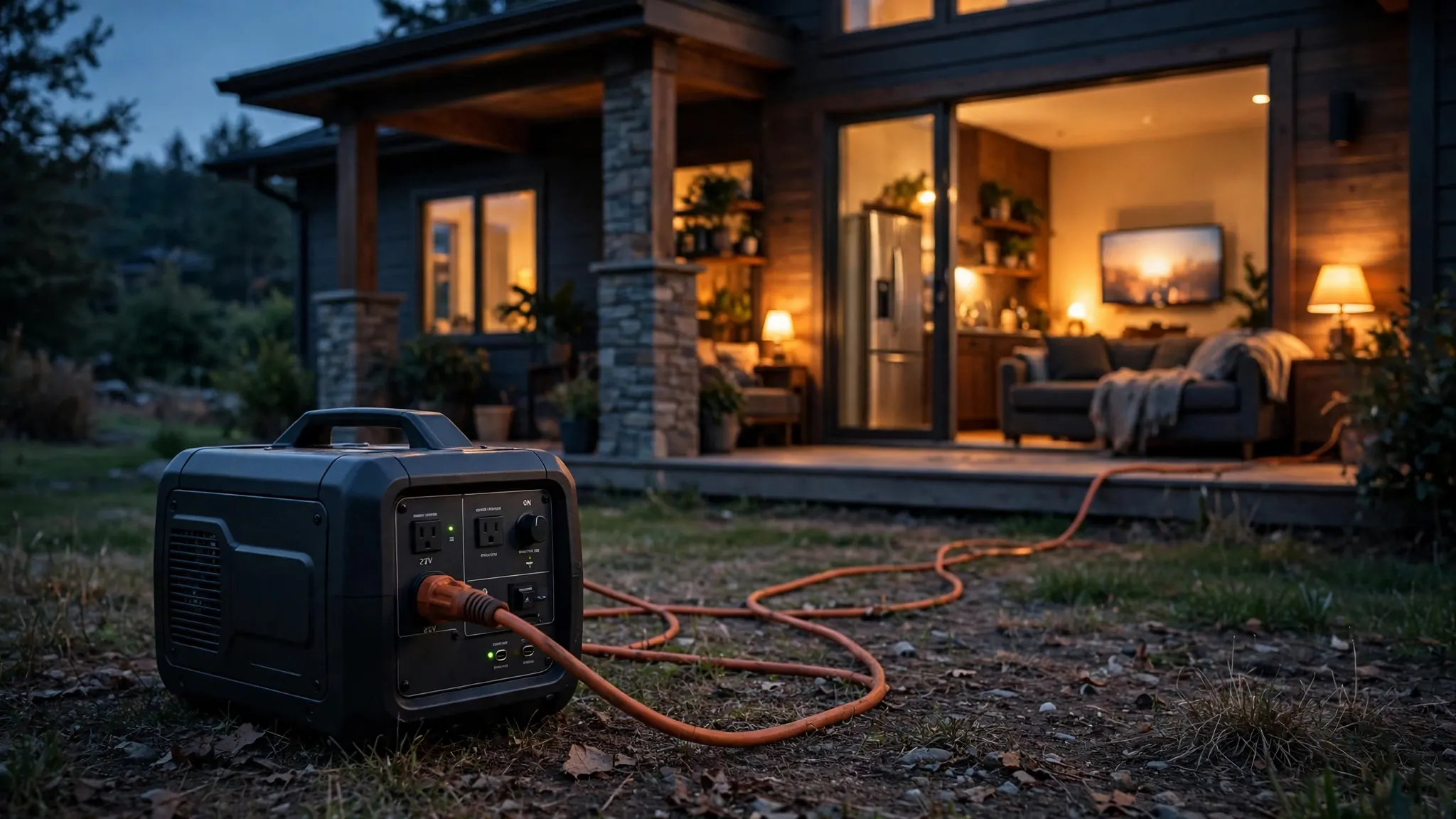
Quick answer: A 2,000-watt generator runs a refrigerator (150–250W), LED lights, Wi-Fi, phone and laptop chargers, a TV, fans, and a CPAP machine — roughly 450 watts of essentials — all at once and all night. It can run a microwave or coffee maker one at a time. It cannot start a window air conditioner, a well pump, or a sump pump, and a 1,500-watt space heater eats nearly its whole budget alone.
“What can a 2000 watt generator run?” is the question I get from apartment dwellers, campers, and homeowners who want the fridge to survive an outage without a 100-pound machine in the garage. The honest answer surprises people in both directions: a 2,000-watt inverter will quietly run more of your daily life than you expect — and it will flatly refuse a few loads that look small on paper. The difference is, as always, whether somebody did the load math before the storm. So let’s do it.
Is that 2,000 watts running or starting?
Read the box carefully, because this class runs the shell game in the opposite direction from the big portables. Most machines sold as “2000 watt” are inverter generators rated at 2,000–2,200 starting watts and only 1,600–1,800 running watts — the Honda EU2200i, for example, is 2,200 peak / 1,800 running. Everything in this article sizes against the conservative end: about 1,800 running watts, 2,200 peak. If your unit is a true 2,000-running-watt model, you have a small bonus, not a different article.
The two numbers, quickly:
- Running watts (~1,800): what it produces continuously, all day. This is your budget.
- Starting watts (~2,200): a few seconds of surge for motor startups. This is your emergency fund — and in this class it’s a small fund.
And the rule I give every customer: plan your steady load at no more than 80% of running watts — about 1,450 watts here. Small inverter engines are happiest loafing; pinned at maximum they get loud (defeating the point of an inverter), hot, and thirsty. For the full sizing method, see What Size Generator Do I Need?.
How many watts does everything actually use?
The same table I use for every size, trimmed to the loads that matter at 2,000 watts — plus the ones people wrongly assume will fit. Two numbers per item: running watts and the starting surge when a motor kicks on. Resistive loads (kettles, heaters) have no surge.
Kitchen
| Appliance | Running watts | Starting watts |
|---|---|---|
| Refrigerator (modern, 18–25 cu ft) | 150–250 | 800–1,200 |
| Chest freezer | 100–200 | 600–1,000 |
| Microwave | 1,000–1,200 | none |
| Coffee maker | 800–1,200 | none |
| Electric kettle | 1,200–1,500 | none |
Comfort and electronics
| Appliance | Running watts | Starting watts |
|---|---|---|
| Ceiling fan (each) | 50–100 | 150–250 |
| Box fan | 50–100 | 150–200 |
| LED lights (whole house) | 150–250 | none |
| Wi-Fi router + modem | 20–40 | none |
| TV + streaming box | 120–200 | none |
| Laptop / home office setup | 150–300 | none |
| CPAP machine | 30–60 | none |
| Phone chargers (4) | 40–60 | none |
The loads that don’t fit
| Appliance | Running watts | Starting watts |
|---|---|---|
| Window AC (8,000–10,000 BTU) | 900–1,200 | 2,200–3,000 |
| Portable space heater | 1,500 | none |
| Sump pump (1/3 HP) | 800 | 1,500–2,000 |
| Well pump (1/2 HP) | 1,000 | 2,000–3,000 |
| Electric water heater (40–50 gal) | 4,500 | none |
Study the right-hand column, because that’s where this class lives and dies. The fridge’s 1,200-watt surge is the biggest event in a normal 2,000-watt setup, and everything else you run has to leave room for it. The window AC is the heartbreaker: its running draw fits, its starting draw is the entire generator.
Combo 1: The blackout essentials (~450 watts)
This is the load this size was born for — the things that turn an outage from an emergency into an inconvenience.
| Load | Running watts |
|---|---|
| Refrigerator | 200 |
| 10 LED lights | 100 |
| Wi-Fi + modem | 30 |
| Phone and laptop charging | 70 |
| CPAP machine | 40 |
| Total steady load | ~440 |
That’s about 25% of capacity, and the worst moment — the fridge compressor starting (1,200W surge) on top of everything — peaks around 1,650 watts, inside the 2,200-watt ceiling. At this load an inverter throttles down to near-idle, burns roughly 0.1–0.15 gal/hr, and is quiet enough to talk over. This combo runs essentially forever on a couple of gallons of gas. If medical equipment is on your list, the dedicated planning guide is Backup Power for a CPAP Machine.
Combo 2: Essentials plus comfort (~1,100 watts)
Add the things that make an outage evening feel normal.
| Load | Running watts |
|---|---|
| Everything in Combo 1 | ~440 |
| Chest freezer | 150 |
| TV + streaming | 150 |
| Home office (laptop, monitor, router) | 250 |
| Ceiling fan or box fan | 75 |
| Total steady load | ~1,065 |
Still under the 80% target, and it works because nothing here surges except the two refrigeration compressors — and their combined worst case (fridge 1,200W + freezer 1,000W starting in the same second, which in practice almost never happens) just touches the peak rating. The generator works a bit harder than Combo 1 and burns roughly 0.2 gal/hr. This is the setup I recommend for apartments and small homes with gas heat and no pumps: genuinely comfortable, genuinely quiet, and cheap to feed.
Combo 3: One big load at a time (rotation)
Want coffee, or a hot meal from the microwave? You can have either — as the only big load, briefly.
- Coffee: coffee maker (1,000W) + fridge (200W) + lights (100W) = ~1,300W running. Fine, as long as the fridge doesn’t start mid-brew; if it does, the surge stacks to roughly 2,500W and may trip the unit. Brew, unplug, move on.
- Microwave: 1,200W + fridge running 200W + lights = ~1,500W. Same surge warning. Ten minutes, then back to Combo 2.
- Kettle: at 1,200–1,500W it’s the biggest single plug in this class. Kettle plus nothing else motor-driven. Boil, unplug.
The discipline is the same one the 5,000-watt owners learn, just with smaller numbers: one big resistive load at a time, and respect the fridge’s surge. If that sounds fiddly, the fix isn’t technique — it’s the 3,500-watt class, where the microwave stops being an event.
What can’t a 2000 watt generator run?
Being blunt, because these are the returns and the one-star reviews:
- Window AC: the running draw fits, the 2,200–3,000W starting surge does not. It is the single most common disappointment in this class. Fans and open windows, or a bigger generator.
- Well pump (1/2 HP): 1,000 watts running would leave almost nothing, and the 2,000–3,000W startup surge meets or exceeds the whole peak rating. No.
- Sump pump (1/3 HP): 800 watts running looks possible until the fridge starts in the same second — combined surge blows past the ceiling. A basement that floods is not the place for “usually works.” The pump math is in What Size Generator Do You Need for a Sump Pump?.
- Space heater plus anything: 1,500 watts is 83% of your running budget before the fridge cycles. A heater alone in one closed room, with the fridge unplugged for the night, is the only version of this that works — and it’s a poor trade.
- Anything with a heating element over ~1,500W: electric water heaters (4,500W), dryers, ovens, and hair dryers at full blast are simply not in this world.
Notice the pattern: everything on the “can’t” list either heats with electricity or starts a serious motor. Small electronics and refrigeration — the loads that actually matter most in an outage — are exactly what this size does best.
How much gas will it burn while doing all this?
Barely any. At Combo 1 the leading models sip 0.1–0.15 gal/hr; at Combo 2, around 0.2 gal/hr. The Honda EU2200i’s 0.95-gallon tank lasts 8.1 hours at quarter load; the Westinghouse iGen2200 stretches a 1.14-gallon tank to roughly 12 hours at quarter load. A single five-gallon can is a multi-day supply at essentials load — which is why this class is the preparedness crowd’s favorite. The broader per-size burn tables are in How Much Fuel Does a Generator Use?.
Which 2000 watt generators should you actually look at?
This class is all inverters, and three names dominate it — all three are also on our quietest generators ranking, because quiet is the whole point here:
- Honda EU2200i (2,200 peak / 1,800 running, ~$1,100–1,300): the benchmark. 48 dB at quarter load — the quietest mainstream generator you can buy — with the strongest dealer network and a 3-year residential warranty. You pay double for it, and owners rarely regret it.
- Westinghouse iGen2200 (2,200 / 1,800, ~$450–550): 52 dB, nearly as quiet, half the Honda’s price, parallel-capable. The value pick for camping and light home backup.
- Champion 2500 Dual Fuel (2,500 / 1,850 on gas, ~$450–600): 53 dB, the lightest of the three at about 39 lb, and the only one that runs propane out of the box — about 34 hours on a 20-lb tank at quarter load. Slightly above the class on watts, which buys real headroom for the fridge surge.
Skip no-name units whose “2000 watts” turns out to be 1,400 running. In this class the running-watts line on the spec sheet is the whole product.
Who is a 2000 watt generator perfect for?
Apartment and condo owners keeping a fridge, lights, and connectivity alive (on a ground-floor patio or yard — never a balcony, never indoors). Campers and RV owners who value quiet over capacity. CPAP users who need a guaranteed quiet night of medical power. Homeowners with gas everything and no pumps, whose outage plan is “essentials, comfortably.” And anyone who already owns a big open-frame portable and wants a quiet overnight sipper to pair with it.
Size up if: you have a well or sump pump, you need a window AC, or “microwave without thinking” matters to you. The 5,000-watt class is where a house starts living normally; this class is where an outage stops being scary. Both are legitimate plans — just don’t buy one expecting the other.
One last check: run the fridge-surge test on paper
Before an outage does it for you, walk your own load list through the worst second this class ever sees. Write down everything you plan to run at once — say the Combo 2 total of about 1,065 watts — then add the fridge’s 800–1,200-watt starting surge on top, as if the compressor kicked on at the worst possible moment. If that stacked number stays under the 2,200-watt peak, your setup survives its hardest second with the lights still on. If it does not, the fix is sequencing, not hope: unplug one load, let the fridge start, then plug back in.
Keep reading
Frequently asked questions
Can a 2000 watt generator run a refrigerator?
Yes — a fridge is the anchor load this size is built around. A modern refrigerator runs at 150–250 watts and surges to 800–1,200 watts for a second or two when the compressor starts. Against roughly 1,800 running watts and 2,000–2,200 peak watts, that fits with room to spare, as long as you don't stack a second motor startup on the same second. Fridge plus lights, Wi-Fi, and chargers is the classic 2,000-watt outage setup.
Can a 2000 watt generator run a window air conditioner?
Realistically, no. A 10,000 BTU window AC runs at 900–1,200 watts, which fits on paper — but its compressor needs 2,200–3,000 watts to start, and that meets or exceeds the entire peak rating of a 2,000-watt generator. The compressor stalls, voltage sags, and the breaker trips. Cooling at this size means fans. If a window AC is non-negotiable, step up to the 3,500-watt class, where the surge fits with headroom.
Can a 2000 watt generator run a microwave?
Yes, but run it alone. A microwave draws 1,000–1,200 watts — more than half the generator's continuous budget by itself. With the fridge and a few lights also connected, the total running load is fine, but if the fridge compressor kicks on mid-cook, the combined surge (about 1,200 watts) can push past the peak rating and trip the unit. Heat your food, then plug the comfort loads back in.
How long will a 2000 watt generator run on a tank of gas?
A long time — this is the most fuel-sipping class there is. The Honda EU2200i runs 8.1 hours at quarter load on a 0.95-gallon tank; the Westinghouse iGen2200 stretches to about 12 hours at quarter load on 1.14 gallons. Expect roughly 0.1–0.25 gallons per hour depending on load, so a five-gallon can you filled for a bigger generator can keep a 2,000-watt inverter fed for most of a week of essentials-only use.
Is a 2000 watt generator enough for a house?
Enough for the essentials of survival and sanity — refrigerator, lights, phone and laptop charging, internet, a TV, fans, and a CPAP machine (30–60 watts) — but not enough to live normally. There's no well pump or sump pump surge capacity, no space heater alongside anything else, and no window AC. Think of 2,000 watts as apartment-scale backup, camping power, and jobsite-light duty. A house that needs pumps or cooling needs the 3,500-watt class at minimum.