How to Winterize a Generator: Storage Steps That Prevent Spring No-Starts
**Quick answer:** Winterizing takes about an hour and roughly $30: decide between a full tank treated with fuel stabilizer and running the generator dry, change the oil before storage rather than after, fog the cylinder, and put the battery on a maintainer. A generator stored that way is good for six months easily — twelve is realistic — and starts in spring instead of needing a carburetor cleaning and a new battery.
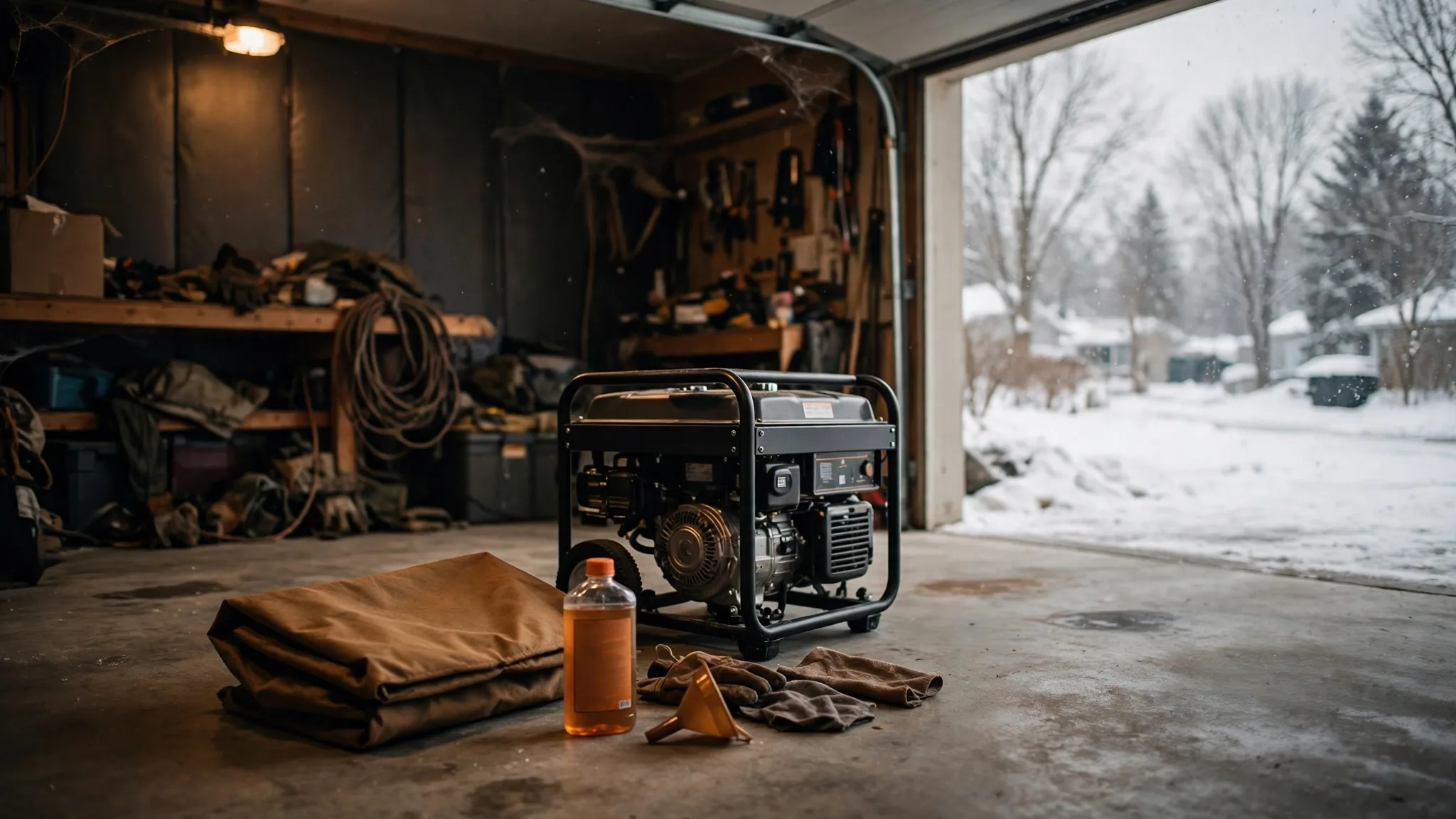
Quick answer: Winterizing takes about an hour and roughly $30: decide between a full tank treated with fuel stabilizer and running the generator dry, change the oil before storage rather than after, fog the cylinder, and put the battery on a maintainer. A generator stored that way is good for six months easily — twelve is realistic — and starts in spring instead of needing a carburetor cleaning and a new battery.
Every spring I get the same phone calls. The first storm knocks out power, somebody wheels out a generator that ran perfectly in October, pulls the cord twenty times, and gets nothing. Then I drain fuel that smells like varnish, quote them a carburetor, and they ask the question that should have been asked in the fall: how to winterize a generator so this doesn’t happen?
Winterizing takes about an hour and maybe $30 in supplies, and it’s the difference between a generator that starts on the second pull in April and one that needs a shop visit. Do it before the first cold snap — and if your area gets winter outages, read the monthly-exercise section too: a winterized generator and a ready generator are two different plans.
Two safety notes: work on a cool engine (run it for the fuel steps, then let it sit 15–20 minutes), and drain fuel only outdoors or in an open garage, into an approved gas can.
Full Tank With Stabilizer, or Run It Dry — Which Is Actually Better?
This argument never dies in generator forums, and honestly both camps are right — for different owners:
Option 1: Store it full, with stabilizer. Fill the tank with fresh fuel treated with stabilizer (STA-BIL is the one I see most). A full tank leaves little air space, so less moisture condenses and the fuel oxidizes slower. The carburetor stays full of stabilized fuel too — as long as the stabilizer circulated through it, which means running the engine about 10 minutes after adding it.
Option 2: Run it dry and drain everything. Shut the fuel valve with the engine running, let it die, then drain the tank and carburetor bowl. No fuel means no stale fuel, ever.
My recommendation, by owner:
- Small portable (under 5,000 watts) sitting in a shed until spring: run it dry. These sit longest and get forgotten hardest, and a dry carburetor cannot gum up.
- You might need it during a January ice storm: full tank with stabilizer, plus the monthly exercise plan below. Run-dry is a 20-minute project in a freezing outage; stabilized and exercised is a cord pull.
- Dual-fuel: on propane there is nothing to winterize — it doesn’t degrade in the tank. Run the gasoline side dry if you used it.
- Storage longer than a year: drain it completely regardless of size. Stabilizer labels promise 12–24 months; I don’t bet engines on labels past a year.
Two cautions. Some fuel-injected portables and most standby units should not be run dry — fuel pumps and injectors prefer to stay wet; check your manual, and if it says don’t, stabilize instead. And ethanol-free gasoline, if you can get it, is the best storage fuel of all: no ethanol means no phase separation, for about $1–2 more per gallon.
Step 1: How Do You Prepare the Fuel System for Storage?
Whichever philosophy you picked, the fuel path gets serviced the same way until the last step:
- Start with fresh fuel. If the gas in the tank is already months old, don’t stabilize it and hope — stabilizer prevents degradation, it does not reverse it. Drain it into a gas can (your car will burn it later, diluted) and refill with fresh.
- Dose the stabilizer correctly. The common dose is 1 oz per 2.5 gallons for storage up to 12 months; many brands say double it for longer. Eyeballing is how people under-dose. Measure it.
- Run the engine 10 minutes. This is the step everyone skips, and it’s the whole point. Stabilized fuel in the tank does nothing for the fuel sitting in the carburetor bowl and jets; ten minutes of running pulls treated fuel through every passage. Add a small load — a shop light or space heater on low.
- Then choose your ending. Full-tank storage: top the tank off after it cools and shut the fuel valve. Run-dry storage: shut the fuel valve with the engine warm, let it die, try one restart to confirm the bowl is empty, then drain the tank and open the carburetor bowl drain screw — usually a small bolt at the bottom of the float bowl — and catch the last spoonfuls.
Swap the inline fuel filter now too, if your model has one. A $4 filter is one less variable in April.
Step 2: Why Should You Change the Oil Before Storage, Not After?
Owners get this backwards constantly — fresh oil in spring feels right. It isn’t. Used oil isn’t just dirty; it’s acidic. Combustion blow-by contaminates it with moisture and acid all season, and that acid sits against bearings, cylinder walls, and seals all winter, etching metal. A spring change drains it after five months of damage. A fall change means the engine sleeps in clean oil.
So, with the engine warm from the fuel run (warm oil drains fully; cold oil leaves sludge), drain and refill with your manual’s weight — 10W-30 for most portables, 5W-30 synthetic if it must crank in deep cold. Most portables take 0.6 to 1.1 quarts: a $6–8 job. Run it one minute, then check the level on flat ground. It’s exactly the routine in our generator maintenance checklist — winterizing is just the annual service, done at the right end of the season.
Step 3: What Does Fogging Oil Do, and How Do You Apply It?
The inside of your cylinder is bare honed steel, and a stored engine breathes — temperature swings pump humid air in and out, and moisture condenses on that cold steel. Rust forms invisibly, and the first spring start grinds the rings across it. Fogging oil is a sticky aerosol oil that coats the wall and stays put for months to prevent that.
How to do it (5 minutes):
- Remove the spark plug (engine cool, plug wire off).
- Spray fogging oil into the plug hole for 2–3 seconds — more is not better; you’re coating a wall, not filling a cup.
- With the plug out and the ignition OFF, pull the cord slowly 3–4 times to smear the oil around the wall and rings.
- Reinstall the plug — and since it’s already in your hand, this is the moment for Step 4.
Fogging oil runs $6–10 a can; one can lasts years. On electric-start-only units, bump the starter for a second with the plug out instead. Skip this step on standby generators — their weekly exercise keeps the cylinder oiled year-round.
Step 4: Should the Spark Plug and Air Filter Be Serviced Now or in Spring?
Now — spring-you has an outage to deal with; fall-you has a free hour. And the plug is already out for fogging, so inspecting it costs nothing.
- The plug: light tan deposits mean a healthy engine. Black and sooty says rich running or a dirty filter; oily says it burned oil this season. Plugs are $3–8 — if it’s fouled, old, or you can’t remember when it went in, replace it, gapped to spec (commonly 0.028–0.031 in.). If it’s clean, wire-brush it and put it back.
- The filter: replace paper elements you can’t see light through ($8–20); wash foam elements in warm soapy water, dry completely, and re-oil. A dirty filter left all winter is also a mouse hotel — see Step 6.
Keep a spare plug, quart of oil, and filter in a bin with the generator — all cheap in October, all unavailable at 9 p.m. during an outage.
Step 5: How Do You Store the Battery So It Survives Winter?
Only applies to electric-start and standby units — but for them, the battery is statistically the part most likely to be dead in spring. Lead-acid batteries self-discharge 3–5% per month, and sitting discharged grows sulfate crystals on the plates — permanent capacity loss — while a discharged battery can freeze and crack its case. One left flat all winter usually gets replaced, at $30–60 for a portable, $80–150 for a standby.
Two good options:
- Battery maintainer (my default): a smart maintainer — Battery Tender is the household name, NOCO makes good ones, $25–50 — keeps the battery full without overcharging. A healthy resting battery reads 12.6–12.8V; a maintainer floats around 13.2–13.5V. Connect it and forget it.
- Remove and store: pull the battery (negative cable first), charge it fully, store it indoors on a shelf, and top-charge every 6–8 weeks.
Standby owners: your unit trickle-charges already, so your job is verification — confirm the charger works, and clean and grease the terminals now, not at −10°F with a flashlight in your teeth.
Step 6: Where Should a Generator Be Stored for the Winter?
The rules are mostly about moisture and fuel vapor:
- Dry beats warm. A dry shed at 20°F beats a damp basement at 60°F. Moisture is the enemy all winter — in the tank, in the cylinder, on the connections.
- Never store a fueled generator in living space. Gasoline vapor is a fire hazard and the smell migrates everywhere. Garage or shed, away from furnaces and pilot lights — and even a “dry” tank isn’t vapor-free.
- Off the ground if you can. A pallet or 2×4s under the frame keeps it out of puddles and spring melt.
The rodent problem is real. It keeps showing up in my spring calls, and in the generator won’t start troubleshooting guide too: mice nest in air boxes and muffler housings and chew filters into bedding. Defenses: clean the air box during Step 4, stuff steel wool in the exhaust outlet (tie a tag on the handle: REMOVE BEFORE STARTING — ask me how I know it matters), and put mothballs around the unit, never inside the air box.
Covers: a breathable cover or an old moving blanket — $15–30 fitted. Not a sealed plastic tarp: it traps condensation all winter and you’ll unwrap rust in April.
What If You Need the Generator Ready All Winter Instead?
Plenty of owners shouldn’t fully winterize at all. If your winters bring ice-storm outages — or a sump pump or well pump depends on that machine in January — the right plan isn’t storage, it’s readiness with storage habits:
- Stabilize the fuel (full tank, treated, per Step 1) and keep the fuel valve ON so it’s genuinely one-pull ready.
- Exercise it monthly: 20–30 minutes under at least 30–50% load — a space heater and some lights — not a 3-minute idle in the driveway. Idling without load wets the plug and never warms the oil enough to boil off moisture; loaded running does both jobs. It’s why an exercised generator can skip most of this guide and still outlast a “properly stored” one — sitting kills these engines, not hours, as our guide to how long generators actually last shows with real numbers.
- Keep the battery on a maintainer between runs, and do the fall oil change and plug/filter service anyway.
- Store it near its running position so a 2 a.m. outage is a wheel-it-out job, not a shed treasure hunt.
And the pre-season work in the storm preparedness checklist — fuel on hand, cords checked, transfer setup tested — turns a ready generator into actual power when the ice comes.
Do Standby Generators Need Winterizing at All?
Mostly, they winterize themselves: weekly exercise keeps oil circulated and the cylinder coated, the battery sits on a charger, and natural gas or propane doesn’t go stale in the line. Your pre-winter list is short, but not empty:
- Battery: load-test or voltage-check it; replace at 3 years on principle.
- Liquid-cooled models: verify coolant level and freeze protection — a 50/50 mix protects to about −34°F.
- Air path: clear leaves from the intake and exhaust louvers, and in snow country keep the unit shoveled out — a buried exhaust is a shutdown, or worse.
- Exercise cycle: confirm it’s enabled, running weekly, completing without fault codes.
- New units: break-in is a separate subject — see how to break in a new generator — and fogging doesn’t apply to a machine that exercises weekly.
How Do You Wake a Winterized Generator Up in Spring?
The wake-up is 15 minutes of undoing:
- Remove the steel wool from the exhaust.
- Check for nests in the air box and around the muffler. Every spring someone skips this and starts a smoldering mouse nest.
- Reconnect the battery (confirm 12.6V+ at rest) and check the oil — the fresh oil from last fall should sit at the top of the fill neck and not smell of gasoline; diluted oil gets changed again.
- Fuel: run-dry owners refill with fresh gas, open the valve, and give the bowl a minute to fill before pulling. Full-tank owners: stabilized fuel is good, but past 12 months, drain and replace it instead of gambling.
- First start outdoors, warm it 2–3 minutes, then run a real load for 10–15 minutes and watch for surging, leaks, or smoke that doesn’t clear. A fogged cylinder smokes blue-white for the first minute — that’s the oil burning off, and it’s the system working.
If it still won’t start, don’t replace parts at random — work the ordered checklist in the won’t-start troubleshooting guide. That’s the point of this whole hour in the fall: a winterized generator almost never needs that guide in spring.
Keep reading
Frequently asked questions
Should I store my generator with a full tank of gas or an empty one?
Both work if you do them completely. A full tank with stabilizer leaves less room for condensation and suits owners who might need the generator mid-winter. Running it dry — tank and carburetor bowl drained — is better for small portables sitting untouched for six months or more. The worst option is the middle: half a tank of untreated fuel in the carburetor all winter. That is what clogs jets and causes spring no-starts.
How long can a generator sit in storage without being run?
Properly winterized, six months is easy and twelve is realistic. Stabilized fuel is rated for 12–24 months, fogging oil protects the cylinder for a season, and a battery on a maintainer holds its charge indefinitely. Past a year, replace the fuel before the first start and load-test the battery — it may be near the end of its 2–4 year life anyway.
Do standby generators need to be winterized?
Mostly no — a standby runs a weekly exercise cycle all winter, so nothing sits long enough to go stale, and pipeline natural gas never degrades. What it does need before winter: a battery check (cold is when weak batteries fail), a coolant check on liquid-cooled models, clear intake and exhaust, and confirmation the exercise cycle is actually running.
What happens if I just park my generator for the winter without doing anything?
Nothing visible — until the first spring outage. Untreated gasoline breaks down in about 30 days and varnishes the carburetor jets within months, the battery self-discharges and sulfates, and mice may nest in the air box. The typical bill: a carburetor cleaning or replacement ($15–35 for the part, $150–350 at a shop), a new battery ($30–60), and a generator that fails exactly when you need it.
How do I keep mice and other rodents out of a stored generator?
Start during the fall service: clean the air box while you service the filter, since a dirty filter left all winter doubles as nesting material. Stuff steel wool into the exhaust outlet, and tie a tag on the handle that says REMOVE BEFORE STARTING so nobody fires the engine with it in place. Put mothballs around the unit — never inside the air box. Then store it dry and off the ground on a pallet or 2x4s, under a breathable cover rather than a sealed plastic tarp, which traps condensation.