Bluetti vs EcoFlow: Which Power Station Wins for Backup?
**Quick answer:** Buy **Bluetti** if you want the most battery per dollar and a modular system you can grow in slices — the AC500 + B300K bundle sells around **$2,099** (list $2,999) and expands to 16.6 kWh. Buy **EcoFlow** if you want the strongest single box — the Delta Pro 3 delivers 4,000W with single-unit 240V, the fastest simple wall charging, and the deepest accessory ecosystem, typically **$2,400–$3,000**. The head-to-head below compares those two home-backup flagships, with the 2 kWh class checked as well. Specs are manufacturer ratings; prices are typical US street bands checked October 2026.
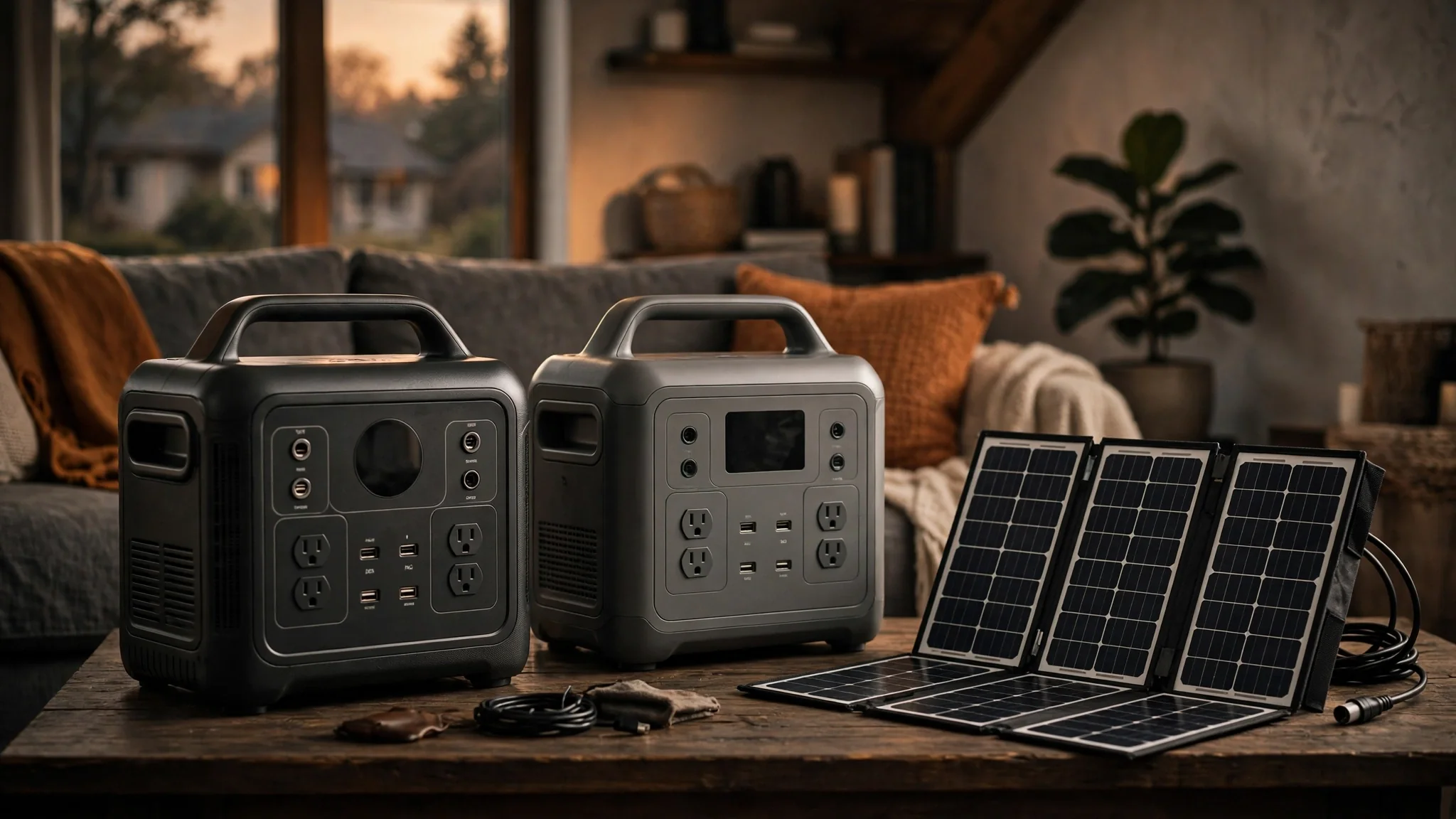
Quick answer: Buy Bluetti if you want the most battery per dollar and a modular system you can grow in slices — the AC500 + B300K bundle sells around $2,099 (list $2,999) and expands to 16.6 kWh. Buy EcoFlow if you want the strongest single box — the Delta Pro 3 delivers 4,000W with single-unit 240V, the fastest simple wall charging, and the deepest accessory ecosystem, typically $2,400–$3,000. The head-to-head below compares those two home-backup flagships, with the 2 kWh class checked as well. Specs are manufacturer ratings; prices are typical US street bands checked October 2026.
If EcoFlow is the polished incumbent of home backup batteries, Bluetti is the value insurgent — a brand that built its following with off-grid and RV users by selling honest LiFePO4 capacity for less money per watt-hour, in boxes you assemble yourself. The AC-class versus Delta-class comparison is really a philosophy comparison: integrated and finished (EcoFlow) versus modular and expandable (Bluetti). Both work. The details decide.
Bluetti AC500 vs EcoFlow Delta Pro 3: the spec table
| Spec | Bluetti AC500 + B300K | EcoFlow Delta Pro 3 |
|---|---|---|
| Capacity (base) | 2,764.8 Wh per battery | 4,096 Wh |
| Continuous output | 3,000W (1 battery) / 5,000W (2+ batteries) | 4,000W (8,000W surge) |
| 240V output | Only with 2 AC500 units + fusion box | Yes — single unit (120V or 240V mode) |
| Expandable to | 16.6 kWh (6 batteries) | 12.3 kWh per unit |
| Solar input | 3,000W | 2,600W |
| Max charging intake | Up to 8,000W (AC + solar, 2+ batteries) | ~5,000W-class (AC + solar) |
| Weight | ~66 lb head + ~65 lb per battery | ~113 lbs (wheeled) |
| Warranty | 4 years | 5 years |
| Typical price | $2,099 sale / $2,999 list (1 battery) | $2,400–$3,000 |
The single most misread spec in this comparison is Bluetti’s output. The AC500 head unit advertises 5,000W — but with one B300K battery attached, output is capped at 3,000W, and the full 5,000W (with 10,000W surge) unlocks only with two or more batteries. Budget for the two-battery bundle (around $3,299 on Bluetti’s store) if you need the headline number. EcoFlow’s 4,000W, by contrast, is what the single box does out of the carton. Neither brand is lying; one of them is making you read footnotes.
Which brand is cheaper per watt-hour?
Bluetti, consistently. Price tracking across both brands’ own stores (September 2026) put Bluetti ahead on cost per kWh in three of four size classes: roughly $478 vs $653 per kWh at 1 kWh (Bluetti’s Elite 100 V2 is the value standout there), $398 vs $446 at 3 kWh, and $542 vs $683 in home-backup class. The 2 kWh class is close to a tie — Bluetti’s Elite 200 V2 (2,073.6Wh, 2,600W, about $899 street) against EcoFlow’s Delta 2 Max (2,048Wh, 2,400W, expandable to 6,144Wh, about $1,029 street) — where EcoFlow’s expandability arguably justifies its small premium. EcoFlow’s pricing looks different again when Jackery is the comparison point instead, which our EcoFlow vs Jackery breakdown covers class by class.
Bluetti’s modular design is itself a pricing strategy: the AC500 head is an inverter with no battery inside, so you buy exactly the capacity you need this year and add a $700–$900 battery module next year instead of replacing the station. Over a five-year horizon of growing needs, that granularity is real money. EcoFlow’s counter is that its integrated units hold value as single appliances and its per-Wh expansion batteries price similarly — but the entry ticket is higher, and there’s no slice smaller than a full extra battery.
Which brand charges faster and takes more solar?
Two different crowns. For simple wall charging, EcoFlow remains the benchmark: Delta-class X-Stream charging refills most of the battery in roughly an hour to 90 minutes from one cable, with no configuration. For maximum intake, Bluetti’s AC500 is the most aggressive charger in the category: up to 8,000W of combined AC + solar with two or more batteries, and 3,000W of solar input — more than the Delta Pro 3’s 2,600W — which matters if your plan is a serious rooftop array cycling the battery daily rather than a garage queen waiting for outages.
The practical translation: in a flickering-grid outage, EcoFlow’s one-cable speed is the more usable advantage. In an off-grid or heavy-solar setup, Bluetti’s intake ceiling wins. Both support pass-through charging and ~20ms UPS-style switchover for keeping a fridge and router alive through the transfer. Daily-cycling shoppers should also note cycle ratings: Bluetti publishes up to 6,000+ cycles to 80% on its Elite line, among the strongest claims in the category.
What about 240V loads and home-panel backup?
This is EcoFlow’s clearest structural win. The Delta Pro 3 outputs 240V from a single unit (in 240V mode — it serves 120V or 240V at a time), pairs with EcoFlow’s Smart Home Panel for circuit-level automatic backup, and starts a typical 240V well pump unaided. A single AC500 is a 120V system: 240V requires a second AC500 plus the fusion box, at which point you’ve spent past Delta Pro Ultra money to get what the Delta Pro 3 does alone.
Bluetti’s honest counter: at the system level, a two-AC500 setup reaches 10,000W and 33+ kWh, beyond a single EcoFlow inverter — and Bluetti’s per-kWh pricing makes that ceiling cheaper to reach. But that’s a two-inverter, four-plus-battery build for serious off-grid homes, not the typical backup buyer. For the full landscape of what these systems can and can’t run, see our portable power stations guide; for the automatic alternative both compete against, see standby generator cost.
What is it like to own each system day to day?
Spec sheets tie more often than ownership does, so the lived differences are worth a section. Setup: the Delta Pro 3 is an appliance — wheel it into place, plug it in, done. The AC500 is a small project: head unit, battery modules, interconnection cables (the B300K needs its P150D-to-P090D adapter cable), and a stack you arrange yourself. That assembly is a one-time hour, and it buys you the modularity — but buyers who hate projects should count it honestly.
Noise and heat: both are effectively silent next to any fuel generator; the AC500’s fans are audible under heavy charging in a quiet room, while the Delta Pro 3’s thermal management is a touch more refined. Neither will bother a sleeping house at fridge-only loads. Apps and control: EcoFlow’s app is the category benchmark — granular charge limits, schedules, firmware that arrives regularly, and clean remote monitoring. Bluetti’s app covers the essentials (Wi-Fi and Bluetooth control, charge/discharge limits) with less polish and the occasional rough edge owners mention in reviews. Support and community: EcoFlow runs the larger formal support operation; Bluetti’s owner community — off-grid forums, RV groups, YouTube teardowns — is unusually deep for a challenger brand, and real-world troubleshooting answers are easy to find for both. Moving them: the Delta Pro 3 is one 113 lb wheeled piece; the AC500 splits into ~65 lb modules one person can carry up stairs separately. For a system that will ever change rooms, Bluetti’s split is a quiet practical win nobody puts on a spec sheet.
None of these day-to-day factors overturns the output and price story above — but they’re the differences you’ll actually notice in year two, long after the unboxing, when the spec sheet is forgotten and the machine is just part of how the house runs.
A worked example: one overnight outage, both systems
Specs stay abstract until you run a night on them, so here is the same outage timed and priced on both flagships, using only the figures already in this guide. Picture a typical essentials list kept alive through a 12-hour overnight outage: a fridge cycling through the evening, a handful of LED lights, the internet router, phone charging, and a CPAP — the 120V load list both brands aim this class at. Modelled generously, that list averages somewhere in the 250–350W range across the night once the fridge’s cycling is averaged in, which works out to roughly 3.0–4.2 kWh of energy between dusk and morning.
Now hold the two systems against that range. A single-battery AC500 starts the night with 2,764.8Wh — enough for the low end of the range, but with little reserve for a microwave burst at midnight or a furnace blower joining the list, and remember its output is capped at 3,000W in that configuration. Add the second B300K — the two-battery bundle at around $3,299 — and the system holds roughly 5.5 kWh with the full 5,000W unlocked: the same night, finished with capacity to spare. The Delta Pro 3 starts with 4,096Wh in one box, which covers the middle of the modelled range on its own, and its 4,000W output means a microwave or blower never has to ask the battery count for permission.
Day two is where the philosophies split again. If the sun comes out, the AC500’s 3,000W solar ceiling refills its larger stack faster than the Delta Pro 3’s 2,600W ceiling refills a smaller one — the modular system rewards the owner who keeps adding panels and batteries. If instead the grid flickers back for an hour, EcoFlow’s simple one-cable wall charging grabs the larger share of a refill inside that window, which is the scenario most suburban outages actually produce. And the well-pump test settles things for rural buyers: the Delta Pro 3 starts a typical 240V pump alone on night one, while Bluetti’s path to 240V — a second AC500 plus the fusion box — is a planned system purchase, not an outage-week improvisation.
The cost of that night, at the home-backup class pricing tracked in this guide — roughly $542 per kWh for Bluetti against $683 for EcoFlow — also explains why neither verdict is universal. The Bluetti owner paid less per stored watt-hour and accepted the assembly, the footnotes, and a second battery to unlock the headline output. The EcoFlow owner paid the premium and took home the finished appliance. The night itself runs fine on either system — which is exactly why the decision belongs to your load list and your budget, not to a spec-sheet trophy.
The verdict: which should you buy?
Buy Bluetti if your loads are 120V essentials (fridge, lights, internet, CPAP, microwave), your budget is the first filter, or you want to start at ~2.8 kWh and grow battery by battery toward 16.6 kWh. The AC500 system and the Elite 200 V2 are the best dollars-per-kWh in home backup right now, and Bluetti’s off-grid community support is deep. Just budget the second battery if you need the 5,000W headline.
Buy EcoFlow if a well pump or any 240V load is on the list, you want panel integration and automatic switchover, you value the fastest simple charging and the best app, or you’d rather buy one finished appliance than assemble a system. The Delta Pro 3 is the more capable single box by a clear margin — you’re paying for output topology and ecosystem, not just watt-hours.
The tiebreaker question: is this a battery system you’ll grow for years, or an appliance you want finished today? System → Bluetti. Appliance → EcoFlow. And as with every brand fight in this category, buy on sale weeks: both brands discount 20–40% so regularly that list price is a negotiating position, not a price. Not sure how much capacity your house needs in the first place? Run the load math in what size generator do I need before either brand gets your money.
Keep reading
Frequently asked questions
Which is better, Bluetti or EcoFlow?
For home backup on a budget, Bluetti — it sells watt-hours cheaper in most size classes, and the AC500's modular batteries let you buy capacity in slices. For output, charging speed, app polish, and ecosystem depth, EcoFlow — the Delta Pro 3 is the stronger single box. My honest split: if the station lives in a garage feeding essentials and every dollar counts, Bluetti. If it feeds a panel, a well pump, or a growing solar array, EcoFlow. Both are LiFePO4, both warranty at 4–5 years, and neither is a mistake at the right price.
Is Bluetti cheaper than EcoFlow?
Per kilowatt-hour, usually yes. Independent tracking of both brands' own stores (September 2026) had Bluetti cheaper per kWh in three of four size classes — about $478/kWh vs $653 at 1 kWh, $398 vs $446 at 3 kWh, and $542 vs $683 in home-backup class. The concrete example in this guide: Bluetti's AC500 + B300K bundle lists at $2,999 and sells around $2,099, while EcoFlow's Delta Pro 3 typically runs $2,400–$3,000. Both brands run near-constant sales, so compare live prices, not list prices, before concluding anything.
Which charges faster, Bluetti or EcoFlow?
It depends how you charge. EcoFlow's wall charging is the fastest simple refill in the business — the Delta line's X-Stream fills most of the battery in about an hour to 90 minutes. Bluetti's AC500 counters with the fastest combined charging anywhere: up to 8,000W of AC plus solar at once with two or more batteries, refilling a two-battery system from empty to 80% in well under an hour. On solar alone, the AC500 also accepts more (3,000W vs the Delta Pro 3's 2,600W). Single-cable wall charging: EcoFlow. Maximum possible intake: Bluetti.
Can Bluetti run a well pump like EcoFlow can?
With the right configuration, yes — but read the fine print. A single AC500 with one B300K battery is capped at 3,000W and 120V only, which cannot start a typical 240V well pump. Add a second battery and output rises to 5,000W, and 240V requires two AC500 units with Bluetti's fusion box. EcoFlow's Delta Pro 3 does 240V from a single unit (in its 240V mode), which is simpler and cheaper if a pump is on your list. Bluetti gets there; EcoFlow gets there in one box.
Do Bluetti and EcoFlow both use LiFePO4 batteries?
Yes — both brands' current lineups are lithium iron phosphate throughout, which is the chemistry you want: roughly 3,000–6,000 cycles depending on model (Bluetti rates its Elite 200 V2 at 6,000+ cycles to 80%), thermal stability a tier above the old NMC cells, and a realistic 10-year service life in backup duty. The B300K batteries in Bluetti's AC500 system are LiFePO4, as is every current Delta and Elite model. Chemistry is a tie; the differences that matter are output topology, charging, and price per watt-hour.