Tesla Wall Connector vs ChargePoint vs Emporia (2026)
If you've narrowed your home charger search down in 2026, the Tesla Wall Connector vs ChargePoint vs Emporia question is probably the exact shortlist sitting in your browser tabs. It's the same three units I install in customers' garages every week, and it's the same three I get asked about at supply houses. I'm Mike Donovan — licensed electrician, 18 years of residential work — and I've mounted, wired, and troubleshot all three of these chargers more times than I can count.
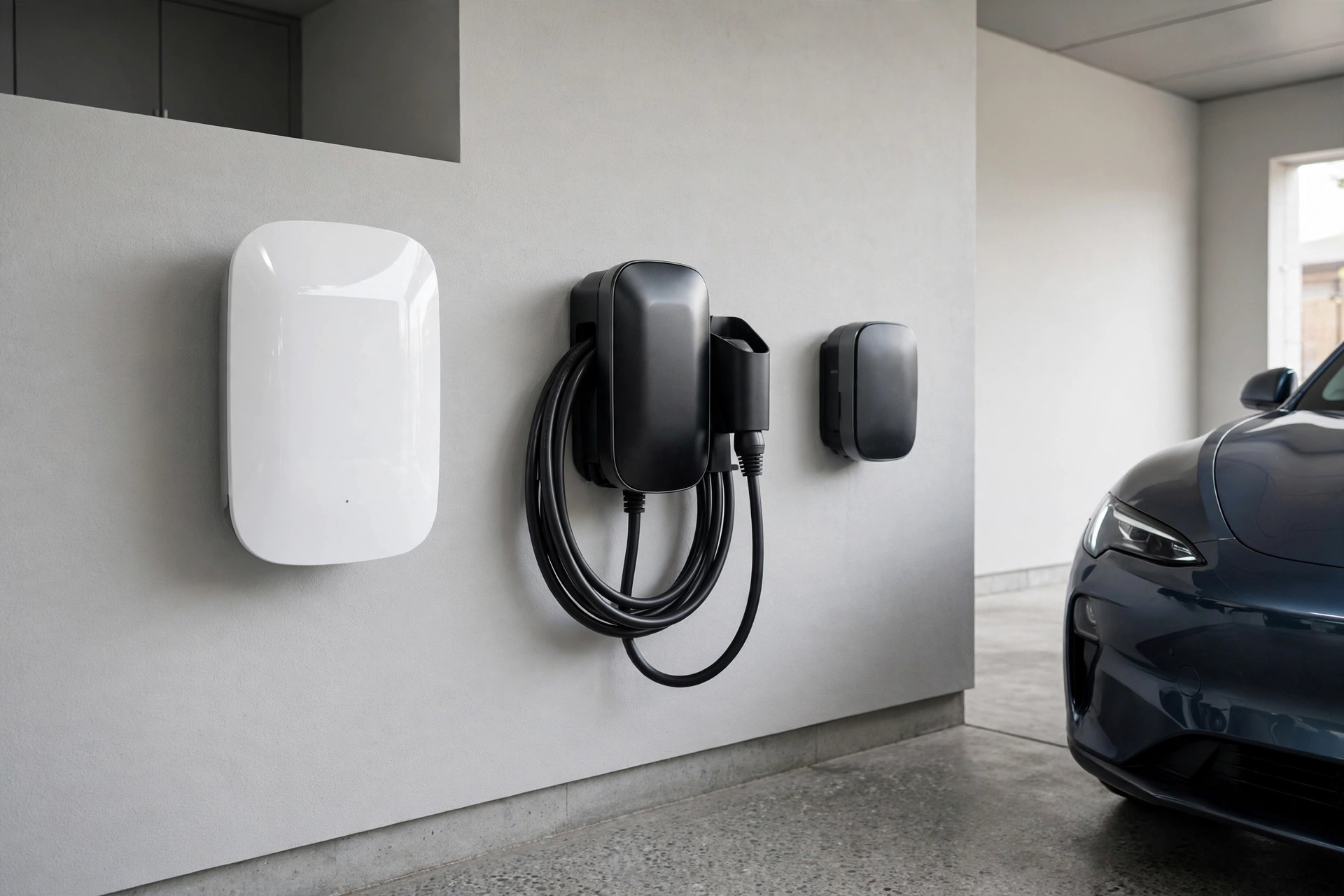
If you’ve narrowed your home charger search down in 2026, the Tesla Wall Connector vs ChargePoint vs Emporia question is probably the exact shortlist sitting in your browser tabs. It’s the same three units I install in customers’ garages every week, and it’s the same three I get asked about at supply houses. I’m Mike Donovan — licensed electrician, 18 years of residential work — and I’ve mounted, wired, and troubleshot all three of these chargers more times than I can count.
Here’s the honest headline before we get into the weeds: all three will charge your car overnight without breaking a sweat. The differences that actually matter are the plug, the app, the price, and how smart the unit is about your electrical panel. Let’s go through them properly.
Tesla Wall Connector vs ChargePoint vs Emporia: The Specs
| Spec | Tesla Universal Wall Connector | ChargePoint Home Flex | Emporia Pro |
|---|---|---|---|
| Price | ~$550 (range $450–$620) | ~$599 (range $549–$649) | ~$449 (range $399–$549) |
| Max output | 48A / 11.5 kW | 50A / 12 kW hardwired; 40A plug-in | 48A / 11.5 kW |
| Connector | NACS with built-in J1772 adapter | J1772 (NACS version available) | J1772 |
| Cable length | 24 ft | 23 ft | 24 ft |
| WiFi | Yes — needed for power sharing & updates | Yes — required for setup | Yes — needed for app features |
| Load management | Power sharing up to 6 units | Basic scheduling only | Excellent, with Vue energy monitor |
| Warranty | 4 years | 3 years | 3 years |
| App quality | Good — inside the Tesla app | Excellent — best in class | Good — data-heavy |
A note on that price row: these prices move. Tesla runs the standard Wall Connector at $420–$475 and the Universal (the one I’m recommending here) at $550. ChargePoint discounts the Home Flex to $549 a few times a year. Emporia is almost always the cheapest of the three, and its simpler non-Pro model dips to $399 regularly. Don’t pay full retail for any of them without checking for a sale or a utility rebate first.
How Fast Do They Charge?
Within a rounding error of each other. At 48 amps on a 60-amp circuit, both the Tesla and the Emporia deliver 11.5 kW, which works out to roughly 40–44 miles of range per hour on most EVs. The ChargePoint’s 50-amp ceiling (12 kW) buys you a theoretical edge — about 2 extra miles per hour — that almost no car can use, because most EVs cap their onboard AC charger at 11.5 kW anyway.
That’s the thing nobody tells you at the charger aisle: the charger rarely sets the speed. Your car’s onboard charger does. A Chevy Bolt tops out at 11.5 kW. A Model 3 tops out at 11.5 kW. Plug any of these three units into any of those cars and you get the same number on the dash in the morning: full.
If you’re still deciding whether you even need Level 2 speeds, do that math first — I walk through it honestly in Level 1 vs Level 2 EV charging, including the cases where the free cord that came with your car is genuinely enough.
The Tesla Universal Wall Connector: The Safe Default
The Tesla unit I’d actually sell you is the Universal Wall Connector ($550), not the cheaper standard one. Here’s why: it has a J1772 adapter built right into the dock. Push a button, the handle comes out as a Tesla (NACS) plug. Push the other way, it comes out as J1772. One charger, every EV on the market, no adapter dongle rattling around your garage.
That’s not a small thing in 2026. Households are mixed now — a Model Y in one bay, a Hyundai in the other, and a kid’s used Bolt on the driveway. The Universal handles all of it without thinking.
Other things it does well:
- Power sharing that actually works. Up to six Wall Connectors on one circuit, splitting amps automatically as cars plug in and finish. If you have two EVs and one 60-amp circuit’s worth of panel space, this is the cleanest solution I install.
- Clean install. The wirebox and faceplate design makes for tidy conduit work, and the unit is compact — it doesn’t dominate a garage wall.
- Four-year warranty, the best of this group.
The honest complaints: if you don’t own a Tesla, you manage it through the Tesla app’s guest/owner setup, and the energy reporting is thinner than ChargePoint’s or Emporia’s. Tesla also doesn’t play nicely with utility demand-response programs the way ChargePoint does. And the standard (non-Universal) Wall Connector at ~$450 is NACS-only — fine for a Tesla-only house, limiting for everyone else.
The ChargePoint Home Flex: The App Is the Product
The ChargePoint Home Flex ($549–$649) is the charger for people who like data and control. ChargePoint also runs the biggest public charging network in North America, and it shows: the app is the most polished of the three, with clean scheduling, accurate energy cost tracking, Alexa integration, and reminders if you forget to plug in.
The hardware is genuinely flexible — hence “Flex.” An electrician can set it anywhere from 16 to 50 amps. Hardwired on a 70-amp circuit it delivers the full 50 amps (12 kW). Plugged into a NEMA 14-50 or 6-50 outlet, it’s capped at 40 amps, which is still 30-plus miles per hour. That adjustability makes it the easiest charger to fit into a crowded panel.
Now the gripe, and it’s a real one: the Home Flex requires WiFi for setup. No WiFi, no activation — the smart features are the product, and ChargePoint won’t let you run it as a dumb charger out of the box. If your garage has weak WiFi (many do; it’s usually the farthest room from the router), plan on a range extender or hardwire access point. I’ve been on installs where we spent longer fighting garage WiFi than mounting the unit.
Also know that at $599 street price, you’re paying a premium for software. If you never open charging apps — most people stop after month two — that premium buys you nothing over the Emporia.
The Emporia Pro: Best Value, Secret Weapon
The Emporia Pro ($399–$549, usually ~$449) is the one I recommend when a customer cares about money and energy, in that order. Charging-wise it’s a peer of the Tesla: 48 amps, 11.5 kW, 24-foot cable, solid build. The app is less beautiful than ChargePoint’s but shows you more — real-time watts, cost per session, solar export if you have panels.
The secret weapon is the ecosystem. Pair the Pro with the Emporia Vue home energy monitor (~$150–$200) clipped into your panel, and the charger can watch your whole house’s load and throttle itself down when the oven, dryer, and AC all run at once — then speed back up when the house calms down. In plain terms: it can keep you from needing a $1,500–$3,000 panel upgrade on a maxed-out 100-amp service. Neither Tesla nor ChargePoint offers anything this effective at this price. I’ve installed this combo in three 1970s houses this year where the alternative quote started with “new panel.”
The trade-offs are fit and finish. The unit looks like what it is — a value-engineered plastic box — and the app’s interface assumes you enjoy numbers. If you do enjoy numbers, you’ll love it. Emporia is also a smaller company than Tesla or ChargePoint; the 3-year warranty is standard, and their support has been good in my experience, but it’s a fair point to weigh.
Installation Notes From the Truck
The chargers differ more on my ladder than they do on your phone. The Tesla’s two-piece design — wirebox first, unit snaps on — is the fastest clean install of the three: I land the conductors, level the box, and click the face on in minutes, and the terminals are laid out like someone actually thought about the person holding the screwdriver. ChargePoint’s real install gift is flexibility. If you already have a NEMA 14-50 outlet in the garage, the Home Flex can be running in twenty minutes. But hardwiring it for the full 50 amps means a 70-amp breaker and heavier wire, which surprises people who budgeted it as a plug-in job. The Emporia is the most conventional install of the three: standard knockouts, standard terminals, nothing clever — which also means nothing exotic to break. It’s the one I’d call genuinely electrician-proof.
One warning that applies to all three, and I put it in every quote: EV charging is a continuous load under the electrical code. A 48-amp charger needs a 60-amp circuit, full stop. If a handyman quotes you a 50-amp breaker for a 48-amp charger “because it’ll be fine,” it will not be fine at 2 a.m. in July when the car, the AC, and the dryer are all running. Pull the permit. The inspection is the cheapest insurance on the entire job, and it’s the reason your homeowner’s policy pays out if anything ever goes wrong.
Honorable Mention: The Grizzl-E
Not everyone wants a smart charger. If your attitude is “just charge the car,” look at the Grizzl-E (~$399–$470) from United Chargers. It’s a Canadian-built aluminum brick of a charger: 40 or 48 amps depending on model, no WiFi required, dip switches inside to set the amperage, and a reputation for surviving winters that kill lesser units. There’s no app to speak of — your car’s app handles scheduling. United Chargers backs it with a 3-year warranty standard (5 years available on some models) and support staffed by people who actually know what a dip switch is. If it dies, it dies simple — no bricked smart features, no account lockout, just a charger that stopped charging, which is exactly how a garage appliance should fail. For a barn, a workshop, or anyone who’s sick of making accounts to use appliances, it’s the most reliable dumb charger I know. It loses this comparison on features, full stop — but it deserves a seat at the table for people who don’t want the features.
Which EV Charger Should You Buy?
- You own a Tesla (or one Tesla and anything else): Tesla Universal Wall Connector. The dual-plug dock and power sharing make it the obvious install, and the 4-year warranty seals it.
- You love apps, schedules, and utility programs: ChargePoint Home Flex. Best software in the business, genuinely useful energy tracking, and the adjustable amperage fits tough panels — as long as your garage WiFi reaches it.
- You’re watching the budget or your panel is nearly full: Emporia Pro, ideally with the Vue monitor. Same charging speed as the Tesla for $100 less, and the load management can save you thousands on electrical work.
- You hate all of the above: Grizzl-E. Plug it in, charge the car, think about something else.
One last installer’s note: pick the charger second and the circuit first. The charger is $400–$650 of a project that usually totals $1,200–$2,500 with installation — I break down where that money goes in the Level 2 EV charger installation cost guide. And if your home also runs a battery or solar — or you’re thinking about it — the load-management conversation here connects directly to home battery vs generator backup, because a 48-amp charger is one of the biggest loads your panel will ever see. Get the panel math right once, and any of these three chargers will serve you for a decade.
Frequently asked questions
Which is better, the Tesla Wall Connector or ChargePoint Home Flex?
For most homes it's a tie on charging speed — both deliver a full overnight charge easily. The Tesla Universal Wall Connector ($550) wins if you own a Tesla or might switch cars, because its built-in adapter handles both NACS and J1772 plugs. The ChargePoint Home Flex ($599) wins on software: better scheduling, better energy tracking, and utility rebate integration. Pick based on your car and how much you care about the app.
Is the Emporia charger as good as Tesla and ChargePoint?
For charging the car, yes — the Emporia Pro pushes the same 48 amps (11.5 kW) as the Tesla unit and costs $100–$200 less. Where Emporia pulls ahead is energy management: paired with the Emporia Vue monitor it can throttle charging automatically to avoid a panel upgrade, something neither Tesla nor ChargePoint does as cheaply. The hardware feels less premium and the app is more data-nerd than polished, but electrically it's the real deal.
Do I need a Tesla charger to charge a Tesla at home?
No. Any Level 2 charger can charge a Tesla. J1772 chargers like the ChargePoint and Emporia work with the adapter that comes with the car, and Tesla's own Universal Wall Connector charges non-Teslas too. Buy the charger that fits your panel, your budget, and your app preferences — not the badge on your car.
Can one home charger charge two EVs?
Yes, with power sharing. Up to six Tesla Wall Connectors can share one circuit and split the available amps automatically. Emporia does it through its app and Vue monitor. ChargePoint Home Flex is one car per unit, so two EVs means two circuits or plugging in on alternate nights. If you're a two-EV household, power sharing should drive your choice.
How much does it cost to install a Tesla Wall Connector, ChargePoint, or Emporia?
The charger itself runs $399–$649 depending on brand and sales. Installation typically adds $500–$1,200 for a straightforward job near your panel, putting most homeowners at $1,200–$2,500 all-in. A long wire run, trenching to a detached garage, or a panel upgrade pushes it higher. The charger brand barely affects install cost — wire distance and panel capacity do.