Level 1 vs Level 2 EV Charging: Speed & Cost
The first question every new EV owner asks me — and I've been asked it hundreds of times in 18 years of residential electrical work — is whether they actually need to spend money on a Level 2 charger. The Level 1 vs Level 2 EV charging question is really a math question wearing a shopping question's clothes. So let's do the math publicly, with real numbers, and I'll show you exactly when the free cord that came with your car is honestly enough — and when it isn't.
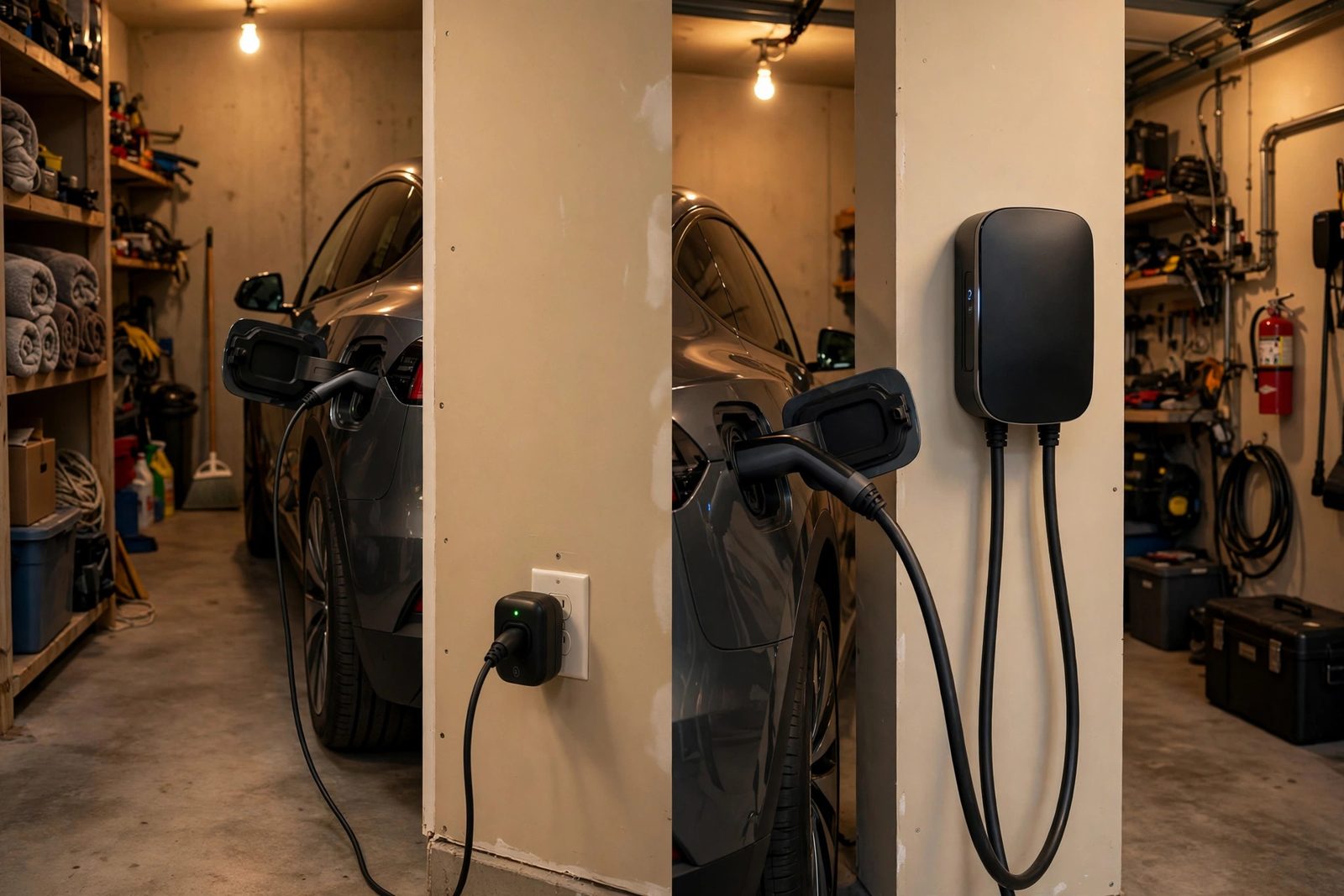
The first question every new EV owner asks me — and I’ve been asked it hundreds of times in 18 years of residential electrical work — is whether they actually need to spend money on a Level 2 charger. The Level 1 vs Level 2 EV charging question is really a math question wearing a shopping question’s clothes. So let’s do the math publicly, with real numbers, and I’ll show you exactly when the free cord that came with your car is honestly enough — and when it isn’t.
Level 1 vs Level 2 Charging: The Basic Math
All home EV charging is just voltage times amps. That’s the whole story:
| Charging level | Circuit | Power | Speed |
|---|---|---|---|
| Level 1 | 120V / 12A (a regular outlet) | ~1.4 kW | 3–5 miles of range per hour |
| Level 2 (32A) | 240V / 32A | 7.7 kW | 25–30 miles per hour |
| Level 2 (40A) | 240V / 40A | 9.6 kW | 30–37 miles per hour |
| Level 2 (48A) | 240V / 48A | 11.5 kW | 40–44 miles per hour |
That miles-per-hour column assumes roughly 3 miles per kWh, which is about right for a Model 3 or Ioniq 5 and slightly optimistic for a Lightning or a Hummer. Big heavy EVs drink more per mile; the math is the same, the numbers just shift a bit.
Level 1 is the cord that comes with (most of) the car plugged into the same outlet as your garage lamp. Level 2 is a dedicated 240V circuit — either a hardwired charger or a big plug — installed by an electrician. One is free. The other runs $1,200–$2,500 installed. The question is whether the free one covers your life.
How Fast Is Level 1 Charging, Really?
Level 1 on a standard 15-amp garage circuit charges at 12 amps continuous (electrical code limits continuous loads to 80% of the circuit rating, and EV charging counts as continuous). That’s 1,440 watts — about the same as a hair dryer running all night.
At 3–5 miles per hour, here’s what a night of charging gives you:
- 8 hours (9pm–5am): 24–40 miles
- 12 hours (7pm–7am): 40–60 miles
- 24 hours parked all weekend: 80–120 miles
The average American drives about 30–40 miles a day. That means a 12-hour overnight window on Level 1 covers the average commute with room to spare. This isn’t a trick. It’s just arithmetic, and it’s the piece of math that most charger marketing hopes you never do.
The catch is efficiency. Charging at low power is a little less efficient — around 80–85% of the wall energy makes it into the battery on Level 1 versus 90–95% on Level 2, because the car’s computers and cooling systems draw a fixed overhead while charging. On a 30-mile day that’s maybe an extra $0.15–$0.25 of electricity. Over a year, call it $50–$90. Real money, but nowhere near enough to justify a $2,000 install on its own.
One more honest note: Tesla no longer includes the mobile connector for free — it’s a $200 add-on (or came with used models if the seller left it in the frunk). Most other brands still include one. Before you assume anything, check what came with your car.
Is Level 1 Enough for a 30-Mile Commute?
Let’s make it concrete, because this is the scenario I see most often. You drive 30 miles round trip to work. You plug in at 7pm. You unplug at 7am. That’s 12 hours at roughly 4 miles per hour = 48 miles recovered for 30 miles used. Every single night, you leave with more than you need, and the battery trends toward full over the week.
Then the weekend happens. Friday night to Monday morning, the car sits plugged in for 60+ hours, recovering 200+ miles. The weekday deficit you never had disappears into the weekend.
When does this break down? Three ways:
- Irregular heavy days. A 30-mile commuter who does a 150-mile day trip Saturday now needs that weekend to catch up — it will, if the car sits. If Sunday is another 100-mile day, Level 1 can’t recover fast enough. One long weekend day per month? Fine. Every weekend? Not fine.
- Shorter overnight windows. Two-shift households, or someone who gets home at 9pm and leaves at 5am, only has 8 hours. 8 hours × 4 mi/hr = 32 miles. A 30-mile commute still fits, but the margin is gone.
- You never get a catch-up day. If every day is 40+ miles and the car is never parked for a full day, Level 1 runs a slow deficit until you’re crawling to a public fast charger on Friday.
For a typical office worker with a 30-mile commute and a car that sleeps in the garage, Level 1 is genuinely enough. I tell people this for free on service calls, and it’s cost me charger installs. It’s still the right answer.
How Fast Does Level 2 Charge Common EVs?
Here’s the 10–80% comparison people actually search for. These use usable battery sizes and assume the car is parked, not preconditioning (cold weather adds time on both levels).
| Vehicle | Battery (usable) | Level 1 (1.4 kW) | Level 2, 32A (7.7 kW) | Level 2, 48A (11.5 kW) |
|---|---|---|---|---|
| Tesla Model 3 RWD | ~57 kWh | ~30 hours | ~6 hours | ~4 hours |
| Tesla Model 3/Y Long Range | ~75 kWh | ~40 hours | ~7.5 hours | ~5 hours |
| Hyundai Ioniq 5 Long Range | ~77 kWh | ~41 hours | ~8 hours | ~5 hours |
| Ford F-150 Lightning ER | ~131 kWh | ~70 hours | ~13.5 hours | ~8.5 hours |
| Chevy Bolt EUV | ~65 kWh | ~35 hours | ~6.5 hours | ~4.5 hours |
Two things jump out. First: on Level 2 at 48 amps, everything finishes overnight — even the Lightning, the hungriest vehicle on this list. Second: Level 1’s problem isn’t speed, it’s recovery depth. If you never use more than 50 miles a day, the 30–40 hour full-charge time is a number you never encounter, because you never get that empty.
Also worth knowing: the F-150 Lightning can accept up to 19.2 kW (80 amps) with Ford’s Charge Station Pro, which cuts that 10–80% time to about 5 hours. It’s the only mainstream EV that uses more than 48 amps at home, and it requires an 80-amp circuit — the biggest home EV install I do, and one that almost always needs a panel capacity check.
What Does Level 2 Cost vs Level 1?
Level 1: $0, plus whatever your car’s mobile connector cost (free with most brands, ~$200 from Tesla). Installation: none. You plug it into an existing garage outlet and you’re done.
Level 2, broken down honestly:
- Charger hardware: $400–$650 for one of the good units — my three-way comparison of the Tesla, ChargePoint, and Emporia covers which one fits which house.
- Electrician install: $500–$1,200 for a typical job — new 40 or 60-amp breaker, a short wire run to the garage, permit, and inspection.
- Total: $1,200–$2,500 all-in for most homes.
What pushes it higher: a panel upgrade ($1,500–$3,000) if your service is already maxed out — common on older 100-amp panels that also run electric dryers, ranges, and AC — or a long trench to a detached garage. Those are legitimate costs, and they’re why I always check panel capacity before quoting, never after.
There’s also a smart middle option nobody advertises: if your service is tight, a charger with load management — like the Emporia Pro paired with its home energy monitor — can throttle charging to fit the panel you already have instead of forcing an upgrade. That combo has saved my customers real money this year.
When Do You Actually Need Level 2?
Level 2 stops being optional in these cases:
- Long commutes. At 60+ miles a day, Level 1 can keep up mathematically on a 12-hour window — barely, and with zero margin. A 48-amp Level 2 turns that same commute into a 90-minute recharge. The peace of mind alone is worth it.
- Two EVs, one garage. Two cars both driving 30 miles a day need 60 miles of overnight recovery. Level 1 gives 40–50. Someone’s car is unhappy by Thursday. Level 2 refills both without thinking about it — especially with power-sharing chargers that split one circuit.
- Cold climates. This one’s physics. In deep winter, the car spends energy heating the battery just to charge it. Level 1’s trickle can barely outrun that heating load in sub-zero weather — I’ve seen Level 1 effectively deliver 1–2 miles per hour on a January night in Minnesota. If you live where winters are real, Level 2 is close to mandatory.
- Rideshare or delivery driving. 150–250 miles a day is Level 2 territory, full stop. You’ll want 48 amps and you’ll want a scheduled start on cheap overnight rates.
- Time-of-use electric rates with short off-peak windows. Some utilities only discount electricity from midnight to 6am. Six hours on Level 1 recovers 24 miles; six hours on Level 2 recovers 240. The charger pays for itself in rate savings — $300–$600 a year in some markets.
When Level 1 Is Genuinely Enough
Flip side, and I’ll be straight with you about it: plenty of people never need Level 2.
- Short commutes under 40 miles a day with the car home overnight. This is most drivers.
- Plug-in hybrids (PHEVs). This is the case everyone forgets. A RAV4 Prime has an 18 kWh battery — Level 1 fills it in about 12 hours, completely, every night. A Prius Prime takes ~6 hours. If you drive a PHEV, you almost certainly never need Level 2.
- Second cars. The commuter EV needs the fast charger; the weekend/errand car is fine on the 120V cord.
- Retirees and work-from-home drivers doing under 20 miles a day. You’ll never outrun Level 1.
A decent rule of thumb: multiply your daily miles by 2. If the result is under 80, Level 1 handles your week. If it’s over 100, get Level 2. Between 80 and 100 is the judgment zone — think about your winters and your weekends.
The Middle Option: Level 2 on a Dryer Outlet
Here’s the tradesperson trick nobody’s ad budget will pay for. A dryer outlet is 240 volts. With the right adapter or a portable dual-voltage charger, a 30-amp dryer circuit delivers 24 amps continuous — about 17 miles per hour, which is roughly a third of a full 48-amp charger and four times Level 1. Equipment cost: $150–$400 for an adapter or splitter. No electrician required if the outlet is healthy.
Rules: never run the dryer and the charger at the same time (a splitter like the NeoCharge handles this automatically, ~$500, and it’s worth it). And have an old dryer outlet inspected before pulling a continuous EV load through it — worn receptacle contacts are a genuine fire risk, and old dryer plugs have been arcing quietly for twenty years. I check them with a thermal camera on service calls; you’d be surprised.
This is the answer for renters, too. Your landlord may not love a new circuit, but nobody notices a plug adapter.
The Bottom Line
Don’t start with the charger. Start with the math: your daily miles, your overnight hours, your winters, your other cars. Level 1 at 3–5 miles per hour is free, gentle on the battery, and genuinely enough for most 30-mile commutes — do the arithmetic before you spend $2,000. If the math says you need more, Level 2 at 25–44 miles per hour charges anything overnight and is the best home electrical upgrade most EV owners make.
If you decide Level 2 is right, your next two reads are the installation cost breakdown — so you know exactly what an electrician should charge you — and my honest Tesla vs ChargePoint vs Emporia shootout for which charger to put on that circuit. And if a 48-amp charger is the thing pushing your panel to its limit, read up on how home batteries and generators compare for backup — because panel capacity planning is where these conversations always end up.
Frequently asked questions
Is Level 1 charging enough for daily driving?
For many drivers, yes. Level 1 adds 3-5 miles of range per hour, so a 12-hour overnight window recovers 40-50 miles — more than the average US commute of ~30 miles round trip. If your daily driving is under 40 miles and the car sits overnight, Level 1 keeps the battery comfortably full. Level 2 becomes necessary for longer commutes, two-EV households, or deep-winter climates.
How much faster is Level 2 than Level 1?
Roughly 7-10x faster. Level 1 at 120V/12A delivers about 1.4 kW (3-5 miles per hour). A 48-amp Level 2 charger delivers 11.5 kW (40-44 miles per hour). A Tesla Model 3 that takes 40+ hours to go from 10% to 80% on Level 1 does it in under 5 hours on Level 2.
How much does it cost to install a Level 2 charger?
The charger hardware runs $400-$650 for a good unit. Installation by a licensed electrician typically adds $500-$1,200 for a straightforward run near your panel, putting most homeowners at $1,200-$2,500 all-in. A long wire run, a detached garage, or a panel upgrade adds $1,500-$3,000 more.
Does Level 1 charging damage the EV battery?
No — slow charging is the gentlest thing you can do to a battery. Level 1 generates less heat than fast charging, and heat is what ages cells. Battery health depends far more on keeping the state of charge between 20% and 80% and avoiding repeated DC fast charging than on which home charger you use.
Can I plug my EV into a dryer outlet for faster charging?
Yes, with caveats. A dryer outlet (240V/30A) delivers up to 24 amps continuous, which is about 17 miles per hour — a big jump over Level 1 — using a NEMA 14-30 adapter or a portable charger with a 14-30 plug. Never use both the dryer and the charger at once, and if the outlet is old or its contacts are worn, have an electrician inspect it first. Worn dryer outlets are a real fire risk under continuous EV loads.