Level 2 EV Charger Installation Cost: 2026 Prices
Level 2 EV charger installation cost is the number everyone googles the week after they buy the car. Here's the honest answer from eighteen years of residential electrical work: most homeowners land between **$1,200 and $1,800 all-in** in 2026 — charger, wire, labor, and permit. That range stretches down to about $800 for a dead-simple garage install and past $4,000 when your panel is full or the run is long. The charger itself is only about a third of what you'll pay. The rest is copper, labor, and whatever your panel situation looks like.
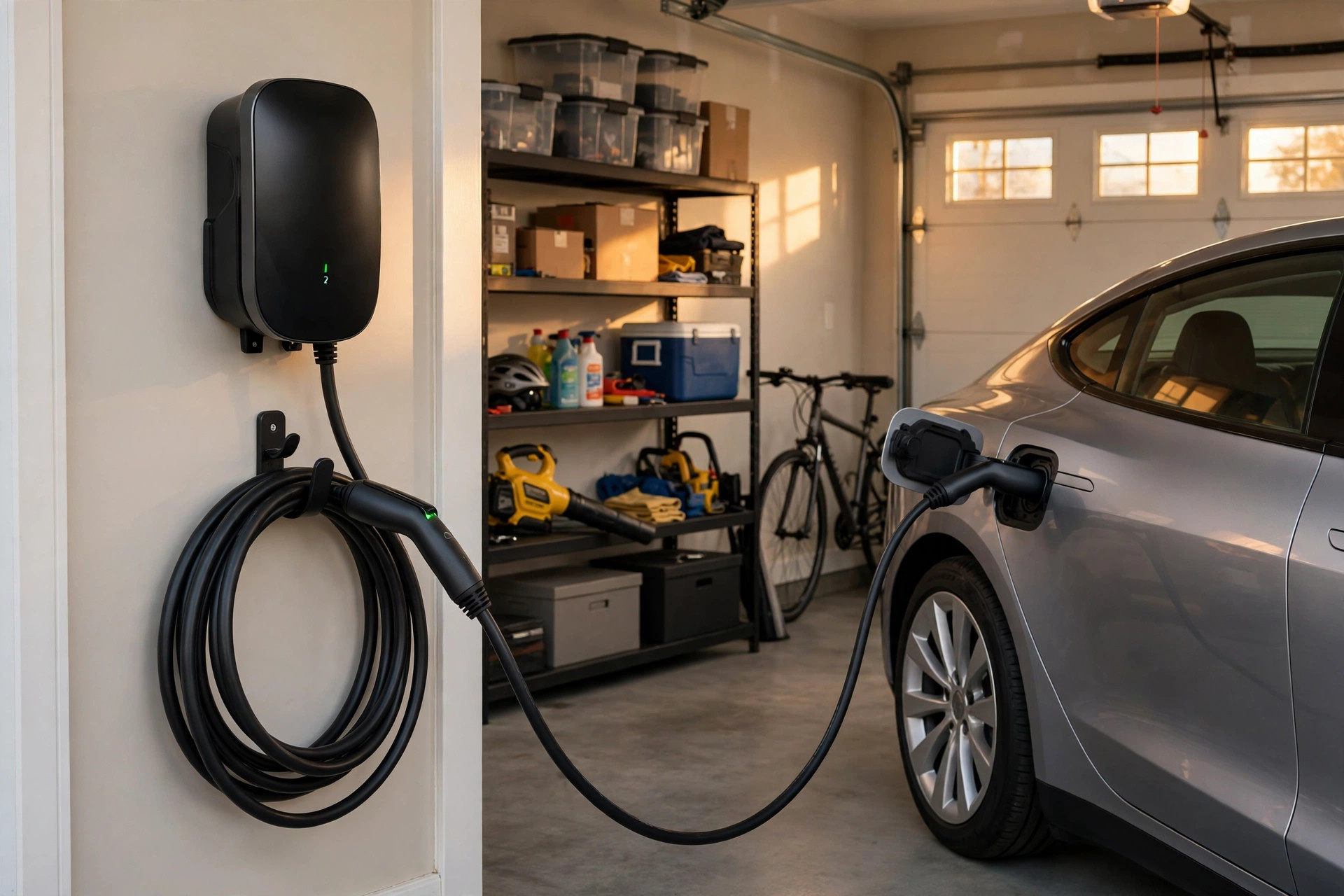
Level 2 EV charger installation cost is the number everyone googles the week after they buy the car. Here’s the honest answer from eighteen years of residential electrical work: most homeowners land between $1,200 and $1,800 all-in in 2026 — charger, wire, labor, and permit. That range stretches down to about $800 for a dead-simple garage install and past $4,000 when your panel is full or the run is long. The charger itself is only about a third of what you’ll pay. The rest is copper, labor, and whatever your panel situation looks like.
I’m going to break this down the way I break it down for customers standing in their garage: what the parts cost, what my labor costs, when the panel becomes the problem, and which quotes to throw in the trash.
Level 2 EV Charger Installation Cost: What’s Actually Included
Four pieces. Every quote you get should show all four, itemized. If it doesn’t, that’s your first red flag.
- The charger (EVSE) unit itself — $400–$700 for the good ones.
- The circuit — breaker, wire, conduit, disconnect if required. This is the part that swings wildly, from $150 in materials for a 5-foot run to $800+ for a long run.
- Labor — the electrician’s time. $500–$1,200 for a standard install in most markets, more in high-cost cities.
- The permit and inspection — $50–$250 depending on your jurisdiction. Yes, you need one. I’ll explain why below.
Notice what’s NOT on that list: drywall repair, trenching to a detached garage, or a panel upgrade. Those are the “surprises” that turn a $1,400 quote into a $4,000 invoice. A good electrician spots them during the site visit. A bad one spots them after the walls are open.
How Much Does the Charger Itself Cost?
The hardware market has settled nicely. You don’t need the most expensive unit, and the cheapest ones have gotten genuinely good.
| Charger | Amps | Typical price (2026) | My take |
|---|---|---|---|
| Tesla Universal Wall Connector | 48A | ~$450–$550 | Best value if anyone in the household drives a Tesla. Has both NACS and J1772. Clean install, reliable. |
| Tesla Wall Connector | 48A | ~$450 | Same as above minus the J1772 adapter magic. Fine if the house is all-Tesla. |
| ChargePoint Home Flex | 50A | ~$549–$649 | The safe mainstream pick. Good app, hardwired or plug-in, works with everything. |
| Emporia Pro EV Charger | 48A | ~$399–$549 | The budget pick that’s actually good. Solid hardware, decent app, often the cheapest 48A unit. |
| Grizzl-E Classic | 40A | ~$400–$470 | Dumb as a rock and proud of it. Metal box, no WiFi to break. If you hate apps, this is your charger. |
| Ford Charge Station Pro | 80A | ~$1,300 | Only makes sense with an F-150 Lightning and only if your service can feed it. Most homes can’t without an upgrade. |
Here’s what nobody tells you: for overnight home charging, a 40-amp charger and a 48-amp charger feel identical. Both refill a typical EV (60–80 kWh battery) in 6–9 hours while you sleep. The 48A units charge about 20% faster, which matters exactly never when the car sits in the garage for ten hours. Don’t pay extra or upgrade your panel just to get 48A instead of 40A. The real-world difference is bragging rights.
Also: hardwired beats plug-in in almost every case. A NEMA 14-50 outlet install is fine, but under the 2023 NEC, plug-in EV chargers need GFCI protection on the receptacle, and GFCI breakers on 50A circuits are notorious for nuisance tripping with EV loads. Hardwired units have the GFCI built into the charger itself, which is how the manufacturers designed it to work. I hardwire whenever the customer lets me.
What Size Circuit Does a Level 2 Charger Need?
This is the part where I get to be an electrician instead of a shopping guide. The National Electrical Code treats EV charging as a continuous load, which means the circuit has to be rated at 125% of the charging current. The math:
- 48A charger → 60A breaker, #6 copper wire minimum (THHN in conduit), dedicated circuit.
- 40A charger → 50A breaker, #6 copper wire minimum, dedicated circuit.
- 32A charger → 40A breaker, #8 copper wire minimum, dedicated circuit.
“Dedicated” means nothing else on that circuit. Not the garage freezer. Not the dryer. The number of “my breaker keeps tripping” calls I’ve gotten from shared circuits could fill a book.
A few more code realities for 2026:
- Load calculation first. Article 220. Before I touch anything, I do a service load calculation on your existing panel. If your 200A service is already at 170A of calculated load, adding a 60A EV circuit isn’t happening without an upgrade — no matter how much you want it. Any electrician who quotes you without doing (or at least discussing) a load calc is guessing.
- Torque specs matter. The 2017 NEC added torque requirements on terminations, and EV circuits are exactly where loose lugs cause meltdowns. Aluminum wire on EV circuits is a hard no from me — copper only, torqued to spec. I’ve seen two garage fires from under-torqued aluminum on high-continuous loads. Not worth it.
- Disconnect requirements vary. Some jurisdictions now want a lockable disconnect within sight of the charger. Cheap to add ($40–$80), annoying to retrofit if the inspector flags it after the fact.
Wire is the silent budget killer. Copper #6 THHN runs roughly $1.50–$2.50 per foot per conductor in 2026, and you need three conductors plus ground. A 60-foot run eats $400–$600 in wire alone before conduit, fittings, and labor. When I quote a job, the distance from panel to charger is the single biggest variable — bigger than which charger you picked.
Level 2 EV Charger Installation Cost: 3 Real Scenarios
Forget the national averages. Here are three jobs from the last year, with real numbers.
Scenario 1: Garage next to the panel (the easy one)
Panel is in the garage, charger goes on the wall six feet away. 200A service with room to spare. Hardwired 48A charger, permit pulled.
- Charger: $450 (Tesla Wall Connector)
- Materials (breaker, 10 ft of #6, conduit, fittings): ~$120
- Labor: 3 hours, ~$450
- Permit: $125
- Total: ~$1,145
This is the job every YouTube video shows you. It’s real, but it’s maybe a third of the installs I do.
Scenario 2: 60-foot run through a finished basement
Panel in the basement utility room, charger in the attached garage. Finished ceiling, so we’re fishing wire or opening drywall. 200A service, load calc passes.
- Charger: $549 (ChargePoint Home Flex)
- Materials (breaker, 130 ft of #6 copper with waste factor, conduit, junction boxes): ~$550
- Labor: full day, ~$1,100 (fishing wire through finished space is slow)
- Permit: $150
- Total: ~$2,350
The wire and the fishing time doubled the job. Nothing was “wrong” — this is just what distance costs.
Scenario 3: 100A panel, full, house from 1978
Charger location is easy — garage shares a wall with the panel. But the panel is a 100A Pushmatic-style relic with no spare slots, and the load calc fails with a 60A EV circuit added. Customer needs the charger at 40A minimum for their commute.
- Charger: $450
- Service upgrade 100A → 200A (new panel, meter work, utility coordination): $2,800
- Circuit + labor: $650
- Permit: $200
- Total: ~$4,100
The charger was 11% of this job. The other 89% was forty-year-old infrastructure. This is the scenario that makes people angry at the quote, and honestly, I get it — but the panel was going to need replacing within five years anyway. The EV just forced the timeline.
How Much Do Electricians Charge for EV Charger Installation?
Labor rates in 2026: $100–$175 per hour for a licensed electrician in most US markets, higher in coastal metros (I’ve seen $200+/hr in the Bay Area and Boston). A standard install takes 3–6 hours of on-site time plus the permit paperwork and the inspection visit.
What drives labor cost up:
- Distance. Every foot of wire run is labor. Fishing through finished walls is 3–4x slower than running exposed conduit in an unfinished basement.
- Trenching. Detached garage 40 feet from the house? That’s a trench, conduit, and possibly concrete cutting. Add $800–$2,000 before you even talk about the charger.
- Attic/crawlspace work. In summer. In the South. I charge accordingly and I’m worth it.
- Inspection callbacks. If the first inspection fails (wrong breaker type, missing label, torque sticker), somebody’s coming back. Good electricians price this risk in.
Permits: $50–$250 depending on jurisdiction. Some cities charge a flat electrical permit fee; others base it on job valuation. Here’s my honest take on permits for EV chargers: pull one. I know the internet is full of “my buddy did it without a permit” stories. Two problems: your homeowner’s insurance can deny a fire claim on unpermitted electrical work, and when you sell the house, the buyer’s inspector will spot a 60A circuit that isn’t on any permit record. The $150 permit is the cheapest insurance on the whole job. Any electrician who suggests skipping the permit is telling you exactly how they run their business.
Is It Worth Upgrading Your Panel for an EV Charger?
This is the $2,000–$3,000 question, literally. A panel/service upgrade typically runs $2,000–$3,000+ in 2026 (higher in expensive markets or when the utility has to upsize the service drop).
Before you agree to one, know your options:
- Turn the charger down. Most smart chargers (Tesla, ChargePoint, Emporia) let you commission at a lower amperage — a 48A charger set to 24A or 32A needs only a 30A or 40A circuit, which often passes the load calc on a 100A service. You lose charging speed you’ll never miss overnight. This is free and I suggest it constantly.
- Load management devices. Products like the Emporia Vue with load management, or a simple DCC (demand charge controller, ~$1,000–$1,500 installed), monitor your total service load and pause EV charging when the house is peaking. Cheaper than a panel upgrade and code-compliant.
- Actual upgrade. If the panel is old, full, or a known problem brand (Federal Pacific, Zinsco — if you have one of these, the EV charger is the least of your worries), just do the upgrade. It’s real infrastructure improvement, not EV overhead.
My rule of thumb: if the panel is healthy and just tight on capacity, derate the charger or add load management. If the panel is old enough to vote, upgrade it and stop putting it off.
EV Charger Installation Quotes You Should Distrust
After eighteen years, I can smell a bad quote in about ten seconds. Watch for these:
- The flat-rate “$499 install” ad. That price covers hanging the charger next to the panel with six inches of wire. Everything else is an upsell. The final invoice never says $499.
- No mention of a load calculation. If they didn’t ask about your panel size or existing loads, they’re not doing electrical work — they’re doing handyman work with a license borrowed from someone else.
- “You don’t need a permit for this.” See above. This sentence tells you everything about the contractor.
- Insisting you need the 80A charger and a panel upgrade. Unless you drive an F-150 Lightning with the extended battery and genuinely need 80A, this is upselling. A 40–48A circuit covers 95% of drivers.
- Cash price with no paperwork. No permit, no invoice, no warranty. When the charger melts a lug in two years, that phone number won’t work anymore.
- Quoting by phone with no site visit. Any honest quote for anything beyond the simplest install requires eyes on the panel and the wire route. Phone quotes are fiction.
Get three quotes. Throw out the lowest if it’s dramatically lower than the other two — that’s the one cutting corners you’ll discover later. The middle quote from the electrician who actually opened your panel and did math is almost always the right one.
Where People Overspend on Home EV Charging
Since you asked for opinions: here’s where I watch money get wasted.
Buying charging speed instead of charging convenience. The jump from a 40A to a 48A setup sometimes triggers a panel upgrade. People spend $2,500 to save 45 minutes on a charge that happens while they sleep. I’ve never once had a customer tell me they regretted the slower charger. I’ve had several regret the panel upgrade they didn’t need.
Smart features nobody uses. Scheduling, energy monitoring, Alexa integration — nice on the box, and then everyone just plugs in at 9pm and unplugs at 7am. The Grizzl-E exists because a lot of people correctly decided the app adds nothing. Buy the dumb reliable box if that’s your personality. Nothing wrong with it.
Future-proofing to absurdity. “What if we get a second EV?” Then you add a second charger later, or you use power-sharing (Tesla and ChargePoint both do circuit sharing — two chargers, one circuit, they split the current). Running 100A of capacity “just in case” today is spending real money on a hypothetical.
Paying the dealership’s “preferred installer.” Some dealers partner with install networks that charge 30–50% over local rates for the referral privilege. Your local licensed electrician does the same work. The charger doesn’t know who hung it.
Rebates and Tax Credits That Cut Your Cost
Free money exists, but it’s patchy — check before you budget around it:
- Federal 30C credit: historically 30% of equipment and installation costs up to $1,000 for residential EV charger installs. Its status has been in flux with recent tax legislation, so verify current IRS guidance for the tax year you’re filing. Don’t let a contractor promise it to you — that’s your tax return, not theirs.
- Utility rebates: the most reliable money. Many utilities offer $250–$500 rebates for Level 2 charger installs, sometimes with an extra bonus for enrolling in a managed-charging or time-of-use program. Check your utility’s website before you buy — some require pre-approval or a specific charger model.
- State programs: a handful of states (California, New York, New Jersey, Colorado among them) have had their own incentives that stack with utility rebates. They change yearly.
One caution: some utility rebates require the charger to be on a separate meter or enrolled in off-peak charging programs. Read the terms. A $500 rebate that locks you into a rate plan you hate isn’t a deal.
The Bottom Line
A Level 2 EV charger install is a $1,200–$1,800 job for most homes, a $2,500 job when the wire run is long, and a $4,000+ job when the panel is the problem. The charger brand matters less than the circuit quality and the load calculation. Get three itemized quotes, pull the permit, run copper, torque the lugs, and don’t let anyone sell you 80 amps you don’t need.
If you’re still deciding between charging setups — or wondering whether a home battery changes the math on overnight charging rates — the home battery vs generator comparison covers the storage side, and transfer switch vs interlock kit is worth reading if your panel work is getting complicated anyway.
Frequently asked questions
How much does it cost to install a Level 2 EV charger at home?
In 2026, most homeowners pay $1,200 to $1,800 all-in: $400–$700 for the charger, $500–$1,200 for electrician labor and wire, and $50–$250 for the permit. If your panel needs an upgrade or the run is long, expect $2,500 to $5,000+.
What size circuit does a Level 2 charger need?
Most 48-amp chargers need a dedicated 60-amp circuit; 40-amp chargers need a dedicated 50-amp circuit. NEC requires the circuit to be rated at 125% of the continuous charging load, and the circuit must be dedicated — no sharing with the dryer.
Can I install a Level 2 charger on a 100-amp panel?
Sometimes. A proper load calculation decides it — if your existing loads leave 60+ amps of headroom, you're fine. If not, you'll need a panel or service upgrade ($2,000–$3,000+), a lower-amperage charger setting, or a load-management device.
Is the federal EV charger tax credit still available in 2026?
The 30C credit (30% of costs, up to $1,000 for residential installs) has applied to home EV charger installations, but its status has shifted with recent legislation — check current IRS guidance before counting on it. Many utilities also offer their own $250–$500 rebates, which are more reliable.
Why did my electrician quote $4,000 for an EV charger install?
Usually one of three things: a long or difficult wire run, a panel that needs upgrading, or a quote with padded margins. Get three quotes, ask for an itemized breakdown, and be suspicious of any quote that doesn't mention a load calculation or a permit.