Predator Generator Won't Start? Fixes for the 3500, 4375 and 9000
**Quick answer:** Work the Predator-specific checks in order: confirm the petcock is fully on and fuel reaches the carburetor, drain stale fuel, check oil level and the low-oil sensor, and replace the stock Torch plug with a properly gapped NGK BPR6ES. If it starts on starter fluid but dies, the carburetor jets are clogged — on these Honda-clone engines a $25–45 replacement carburetor is often smarter than cleaning. Steps 1 through 4 take about ten minutes and fix a third of these machines.
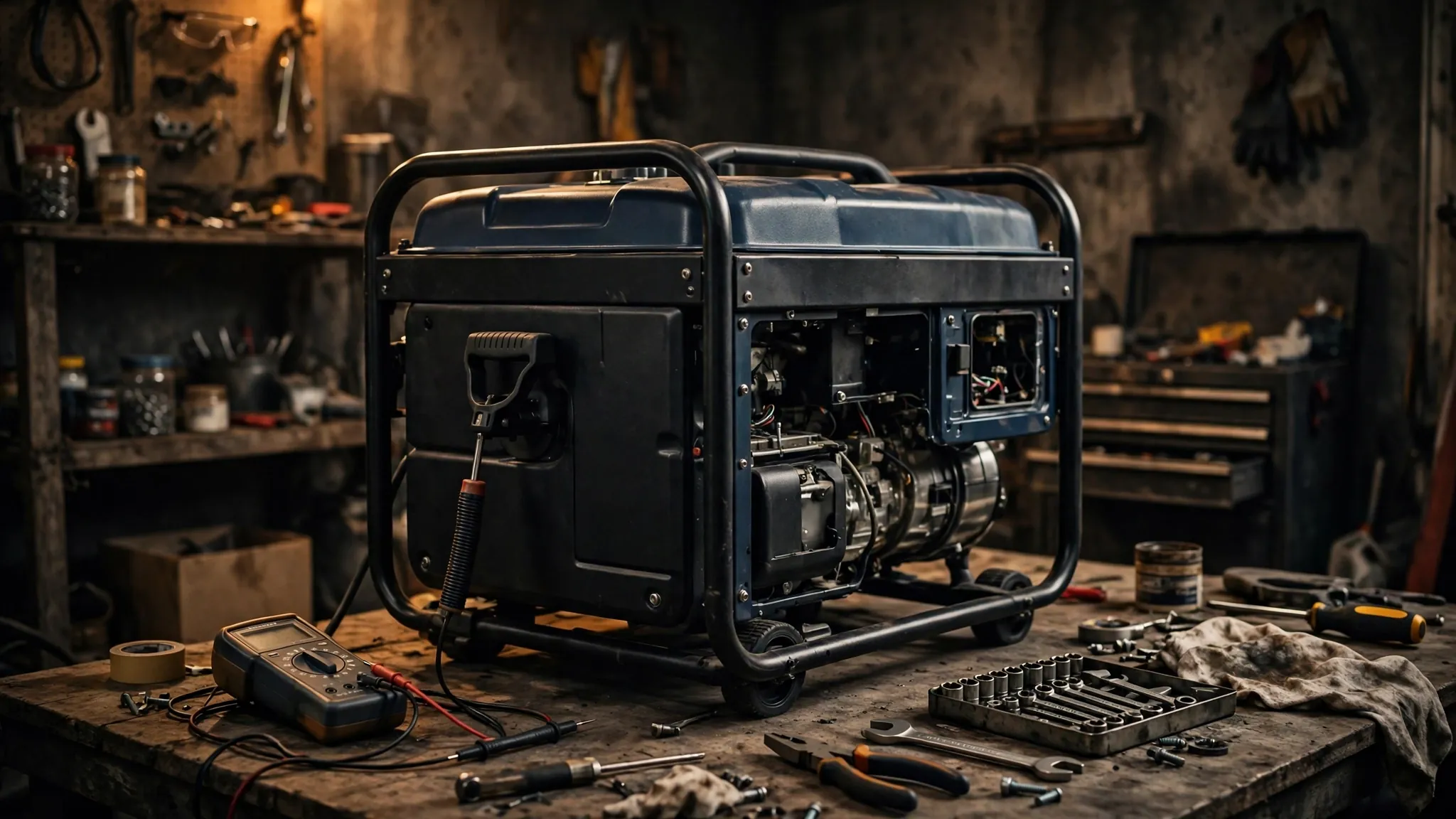
Quick answer: Work the Predator-specific checks in order: confirm the petcock is fully on and fuel reaches the carburetor, drain stale fuel, check oil level and the low-oil sensor, and replace the stock Torch plug with a properly gapped NGK BPR6ES. If it starts on starter fluid but dies, the carburetor jets are clogged — on these Honda-clone engines a $25–45 replacement carburetor is often smarter than cleaning. Steps 1 through 4 take about ten minutes and fix a third of these machines.
A Predator generator won’t start for the same handful of reasons every other small engine won’t — plus two or three quirks specific to Harbor Freight’s machines. I’ve serviced a lot of these. They’re Honda-clone engines built to a price, and once you know where the corners were cut, they’re honestly some of the easiest generators in America to diagnose. The failures cluster in the same places: the carburetor, the low-oil sensor, and a stock spark plug I wouldn’t trust to light a birthday cake.
I’m Mike Donovan, licensed electrician, 18 years in the trades. This guide covers the models I see most: the Predator 3500 Super Quiet inverter, the 4375 open-frame workhorse, and the big 9000/9500 electric-start units. Different brand? Start with my general generator won’t start troubleshooting guide; this article goes deep on the Predator-specific stuff. Firman owners will find the parallel brand-specific checks in our Firman generator won’t start guide, since the two brands share many of the same carburetor and petcock failure patterns.
Before you touch anything, three safety rules:
- Disconnect the spark plug wire before any inspection beyond cranking checks. You do not want the engine firing while your fingers are near moving parts.
- Work on a cool engine and outdoors. Wipe up fuel spills immediately; no open flames near an open fuel system.
- Never defeat a safety sensor to “fix” a no-start. Below I’ll show you how to test the low-oil sensor by unplugging it for ten seconds. That’s a diagnostic, not a repair — running with it disconnected is how a $15 problem becomes a seized engine.
Which Predator Do You Have? Why It Changes the Checks
Under the plastic there are really two engine families, and it helps to know which one is in front of you.
| Model | Engine | Start type | Predator-specific weak points |
|---|---|---|---|
| 3500 Super Quiet inverter | 212cc | Recoil (electric on newer versions) | Carb pilot jet, CO sensor lockout on late models, Torch plug |
| 4375 | 212cc | Recoil only | Petcock screen, carb main jet, low-oil sensor |
| 9000 / 9500 | 459cc | Electric + recoil backup | Battery, vacuum fuel pump, low-oil sensor, carb |
| 2000 inverter | 79cc | Recoil | Tiny carb jets clog fastest of the whole line |
All of them run carburetors with small jets — and small jets plus ethanol fuel plus a generator that sits for months equals the no-start you’re staring at. Work the steps in order; steps 1 through 4 take ten minutes total and fix a third of these machines.
Step 1: Is Fuel Actually Reaching the Carburetor? The Petcock Problem
Every Predator has a fuel petcock — the small valve under or beside the tank — and it causes more confusion than any other part on the machine. The labeling trap. On several models the petcock lever positions are marked with small, easily misread icons. I’ve been called out to a “dead” 4375 that had the petcock a quarter-turn from ON — it would cough once on the fuel left in the bowl and quit, which sent the owner down a carburetor rabbit hole. Turn the valve fully to ON and confirm the lever actually points where the casting says it should; cheap valves can slip on their shaft.
The clogged petcock screen. Inside the petcock there’s a fine mesh screen, and the open-frame models (4375, 9000) often have a sediment bowl you can unscrew. Rust flakes and debris from a dirty gas can collect there. Unscrew the bowl over a rag, rinse the screen in fresh gas, and check flow with the line disconnected: a steady stream, not a drip-drip. A starved bowl gives you the classic starts-then-dies-in-a-minute pattern — which my guide to a generator that starts then dies walks through specifically.
The vacuum fuel pump (9000/9500 and some inverters). The big-frame Predators use a small vacuum-operated fuel pump driven by crankcase pressure pulses through a thin rubber hose. If that hose cracks, slips off its nipple, or gets pinched when the panel goes back on, the pump stops delivering and the engine starves. The pump is a $10–15 part, and it fails often enough that I check the hoses on every 9000 that comes in “dead.”
Cost: $0 for cleaning and reseating hoses, $10–15 for a pump. Ten minutes.
Step 2: Drain the Fuel — Predator Carbs Hate Stored Ethanol
If the fuel in the tank is more than a couple of months old and wasn’t stabilized, don’t waste pulls on it. Predator carburetors clog fast on E10: the main jet on the 212cc carb is a tiny orifice, and ethanol-blend fuel leaves varnish and absorbs water as it sits in that small float bowl. I have cleaned Predator carbs gummed solid after one winter — while a Honda next to one, on the same fuel, started on the third pull. Its jet passages are simply more forgiving.
Drain the tank with a hand siphon into an approved can, then drain the carb bowl via the screw at the bottom (10mm on most of these). Yellow-brown fuel smelling like varnish was never going to run. Refill fresh — and my honest recommendation for Predator owners: if you can get ethanol-free gasoline (many stations sell it as “recreational fuel”), run it in these machines. It costs $0.50–1.00 more per gallon, a Predator burns only a few gallons a year in standby duty, and it eliminates the biggest cause of death in this product line. Otherwise, add stabilizer the day you buy the fuel, not the day you store it.
Step 3: The Low-Oil Sensor — the Predator False Alarm
This is the most Predator-specific failure in the article. All Predators have a low-oil shutdown that kills the spark when oil drops below a threshold — and on these units the sensors themselves fail at a rate I don’t see on Honda or Yamaha engines. The float sticks, or the switch fails closed, and the engine gets no spark even with the crankcase full of oil. It cranks perfectly, fuel is fresh, and there is simply no spark. Owners replace carburetors. It was never the carburetor.
Test in this order:
- Level the generator and check the oil properly. On most Predators the correct level is oil right up to the bottom of the fill threads — not “somewhere on the dipstick.” On a slope, a good sensor reads low and does its job. Top it off with 10W-30 (the 212cc takes about 0.5–0.6 quarts; the 459cc about 1.1) and try again. This alone resurrects a surprising number of them — these engines consume a little oil and owners rarely check.
- Test for spark. Pull the plug, reconnect the wire, ground the plug shell on the engine, and crank. No spark with full oil points at the sensor circuit or the coil.
- The ten-second sensor test. Find the single wire coming out of the crankcase near the oil fill and unplug it, then test for spark again. Spark returns? The sensor (or its float) has failed.
Now the warning, and I mean it: plug the wire back in and replace the sensor ($10–20 online). Do not leave it disconnected and call it fixed — that sensor is the only thing standing between a slow oil leak and a thrown rod. I test with it disconnected; I have never sent a machine home that way, and neither should you.
Step 4: Replace the Spark Plug — Don’t Even Test the Stock One
Predators ship with Torch brand plugs (F6RTC is the common one). Enough are weak, mis-gapped out of the box, or fouled after a few flooded start attempts that my rule is simple: on a no-start Predator, the stock plug comes out and an NGK BPR6ES goes in. The Champion RN12YC is an acceptable cross. Gap either one to 0.028–0.031 inches — don’t trust the factory gap on a $6 plug.
Cost: $5–7, five minutes, and it’s the cheapest diagnostic in the article: a fat blue spark at a known-good plug proves ignition and convicts fuel delivery. Still no spark with a new plug and the oil-sensor wire temporarily unplugged (Step 3)? That’s the ignition coil — $20–40, four bolts, twenty minutes. But test in order before you buy one. And read the old plug while it’s out: soaking wet means you’ve been flooding it (choke discipline, Step 5); black and sooty means it has been running rich, usually a filthy air filter.
Step 5: Choke, Air Filter, and Starting Technique by Model
Recoil models (3500, 4375, 2000): Full choke for a cold engine, two or three smooth, complete pulls — don’t yank the rope to the end of its travel like a chainsaw; Predator recoil starters break, and they’re annoying to rewind. The moment it coughs, choke to half; when it smooths out, choke fully off. Drowning a 212cc with full choke on a warm day is the second most common owner-inflicted no-start I see.
Electric-start models (9000/9500): If the starter clicks or cranks slowly, the little 12V battery is done or discharged — they last 2–3 years and nobody maintains them. Jump it from a vehicle battery (engine off) to test: if it spins strong and starts, replace the battery, $35–60. The recoil backup works too, though on a 459cc it’s a genuinely hard pull. A 9000 that cranks strong but won’t fire gets the same Steps 1–4 as everything else.
CO sensor lockout (newer 3500s and dual-fuel models): Recent Predators carry a CO Secure sensor that shuts the engine down in high carbon monoxide and can leave it locked out with a flashing indicator until it clears. If yours shut down in a garage doorway or anywhere semi-enclosed, it may be protecting you, not broken. Move it fully outdoors, let it air out per the manual, and never bypass that sensor — generators kill people with CO every storm season.
Air filter: Foam on most Predators. If it’s crumbling, saturated, or rodent-chewed (check the airbox for nesting material after storage), wash it in warm soapy water, dry completely, re-oil lightly, or replace for $8–15.
Step 6: The Carburetor — and Why Predator Owners Should Usually Swap It
If you’ve confirmed spark (Step 4) and fuel at the carburetor inlet (Step 1) and it still won’t start, do the starter-fluid test: a one-second shot into the air intake, then crank. Starts and dies? Ignition and compression are fine — the carburetor isn’t delivering fuel, and on a Predator that means clogged jets, because it almost always means clogged jets.
On most brands this is where I walk you through a 45–90 minute carburetor cleaning. On a Predator, my advice flips, and it’s simple economics:
- Clean it: carb cleaner at $10–15, a rebuild kit at $10–20, an hour or more picking varnish out of jets the diameter of a hair — and if you miss one passage, you do it again.
- Swap it: a complete replacement carburetor for the 212cc engines runs $25–45 on Amazon, arrives with fresh gaskets, and bolts on in 15–20 minutes. Carbs for the 459cc in the 9000 run similar money.
For a machine that cost $350–900 new, a $35 carburetor is one of the best bargains in small-engine repair. Search by engine size and model (“Predator 212cc carburetor”), and photograph your linkage before unhooking anything — clone carbs occasionally need the choke linkage transferred from the old unit.
When would I clean instead? If the swap carb is visibly worse cast than your original, or your model’s replacement is out of stock during storm season — which happens, because everyone else’s Predator died the same week. One more distinction: an engine that starts but hunts up and down has a partially clogged carb, not a dead one — see my guide to generator surging first; that one’s often a ten-minute pilot-jet cleaning.
Warranty and Parts: the Honest Harbor Freight Picture
The warranty is short. Harbor Freight’s standard warranty on these generators is 90 days — not the 2–3 years you get from Champion or Westinghouse. Inside 90 days, don’t wrench on it at all: take it back and exchange it, because opening the carburetor gives a returns desk a reason to argue. And if you bought the Extended Service Plan, this no-start is exactly what it exists for — use it instead of your Saturday; replacement-plan terms mean they swap the unit rather than repair it.
Parts after warranty are the Predator’s secret strength. Because the engines are Honda GX clones, wear parts are everywhere: carburetors, coils, recoil starters, filters, and gaskets on Amazon, eBay, and small-engine sites, plus Harbor Freight’s own parts line (call with your model and item number — in-store staff can’t order most internal parts, but the parts department can). A recoil starter is $15–25, a coil $20–40; no problem on this page costs more than about $60 in parts. The cheap generator is a rational choice — as long as you accept that you are the dealer service network.
When to Stop and Get Help
Work the steps in order and a Predator will almost always confess. Stop and hand it off when:
- There’s no compression — the recoil pulls with almost no resistance, or the electric starter spins the engine unnaturally fast. That’s valves or rings, internal work, and on a $350 generator it’s usually an economic decision, not a repair. (A healthy 212cc should read roughly 90 PSI and up.)
- It has spark and fuel and still won’t even cough on starting fluid. Same conclusion: compression or valve timing, beyond driveway diagnosis.
- Fuel is leaking from anywhere you can’t fix by re-clamping a hose. Don’t run it — fix the leak or take it in.
- It’s inside the 90-day warranty or ESP coverage. Your help is the returns desk; that’s what the coverage is for.
For a shop, expect $100–175 for diagnosis in most markets — a third of a new 4375. That’s the final Predator truth: these machines reward owners who’ll turn a wrench for twenty minutes and punish owners who pay shop rates. Stay in the first group with the generator maintenance checklist — fifteen minutes a season is the difference between the cheapest generator you’ll ever own and a very expensive paperweight.
Keep reading
Frequently asked questions
Why won't my Predator generator start after sitting in storage?
Almost always the carburetor. Predator carburetors have small jets that clog fast on stored ethanol-blend fuel — a few months of sitting can varnish the main jet shut. Drain the old fuel; if the engine starts on starter fluid but dies, the carburetor needs cleaning or replacing. A replacement costs $25–45, which is why many owners swap instead of cleaning.
How do I test whether my Predator's low-oil sensor is bad?
Top the oil up to the top of the fill threads with the generator level first — that's the real fix half the time. If it still has no spark, unplug the single sensor wire at the crankcase and test again. If spark returns, the sensor has failed: reconnect it and replace the sensor ($10–20). Never run the generator with the sensor defeated — the test takes ten seconds, but running unprotected can seize the engine on genuinely low oil.
What spark plug does a Predator generator use?
Most Predator models (3500 inverter, 4375, 9000) ship with a Torch F6RTC plug. The direct NGK cross-reference is the BPR6ES; the Champion RN12YC also fits. Gap it to 0.028–0.031 inches. Stock Torch plugs are a known weak point — swapping in an NGK is a $5–7 upgrade I recommend on any Predator that won't start.
My Predator is still under warranty — should I repair it or take it back?
Take it back first. Harbor Freight's standard generator warranty is only 90 days, and tearing into the carburetor yourself gives them a reason to argue. Inside 90 days, let the store exchange it; if you bought the Extended Service Plan, use it. Outside warranty, these are some of the cheapest generators in America to fix yourself — Honda-clone engines, parts everywhere.
Is ethanol-free gasoline worth the extra cost in a Predator generator?
For most Predator owners, yes, because these carburetors clog fast on stored E10 and the small main jet on the 212cc carburetor leaves very little room for varnish. Ethanol-free gasoline costs $0.50–1.00 more per gallon, but a Predator burns only a few gallons a year in standby duty, so the yearly premium stays small. In return, it eliminates the biggest cause of death in this product line. If you cannot get it, add stabilizer the day you buy regular fuel, not the day you store it.