Generator Surging? Why It Hunts Up and Down (and How to Fix It)
**Quick answer:** Surging that smooths out under load usually points to a clogged pilot jet, especially after storage with old fuel. Clean the pilot jet first — about an hour and $5–10 for carb cleaner — then test with no load and with a steady load like a 1,500-watt space heater. If it still hunts, work through the air filter, governor linkage, fuel delivery, and spark plug in that order.
Quick answer: Surging that smooths out under load usually points to a clogged pilot jet, especially after storage with old fuel. Clean the pilot jet first — about an hour and $5–10 for carb cleaner — then test with no load and with a steady load like a 1,500-watt space heater. If it still hunts, work through the air filter, governor linkage, fuel delivery, and spark plug in that order.
Generator surging is the fault I get called about more than any other after storm season. The engine won’t settle — rev, drop, rev, drop, that wah-wah-wah sound every two or three seconds — and the lights pulse bright and dim right along with it. Owners assume the machine is dying. It usually isn’t. Generator surging (mechanics also call it hunting) is almost always a fuel-delivery problem you can fix in your driveway for the price of a can of carb cleaner.
I’m Mike Donovan, licensed electrician, 18 years in the trades. I’ve cleaned more gummed-up carburetors than I can count, and I’d bet a good lunch yours has the same problem most of them had — a pilot jet the width of a hair, half-blocked with varnish. Let’s work the causes in order, cheapest and most likely first.
First, four safety rules, because you’ll be working around fuel and a hot engine:
- Let it cool and pull the spark plug wire before you open anything up. A surging engine was just running — it’s hot, and it can kick.
- Work outdoors. You’ll drain a float bowl of gasoline. No smoking, no pilot lights, no sparks nearby.
- Never run it in the garage to “test.” Carbon monoxide kills people during outages every year, including people testing a repair with the door open.
- Don’t test on sensitive electronics. Use a work light or an old space heater, not your furnace board.
What is generator surging, exactly — and why does it matter?
A healthy conventional generator holds a steady 3,600 RPM, because engine speed is output: 3,600 RPM gives you 60 Hz and roughly 120 volts. When the engine hunts, speed swings — say 3,200 to 3,800 RPM — and voltage swings with it, about 100 to 135 volts. You hear it as the revving cycle and see it as flickering lights.
Those swings are why you fix this rather than live with it. Compressor motors (fridge, freezer, AC) overheat on low voltage and get hammered on high voltage. Control boards hate cycling power. And conventional generators already produce dirty power — total harmonic distortion of 15–25% on cheap portables isn’t unusual — so a surging conventional unit is the worst-case diet for electronics. That’s the whole argument for the inverter models in our quietest generators rundown: their output stays stable even as engine speed varies. For a surging conventional machine, fix the engine first.
What’s the fastest test to find the cause?
Before you take anything apart, do this two-minute test. Start it cold, warm it up two minutes, and watch it with no load — then plug in a steady load, a 1,500-watt space heater is perfect, and watch again.
- Surges at no load, smooths out under load: pilot jet. This is the classic tell, and it’s cause #1 below.
- Surges at no load and under load: fuel delivery, governor, or a badly clogged carb overall.
- Only surges when a specific appliance cycles on and off: probably load behavior, not a fault — see the last cause.
- Surges and then dies outright: that’s drifting into a different fault — see our guide to a generator that starts then dies.
Note which pattern you have. It saves real time.
Cause #1: Is the pilot jet in the carburetor clogged?
Nine times out of ten, yes — especially if the generator sat with gas in it. The carburetor has two fuel circuits. The main jet feeds the engine under load. The pilot jet (idle jet) feeds it at idle and light load through a passage a wire-brush bristle barely fits. Gasoline starts forming varnish in 30–60 days; ethanol blends are worse. The pilot jet clogs first because it’s the smallest hole in the system.
Here’s the cycle that results: pilot jet restricted → mixture goes lean at idle → RPM falls → the governor yanks the throttle open → engine gets a gulp through the main circuit and overshoots → governor closes the throttle → back to the lean pilot circuit → RPM falls again. Under a real load, the main jet is flowing anyway, so the engine smooths out. That contrast is your diagnosis, free of charge.
I pulled a Predator 4375 out of a customer’s garage last fall that had surged since spring. Under load powering his fridge it ran like a watch. Unplug the fridge — wah-wah-wah. Twenty minutes cleaning the pilot jet and it idled like new. He’d been quoted $300 for a “governor problem.”
How do you clean a pilot jet, step by step?
You need a screwdriver, a socket for the bowl bolt, carb cleaner, and one strand pulled from a wire brush. An hour if it’s your first time.
- Engine cool, plug wire off, fuel valve closed. Take a phone photo of the linkage and springs before touching anything — you’ll thank yourself at reassembly.
- Remove the air filter housing to expose the carburetor.
- Put a container under the carb and open the bowl drain screw to drain the fuel. Rust flakes or jelly-like blobs mean the tank needs draining too.
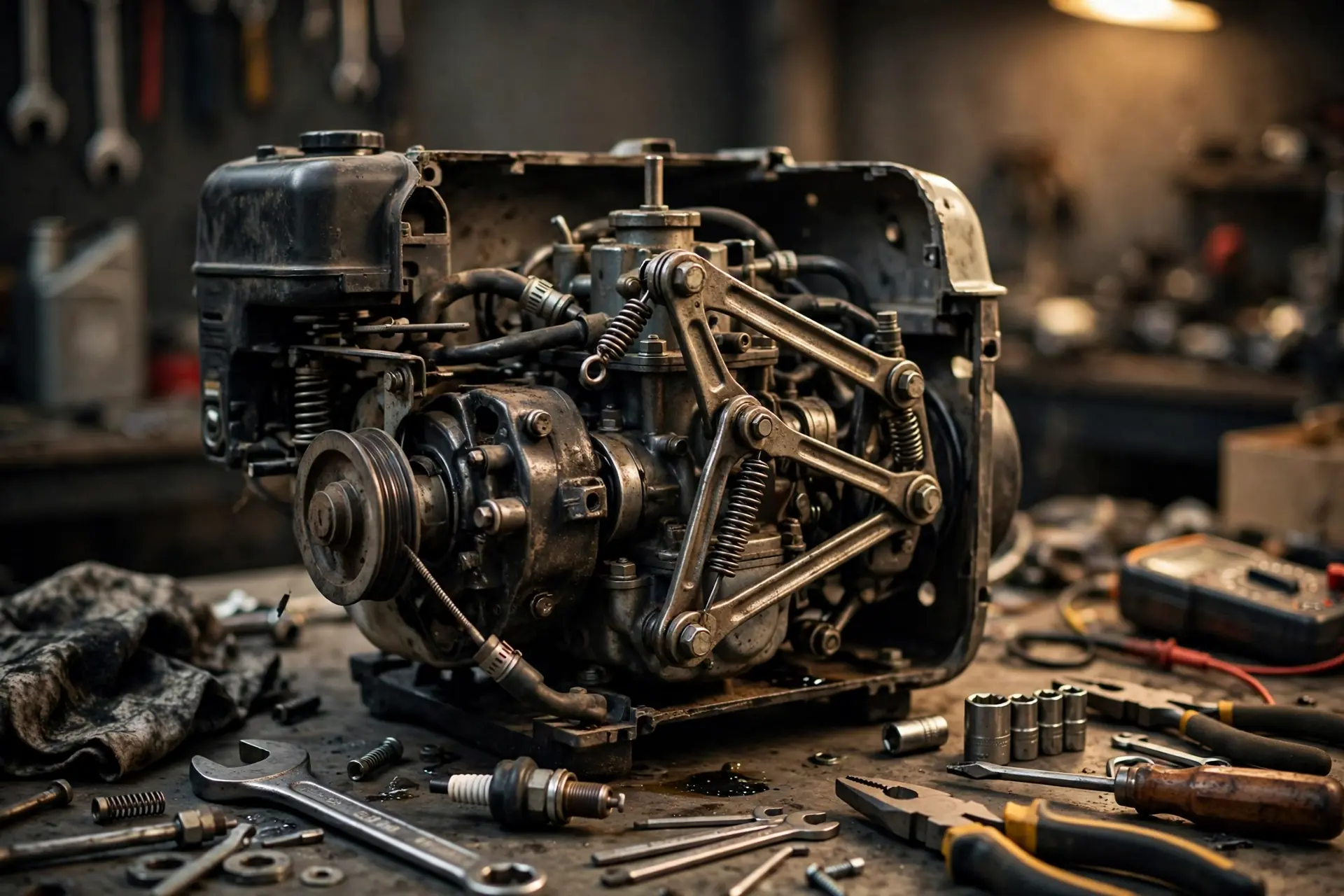
- Remove the float bowl. On most Honda-clone carbs (Predator, Champion, Westinghouse, many Generac portables), the pilot jet is a black plastic piece pressed into the top of the carb body, underneath the idle-speed screw. Pry it out gently with a small flat screwdriver. On other carbs it’s a brass jet in the tower beside the main jet — unscrew it.
- Hold the jet up to the light. You should see a clean round pinhole. Spray it through with carb cleaner, then pass your wire strand through the orifice once or twice, gently. No drilling, no forcing — enlarge that hole and the idle mixture is permanently rich.
- Spray cleaner through every passage in the carb body you can reach and blow them out with compressed air or the spray straw. Clean any varnish out of the float bowl.
- Reassemble with the jet pressed fully home. Check the bowl gasket — if it’s pinched or swollen, replace it (a couple of dollars) or you’ll chase a drip next.
- Fresh fuel in the tank, valve open, and test: two minutes at no load, then two minutes under your heater load.
Costs: carb cleaner is $5–10 a can. If cleaning doesn’t cure it — carb body passages sometimes corrode beyond saving — a replacement carburetor for a common portable is $20–60 online and bolts on in 15 minutes. A shop charges $75–120/hour labor; a clean-and-tune totals $120–250. My take: try cleaning once. If it still hunts, replace the carb rather than paying shop labor to clean it twice.
If your generator won’t start at all, that’s a different checklist — work through our generator won’t start troubleshooting first, then come back here.
Cause #2: Is the air filter choked?
A clogged air filter starves the engine of air, the mixture goes rich, and the governor hunts trying to hold speed on a mixture that won’t burn consistently. It’s the easiest check on this list — don’t skip it even though it’s cause #2.
Pop the filter cover. Paper elements: hold it to the light — if you can’t see light through the pleats, replace it ($8–20). Foam elements (common on inverter models): wash in warm soapy water, dry completely, re-oil lightly. If the foam crumbles in your hand, it’s done. While the housing is open, look for the mouse nest — I’ve found nests, acorns, and once a very committed wasp colony in air boxes after winter storage. Check the filter every 50 hours or at the start of storm season — it’s item one on our generator maintenance checklist for a reason.
Cause #3: Is the governor linkage sticking or the spring wrong?
The governor is the mechanical brain that holds RPM steady. A spinning flyweight assembly inside the engine pushes against a linkage, and a spring pulls the other way; that tug-of-war sets your throttle. Surging follows when the linkage can’t move freely or the spring force is wrong.
Check: Engine off, work the throttle linkage by hand. It should snap back and forth with light spring resistance and zero grit. Look for gummed pivot points (clean with carb spray and a drop of oil), bent rods, and — very common — a stretched or wrong replacement spring. That spring is calibrated. Owners stretch it “a little” to fix a surge and make it worse.
Fix: Clean and free the linkage first; that’s free and often enough. A correct OEM governor spring is $5–12. Don’t bend linkage or stretch springs experimentally. One honest boundary: if the governor arm has slop in its crankcase shaft, the internal governor gear may be failing. That’s inside the crankcase. That’s a shop job.
Cause #4: Is fuel delivery starving the engine?
A partially blocked fuel path gives the same lean-surge pattern as a clogged pilot jet, just from upstream. Work it in order:
- Fuel filter: Inline filters are $3–6. If you can see debris in it, replace it. Some portables hide a screen in the tank outlet or petcock instead — pull the petcock and check.
- Gas cap vent — the sneaky one: The tank needs air to replace the fuel that leaves. If the cap vent clogs, a vacuum builds and fuel flow slows until the engine stumbles. Test: when it starts surging, loosen the gas cap. If the surge stops within seconds, you’ve found it. Clean the vent or replace the cap ($8–15).
- Fuel lines and petcock: Cracked lines suck air; a petcock half-blocked with tank rust passes enough fuel for idle but not for load. Replace anything stiff or cracked.
Bad fuel belongs here too. If the gas is more than a month or two old and wasn’t stabilized, drain and refill before you blame hardware — a hunting engine also wastes fuel, which is why the numbers in our generator fuel consumption guide assume a healthy, steady engine.
Cause #5: Could it just be the spark plug?
A worn, fouled, or wide-gapped plug misfires irregularly, and a misfire cycle feels a lot like a surge — except it’s ragged rather than rhythmic. Pull the plug: look for heavy black soot (rich running — check that air filter), white blistering (lean/overheating), or a gap drifted past spec, typically 0.028–0.031 in. on most portables. A new NGK or Champion is $3–8 and takes five minutes. Replace it on suspicion; it’s the cheapest part on the machine.
Do inverter generators surge differently?
Yes, and this trips people up. An inverter generator’s engine speed is supposed to vary — electronics throttle the engine with demand, and eco mode idles it right down. A Honda EU2200i quietly changing pitch as loads come and go is healthy, not hunting.
Judge it this way: put a steady load on it (that space heater again) with eco mode off. A healthy inverter settles to one steady speed. If it hunts at a steady load, the cause list is the same as a conventional machine — and the pilot jet is still suspect #1, because inverter carbs have the same tiny idle circuits and the same ethanol problems. If it only hunts in eco mode at very light load, run light loads with eco off; some stepper-motor throttle controls genuinely hunt a little near zero load, and that’s a quirk, not a failure. The real difference is what comes out of the outlets: an inverter’s output stays clean 120V/60 Hz while its engine moves around, while a conventional unit’s voltage follows its engine up and down — another reason the machines in our quietest generators guide earn their keep for electronics.
Is it the load, not the generator?
Some loads cycle: an AC compressor, a well pump, a furnace blower, a fridge. Every time one kicks on, the governor reacts — a brief dip and recovery is the governor doing its job, and an undersized generator reacts harder and longer. If the “surge” lines up exactly with an appliance cycling, time it against the appliance before you open the carburetor. If the generator runs steady on the heater test but wobbles all evening powering the house, it may simply be undersized for your largest motor’s starting surge. Don’t confuse this with the harder fault where the unit runs fine for 15–20 minutes and then shuts down completely under load — that’s overheating or oil-related, covered in our guide to a generator that keeps shutting off.
When should you call a pro — and what’s the short version?
Call a small-engine shop if you’ve cleaned the pilot jet, confirmed the filter, linkage, fuel flow, and plug, and it still hunts — or if the governor shaft has play in the crankcase. Shop labor runs $75–120/hour and most surge diagnoses end in that $120–250 window with parts. That’s exactly why the order in this article matters: the free and $10 fixes come first.
The short version: surging at idle that smooths under load is a clogged pilot jet until proven otherwise. Clean it (an hour, $10), test with a steady load, then move down the list — filter, linkage, fuel flow, plug. Nine of ten surging generators I see run steady before lunch.
Keep reading
Frequently asked questions
Why does my generator surge at idle but run smooth under load?
That's the classic signature of a partially clogged pilot jet. The pilot jet feeds the engine at idle and light load; when it's restricted, the mixture goes lean, RPM drops, the governor opens the throttle to compensate, and the cycle repeats. Under load the main jet takes over and flows enough fuel, so the surging disappears. Clean the pilot jet or the carburetor and the idle surge almost always goes away.
Is generator surging dangerous for my electronics?
It can be. On a conventional generator, engine speed sets both voltage and frequency — 3,600 RPM makes 60 Hz. A surging engine can swing output between roughly 100 and 135 volts, and that cycling is hard on refrigerator compressors, furnace control boards, and anything with a motor or a cheap power supply. Don't run sensitive electronics on a surging generator. Fix the surge first, or use an inverter model with clean, stable output.
How much does it cost to fix a surging generator?
Doing it yourself: $0–10 if cleaning the pilot jet fixes it, $20–60 for a replacement carburetor if it doesn't. A shop charges $75–120 per hour for labor, and a carburetor clean or swap typically lands at $120–250 total with parts. Surging is one of the cheapest generator problems to fix — it's almost never worth replacing the whole machine over it.
Why does my inverter generator surge in eco mode?
Inverter generators vary engine speed with load, and eco mode drops the engine to a low idle. A little hunting with a cycling load in eco mode is normal; sustained surging at a steady load isn't. Test with eco mode off: if it smooths out, the problem is in the idle circuit — usually that same pilot jet — not the inverter electronics.
How can I prevent my generator from surging again after storage?
Prevention is mostly fuel discipline, because gasoline starts forming varnish in 30–60 days and ethanol blends are worse, and the tiny pilot jet clogs first. Drain fuel that is more than a month or two old if it was not stabilized, refill with fresh fuel before blaming hardware, and check the air filter every 50 hours or at the start of storm season. A hunting engine also wastes fuel, so a clean filter, fresh gasoline, and a carburetor stored without stale fuel give the governor a stable mixture to hold.