Firman Generator Won't Start? 9 Checks in the Right Order
**Quick answer:** Work the checks in this order: **(1) fuel selector ON, (2) fresh gasoline, (3) oil filled to the H mark on a level surface, (4) choke for one pull only, (5) spark plug, (6) carburetor, (7) air filter, (8) battery on electric-start models, (9) fuel filter and lines.** The first four fix most Firman no-starts and cost nothing. Every spec below — fuel grade, plug type, plug gap, oil — comes from Firman's own owner's manuals, not forum folklore.
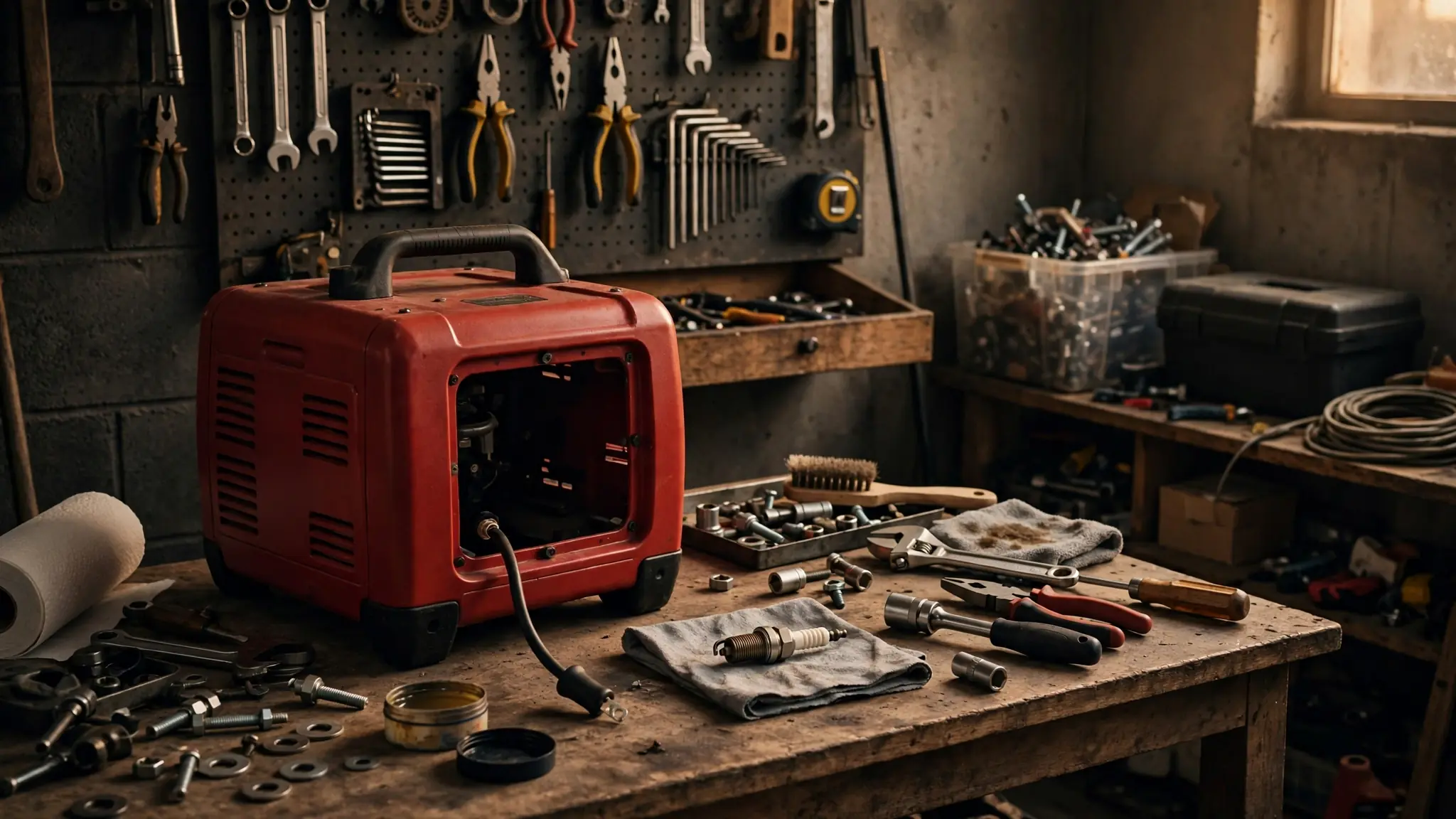
Quick answer: Work the checks in this order: (1) fuel selector ON, (2) fresh gasoline, (3) oil filled to the H mark on a level surface, (4) choke for one pull only, (5) spark plug, (6) carburetor, (7) air filter, (8) battery on electric-start models, (9) fuel filter and lines. The first four fix most Firman no-starts and cost nothing. Every spec below — fuel grade, plug type, plug gap, oil — comes from Firman’s own owner’s manuals, not forum folklore.
A Firman that won’t start is almost never a dead Firman. These are simple single-cylinder engines (the larger portables run a 439cc-class block, the inverters smaller ones), and the failure points are the same handful on every unit that rolls into a shop after storm season. The mistake I see owners make is starting at the carburetor — the dirtiest, slowest job — when the actual problem was a fuel selector left OFF since last winter. Order matters. The table below is the whole article on one screen; the sections after it explain the checks that need explaining.
| # | Check | Symptom that points here | Fix | Time |
|---|---|---|---|---|
| 1 | Fuel selector / fuel valve | Cranks fine, never fires; remote-start indicator flashing | Selector to GAS (or LPG on dual-fuel); valve ON | 1 min |
| 2 | Stale gasoline | Sat more than ~30–60 days; starts on starting fluid, dies | Drain tank + carburetor bowl, refill fresh 87 octane | 20–30 min |
| 3 | Low-oil sensor | Fires then dies, or no spark; sitting on a slope or grass | Level surface; oil to the H mark with 10W-30 | 5 min |
| 4 | Overchoking | Wet, fuel-smelling plug; started fine yesterday | Choke for 1 pull only, then RUN; dry or replace plug | 5 min |
| 5 | Spark plug | No spark at the plug; black or damaged electrode | Replace (Torch F6RTC / NGK BPR6ES), gap 0.028–0.031” | 10 min |
| 6 | Carburetor | Fresh fuel + good spark, still no start | Drain bowl; clean jets or fit a rebuild kit | 30–60 min |
| 7 | Air filter | Starts hard, runs rough, black smoke | Wash foam element or replace paper element | 10 min |
| 8 | Battery (electric start) | Click or silence on the button; recoil works | Charge, clean terminals, or replace the battery | 15 min |
| 9 | Fuel filter / lines | Starts, starves, and dies under load | Clean or replace the inline filter; check line kinks | 15 min |
This guide covers gasoline and dual-fuel Firman portables. If your unit starts and then dies within a few minutes, that’s a related but different fault tree — see our generator starts then dies guide, and for brand-neutral theory, our generator won’t start troubleshooting guide.
Is the fuel selector actually on?
It sounds insulting until you’ve done it yourself. Firman’s dual-fuel portables have a fuel selector switch with GAS, LPG, and OFF positions, and the company’s official troubleshooting chart lists “fuel selector switch set to OFF” as cause number one for a no-start — ahead of everything mechanical. Their chart adds a detail owners miss: on those models you need a solid red indicator light to start the engine; a flashing red light or no light means the start sequence isn’t armed.
Straight-gasoline models have a simpler fuel valve at the tank, and it gets closed for storage and transport (Firman tells you to transport with the valve OFF). Months later, that’s the whole problem. Selector to GAS, valve ON, engine switch to RUN — try it before you touch a single tool.
Is the gasoline stale?
Firman specifies clean, fresh, unleaded gasoline, minimum 87 octane (87 AKI / 91 RON), with no more than 10% ethanol — E10 maximum, never E15 or E85. “Fresh” is doing real work in that sentence. Pump gasoline starts oxidizing within about 30 days; the ethanol fraction absorbs moisture from the air, and the fuel leaves varnish deposits as it ages. A generator that ran perfectly when you parked it in October can be genuinely unfuelable by February on the same tank.
The test is simple: if it fires on a short shot of starting fluid (or a teaspoon of fresh gas down the carb throat) and dies, fuel delivery or fuel quality is your problem. Firman’s own correction for stale gasoline is to drain the fuel tank and the carburetor and refill with fresh gasoline — not to add fresh on top of old, which just dilutes the varnish. While you’re there, drain the carburetor bowl through its drain screw and catch what comes out: cloudy, dark, or water-beaded fuel confirms the diagnosis.
Prevention lives in our generator maintenance checklist: stabilizer in every tank you won’t burn within a month, or drain the system for storage.
Is the low-oil sensor stopping you?
Firman portables carry a low-oil shutdown: when the oil level in the crankcase drops below the threshold, a sensor activates a switch that stops the engine — or prevents it from starting at all. It’s a protective device, and it generates more phantom no-starts than any real failure on these machines, for two reasons:
The unit isn’t level. The sensor reads the oil where it pools. On a slope, in a truck bed, or sunk into soft grass on two legs, a correctly filled engine can read as low. Firman’s manual troubleshooting step is explicit: if the oil level checks within specification, put the generator on an even surface.
The sump isn’t full enough. A level that’s “between the marks” can still fail to deactivate the switch. The manual’s wording: make sure the sump is completely full of oil — fill to the H (upper) mark on the dipstick. Use the oil Firman recommends, SAE 10W-30, API SJ or higher. And note the opposite trap from the same page of the manual: overfilling can cause hard starting too, so fill to H, not past it.
Disconnecting or bypassing the sensor to “test” it is a bad idea — a genuinely low engine run without oil pressure protection dies permanently, and the sensor is rarely the failed part. Fill it, level it, and it almost always clears.
Are you overchoking it?
Firman’s inverter manual (the W03083) is unusually blunt about this, and it’s the best starting-procedure advice in the whole document: keep the choke lever in CHOKE for only 1 pull of the recoil starter. After the first pull, move it to RUN for up to the next 3 pulls. Too much choke, the manual says, leads to spark plug fouling and engine flooding from lack of incoming air — “this will cause the engine not to start.”
So the classic owner sequence — choke on, pull six times, now it won’t start at all — is self-inflicted. If you suspect flooding: choke OFF (RUN position), fuel valve on, and pull several times to clear the cylinder, or pull the plug, dry it, and reinstall. Then restart the sequence properly: one pull on choke, then RUN.
On inverter models with push-button electric choke, a dead battery disables the automatic choke — and Firman documents the workaround: remove the maintenance cover, find the yellow manual choke lever, set it to CHOKE by hand, start the engine, then move it to RUN. Worth knowing before you need it at midnight.
Does the spark plug fire?
Pull the plug — Firman includes the wrench in the tool kit. You’re looking for three things: condition, gap, and spark.
- Condition: Light tan is healthy. Black and dry is carbon fouling (overchoking, dirty air filter). Black and wet is flooding or oil. Cracked porcelain or a rounded-off electrode means replace regardless.
- Gap: 0.028–0.031 inches (0.7–0.8 mm) per Firman’s maintenance section. Check with a feeler gauge; a gap that’s closed up from a dropped plug is a classic no-spark cause.
- Spark test: Reconnect the boot, hold the plug’s threads against a bare metal engine surface, and pull the starter (or crank electric start). You want a fat blue spark. No spark with a known-good plug points at the ignition coil or the low-oil switch circuit — go back and re-verify the oil level first, because the sensor kills spark by design.
Replacement plugs are specified by name in the manual: Torch F6RTC, NGK BPR6ES, or Champion RN9YC — all equivalents, all cheap, all stocked at any auto parts store. Thread by hand until seated to avoid cross-threading, then snug with the wrench. (Our Predator generator won’t start guide covers the same plug-first method on Harbor Freight’s engines — the engines are cousins, and so are their faults.)
Is the carburetor gummed up?
If you have fresh fuel in the tank and a fat spark at the plug and it still won’t fire, the carburetor is holding last season’s varnish in its pilot jet — the smallest passage in the system and the first to clog. Ethanol fuel left sitting in the carburetor is the cause in the overwhelming majority of cases; the float bowl is a tiny open reservoir that concentrates everything bad about old gasoline.
Start with the bowl drain screw: open it and confirm fuel actually flows from the tank through the carb (this also catches a blocked inline filter or a kinked line — check #9). A carb that gets fuel but won’t run the engine needs its jets cleaned with carb cleaner and fine wire, or — honestly, on the smaller inverters — replacement, since complete Firman-compatible carburetors often cost less than an hour of shop labor. This is the one job on the list where a first-timer should watch a model-specific video before opening anything, because the linkage springs have strong opinions about where they live.
Storage is the real fix: Firman’s guidance for layup is fuel valve OFF, battery disconnected on electric-start models, and the system either stabilized or drained. Thirty seconds of prevention in October beats a carburetor on the bench in January.
Recoil vs. electric start: is the battery the problem?
A button that clicks — or does nothing — is an electrical problem, not an engine problem. The small sealed batteries in portable generators discharge in storage, sulfate, and commonly last only 2–3 seasons; corrosion on the terminals adds resistance that a marginal battery can’t overcome. Charge it fully, wire-brush the terminals, and retry. On dual-fuel models with remote start, note the programmed behavior from the manual: the starter cranks 3–5 seconds per attempt, retries up to six attempts, then flashes the indicator and stops — a flashing light after six tries is the system reporting failure, not a new fault.
The saving grace of the Firman lineup is that electric start is an addition, not a replacement: the recoil starter stays. Pull-start the machine for this outage and sort the battery in daylight. And if neither starter turns the engine over at all — a cord that won’t budge — stop pulling: that’s mechanical (a seized engine or a hydro-locked cylinder from tipped storage), and forcing it makes things worse.
When should you stop and call Firman?
Call Firman customer service at 1-844-FIRMAN1 — or an authorized service facility, per the manual — when: you have verified fuel, oil, and spark and it still won’t start; the recoil won’t pull; the unit starts but produces no AC output (that fault tree starts at the breaker and ends inside the alternator); or anything smells of burnt wiring. Have the model and serial number ready — Firman’s support will ask for them first, along with proof of purchase if it’s a warranty conversation.
One last piece of order-of-operations advice, because it’s the whole point of this guide: resist the urge to start at the carburetor. Fuel selector, fuel quality, oil level, choke technique, spark — that sequence finds the fault in fifteen minutes on most machines, with no parts and no disassembly. The carburetor is check six for a reason.
Frequently asked questions
Why won't my Firman generator start even though it has gas?
In my experience it's usually one of three things: the fuel selector is still in the OFF position (the number-one step in Firman's own troubleshooting chart), the gasoline is stale from sitting, or the low-oil sensor is blocking the start because the unit isn't level or the sump isn't filled to the H mark on the dipstick. Work the checks in this guide in order — fuel, oil, choke, spark, carburetor — and you'll find it. Nine times out of ten it's one of the first four, and all four are five-minute fixes with no parts.
How do I know if the low-oil sensor is stopping my Firman from starting?
Firman builds a low-oil shutdown into these engines: if the oil level reads below the threshold, a sensor kills the spark and the engine won't start or will die right after starting. The tell is a unit that cranks or fires briefly but won't stay running, especially sitting on grass or a sloped driveway — the oil pools to one side and the sensor reads it as empty. Move the generator to a flat, level surface, pull the dipstick, and top the oil all the way to the H mark. Firman's manual is specific: the sump must be completely full to deactivate the switch.
What spark plug does a Firman generator use, and what gap?
Most Firman portable engines spec a Torch F6RTC, NGK BPR6ES, or Champion RN9YC — Firman's manuals list all three as equivalents, so whichever your parts store stocks is fine. The gap is 0.028–0.031 inches (0.7–0.8 mm), measured with a feeler gauge. I pull the plug on any no-start before I touch the carburetor: if it's black, wet, or the gap has closed up, a fresh plug at about $5 is the cheapest diagnostic there is. Thread the new one in by hand first — cross-threading an aluminum head turns a small job into a big one.
Can stale gas really keep a Firman generator from starting?
Yes — it's the most common cause I see on units that sat since last season. Firman specs clean, fresh unleaded gasoline, minimum 87 octane, with no more than 10% ethanol. Gasoline starts degrading in about 30 days, and ethanol-blended fuel absorbs water and leaves varnish in the carburetor's tiny jets. Firman's own troubleshooting chart gives the fix for stale gasoline: drain the tank and the carburetor, then refill with fresh fuel. If the unit still won't start on fresh gas, the carburetor itself is carrying the varnish and needs cleaning.
My Firman electric-start generator just clicks. What now?
A click with no crank means the battery, almost every time. Portable generator batteries are small, they self-discharge in storage, and they rarely last more than a couple of seasons without a maintainer. Charge it or jump it, clean the terminals, and try again. The good news: every Firman electric-start model I've worked on keeps its recoil starter as a backup, so a dead battery doesn't strand you — pull-start it for the outage and replace the battery later. On the inverter models with push-button choke, the manual even documents a manual choke lever under the maintenance cover for exactly this dead-battery situation.