Hardwired vs Plug-In EV Charger: Which Is Better?
Hardwired vs plug-in EV charger. It's the first real decision in any home charging install, and it's the one people make based on the wrong information — usually a YouTube video or a buddy who says "just put in a dryer outlet, it's fine." Sometimes he's even right. Sometimes he's describing a fire hazard. I'm a licensed electrician; I've installed both ways hundreds of times, and I've also been called out to replace the melted outlets nobody warned you about. Here's the honest comparison: real amp limits, real 2026 costs, and the receptacle problem that should decide this for most people.
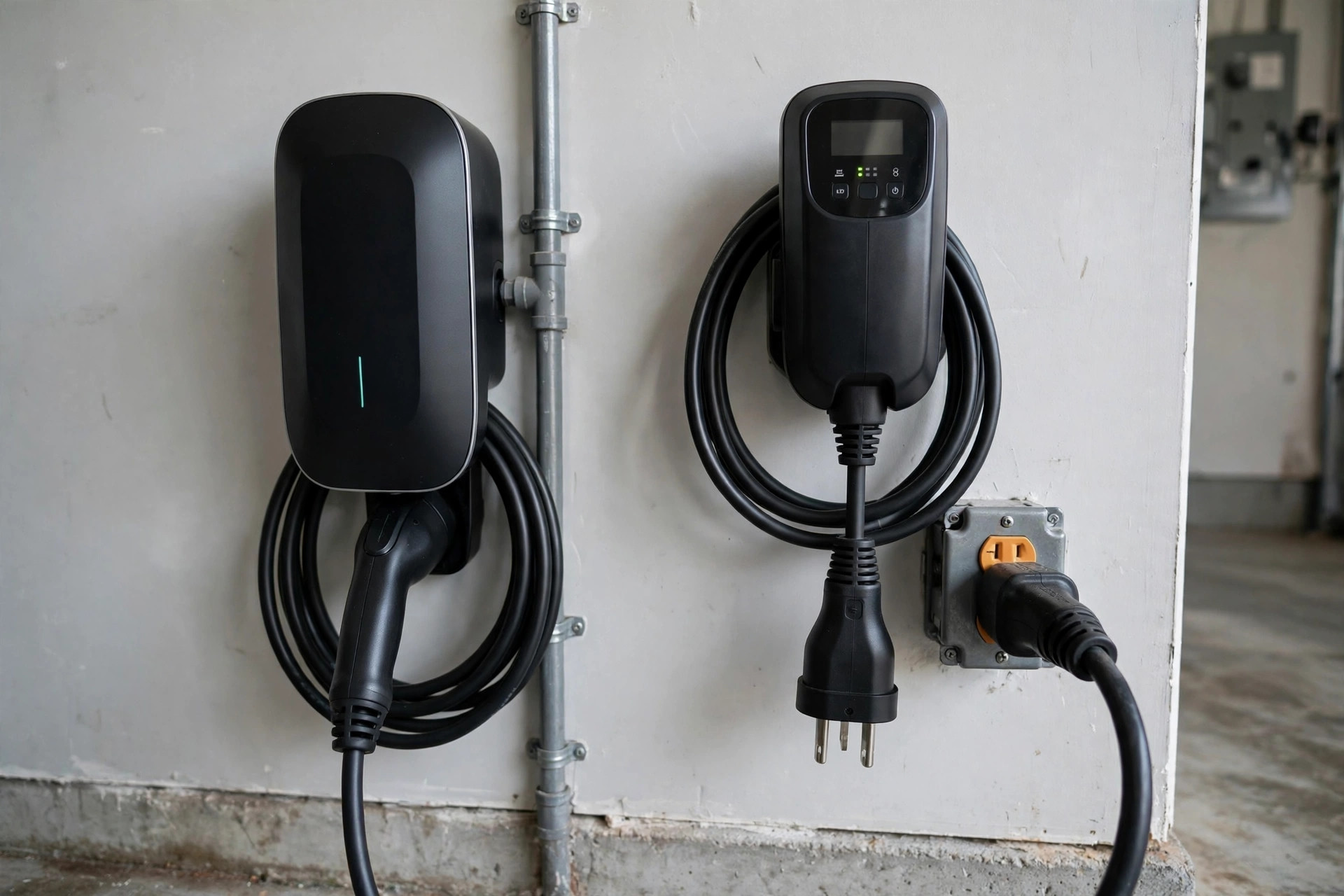
Hardwired vs plug-in EV charger. It’s the first real decision in any home charging install, and it’s the one people make based on the wrong information — usually a YouTube video or a buddy who says “just put in a dryer outlet, it’s fine.” Sometimes he’s even right. Sometimes he’s describing a fire hazard. I’m a licensed electrician; I’ve installed both ways hundreds of times, and I’ve also been called out to replace the melted outlets nobody warned you about. Here’s the honest comparison: real amp limits, real 2026 costs, and the receptacle problem that should decide this for most people.
Short version up front: hardwired is better for most permanent homes. Plug-in is better for renters and short-timers. The details below are why — and there’s one detail, about a $15 part, that matters more than everything else in this article combined.
What Is a Hardwired EV Charger?
A hardwired charger is wired directly into a dedicated circuit — no plug, no outlet. The cable from your panel (or a junction box) lands straight on terminals inside the charger unit, which is permanently mounted on the wall. Think of it like a water heater or a central AC disconnect: it’s part of the house’s electrical system, not an appliance you unplug.
Key facts:
- Max output: 48 amps (11.5 kW) on a 60-amp circuit. That’s the ceiling for residential Level 2 in North America, and per NEC rules, anything above 40 amps must be hardwired — there’s no plug rated for it.
- The charger itself — Tesla Wall Connector, ChargePoint Home Flex, Emporia Pro, Enphase (ClipperCreek) units — is typically the same hardware sold in plug-in form, just configured for direct wiring.
- Removing it means an electrician visit (or leaving it for the next owner, which is increasingly a selling point).
What Is a Plug-In EV Charger?
A plug-in charger connects through a NEMA 14-50 receptacle — the same 50-amp, 240V outlet style used by electric ranges and RV hookups. The charger ships with a short cord and a 14-50 plug; you mount the unit, plug it in, done.
Key facts:
- Max output: 40 amps (9.6 kW) on a 50-amp circuit. NEC continuous-load rules say a charger can only draw 80% of the circuit rating — 40A is the hard ceiling for any 14-50 setup, no matter what the charger’s box claims.
- It’s portable in the practical sense: unplug it, take it when you move, plug it in at the next house (if the next house has the outlet).
- It’s the only sane option if you rent, since you’re (usually) not cutting into a landlord’s electrical system — though even adding the outlet needs the landlord’s written permission and a permit in most places.
One more thing people get wrong: a 14-50 is not a dryer outlet. Dryers use a NEMA 14-30 (30-amp) outlet, which caps a charger at 24 amps. Plugging a 40-amp charger into a dryer circuit via some adapter you found online is how nuisance trips — and worse — happen. Different circuit, different rules.
Hardwired vs Plug-In EV Charger: Side-by-Side
| Hardwired | Plug-In (NEMA 14-50) | |
|---|---|---|
| Max charging rate | 48A / 11.5 kW | 40A / 9.6 kW |
| Circuit required | 60A dedicated | 50A dedicated |
| Miles added per hour (typical EV) | ~44–46 miles | ~36–38 miles |
| Receptacle needed | None | Industrial-grade 14-50 only (~$80–$100) |
| GFCI breaker required | Usually no (check local code) | Yes, per NEC 625.54 for receptacles |
| Nuisance-trip risk | Low | Moderate (double-GFCI issue) |
| Portability | None — stays with house | Unplug and take it |
| Weather rating for outdoor installs | Typically better sealed, no exposed plug | Plug/outlet exposed to elements |
| Installed cost (new circuit, 2026) | $800–$1,500 typical | $900–$1,700 typical (adds outlet + GFCI breaker) |
| Best for | Forever homes, 2-EV households, max speed | Renters, movers, existing 240V outlet |
That speed row deserves a reality check. 48A vs 40A sounds like a big deal — 20% faster! In practice, both fill a typical EV overnight. At 40 amps you add ~37 miles per hour; a car that arrives home at 20% and needs 200 miles by morning takes about 5.5 hours. At 48 amps it’s about 4.5 hours. Either way, the car is full long before you wake up. The speed difference only matters in edge cases: a huge-battery truck (200 kWh Silverado EV), two EVs sharing one charger in rotation, or a household that genuinely needs a fast mid-day turnaround. For a single commuter EV, speed alone should not decide this. Reliability should — and that’s where the receptacle story comes in.
Is Hardwired Better Than Plug-In for Reliability?
Yes, and it’s not close. Every plug connection is a failure point: two sets of contacts, spring tension holding them together, heat cycling loosening them over years. Hardwired connections are torqued-down lugs inside a sealed enclosure. There’s simply less to go wrong.
The numbers back this up in my own service calls. In 18 years, I’ve replaced exactly zero hardwired EV charger connections for heat damage. Melted or heat-scorched 14-50 receptacles? I’ve lost count — dozens, and the pattern is always the same: a cheap residential-grade outlet, a charger pulling 40 amps continuously for 8 hours a night, contacts gradually loosening, resistance climbing, heat building, plastic softening. The car usually still charges fine right up until it doesn’t. People find it when they smell it, see the scorch marks, or the charger faults out.
Hardwired also sidesteps the second reliability headache: GFCI nuisance trips. More on both below, because these two issues — melting outlets and nuisance trips — are the real argument in this entire comparison.
Can You Install a 48A Charger on a NEMA 14-50 Outlet?
No. Full stop. This question comes up constantly because some chargers ship as “48A” units with a plug option, and people assume the plug delivers the full rate.
The math is baked into the NEC. EV charging is a continuous load — it runs at full power for 3+ hours. Continuous loads are capped at 80% of the circuit rating:
- 50-amp circuit (14-50 outlet) → 40 amps max charging
- 60-amp circuit → 48 amps max charging, hardwired only
- 40-amp circuit → 32 amps max
- 30-amp dryer circuit → 24 amps max
Most quality chargers (ChargePoint Home Flex, Emporia, Grizzl-E) handle this correctly: plug them into a 14-50 and they cap at 40A automatically or via a setting you configure at install. The danger is a no-name charger — or a homeowner — overriding that setting. A 48-amp draw on a 50-amp circuit with a bargain outlet is a genuine fire scenario. If you need 48 amps, you need the 60-amp circuit and a hardwired connection. There is no adapter that changes this math.
The Receptacle Problem Nobody Mentions
Here’s what nobody tells you, and it’s the most important section in this article.
The NEC now requires GFCI protection on receptacles used for EV charging (NEC 625.54 — in the code since 2017 and carried through current editions; some jurisdictions adopted it later than others, but the direction is universal). So your new 14-50 outlet goes on a GFCI breaker. Reasonable on paper — it’s a garage, there’s water around, shock protection makes sense.
Two problems in the real world:
Problem 1: Double-GFCI nuisance trips. Your EV charger already contains its own ground-fault protection — a CCID (charging circuit interrupting device) that trips around 20 mA. The panel GFCI breaker trips at 5 mA. Two devices in series with different thresholds and response curves will occasionally nuisance-trip each other — during charging self-tests, in humidity, on hot nights. Result: you wake up to a car that stopped charging at 2am at 43%, and a breaker that needs resetting. It’s the #1 complaint I hear from plug-in owners, and there’s no clean fix short of hardwiring (hardwired chargers generally don’t trigger the receptacle GFCI requirement, since there’s no receptacle — check your local code edition to confirm).
Problem 2: The $15 outlet. A residential-grade NEMA 14-50 from the big-box store costs $10–$15. It was designed for a range that cycles its elements on and off, or an RV that plugs in a few weekends a year. It was NOT designed to carry a continuous 40-amp load for 8–10 hours every single night, with a heavy plug being yanked in and out. The contacts are thin, the clamping force is weak, and the body is cheap thermoplastic. Under EV duty, these outlets loosen, overheat, and melt. I’ve pulled out ones with the plastic bubbled around the blades.
The fix is known and cheap relative to the job: an industrial-grade receptacle — Hubbell HBL9450A or Bryant 9450FR, about $80–$100. Thick contacts, serious clamping force, glass-reinforced body, rated for exactly this duty. Every reputable EV charger maker quietly recommends one; Leviton even sells an EV-rated line now. If your electrician quotes a plug-in install with a $15 outlet in the materials list, that’s a red flag about the whole job.
So when someone tells you plug-in is “cheaper and just as good,” make sure the comparison includes the $90 outlet and the GFCI breaker premium — because a plug-in install done right often costs the same as hardwired, or more.
Hardwired vs Plug-In EV Charger Installation Cost
Assuming a new dedicated circuit run in a typical garage (panel in or near the garage, 20–40 ft run), 2026 pricing:
- Hardwired: charger $400–$650 (Emporia Pro ~$599, Tesla Wall Connector ~$550–$650, ChargePoint Home Flex ~$549–$649) + installation $800–$1,500. Wait — the install figure includes the circuit; total project typically $1,300–$2,200.
- Plug-in: same charger cost (plug-in variants are the same price) + installation $900–$1,700, because you add the industrial outlet ($80–$100) and the GFCI breaker ($100–$150 vs ~$25 for a standard breaker). Total project typically $1,400–$2,400 for an equivalent new-circuit job.
- Plug-in into an existing suitable outlet: $0–$200 (mounting + verifying the outlet is industrial-grade and the circuit is sound). This is the only scenario where plug-in is dramatically cheaper — the outlet’s already there and it’s the good one.
Distance is the cost driver nobody budgets for: every additional 50 feet of 6 AWG copper run can add $300–$600. Panel capacity matters too — if your 100-amp service is maxed out, a load-management device ($300–$600) beats a $2,500+ service upgrade, and that’s true for either connection type. For the full cost picture including panel work and permits, see our Level 2 EV charger installation cost guide — and if you’re weighing the charger against other home electrical projects, the panel-capacity logic is the same one I walk through in the home battery vs generator comparison, weird as that sounds. Panels don’t care what the load is; they care about the amps.
Which EV Charger Should You Install? The Verdict by Scenario
- You’re renting: Plug-in, if your landlord approves the outlet install in writing. You take the charger when you leave; the landlord keeps a nice 240V outlet as an amenity. (Some landlords split the cost for exactly that reason — worth asking.)
- You bought a “forever home” with panel capacity: Hardwired, no hesitation. Full 48 amps, torqued connections, no receptacle to melt, no GFCI breaker to nuisance-trip, cleaner look, and a hardwired charger is a genuine selling feature later. This is what I install at my own house.
- Your panel is nearly full: Either type works with a load-management system (the charger throttles when the house load spikes). Hardwired units like the Tesla Wall Connector and Emporia Pro have the cleanest load-management ecosystems. Connection type is not the deciding factor here — the panel is.
- You already have a 14-50 in the garage: Plug-in — but walk over and look at the outlet first. If it’s a bargain residential unit, spend the $90 and swap in a Hubbell or Bryant before you plug a car into it nightly. That swap is a 20-minute job for an electrician and it removes the biggest risk in your whole setup.
- You’re moving within 2 years: Plug-in. Unplug, patch two screw holes, take the $500 charger with you. Hardwired means paying an electrician twice — once to remove it, once to reinstall — or leaving it behind.
- Two EVs, or a big-battery truck: Hardwired at 48A, ideally with power-sharing (two Tesla Wall Connectors or Emporias on one 60A circuit, splitting dynamically). Plug-in can’t touch this configuration.
My Honest Bottom Line
The hardwired vs plug-in EV charger debate gets framed as speed vs convenience. It’s really reliability vs flexibility. Hardwired wins reliability — fewer failure points, no melting outlets, no nuisance trips — and for a home you plan to keep, that’s the deciding argument. Plug-in wins flexibility, and for renters and short-timers that’s the deciding argument, full stop.
What I won’t sign off on, either way: a plug-in install built on a $15 outlet, a 48-amp charger configured above 40 amps on a 50-amp circuit, or any setup where somebody’s plan for GFCI protection is “we’ll just swap the breaker if it trips.” Do the install once, do it to code, with the industrial-grade parts — and then forget about it for a decade, which is exactly what home charging is supposed to feel like.
Frequently asked questions
Is a hardwired EV charger better than plug-in?
For most permanent homes, yes. Hardwired gives you the full 48 amps (11.5 kW) on a 60-amp circuit, a cleaner install with no receptacle failure point, and no GFCI nuisance-trip headaches. Plug-in (NEMA 14-50) wins if you rent, might move soon, or already have a suitable 240V outlet in the garage. Neither is wrong — the wrong choice is a plug-in setup built on a cheap $15 outlet.
Can you plug a 48-amp EV charger into a NEMA 14-50 outlet?
No. A NEMA 14-50 is a 50-amp outlet, and NEC continuous-load rules cap any charger on it at 40 amps (80% of 50A). Chargers above 40 amps — 48A models included — must be hardwired on a 60-amp circuit. If a charger advertises 48-amp plug-in operation on a 14-50, it's mislabeled or misconfigured; set it to 40A or hardwire it.
Why does my EV charger keep tripping the GFCI breaker?
The NEC (625.54) requires GFCI protection on receptacles used for EV charging, but your EV charger already has its own ground-fault protection inside (a CCID circuit). Two GFCI devices in series sometimes nuisance-trip each other, especially the sensitive 5 mA breaker type. Hardwiring the charger eliminates the receptacle GFCI requirement in most jurisdictions and ends the nuisance trips.
What outlet should I use for a plug-in EV charger?
An industrial-grade NEMA 14-50 receptacle — Hubbell HBL9450A or Bryant 9450FR, roughly $80–$100. Do not use a $10–$15 residential-grade outlet from a hardware store. EV charging is a continuous 40-amp load for 6–10 hours; cheap outlets have weak contact pressure, loosen with heat cycles, and melt. This is the single most common EV-charging fire cause I see.
How much more does hardwired installation cost than plug-in?
Often nothing more — sometimes less. If you're running a new circuit anyway, hardwiring skips the $80–$100 industrial outlet and the GFCI breaker premium, so labor is about equal. Plug-in is cheaper only when a suitable 240V outlet already exists in the right spot. Hardwired quotes in 2026 typically run $800–$1,500 for a straightforward garage install; full breakdowns are in our Level 2 installation cost guide.