Can an EV Power Your House? V2H Explained (2026)
Can an EV power your house? Yes — and it's not a concept car fantasy anymore. If you bought the right truck, you've already got the biggest home battery money can buy sitting in your driveway. Here's the part the commercials skip: **your truck is a 100 kWh battery on wheels**, but turning it into a house backup system takes specific hardware, a few thousand dollars of electrical work, and an EV that actually supports bidirectional charging. Most EVs on the road in 2026 don't.
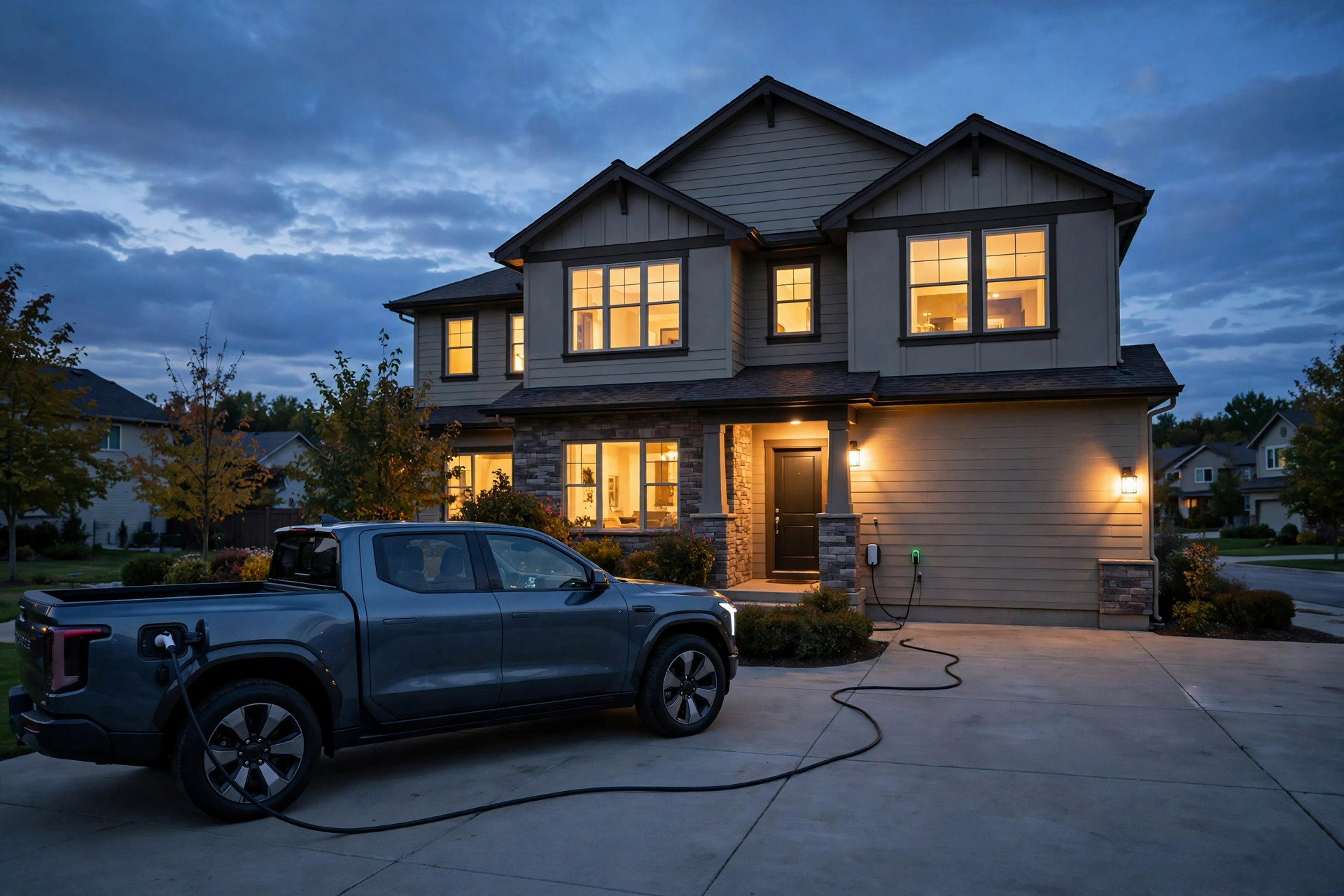
Can an EV power your house? Yes — and it’s not a concept car fantasy anymore. If you bought the right truck, you’ve already got the biggest home battery money can buy sitting in your driveway. Here’s the part the commercials skip: your truck is a 100 kWh battery on wheels, but turning it into a house backup system takes specific hardware, a few thousand dollars of electrical work, and an EV that actually supports bidirectional charging. Most EVs on the road in 2026 don’t.
I’m an electrician, not a car salesman, so here’s the honest version: which vehicles can do it, what the gear costs installed, how many days of backup you really get, and the warranty and utility fine print nobody reads out loud.
What Is V2H, Exactly?
V2H stands for vehicle-to-home: your EV’s battery discharges through a bidirectional charger into your home’s electrical panel, powering your house circuits during an outage (or, in some setups, during expensive peak-rate hours).
The key word is bidirectional. A normal EV charger is a one-way street — power flows from your panel into the car. A bidirectional charger lets power flow both ways: panel to car when charging, car to panel when backing up the house. That requires:
- An EV with bidirectional-capable onboard hardware (most EVs don’t have this)
- A bidirectional charger or gateway device (different from a standard Level 2 charger)
- An automatic transfer/islanding switch that disconnects your house from the grid during an outage — same safety concept as a generator transfer switch, because backfeeding the grid can kill a lineworker
Without the islanding hardware, V2H is a non-starter. The utility will not let your truck energize dead lines. Every legitimate V2H install includes this, and it’s a big chunk of the cost.
V2H vs V2L vs V2G: Know the Difference Before You Shop
Manufacturers throw these acronyms around like they’re interchangeable. They’re not, and the distinction decides what your EV can actually do in a blackout.
- V2L (vehicle-to-load): The car has a regular 120V outlet built in (or a plug-in adapter). You run extension cords to a fridge, a lamp, a phone charger. Power is low — typically 1.9 kW on Hyundai/Kia’s onboard outlet, up to 3.6 kW with their V2L adapter in some markets. It will NOT power your panel, your furnace, or your well pump. Think “fancy camping generator.”
- V2H (vehicle-to-home): The car feeds your actual electrical panel through a bidirectional charger, powering hardwired circuits — furnace blower, well pump, lights, fridge — up to 7–11 kW depending on the system. This is the whole-house backup play.
- V2G (vehicle-to-grid): The car exports power to the utility grid for credit or payment. Almost nobody in the US is doing this residentially in 2026. It needs utility programs that barely exist, special metering, and interconnection agreements most utilities haven’t standardized. When a salesperson says “V2G-ready,” assume they mean the hardware might support it someday.
Here’s the trap I watch people fall into: they buy a Hyundai Ioniq 5 because they heard “it can power your house,” then discover it only does V2L — extension cords, not panel backup. Great car. Not a V2H car. Know which one you’re buying before you sign.
Which EVs Can Power Your House in 2026?
Short list. True V2H-capable EVs sold in the US right now:
Ford F-150 Lightning — the benchmark
The Lightning’s Intelligent Backup Power is the most mature V2H system on the market. Extended Range models (131 kWh usable battery) can automatically power your home when the grid drops — the truck detects the outage and switches over, no action needed from you.
What it costs: Ford’s Home Integration System (the bidirectional charger, dark start battery, and transfer/islanding hardware) runs about $3,800+ for the hardware alone, before installation. Installed, most homeowners report $6,000–$9,000 all-in depending on panel work and distance from the panel to the charger location. Output is 9.6 kW — enough for essentials plus a lot more, though not a 5-ton AC and an electric range simultaneously.
Standard Range Lightnings (98 kWh) support it too, with proportionally less runtime. This is the system I’d spec for a customer today if they already own the truck.
Tesla Cybertruck — Powershare
Tesla’s Powershare lets the Cybertruck (123 kWh battery) feed up to 11.5 kW to your home through the Tesla Universal Wall Connector paired with a Tesla Gateway — the same gateway hardware used in Powerwall installs. If you already have a Powerwall gateway, integration is cleaner.
Cost reality: the Universal Wall Connector is roughly $450–$550, but the gateway, transfer equipment, and installation typically push a full Powershare home setup to $4,000–$7,000+ installed. Tesla’s own marketing leans on the headline; the installed invoice is the real number. Also note: Powershare is Cybertruck-only. Your Model Y cannot do this, and Tesla has given no timeline for bidirectional charging on its other vehicles.
Chevy Silverado EV (and GMC Sierra EV)
GM’s Ultium trucks support V2H through the GM Energy ecosystem: a bidirectional PowerShift charger (roughly $1,700 for the charger unit) paired with a home hub/gateway. Full installed setups land around $5,000–$8,000 depending on the home’s electrical situation. Battery sizes up to 200+ kWh on some Silverado EV trims mean serious runtime — the biggest battery in the segment. GM’s system is newer and the installer network is thinner than Ford’s, so get multiple quotes and verify your installer has actually commissioned one before.
Hyundai / Kia / Genesis (E-GMP platform) — V2L only, and that’s fine
The Ioniq 5, Ioniq 6, EV6, EV9, and Genesis EVs have excellent V2L — a genuinely useful 120V outlet for camping, job sites, and running a fridge off an extension cord in an outage. But they cannot do V2H. There is no bidirectional panel integration from the factory. Aftermarket options (like dcbel’s home energy units) claim to add it, but that’s third-party hardware with third-party warranty implications — I’d want to see a lot more field history before recommending one to a customer.
What about everyone else?
- Rivian R1T/R1S: No V2H as of 2026. Promised “eventually” for years. Don’t buy on promises.
- Nissan Leaf: The old CHAdeMO Leaf technically supported bidirectional charging, and it was the V2G test mule for a decade — but it’s a 40–62 kWh car, Nissan’s moved to CCS/NACS, and this is legacy trivia, not a buying recommendation.
- Everyone else (most Teslas, most EVs): One-way charging only. Your EV is a load, not a source.
Bottom line: if V2H matters to you, your choices in 2026 are a Ford truck, a Cybertruck, or a GM truck. That’s the whole list.
What Equipment Does V2H Actually Require?
Let me walk a typical install, because the hardware list is where quotes get confusing:
- Bidirectional charger ($1,500–$2,500 for the unit): replaces or supplements your normal Level 2 charger. Ford’s Charge Station Pro, Tesla’s Universal Wall Connector in Powershare mode, GM’s PowerShift charger. This is the piece that lets current flow both ways.
- Transfer/islanding device ($1,000–$2,500): automatically disconnects your home from the grid when power fails so your truck doesn’t backfeed utility lines. Ford bundles this in the Home Integration System; Tesla uses its Gateway. This is the same life-safety function a generator transfer switch performs, and it’s not optional.
- Electrical labor, permits, and panel work ($2,500–$5,500): running the 240V circuits, mounting hardware, utility coordination, permit fees, inspection. If your panel is full or you need a service upgrade, add $2,000–$4,000 more.
- Utility interconnection paperwork: most utilities require notification or approval for any device that can energize your panel during an outage. Some treat V2H like a generator interconnection; a few haven’t written the rules yet, which means delays.
Total: $4,000–$8,000+ installed for a straightforward setup, more if your panel needs work. That number surprises people who assumed “the truck does it for free.” The truck is the battery. Everything around it costs real money — same as buying a generator engine and still needing the transfer switch installed.
How Long Can an EV Power Your House? The Capacity Math
This is the fun part. A truck battery dwarfs every home battery on the market. A Tesla Powerwall 3 holds 13.5 kWh. A Ford F-150 Lightning Extended Range holds 131 kWh usable — roughly ten Powerwalls. Here’s what that means in outage hours:
| Load scenario | Approx. draw | Lightning ER (131 kWh) | Cybertruck (123 kWh) |
|---|---|---|---|
| Bare essentials (fridge, lights, phones, Wi-Fi) | 0.5–1 kW | 5–9 days | 5–8 days |
| Essentials + gas furnace blower (winter) | 1–1.5 kW | 3.5–5 days | 3–4.5 days |
| Normal-ish use, no central AC | 2–3 kW | 2–3 days | 2–2.5 days |
| Whole home with central AC cycling | 4–6 kW | 22–32 hours | 20–30 hours |
The honest planning number I give people: 2–4 days of essential loads from a full truck battery. That’s the realistic zone — you won’t run the house like nothing happened, but you’ll have refrigeration, heat (gas furnace), lights, communications, and device charging for days.
Two caveats from the field. First, nobody’s truck sits at 100% when the outage hits — plan on 70–80% state of charge as your realistic starting point, which cuts every number above by a quarter. Second, once the truck is empty, recharging requires the grid to come back or a working public fast charger nearby — and after a hurricane, those chargers are either down or have lines around the block. A home battery paired with solar recharges itself daily; a truck doesn’t. Size your expectations accordingly.
Is V2H Better Than a Home Battery or Generator?
Depends what you already own. Here’s how I’d frame it for a customer:
If you already own a V2H-capable truck: V2H is the cheapest whole-house-ish backup you’ll ever buy, because the $50,000+ battery is a sunk cost — you bought it for driving. Spending $6,000–$7,000 on the home integration to unlock 100+ kWh of backup beats buying a $10,000–$15,000 standby generator or two Powerwalls. The math is genuinely compelling here.
If you don’t own the truck: Do NOT buy a $60,000–$80,000 truck as a backup power strategy. That’s the most expensive battery ever sold. Buy the generator or the home battery for a tenth of the price and pick your next vehicle on its merits as a vehicle.
V2H vs standby generator: The truck wins on capacity-per-dollar (if you own it), silence, and zero maintenance. The generator wins on indefinite runtime — natural gas doesn’t run out, a truck battery does — and on availability: the truck only backs up your house when it’s parked at home. If the outage hits while you’re at work with the truck, you’ve got nothing.
V2H vs home battery: The truck wins on raw capacity (131 kWh vs 13.5 kWh per Powerwall) and cost-per-kWh. The home battery wins on automation maturity, solar pairing (it recharges daily from your panels), and the fact that it’s always home. For a solar household, I’d still spec the Powerwall first — see the full home battery vs generator breakdown for that math.
The Limits Nobody Puts in the Brochure
Now the part that keeps me honest as an electrician. V2H is real, but it’s early, and every one of these matters:
Battery warranty fine print. Using Ford Intelligent Backup Power or Tesla Powershare won’t void your warranty — the manufacturers cover their own backup features. But batteries wear with cycles, and warranties are written around it: typically 8 years/100,000 miles with a ~70% capacity-retention threshold. Occasional outage use (a few dozen partial cycles a year) is negligible wear. But if you’re dreaming of daily V2H cycling to dodge peak electricity rates, understand you’re spending battery life to save pennies per kWh — and a replacement pack costs more than the electricity you’ll ever arbitrage. Backup use: fine. Daily cycling: do the wear math first.
The truck has to be home. Obvious, but people miss it. Your backup battery commutes. If the storm hits at 2pm and your truck is 30 miles away, your V2H system is a very expensive wall ornament until you get home — assuming the roads are passable.
Utility rules are a patchwork. Some utilities have clear V2H interconnection processes. Some treat it like a generator install. Some haven’t written the policy yet, which means your permit sits in limbo. And true V2G — selling power back to the grid — is effectively unavailable to residential customers in most of the country in 2026. Buy V2H for backup, not for grid income.
It’s still early tech. Ford’s system is the most proven and it’s only a few years old. Installer experience varies wildly — I’ve seen quotes from electricians who clearly hadn’t commissioned one before. Ask any bidder: how many V2H systems have you personally installed and commissioned? If the answer is zero, they’re learning on your house.
Automatic transfer isn’t universal. Ford’s setup switches over automatically. Some configurations require manual intervention or app confirmation. Confirm the exact behavior of your specific setup before the storm, not during it.
Can You Install V2H Yourself?
No. And I say that as someone who generally respects a competent DIYer — I’ve got nothing against a homeowner swapping a breaker. V2H is different: 240V bidirectional equipment, utility interconnection, automatic islanding that has to work perfectly the one time it matters, permits, and inspections. A miswired transfer device can backfeed the grid and kill a lineworker, which is why utilities and inspectors are strict about it.
What you CAN do yourself: research the systems, get three quotes, check your panel’s spare capacity (take a photo of the panel schedule and the main breaker rating — any decent electrician can pre-qualify you from that), and confirm your utility’s interconnection requirements. Then hire a licensed electrician with V2H or solar-plus-storage experience. The labor is $2,500–$5,500 of the job; it’s the wrong place to economize.
The Honest Verdict
Can an EV power your house? If it’s the right EV — absolutely, and it’s the best backup-per-dollar in the business for people who already own the truck. A 100+ kWh battery on wheels covering 2–4 days of essentials for a $6,000–$7,000 home integration cost is a deal no generator or home battery can touch on capacity.
But it’s a backup system with a commute, an early-adopter installer base, and warranty fine print worth reading. If you’re buying the truck anyway, add the home integration — it’s the smartest money in backup power right now. If you’re shopping for backup power and don’t need a new truck, a properly sized generator or a home battery remains the saner purchase. Buy the truck for the truck. Let the backup power be the bonus.
Frequently asked questions
Can any EV power a house during an outage?
No. Only EVs with true bidirectional charging (V2H) can power a house — currently the Ford F-150 Lightning, Tesla Cybertruck, and Chevy Silverado EV. Most EVs, including Teslas other than the Cybertruck, cannot send power back to a home panel. Hyundai and Kia EVs offer V2L (a 120V outlet in the car), which runs extension cords, not your house wiring.
How long can an EV power a house?
A 100+ kWh truck battery typically covers 2–4 days of essential loads (fridge, lights, furnace blower, phones, Wi-Fi) at 1–2 kW average draw. Whole-home use with central AC drains it in under a day. Realistic planning number: a Ford F-150 Lightning Extended Range (131 kWh usable) holds roughly 30–50 kWh of essentials per day, so 3 days is a fair expectation before you need to recharge or drive to a working charger.
How much does V2H installation cost in 2026?
Expect $4,000–$8,000+ all-in for a full V2H setup: $1,500–$2,500 for the bidirectional charger or gateway hardware, plus $2,500–$5,500 in electrician labor, transfer/islanding equipment, permits, and any panel work. Ford's Home Integration System hardware alone runs about $3,800 before installation. Most quotes I see land around $6,000–$7,000 total.
Does using V2H void my EV battery warranty?
Using the manufacturer's own backup feature (Ford Intelligent Backup Power, Tesla Powershare) does not void the warranty — those features are covered under the battery warranty terms. But read the fine print: warranties are time-and-mileage bound (typically 8 years/100,000 miles), degradation below ~70% is the usual trigger, and heavy daily V2H cycling adds real wear. Backup-only use a few times a year is negligible; daily V2H cycling is not.
Can you install V2H equipment yourself?
No — not legally, and not safely. V2H requires a bidirectional charger, an automatic transfer/islanding device, utility interconnection approval in most jurisdictions, and a permit with inspection. This is service-panel work at 240V with utility coordination. Hire a licensed electrician who has done V2H or solar-plus-storage installs before.